



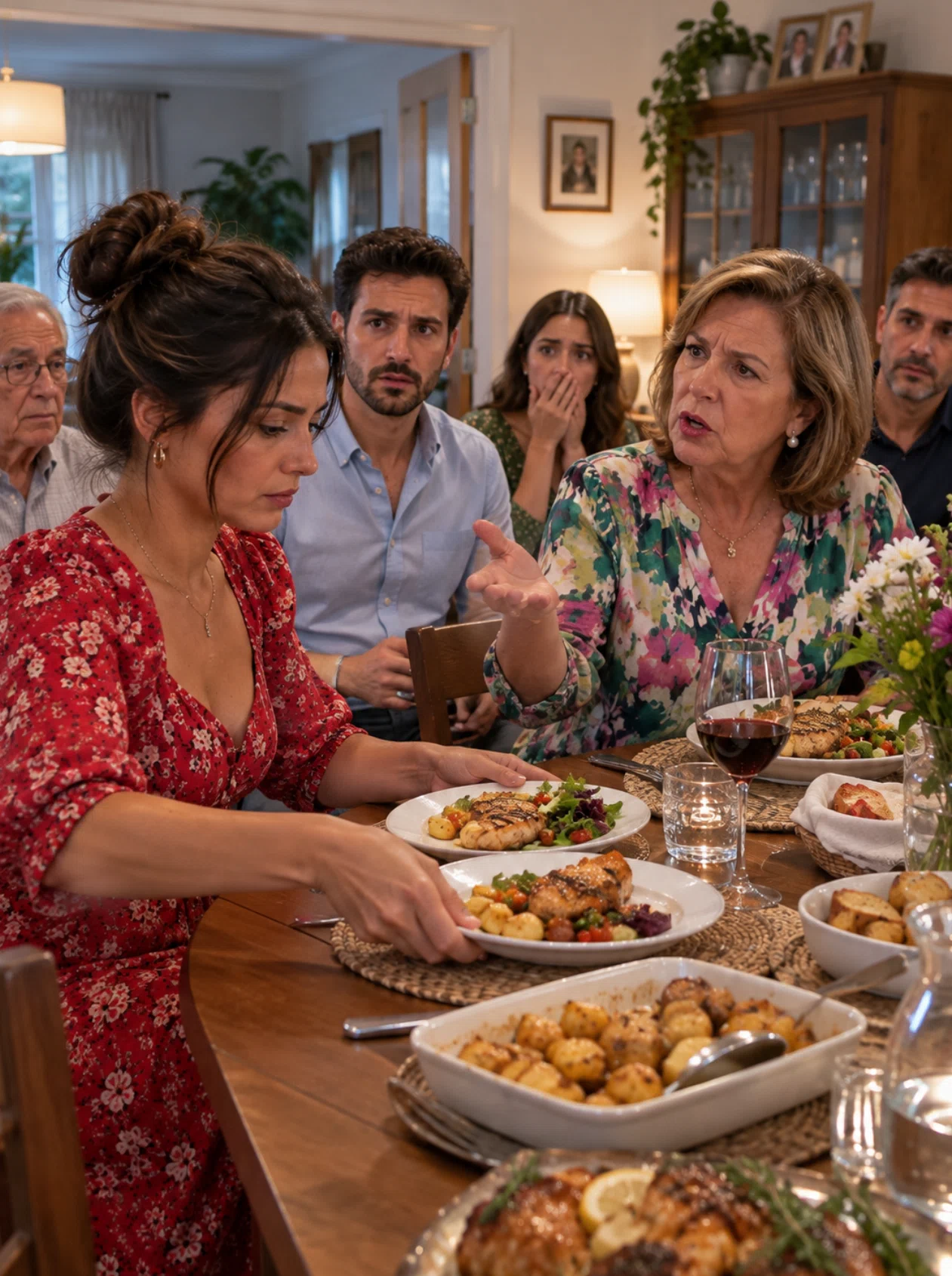
“And when are you finally going to learn how to cook?” my mother-in-law, Carmen, asked in the middle of our family dinner.
She didn’t raise her voice. She didn’t need to. She said it with that thin, satisfied smile of hers that always appeared right before she said something meant to embarrass me in front of everyone else.
For a few seconds, no one said a word. My husband, Javier, stopped cutting his meat. His sister, Lucía, slowly lowered her fork. Lucía’s husband, Andrés, looked first at Carmen and then at me.
Even Antonio, my mother-in-law’s older brother, who usually noticed absolutely nothing around him while he was eating, looked up from his plate.
I didn’t answer.
I simply looked at Carmen. Then I looked at my plate. And without saying a word, I picked it up with both hands.
Carmen frowned slightly.
“What are you doing?” I didn’t answer. I leaned across the table, moved her plate aside, and placed mine in front of her.
Then I put her plate in front of myself. Javier’s eyes widened.
Lucía covered her mouth with her napkin. Carmen looked first at the plate now sitting in front of her.
Then at me. “Elena, what exactly is this supposed to mean?”
I picked up my fork.
“Nothing.”
“What do you mean, nothing?”
“You just said I don’t know how to cook.”
I gestured toward her plate.
“So eat what I was eating.”
Then I looked at the plate now in front of me.
“And I’ll eat what you were eating.”
For several seconds, complete silence settled over the table.
Because there was one small detail Carmen had apparently forgotten.
Both plates contained exactly the same food.
The same roasted meat.
The same potatoes.
The same salad.
The same vegetables.
Everything had been served from the same dishes I had placed in the middle of the table ten minutes earlier.
Carmen blinked several times.
“Don’t be ridiculous.”
“I’m not.”
I cut a small piece of meat from the plate that had belonged to her only moments ago.
“I just want to see whether my food tastes different when it’s sitting in front of you.”
Andrés made a strange coughing sound.
I knew perfectly well that he was trying not to laugh.
Carmen knew it too.
“Very funny,” she said.
“I wasn’t trying to be funny.”
“Then give me my plate back.”
“Why?”
“Because it’s my plate.”
I looked at her.
“A moment ago, it was my plate, and you didn’t seem to like it very much then.”
Javier rubbed a hand over his face.
“Elena…”
I turned toward him.
“Yes?”
He opened his mouth.
Then closed it again.
He knew there was nothing intelligent he could say at that moment.
And maybe that was for the best.
The dinner had actually started out quite well.
Or at least I thought it had.
It was Sunday.
All week, Carmen had been repeating how long it had been since the whole family had gathered together.
So Javier and I decided to invite everyone to our house.
I had started cooking that morning.
Roast meat with herbs.
Garlic potatoes.
Roasted vegetables.
Salad.
And an apple pie I had prepared the day before.
Javier set the table.
He even opened a bottle of wine we had received as an anniversary gift.
When everyone arrived, Carmen walked into the kitchen, looked at the serving dishes, and said:
“Well. At least there’s enough food.”
That was her first comment.
Not:
“It smells wonderful.”
Not:
“Thank you for cooking for everyone.”
No.
“At least there’s enough food.”
I knew that tone far too well.
So I simply smiled.
“Yes. I don’t think anyone will leave hungry.”
Carmen lifted the lid from the potatoes.
“They’re quite browned.”
“We like them that way.”
“Javier used to prefer them less cooked.”
Javier was standing behind her.
“Mom, I like them like this.”
Carmen didn’t even look at him.
“You say you like everything these days.”
I took a deep breath.
She had been in our house for less than three minutes.
During dinner, the comments continued.
First, the salad.
“There isn’t enough dressing.”
Then the vegetables.
“I wouldn’t mix zucchini and peppers.”
Then the meat.
“It’s a little dry around the edges.”
Javier tried to intervene.
“Mom, it tastes great.”
“I didn’t say it didn’t.”
Five minutes later:
“I’m just saying Elena still has some things to learn.”
I kept eating.
I didn’t want to turn a family dinner into an argument.
That was exactly what Carmen expected.
Because Carmen had a particular talent.
She never said anything terrible enough to justify a major fight.
She didn’t insult you directly.
She didn’t shout.
She just scattered small, poisonous comments around the table.
One.
Then another.
Then a third.
And if I reacted, she would look surprised.
“I was only giving my opinion.”
“You can’t say anything around you.”
“You take everything personally.”
It had worked for years.
Until that evening.
Because after she ate a piece of meat, took a sip of wine, looked at me, and asked in front of everyone:
“And when are you finally going to learn how to cook?”
Something inside me simply clicked.
I didn’t feel angry.
I didn’t even feel embarrassed.
I felt tired.
Deeply tired.
So I switched our plates.
Carmen was still staring at me.
“Give me my plate back.”
“What difference does it make?”
“It’s my plate.”
“But the food is the same.”
“That’s not the point.”
“Then what is the point?”
She pressed her lips together.
I waited.
Javier waited.
Everyone waited.
Finally, Carmen said:
“I don’t like you making a fool of me in front of the family.”
I couldn’t stop a small smile.
“Interesting.”
“What’s interesting?”
“That thirty seconds ago, you had no problem trying to make a fool of me in front of the exact same family.”
Lucía lowered her eyes.
Carmen straightened in her chair.
“I wasn’t trying to humiliate you.”
“You weren’t?”
“I was only asking a question.”
“And I only switched two plates.”
Antonio cleared his throat.
“Well, if I’m being completely honest, the meat really is good.”
Carmen shot him a look.
“Nobody asked you.”
Antonio raised both hands.
“Whatever you say.”
I cut another piece of potato.
“Does it taste better now?”
Carmen looked at me.
“What?”
“The food. Now that it’s sitting on my old plate.”
This time Andrés couldn’t hold back his laugh.
Lucía lightly slapped him on the arm.
“Sorry,” he said. “But seriously…”
Carmen brought her palm down lightly on the table.
“This is disrespectful!”
I looked at her.
“What exactly?”
“Your behavior.”
“I didn’t criticize your cooking.”
“Because I didn’t cook.”
“Exactly.”
Silence fell over the table again.
It took Carmen a few seconds to understand what I meant.
“What are you trying to say?”
“That it’s very easy to judge someone else’s effort when you haven’t done anything yourself.”
“Nothing?”
“You came here, sat down, and ate.”
“I’m a guest!”
“Exactly.”
I put my fork down.
“And when I’m a guest in your home, I never tell you your potatoes are too cooked, your salad needs more dressing, or that you should learn how to cook.”
Carmen’s eyes widened.
“That’s because I know how to cook.”
“There it is again.”
“What?”
“That need to constantly prove that you do everything better than everyone else.”
Javier finally stepped in.
“Mom, Elena is right about one thing.”
Carmen slowly turned her head toward him.
“One thing?”
Javier swallowed.
“You’ve been criticizing the food since you arrived.”
“I have a right to my opinion!”
“Of course.”
“Then what’s the problem?”
“There’s a difference between saying, ‘I prefer my potatoes less cooked.’”
Javier gestured toward the table.
“And asking Elena in front of everyone when she’s finally going to learn how to cook.”
Carmen stared at him without moving.
“I see.”
Javier sighed.
“Mom…”
“No, no. I understand perfectly.”
She turned toward me.
“You’ve turned him against me.”
I was quiet for a few seconds.
Then I looked at Javier.
“Do you want to answer that one, or is it my turn again?”
Lucía burst out laughing.
Carmen turned toward her.
“You too?”
“Mom, please,” Lucía said. “Elena has been cooking since this morning for seven people. The food is good. You could just stop.”
Carmen looked genuinely offended.
“Unbelievable.”
She stood up.
“Now you’re all against me.”
“Nobody is against you,” Javier said.
“Of course not.”
She grabbed the handbag hanging over the back of her chair.
“A person tries to teach you something, and this is the thanks she gets.”
I stood up too.
“Carmen.”
She turned around.
“What?”
“That is exactly the problem.”
“What is?”
“No one asked you to teach me anything.”
She went still.
“I’ve been married to Javier for twelve years.”
I looked at the table.
“I’ve cooked thousands of meals. Sometimes better, sometimes worse. Like everyone.”
Then I looked at her again.
“But I do not have to pass an exam in front of you every week.”
Carmen crossed her arms.
“You always exaggerate.”
“Maybe.”
“Then admit it.”
“But not today.”
Her expression changed.
She hadn’t expected that answer.
I continued.
“If you don’t like something, you can leave it on your plate. You can say you prepare it differently. You can even choose not to eat it.”
I gestured toward the chair.
“But I’m not going to sit at my own table anymore while you speak to me like I’m a teenager trying to earn your approval.”
No one said a word.
Carmen looked at Javier.
“Are you going to let her speak to me like that?”
Javier slowly stood up.
“Mom, I don’t need to let Elena do anything.”
“Excuse me?”
“Elena is my wife. She isn’t my child.”
Carmen clenched her jaw.
“Wonderful. Now I see who’s in charge here.”
I almost laughed.
“No one needs to be in charge.”
Carmen picked up her coat.
“I’ve lost my appetite.”
Andrés glanced at her plate.
“Well, if you’re not going to eat it…”
Lucía slapped him on the arm again.
“Andrés!”
“What? The meat really is excellent.”
Even Javier laughed.
So did I.
Carmen didn’t.
A few minutes later, she left the house.
Antonio finished everything on his plate.
Then he took some more potatoes.
“Just for the record,” he said, “I’ve been eating my sister’s cooking for forty years, and these potatoes are better than hers.”
“Antonio!” Carmen’s voice came from the hallway.
He shrugged.
“Someone had to say it eventually.”
The door closed.
For several seconds, we all sat in silence.
Then Lucía looked at me.
“Did you really switch the plates without any kind of plan?”
“Yes.”
“That was the best part of the whole evening.”
Javier sat down beside me.
“I thought you were going to throw the plate at her.”
I looked at him.
“I don’t waste food.”
Everyone started laughing.
But later, after the guests had gone and Javier and I were clearing the table, he suddenly became quiet.
“What is it?” I asked.
“I’m thinking.”
“That’s always dangerous.”
He smiled slightly.
“I’m serious.”
He placed two plates beside the sink.
“My mother has been doing this for years.”
“Yes.”
“And I often don’t say anything.”
“That’s true too.”
“Because I’m so used to it that I barely even notice anymore.”
I looked at him.
“I notice.”
“I know.”
He was quiet for a moment.
“And that means you’ve been listening to all those comments for years while I kept telling myself they weren’t important.”
I didn’t answer.
I didn’t need to.
Javier lowered his eyes.
“I’m sorry.”
I leaned against the kitchen counter.
“I don’t need you to fight with her every time she says something.”
“I know.”
“But I do need you not to leave me alone every time she does.”
He nodded.
“I can do that.”
Two weeks later, we had dinner at Carmen’s house again.
This time she made chicken, rice, and salad.
We all sat down at the table.
I tasted the rice.
It could have used a little more salt.
Carmen looked at me.
I looked at her.
For a moment, we both knew exactly what I was thinking.
She raised an eyebrow.
“What?”
I smiled.
“Nothing.”
I reached for the salt shaker.
“It’s very good.”
Carmen watched me for another two seconds.
Then, to my surprise, she smiled.
“Thank you.”
And that was it.
Nobody switched plates.
Nobody argued.
Nobody had to prove they were a better cook than anyone else.
That evening, I understood something I should have realized much earlier.
The biggest family arguments almost never begin with big things.
Sometimes they begin with potatoes.
With one sentence.
One look.
One seemingly harmless question:
“When are you finally going to learn how to cook?”
But sometimes, behind those small remarks, there is something much heavier.
The habit of judging others.
The need to feel superior.
The belief that simply because someone is a mother, a mother-in-law, or older, they have the right to constantly correct and criticize everyone else.
And sometimes you don’t need to shout to set a boundary.
You don’t need to insult anyone.
You don’t even need to leave the table.
Sometimes all it takes is something very simple.
Like switching two plates.
And letting the silence do the rest.