



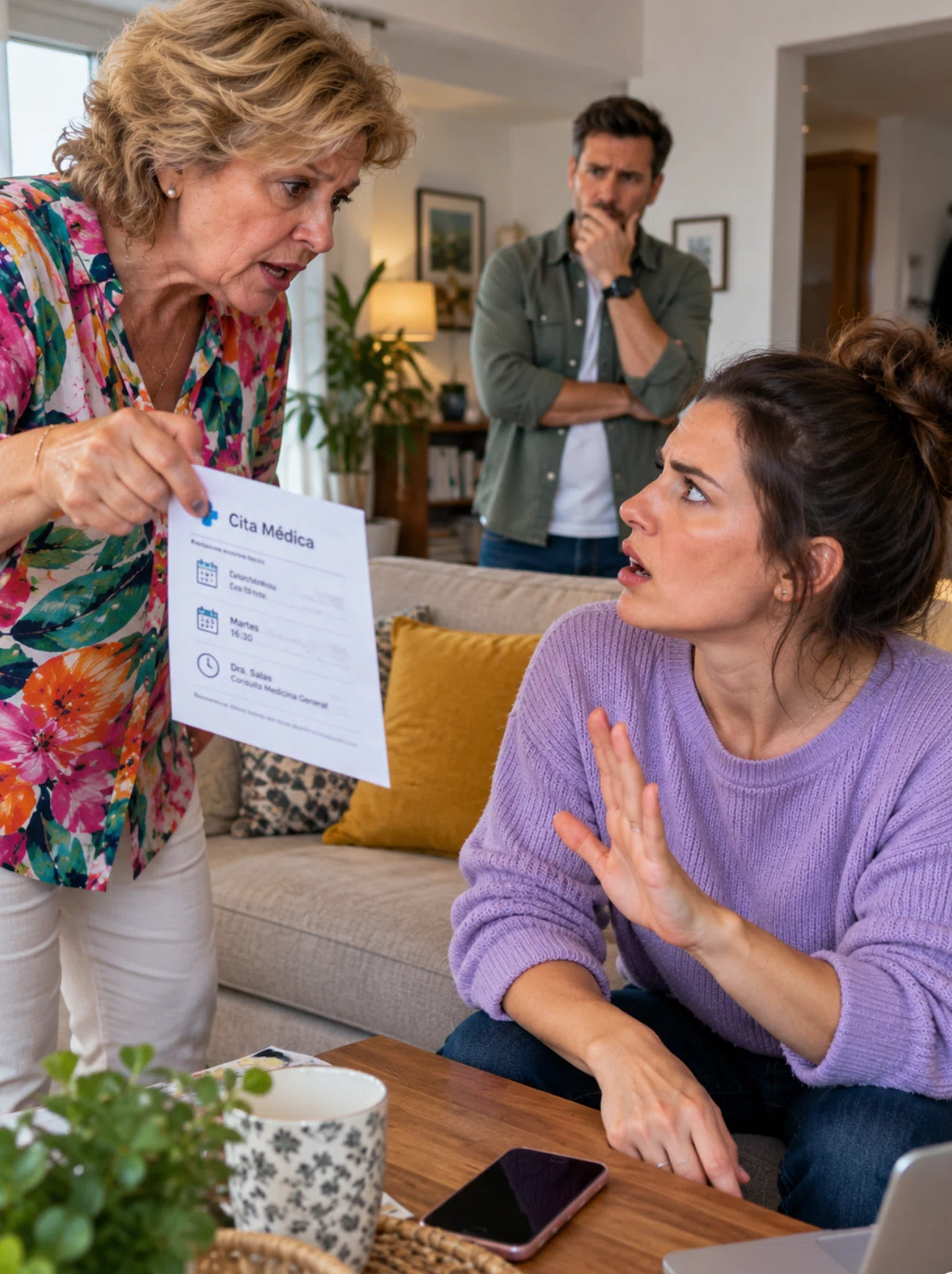
“I booked you a doctor’s appointment. It was about time you got yourself checked out,” my mother-in-law announced so calmly that at first I thought she was joking.
I slowly lowered my coffee cup onto the table.
It was Sunday, a little after eleven in the morning. My husband, Javier, was standing at the kitchen counter slicing bread. His sister, Lucía, sat across from me, stirring sugar into her coffee. Carmen, my mother-in-law, had just pulled a small folded piece of paper from her handbag.
She placed it in front of me. “Tuesday. Four-thirty.”
I looked at the paper. Then at her. “What is this?”
“Your appointment.”
“What appointment?” Carmen sighed as though she were explaining something painfully obvious to a child.
“With Dr. Salas. She’s excellent. A friend of mine has been seeing her for years.”
Javier put down the knife.
“Mom, what are you talking about?”
“I made Elena a doctor’s appointment.”
I looked at the paper again.
My name was on it, along with the clinic and appointment time.
For several seconds, I didn’t know what to say.
“You made a doctor’s appointment in my name?”
“Yes.”
“Without asking me?”
Carmen waved a hand dismissively.
“If I’d asked, you would’ve said no.”
Lucía looked up from her coffee.
Javier went completely still.
I pushed the paper back toward Carmen.
“Then call them and cancel it.”
The smile disappeared from her face.
“Excuse me?”
“Cancel the appointment.”
“Elena, don’t start.”
“I’m not starting anything. I don’t need you arranging my medical appointments.”
Carmen leaned back in her chair.
“I’m only trying to help you.”
“I didn’t ask for your help.”
“That’s exactly your problem. You never ask for help.”
“My problem?”
“Yes.”
I looked at Javier.
He seemed just as confused as I was.
“Mom,” he cut in. “Why did you do this?”
Carmen looked at him as though the answer should have been obvious.
“Because somebody had to.”
“Had to do what?”
“Take care of things.”
She turned toward me.
“You’ve been tired all the time lately. You don’t look well, and you keep complaining about headaches.”
I frowned.
“I mentioned having a headache twice.”
“And a few days ago, you didn’t even eat dessert.”
I blinked.
“What does that have to do with anything?”
“Nothing by itself. But when you put everything together…”
“What exactly are you putting together?”
Carmen began counting on her fingers.
“Fatigue. Headaches. Less appetite. You’ve been more irritable than usual…”
A short laugh escaped me.
“More irritable?”
“Yes. Much more.”
Lucía placed her spoon on the saucer.
“Mom, I really don’t think this is any of your business.”
Carmen turned sharply toward her.
“Stay out of this.”
“But you made Elena a doctor’s appointment without asking her.”
“Because I’m worried about her!”
“No,” I said. “This isn’t concern.”
Carmen stared at me.
“It isn’t?”
“No. Concern would be asking me if I’m okay. This is you making decisions for me.”
Silence settled over the kitchen.
Carmen picked up the paper.
“I genuinely don’t understand why you have to turn every good thing I try to do into some kind of attack.”
I pressed my lips together.
That was always the problem with Carmen.
According to her, she never did anything with bad intentions.
When she went into our bedroom and folded our clothes without anyone asking her to, she was just “helping.”
When she reorganized our kitchen cupboards, she was “helping.”
When she asked how much we had paid for our sofa, our vacation, or some home renovation, she was merely “interested.”
When she told Javier I worked too much and should spend more time at home, she was simply “concerned.”
And now she had decided she could arrange my medical care too.
“Carmen,” I said calmly, “how did you even manage to make this appointment?”
Her brow furrowed slightly.
“I called the clinic.”
“I understand that. What information did you give them?”
For the first time, she looked uncomfortable.
“Your name.”
“Only my name?”
She didn’t answer.
Javier turned toward her.
“Mom.”
“What?”
“What information did you give them?”
“The usual information.”
My stomach tightened.
“What do you mean by ‘the usual information’?”
Carmen sighed impatiently.
“Your full name, your date of birth…”
I interrupted her.
“How do you know my exact date of birth?”
She looked surprised.
“Elena, come on. You’ve been my daughter-in-law for nine years.”
“I didn’t ask how long I’ve been your daughter-in-law.”
Javier put the knife down on the counter.
“Mom, answer her question.”
Carmen looked at him irritably.
“It was on some papers.”
“What papers?” I asked.
Silence.
And then I understood.
Two weeks earlier, Javier and I had left several documents on the desk in our small home office while dealing with some insurance paperwork.
Carmen had been at our house that afternoon.
She had been alone for about twenty minutes while Javier and I went to the store.
“Did you go into our office?” I asked.
“Don’t be ridiculous.”
“Did you?”
“The door was open.”
Javier rubbed his forehead.
“Mom…”
“What? I didn’t go digging through drawers!”
“Then how did you see my documents?” I asked.
“They were on the desk.”
“And you decided to read them.”
“I saw your date of birth. Nothing else.”
“And wrote it down?”
Carmen didn’t answer.
That was answer enough.
I stood up.
“Cancel the appointment.”
“Elena…”
“Now.”
“Don’t speak to me in that tone.”
“Then don’t use my personal information to organize my life.”
Carmen stood too.
“You are ridiculously overreacting!”
Javier stepped closer to us.
“Mom, that’s enough.”
Carmen looked at him, offended.
“Oh, so you’re taking her side now too?”
“This isn’t about taking sides.” “Of course it is! Ever since you got married, everything I say or do is wrong.”
“You used her personal information to make a medical appointment without her permission.”
“Because I was worried!”
“Then you could have talked to her.”
Carmen grabbed her handbag.
“Fine. Next time I just won’t care about anyone.”
“Don’t turn this into something else,” I said.
She spun toward me.
“What am I turning it into?”
“A story where you’re the victim because I won’t let you make decisions for me.”
Lucía briefly closed her eyes.
I knew that expression well.
She knew the argument was about to get worse.
And it did.
“You know what I think?” Carmen said. “You’ve become absolutely unbearable lately.”
“Mom,” Javier warned.
“No. Enough. Everything bothers her. Everything is supposedly an invasion of privacy. Everything is disrespectful.”
I folded my arms.
“Because lately you’ve crossed too many boundaries.”
“What boundaries?”
“My belongings. My home. My documents. And now even my health.”
“I am your husband’s mother!”
I stared at her for several seconds.
“And what does that make you? My legal guardian?”
Lucía covered her mouth with her hand, trying to hide her reaction.
Carmen’s face turned red.
“I don’t have to listen to this.”
“Then cancel the appointment, and we’re done.”
“I’m not calling them now.”
“Why not?”
“Because it’s Sunday.”
“Then tomorrow.”
“We’ll see.”
I shook my head.
“No. Not ‘we’ll see.’”
I took out my phone.
Carmen watched me.
“What are you doing?”
“Looking up the clinic’s number.”
“Why?”
“So I can cancel the appointment myself.”
Her expression changed.
“There’s no need to turn this into some big drama.”
“I’m not creating any drama.”
I found the clinic’s number and saved it.
“I’ll call them myself tomorrow. And while I’m at it, I’ll ask exactly what information you gave them when you made the appointment.”
Carmen went slightly pale.
Javier noticed.
So did I. “Is there anything else we should know?” Javier asked.
“No.”
“Mom.”
“I said no!”
She grabbed her coat.
“I’m leaving.”
Lucía stood up.
“So am I.”
“You can stay,” Carmen said coldly.
Lucía looked at her.
“I don’t want to argue anymore.”
Carmen headed toward the door, but before leaving, she turned back to me.
“One day you’ll understand that not everyone is trying to hurt you.”
Without raising my voice, I answered:
“And maybe one day you’ll understand that wanting to help someone doesn’t give you the right to make decisions for them.”
She left.
On Monday morning, I called the clinic immediately.
I explained what had happened.
The receptionist found the appointment and canceled it.
Then I asked what information they had been given.
She wouldn’t provide too many details over the phone, but she confirmed one thing that made me even angrier.
Carmen hadn’t only given them my name and date of birth.
She had also listed her own phone number as the contact number.
When Javier came home from work, I told him.
He stared at me.
“Her own number?”
“Yes.”
“Why?”
“That’s exactly what I’d like to know.”
Javier called his mother while I was sitting beside him.
Carmen answered on the third ring.
“Mom, Elena called the clinic.”
A pause.
“Yes.”
Another pause.
“No. I want to know why you gave them your phone number as the contact number.” I could hear Carmen speaking from where I sat, though I couldn’t make out every word.
Javier frowned.
“So they could notify you?”
Silence.
“Mom, Elena has her own phone.”
More silence.
“It doesn’t matter if you thought she might forget.”
Javier closed his eyes.
“Never do anything like that again.”
Carmen raised her voice on the other end.
This time I heard one sentence clearly.
“Apparently I need permission these days even to care about my own family!”
Javier replied:
“Not to care about them. But you do need permission to make decisions for Elena.”
When the call ended, Javier placed his phone on the table.
“She’s angry.”
“I expected that.”
“She thinks we humiliated her.”
I gave a humorless laugh.
“We did?”
Javier sat across from me.
“She said one more thing.”
“What?”
He hesitated.
“She wanted you to go to that doctor because afterward she planned to ask how the appointment went.”
I froze.
“Ask who?”
“You. At least that’s what she claims.” “At least that’s what she claims?”
Javier sighed.
“Elena, I don’t think she had some strange plan. I think she genuinely doesn’t understand where her concern ends and our privacy begins.”
That sentence stayed with me.
Because that was exactly what this was about.
For the next ten days, Carmen didn’t come to our house.
She didn’t call me either.
She only spoke to Javier.
Until Thursday evening, when I received a message from her.
“I hope you’re happy now. Everything has been canceled.”
I didn’t reply.
Five minutes later, another message arrived.
“I only wanted to help you.” I didn’t reply to that one either.
The following Sunday, Javier asked whether I would mind if he invited his mother over for lunch.
“She can come,” I said. “But I’m not going to pretend nothing happened.”
Carmen arrived at one-thirty.
She brought a cake.
She placed it on the table and took off her coat.
For almost twenty minutes, we talked about completely meaningless things.
The weather.
Lucía’s job.
A neighbor whose car had broken down.
Until Carmen finally looked at me.
“Are you okay?”
“I’m fine.”
“Are you sure?”
“Yes.”
She nodded.
Then she began fiddling with the edge of her napkin. “I’ll never make another doctor’s appointment for you.”
“Thank you.”
“But I still think you overreacted a little.”
Javier put down his fork.
I raised my hand.
“Leave it.”
I looked at Carmen.
“You don’t have to agree with me. I just need you to respect my boundary.”
She remained silent.
“If you’re ever worried about my health,” I continued, “you can ask how I’m feeling. You can tell me you think I should see a doctor. You can even recommend someone. But the decision is mine.”
Carmen lowered her eyes to her plate.
“I just thought you’d keep putting it off.”
“Maybe I would.”
“And I wanted to help.”
“I know.”
She looked up. “Then why did you get so angry?”
It took me several seconds to answer.
“Because helping someone means standing beside them. It doesn’t mean taking control of their life without asking permission.”
Carmen didn’t answer.
But she didn’t argue either.
And with her, even that was progress.
After lunch, we cleared the table.
As Carmen prepared to leave, she stopped by the door.
“By the way,” she said, “that doctor really is very good.”
I looked at her.
A small smile appeared on her face.
“I’m just saying—in case you ever decide to make an appointment yourself.”
This time, I smiled too.
“That already sounds much better.” Carmen left. And that afternoon, I realized something I probably should have understood years earlier.
Some people confuse caring about someone with having the right to control their life.
They do it with good intentions.
At least, that’s what they tell themselves.
But even good intentions need boundaries.
My mother-in-law was allowed to give me advice, worry about me, and even tell me when she thought I was making a mistake.
But she wasn’t allowed to make decisions for me.
And if she ever forgot that again, I already knew exactly what I would say:
“My health. My decision.”