



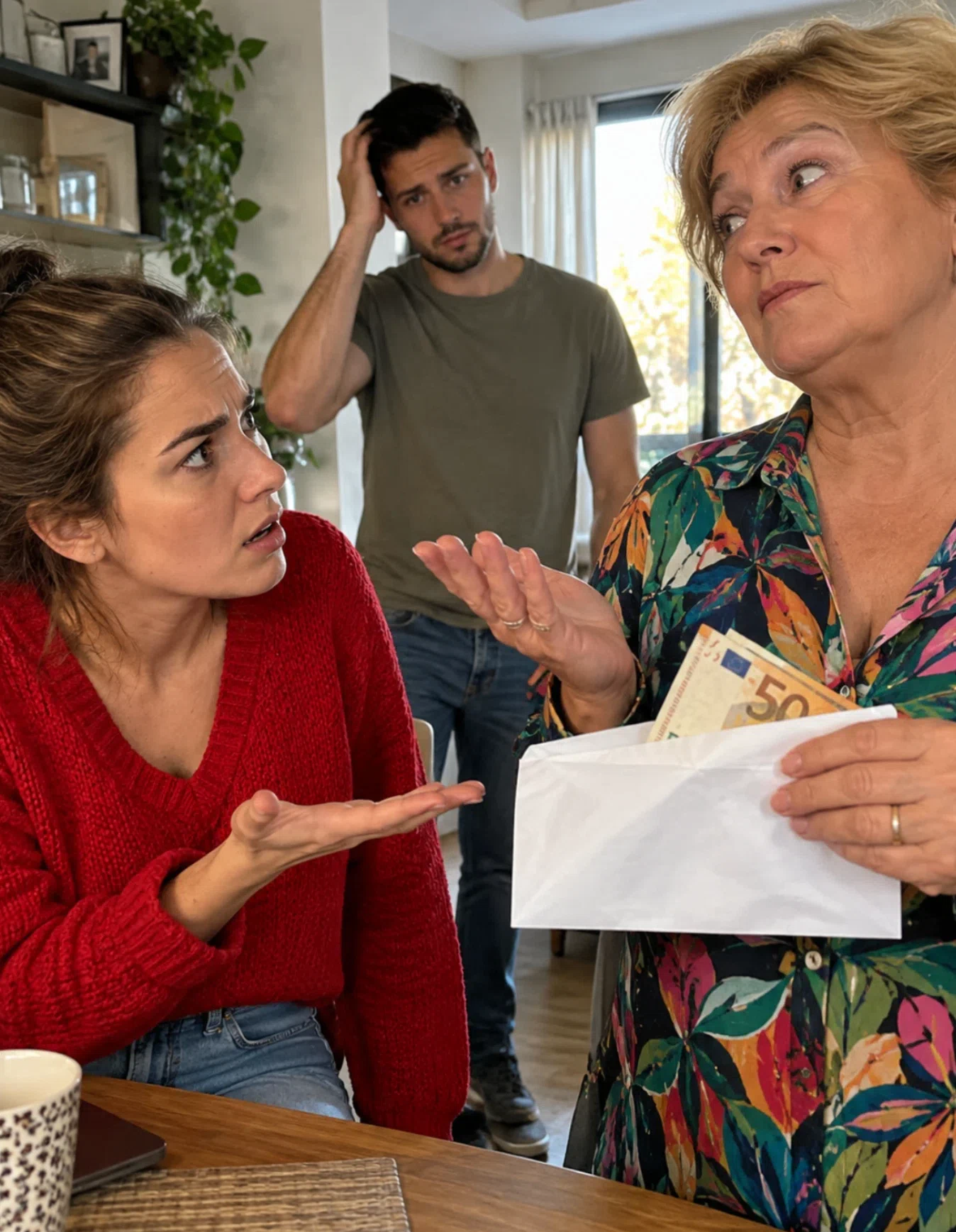
“I took a little money from your envelope. You’re saving anyway,” my mother-in-law said with complete calm.
I stared at her, convinced I must have misunderstood.
“Did you seriously just admit that you took our money without permission?”
Carmen set her coffee cup on the table and frowned slightly, as if I were the one overreacting.
“Elena, please. Don’t make a big drama out of it. I didn’t empty the envelope.” My husband, Javier, who was standing at the kitchen counter slicing an apple pie, put the knife down on the cutting board.
“Mom… what envelope?”
Carmen looked at him.
“The one you keep in the sideboard drawer.”
My stomach tightened.
Not because I had just discovered that Carmen knew where we kept that money.
But because she had just confirmed that she had opened a drawer in our home, found an envelope that didn’t belong to her, opened it, and taken money out.
And she still seemed convinced that my reaction was the real problem.
It was Sunday, a little after four in the afternoon.
Carmen had come over for coffee. Javier and I had been married for almost six years, and for the past eight months we had been saving to replace the windows in our apartment before winter.
It wasn’t a fortune.
Every month, we put whatever we could spare into that envelope: fifty euros, a hundred, sometimes two hundred if we had spent less than expected.
The week before, I had counted the money.
There had been €1,850.
The envelope was inside a drawer in the living room sideboard, underneath a folder of documents.
It wasn’t lying out in plain sight.
And Carmen had absolutely no reason to open that drawer.
“How much did you take?” Javier asked.
His mother made a casual gesture with her hand.
“Two hundred.”
I stared at her.
“Two hundred euros?”
“Yes.”
“And when exactly were you planning to tell us?”
“I’m telling you now.”
A short laugh escaped me.
“That doesn’t answer my question.”
Carmen sighed.
“I took it on Friday.”
Friday.
Two days earlier.
On Friday, I had worked until seven. Javier had gotten home even later. And Carmen had stopped by because, according to her, she wanted to leave us a container of food.
She had a spare key to our apartment for emergencies.
Suddenly, something occurred to me.
“Did you go into our bedroom too?”
“No.”
“Did you open any other drawers?”
“Elena…”
“I asked you a question.”
Javier stepped in.
“Mom, why were you even looking inside the sideboard?”
Carmen crossed her arms.
“I was looking for batteries.”
“The batteries are in the kitchen,” Javier said.
There were a few seconds of silence.
Carmen looked away.
I didn’t like that at all.
“What did you need two hundred euros for?” I asked.
“Lucía had an unexpected expense.”
Of course.
Lucía.
Javier’s younger sister.
Thirty-two years old, steadily employed, and extraordinarily talented at turning every personal expense into a family emergency.
“What expense?” Javier asked.
“She had to pay her car insurance.”
“Then why didn’t she call me?”
“Because she knew you’d say no.”
Javier froze.
I rested my elbows on the table.
“So you knew he didn’t want to give her money, and you decided to take it anyway.”
“Don’t dramatize everything.”
“I’m not dramatizing anything. I’m trying to understand.” Carmen looked at me with obvious irritation.
“That money was just sitting there.”
For a moment, I thought she was joking.
“Excuse me?”
“You’re saving it. You didn’t need it right now. Lucía did.”
“And that somehow made our money available for you to take?”
“She’s my daughter!”
“And this is our money.”
“It’s my son’s money too.”
I looked at Javier.
He closed his eyes for a second.
We knew that phrase.
We had heard it far too many times.
Whenever we bought something for the apartment: “That’s my son’s money.”
Whenever we booked a vacation: “My son works for that money.”
When I replaced my phone after five years: “I hope Javier didn’t pay for it.”
As though my salary simply ceased to exist the moment it entered our account.
“I put half that money in there,” I said.
Carmen shrugged.
“I’m not saying you didn’t.”
“Then you took my money too.” “I’ll give it back.”
“When?”
“When I can.”
That answer made Javier look up.
“What do you mean, when you can?”
“When I can, son. I’m not printing money at home.”
“Then you didn’t borrow it,” I said. “Because when someone borrows something, they ask first.”
Carmen tapped her fingers lightly against the table.
“What a way to turn something so trivial into a huge problem.”
I stood up.
Walked over to the sideboard.
Opened the drawer. Took out the envelope.It already felt lighter.
I opened it and started counting.
Carmen watched me from the table.
Javier came closer.
I counted once.
Then again.
“Three hundred is missing.”
The room went silent instantly.
Javier looked at his mother.
“You said two hundred.”
Carmen didn’t answer.
“Mom.”
“Well… maybe it was three hundred.”
I turned toward her.
“Maybe?”
“I don’t remember exactly.”
“You don’t remember whether you took two hundred or three hundred euros from an envelope that wasn’t yours?”
“Don’t talk to me as if I’m a thief.” I looked straight at her. “Then tell me what I should call someone who enters another person’s home, opens a drawer, finds money, takes it without asking, and two days later can’t even remember how much they took.”
Carmen jumped to her feet.
“I’m your mother-in-law!” “That doesn’t change what you did.” “Javier, are you really going to let your wife speak to me like this?”
Javier didn’t answer immediately.
Carmen looked at him, waiting for him to do what he always did.
Calm everyone down.
Say we were both overreacting.
Find some middle ground where nobody was really to blame.
But this time, he didn’t.
“Give the money back, Mom.”
Carmen blinked.
“What?”
“The three hundred euros.”
“I just told you I can’t right now.”
“Then get it back from Lucía.”
“She already paid the insurance!”
“That’s not our problem.”
Carmen’s eyes widened.
“Are you serious?”
“Completely.”
“She’s your sister.”
“And it was our money.”
For the first time since the conversation began, Carmen seemed to realize that Javier wasn’t going to take her side.
She grabbed her handbag from the chair.
“Fine. Now I see how things work in this family.”
“Yes,” I replied. “From now on, it’s going to be very simple: nobody takes something that doesn’t belong to them.”
Carmen shot me a furious look. “Don’t worry. I’ll never touch your precious money again.”
“I hope not.”
She headed toward the front door.
But Javier followed her.
“Mom.”
Carmen turned around.
“What now?”
Javier held out his hand.
“The keys.”
She froze.
“What keys?”
“The spare keys to our apartment.”
“Are you throwing me out of your home?”
“No. I’m asking for the keys to a home you entered while we weren’t here and took money from.”
“I’m your mother!”
“And you’ll still be my mother even if you don’t have keys to our apartment.” Carmen looked first at Javier, then at me.
For a few seconds, I thought she would refuse.
Finally, she opened her handbag, searched inside, and pulled out the key ring.
She dropped the two keys into Javier’s hand so hard that they clinked together.
“I hope you’re happy now,” she said to me.
“I’ll be happy when the three hundred euros are back.”
Carmen walked out and slammed the door behind her.
For several seconds, neither of us spoke.
Javier put the keys on the table.
“I’m sorry.”
I shook my head.
“I don’t want you apologizing for her.”
I counted the money again and put it back into the envelope.
€1,550.
Javier sat down across from me.
“Tomorrow, we’re changing the lock.”
I looked at him in surprise.
“We have her keys back.”
“The ones we know about,” he replied.
I stared at him for a few seconds.
“You think she made another copy?”
Javier looked toward the door.
“After today, I’d rather not have to find out.”
On Monday afternoon, we changed the lock.
And on Wednesday, something even stranger happened.
Lucía called me.
Not Javier.
Me.
“Elena, Mom says you’re angry about the money.” “We’re not angry ‘about the money.’ We’re angry because she entered our home and took it without permission.”
There was a pause.
“I didn’t know where she got it.”
That silenced me.
“What did she tell you?”
“That Javier gave her three hundred euros to help me.”
I closed my eyes.
So she hadn’t just taken the money.
She had also lied about where it came from.
“Lucía, Javier knew nothing about it.”
“I’ve realized that now.”
“Do you still have the money?”
“No. I paid the insurance.”
She sighed.
“But I can pay you back on Friday when I get paid.”
“You don’t have to pay it back.”
“Yes, I do. The money ended up with me.”
On Friday, Lucía transferred the three hundred euros to us.
Carmen didn’t call.
Eleven days passed.
Then, one Sunday at twelve fifteen, the doorbell rang.
Javier opened the door.
Carmen was standing outside holding a cheesecake.
“Can I come in?”
Javier looked at me.
I nodded.
Carmen came inside, put the cheesecake on the table, and sat down.
For several minutes, she talked about the weather, a neighbor, and a special offer she had found at the supermarket.
Finally, she looked at me. “I suppose you’re waiting for me to apologize.”
“I’m not waiting for anything.”
That seemed to bother her more than any accusation could have.
She lowered her eyes to her hands.
“I shouldn’t have taken the money.”
I said nothing.
“I thought that since you were saving it and Lucía needed it…”
“That was exactly the problem,” I interrupted. “You decided you had the right to choose who needed our money more.”
Carmen slowly nodded.
“Yes.”
Javier sat down beside me.
His mother took a deep breath.
“It won’t happen again.”
I looked at her.
“It can’t happen again. You don’t have the keys anymore.”
Carmen pressed her lips together, but this time she didn’t argue.
A few minutes later, we cut the cheesecake.
The conversation was awkward, but calm. And as I cleared the plates afterward, I thought about how those three hundred euros had taught us something we probably should have learned much earlier.
The problem had never been the envelope.
It wasn’t even the money.
The problem was that for years, Carmen had confused being Javier’s mother with having the right to decide everything that belonged to her son.
Our home.
Our money.
Our time.
Our decisions.
That afternoon, she lost the keys.
But more importantly, for the first time, she understood that she had lost something else too:
the right she had given herself to enter our lives without asking permission.