



The insult came so loudly that even the neighbours across the hedge stopped talking.
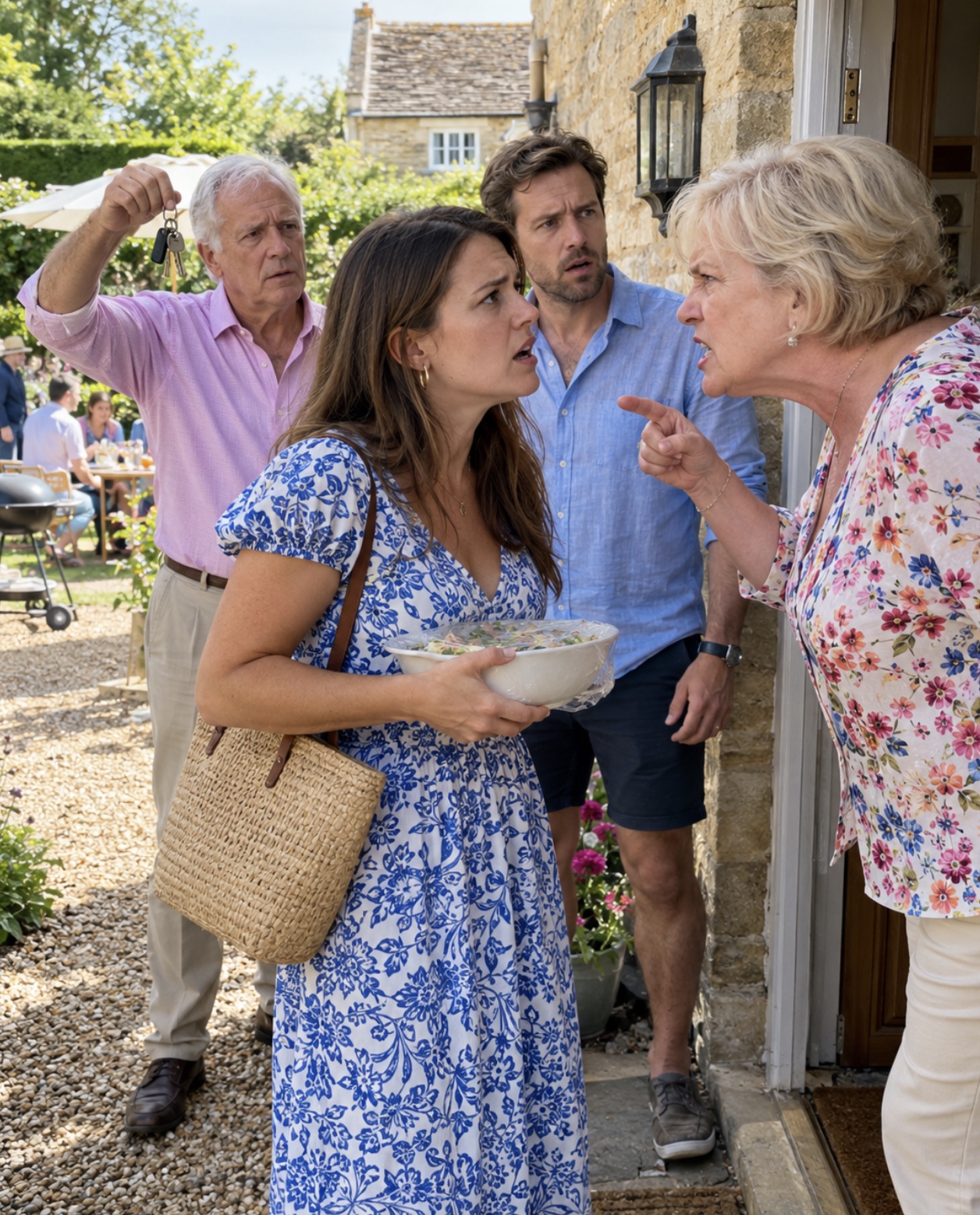
I was standing on the gravel path outside a cottage in the Cotswolds with a bowl of potato salad in my hands, while my mother-in-law, Margaret, blocked the front door as if I were a bailiff arriving with a court order.
“You heard me, Rachel,” she said, her face flushed beneath the wide straw hat she had bought for the weekend. “You are not setting foot inside this house again. Not after the way you’ve behaved. I will not have some penniless little opportunist treating my family like this.”
Behind me, my husband, Tom, went completely still.
Inside the cottage, I could see his sister Sophie at the dining table, frozen halfway through pouring wine.
Nobody spoke.
Then my father-in-law, Peter, reached into the pocket of his wax jacket, pulled out a heavy ring of keys and held them up between two fingers.
“Before you ban Rachel from anywhere,” he said quietly, “perhaps you should tell her whose money finished this place.”
Margaret’s expression changed.
Only for a second.
But I saw it.
And for the first time in seven years of knowing her, I realised that my mother-in-law wasn’t merely angry.
She was frightened.
The cottage had always been sacred territory in Tom’s family.
It stood outside Bourton-on-the-Water, down a narrow lane bordered by dry-stone walls and hawthorn hedges. It had honey-coloured stone, low ceilings, uneven oak floors and a garden Margaret described to everyone as “our little piece of England”.
Every Easter, every August bank holiday, every Christmas between Boxing Day and New Year, the entire family descended on it.
Margaret organised sleeping arrangements.
Margaret chose the menus.
Margaret decided who brought what.
And Margaret reminded everybody, repeatedly, that the cottage had been “in the family for generations”.
That last part wasn’t entirely true.
Peter’s grandfather had owned a small stone building on the land, but it had been little more than a neglected two-room agricultural cottage. Peter inherited it in his thirties.
The building everyone now admired—the three bedrooms, conservatory, second bathroom, proper kitchen, central heating and converted attic—had come much later.
Whenever I asked about the renovations, Margaret brushed it off.
“We did it bit by bit,” she would say.
Or, “Peter was very handy in those days.”
Or my favourite:
“You wouldn’t understand. People used to save for things instead of putting everything on credit.”
Margaret had decided very early in my relationship with Tom that I did not come from the right sort of background.
My father had been a bus mechanic in Coventry. My mother worked reception at a dental practice.
I went to a state school, studied accounting in Birmingham and was still paying off my student loan when I met Tom at thirty.
Margaret, by contrast, had gone to boarding school and could mention someone’s university within ninety seconds of meeting them.
Tom had warned me.
“She’s old-fashioned,” he’d said.
What he meant was that she noticed shoes, accents, table manners and postcode districts.
At first, she was subtle.
She asked whether my parents “rented or owned”.
She wondered aloud whether accounting was “a bit repetitive”.
When Tom and I bought a modest three-bedroom semi in Leamington Spa, she spent our housewarming asking if we planned to “move somewhere more permanent one day”.
I laughed most of it off.
Tom didn’t.
Over the years, he challenged her more and more.
That only made Margaret cleverer.
She stopped insulting me directly and started disguising insults as concern.
“Rachel works very hard because she has to.”
“Rachel is practical with money because of how she was brought up.”
“Rachel doesn’t care about appearances, which must be wonderfully freeing.”
The family cottage became the place where those remarks multiplied.
There, Margaret was queen.
She corrected how I loaded the dishwasher.
She once took a chopping board out of my hands because apparently I was slicing tomatoes “against the grain”.
She even told me not to use the upstairs shower before nine because “the water pressure isn’t designed for everybody’s personal routine”.
I tolerated it mostly for Peter.
Peter was the opposite of his wife.
Quiet, funny, incapable of taking himself seriously.
He restored old furniture, kept packets of biscuits hidden in the shed, and had developed the habit of slipping out for walks whenever Margaret began giving orders.
We got on well.
Better, in fact, than Margaret liked.
Three years earlier, Peter had suffered a mild stroke.
He recovered remarkably well, but afterwards he became less willing to argue.
Margaret took over even more.
Then, eighteen months before that awful weekend, Peter called me unexpectedly.
“Rachel,” he said, “I need some professional advice.”
I assumed it was tax-related.
It wasn’t.
Peter had discovered serious damp in the cottage.
Not ordinary damp.
Structural problems.
The old rear wall had shifted. The roof timbers over the extension were compromised. A survey estimated repairs at just under £68,000.
Peter had some savings, but not enough.
Tom and Sophie both had mortgages and young children.
Margaret refused to sell.
“It’s the one thing that holds this family together,” she said.
So Peter asked me something uncomfortable.
Could I help him organise his finances and find a way to save the cottage without putting himself into dangerous debt?
For nearly two months, I went through paperwork with him.
Insurance policies.
Savings accounts.
Old bonds.
A tiny investment portfolio he’d forgotten existed.
Eventually we found about £31,000.
The rest was impossible.
That was when I made the mistake that would eventually lead to Margaret standing in a doorway calling me a pauper.
I offered Peter a loan.
Not from Tom and me jointly.
From me.
Four years earlier, my aunt Janice had died.
She had no children, and she left me most of her estate.
After tax and the sale of her little bungalow near Rugby, I received more money than I had ever expected to have in my life.
I paid off part of our mortgage.
I put money aside for our children.
The rest sat in investments.
When Peter needed £37,000 to save the cottage, I could provide it.
Peter refused at first.
Absolutely refused.
“You’ll need that money,” he said.
“I don’t need it sitting in an account while your house falls down.”
“It isn’t your responsibility.”
“No. It’s not. That doesn’t mean I can’t help.”
We agreed on a formal loan.
Zero interest.
Repayment whenever Peter was able.
Everything written properly.
Everything signed.
Tom knew.
Our solicitor knew.
Margaret did not.
Peter begged me not to tell her.
That should have bothered me more than it did.
“She’ll be humiliated,” he said.
“Because you borrowed money?”
“Because I borrowed money from you.”
I remember staring at him.
“Peter, that’s worse.”
“I know.”
He rubbed his forehead.
“Give me time.”
So I did.
📚 The one thing Margaret never expected anyone to reveal was still hidden behind that front door — keep reading below. 👇
The repairs took seven months.
Scaffolding covered half the house.
The kitchen ceiling was opened.
The rear wall was partially rebuilt.
New drainage was installed around the garden side.
Margaret complained constantly about the cost but somehow never asked where the money had come from.
I later discovered why.
Peter had told her the money came from cashing out old investments.
Technically, some of it had.
Just not most of it.
When the cottage reopened, Margaret gave everyone a tour as though she had personally restored Chatsworth House.
“This should last another hundred years,” she said proudly.
I said nothing.
Peter repaid £500 here, £1,000 there.
By the summer of the argument, he had returned just under £9,000.
I had never chased him.
I never intended to.
The explosion happened over something almost absurdly small.
A weekend barbecue.
Margaret had invited fourteen people.
Tom and I arrived with our two children, six-year-old Ben and four-year-old Emily, around eleven on Saturday morning.
Sophie was already there with her husband, Mark.
Margaret was directing everyone like an air traffic controller.
“Rachel, salads in the utility room. Tom, chairs from the shed. Sophie, not those glasses, the proper ones.”
I put down the food and helped.
For two hours, everything was normal.
Then my phone rang.
It was our mortgage broker.
Tom and I had been considering extending our house instead of moving.
We had recently received a preliminary quote and were discussing whether to refinance a small part of the mortgage.
The call lasted maybe five minutes.
When I returned to the garden, Margaret was telling Sophie’s friend Claire that Tom and I were “having financial difficulties”.
I stopped.
“Sorry?”
Margaret smiled.
“Oh, Rachel. I hope you don’t mind. I simply said you’re restructuring things.”
“We’re not having financial difficulties.”
She tilted her head.
“You’re borrowing against the house.”
“We’re considering an extension.”
Claire immediately looked away.
Tom walked over.
“Mum, don’t discuss our finances with people.”
Margaret sighed dramatically.
“I was expressing concern.”
“You were gossiping.”
“That’s unfair.”
“No, it isn’t.”
The atmosphere changed.
Margaret disappeared into the kitchen.
Twenty minutes later she returned and announced that lunch would be served inside because “some people clearly needed time to calm down”.
I almost laughed.
Then Ben came running from the house.
“Mum! Grandma said we can’t go upstairs.”
Margaret followed him out.
“I said no muddy shoes upstairs.”
“He took them off.”
“Well, there are expensive things in the bedrooms.”
Tom frowned.
“Mum, they’ve stayed here twenty times.”
Margaret looked straight at me.
“Standards slip when people start assuming things belong to them.”
There it was.
I put down my glass.
“What is that supposed to mean?”
“Nothing.”
“It clearly means something.”
Peter was watching from under the apple tree.
Margaret folded her arms.
“I simply think certain boundaries have been blurred.”
“Which boundaries?”
She gave a small laugh.
“Oh, Rachel, please don’t make a scene.”
I could feel my pulse rising.
“You’ve spent all morning discussing my finances with guests, and now you’re implying my children can’t be trusted upstairs. If you have something to say, say it.”
Tom murmured, “Rach…”
But I was done pretending not to understand.
Margaret’s expression hardened.
“You want honesty?”
“Yes.”
“Fine. You behave here as though this were your home.”
I stared at her.
“I made potato salad and moved six chairs.”
“You advise Peter about money. You question household decisions. You rearranged the utility cupboard last Christmas.”
“That was because a bottle of bleach was next to the children’s squash.”
“It is not your place.”
Peter finally stood.
“Margaret.”
But she was already going.
“And frankly,” she continued, “I’m tired of you arriving here and behaving as though you’ve somehow earned a stake in this family.”
Tom stepped forward.
“That’s enough.”
“No, Thomas, it isn’t. Somebody needs to say it.”
She pointed toward me.
“She married into this family and now acts as though everything should revolve around her. Your father listens to her about money, you defend her constantly, and every year she becomes more entitled.”
I was so angry my hands had started shaking.
“Entitled to what?”
Margaret looked around at the cottage.
“This.”
I actually laughed then.
Not because it was funny.
Because the alternative was crying.
“I have never asked for anything here.”
“You don’t have to ask. People like you rarely do.”
Silence.
Even Margaret seemed to realise she’d gone too far.
I said quietly, “People like me?”
She should have stopped.
Instead, she doubled down.
“People who come from very little and suddenly find themselves surrounded by things they never had.”
Tom’s face changed.
“Mum.”
But Margaret’s humiliation had turned into rage.
“Don’t ‘Mum’ me. I’m sick of walking on eggshells around her. If she doesn’t like how we do things, she can leave.”
“That’s exactly what we’ll do,” Tom said.
I turned toward the house to collect the children’s bags.
Margaret moved faster.
She reached the door before me and planted herself in the entrance.
“No.”
I stared at her.
“What?”
“You’re not going back inside.”
“My handbag is in there.”
“I’ll bring it out.”
“Margaret, move.”
“No.”
Then came the sentence I would remember for years.
“You’re never setting foot here again, you pauper!”
That was when Peter took out the keys.
He walked slowly from the garden, stopped beside me and looked at his wife.
“Before you ban Rachel from anywhere,” he said calmly, “tell her whose money finished this place.”
Margaret went pale.
Tom looked from his father to me.
He knew about the loan, but he had never expected Peter to say it like that.
Sophie whispered, “What money?”
Peter ignored her.
“Go on, Margaret.”
“You said the investments—”
“Some of the investments.”
Peter turned to the rest of us.
“When the structural work was done, we were short thirty-seven thousand pounds.”
Sophie blinked.
“What?”
“I asked the bank. They wouldn’t lend enough at sensible terms because of my age. I considered selling.”
Margaret snapped, “Peter, stop.”
“No.”
It was the first time I had ever heard him answer her with such finality.
“Rachel lent me the rest.”
Claire quietly picked up her handbag.
Mark looked down at the table.
Sophie simply stared at me.
Peter continued.
“She never asked for interest. She never asked for ownership. She never told anybody. And she has never once reminded me that most of the extension you love boasting about is standing because she helped us.”
Margaret’s eyes filled with tears.
But they weren’t tears of gratitude.
They were furious tears.
“You lied to me.”
“Yes,” Peter said.
“About our own finances.”
“Yes.”
“You let me stand here looking like a fool.”
Peter’s voice remained calm.
“No, Margaret. Rachel protected you from feeling like one. What happened today was your own work.”
Margaret turned on me.
“How much?”
“Peter—”
“How much does he still owe you?”
I hesitated.
Peter answered.
“Twenty-eight thousand and a bit.”
Sophie sat down hard.
Margaret looked physically ill.
Then she said something none of us expected.
“Then sell the cottage.”
Peter frowned.
“What?”
“Sell it. Pay her. I won’t owe her anything.”
I could finally see the truth.
The debt itself wasn’t what Margaret couldn’t tolerate.
It was the reversal.
For years, she had built her identity around being the person with more.
More security.
More tradition.
More property.
More class.
Finding out that I had quietly helped preserve the place she used to make me feel inferior was unbearable to her.
“I don’t want the cottage sold,” I said.
Margaret laughed bitterly.
“How generous.”
“No. Practical. Peter can repay me when he wants. Or not.”
She stared at me.
“Not?”
I looked at Peter.
Then at Tom.
This part had been on my mind for months.
“My aunt left me money because when I was twenty-two and broke, she let me live with her for a year without charging rent. She told me people become obsessed with keeping score and forget why they helped in the first place.”
Peter shook his head.
“Rachel—”
“If the money becomes a burden, forget it.”
“No.”
“That’s my decision.”
“No, it isn’t.”
I smiled.
“It was my money.”
For once, Peter had no answer.
Margaret did.
She sat down on the stone bench beside the door and covered her face.
Nobody moved toward her.
Not immediately.
Then Sophie did.
She sat beside her mother.
“Mum,” she said softly, “why are you like this with Rachel?”
Margaret lowered her hands.
“What does that mean?”
“You know exactly what it means.”
Sophie glanced at me.
“You talk about her job. Her parents. Her clothes. Her house. You’ve been doing it for years.”
Margaret’s face crumpled.
“I wanted better for Tom.”
Tom stared at her.
“Better than what?”
She couldn’t answer.
Peter looked tired.
That moment changed something.
Not instantly.
There was no dramatic apology.
No hug.
No perfect reconciliation.
Tom and I left that afternoon.
For three months, I didn’t visit the cottage.
Margaret didn’t call.
Peter did.
So did Sophie.
Then, in November, a thick envelope arrived.
Inside was a bank transfer confirmation for £28,400.
I rang Peter immediately.
“What have you done?”
“Sold something.”
“What?”
There was a pause.
Then he laughed.
“Margaret’s jewellery.”
I nearly dropped the phone.
“Peter!”
“Relax. Her idea.”
I didn’t believe him.
But ten minutes later Margaret rang.
Her voice was stiff.
“I didn’t sell all of it.”
“I wasn’t going to ask.”
“A few pieces I never wore.”
“You didn’t have to do that.”
“Yes,” she said. “I did.”
Another silence.
Then she added, “I was cruel to you.”
It was the closest thing to an apology I had ever heard from her.
“I was ashamed,” she continued. “Not of borrowing money. Of needing help from someone I had decided shouldn’t have been in a position to help me.”
That sentence surprised me more than the cheque.
“I know how that sounds.”
“Yes,” I said.
“It sounds awful.”
“Yes.”
She let out a weak laugh.
Then she said, “Peter says I’ve spent years confusing money with character.”
I didn’t respond.
“Apparently he’s been waiting thirty-six years to tell me that.”
“That sounds like Peter.”
There was another pause.
“We’re having Christmas at the cottage.”
I waited.
“I understand if you don’t want to come.”
That mattered.
Not the invitation.
The absence of an order.
“We’ll think about it.”
We did go.
Margaret didn’t become a different person overnight.
She still corrected how Tom carved turkey.
She still complained when Sophie bought supermarket mince pies instead of making them.
And when I put wine glasses in the wrong cupboard, I caught her staring at them.
Then she stopped herself.
That tiny act of restraint almost made me smile.
After lunch, Peter handed me a cup of tea and nodded toward the conservatory.
“Worth thirty-seven thousand?”
I looked at the repaired stone wall, the windows covered in rain, our children playing Monopoly on the floor.
“No.”
He looked offended.
“Absolutely not?”
“Maybe thirty-five.”
He laughed so loudly Margaret shouted from the kitchen asking what was funny.
Peter winked at me.
“Nothing, dear.”
The cottage was never put in my name.
I never wanted it.
Years later, when Peter and Margaret finally decided to transfer ownership, they divided it equally between Tom and Sophie.
Exactly as they had always intended.
But Margaret added one strange sentence to the letter she gave us with the paperwork.
She wrote:
“This house belongs to the family. Rachel proved that long before I was ready to admit she was part of it.”
I kept that letter.
Not because I needed the recognition.
And certainly not because of the cottage.
I kept it because sometimes the most expensive thing a person owns is not a house, a piece of land or a family inheritance.
Sometimes it is the story they have spent years telling themselves about who is above whom.
And Margaret had finally paid the price of letting hers go.