



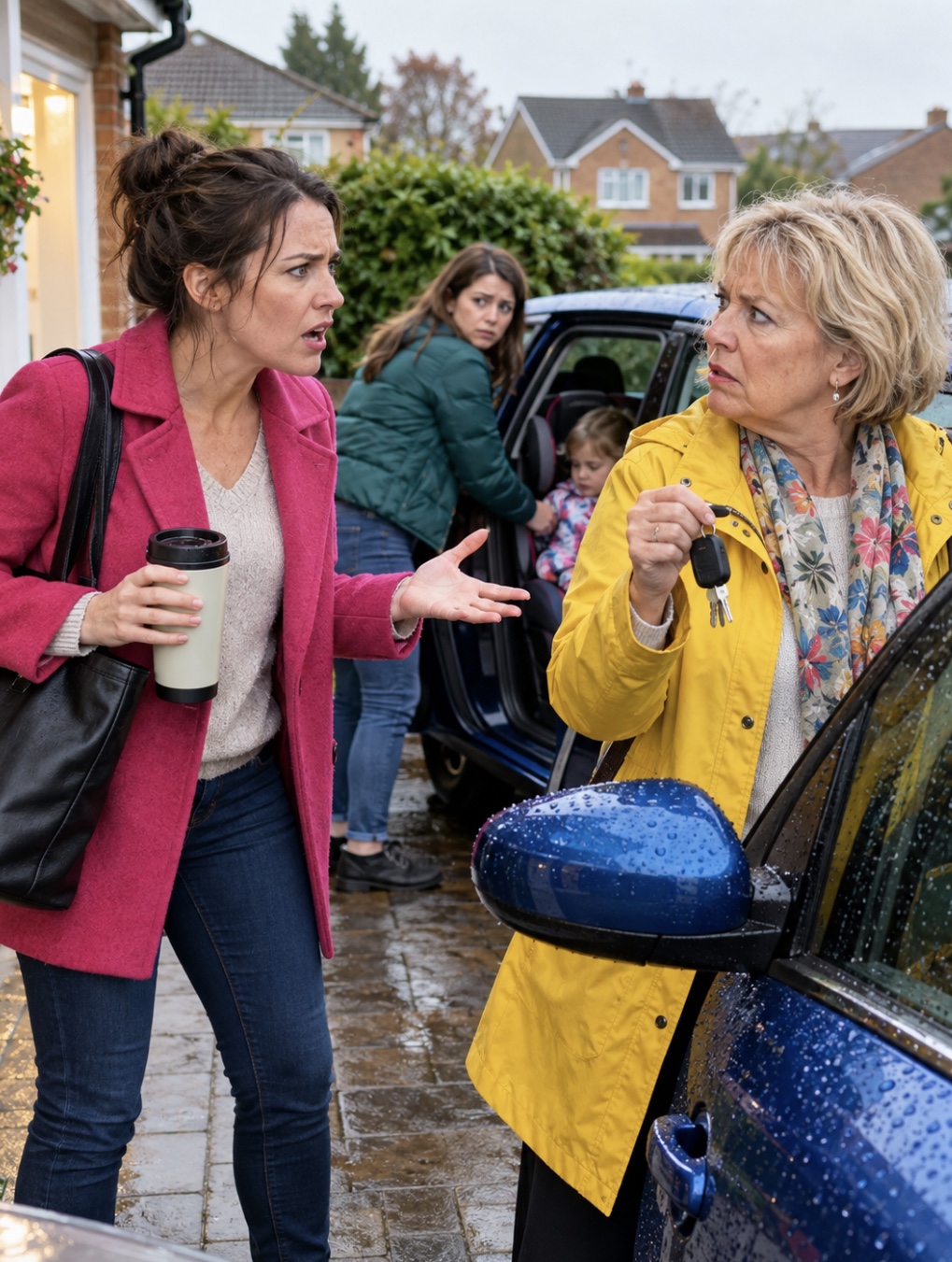
The first time my mother-in-law told me I no longer needed my own car, she was standing in my driveway with my keys already in her hand.
“You work from home three days a week,” Denise said, as if that settled everything. “You can walk.”
For a few seconds, I genuinely thought I had misunderstood her.
It was a wet Tuesday morning in late November, the kind of grey English morning when the sky seemed to start at the rooftops. I was wearing one trainer, holding a travel mug in one hand and my laptop bag in the other, trying to leave for an appointment in Reading before the motorway turned into a car park.
My blue Ford Fiesta was parked exactly where I had left it the night before.
Denise stood beside the driver’s door.
Behind her, my husband’s younger sister, Chloe, was buckling her four-year-old daughter into the back seat.
“What are you doing?” I asked.
Denise looked almost offended by the question.
“Chloe’s car is still at the garage.”
“I know.”
“So she needs yours.”
I stared at her.
“I need mine.”
“You said you only had one meeting.”
“In Reading.”
“You can get the train.”
“From here?”
Denise gave a little shrug. “Bus to the station.”
It would have taken me nearly an hour to reach the station by bus, then another forty minutes on the train, plus a taxi at the other end. Driving took twenty-five minutes on a good morning.
I set my laptop bag down.
“Give me the keys, please.”
Chloe stopped fiddling with the child seat.
“Mum,” she murmured.
Denise folded her fingers around the keys.
“You’re being dramatic, Rachel. Chloe has Poppy with her.”
“And?”
“And it’s raining.”
“So I should miss a client meeting because it’s raining?”
“You can walk to the bus stop.”
That was when something changed in the air.
Not because of the words themselves. Denise had said worse things over the years, usually with a smile. But because she was standing on my property, holding the keys to something I had bought with my own money, explaining to me why someone else needed it more.
I held out my hand.
“The keys.”
She rolled her eyes and dropped them into my palm.
Chloe looked mortified.
“I’m sorry,” she said. “Mum said you’d already agreed.”
I turned to Denise.
“No. I didn’t.”
Denise’s face went very still.
That should have been the end of it.
It wasn’t.
My husband, Tom, called me just after lunch.
“Why did Mum ring me saying you left Chloe stranded?”
“I didn’t leave Chloe stranded.”
“She said Chloe had no way to take Poppy to nursery.”
“Chloe had already brought Poppy to our house somehow.”
There was a pause.
“She got an Uber.”
“Then she wasn’t stranded.”
Tom sighed.
That sigh irritated me more than Denise’s entire performance.
“Rachel, her car’s broken.”
“I know.”
“It’s only for a few days.”
“Then she can ask me.”
“She thought Mum had.”
“No. Your mother told her I’d agreed, came into our house, took my keys off the hook, and tried to leave with my car.”
Another pause.
This one longer.
“She came into the house?”
“Yes.”
“How?”
I looked toward the little ceramic bowl by the hallway mirror where we kept keys, loose coins and post.
“I assumed you let her in.”
“I’m at work.”
“No, Tom. I mean how does she have access?”
He went quiet.
Then he said, “She’s got the spare key.”
That was news to me.
Our spare front-door key had once been kept by our neighbour, Mr Patel, for emergencies. After he moved to Manchester, I had assumed Tom put it in his desk drawer.
Apparently not.
“When did you give your mother our key?”
“Months ago.”
“Why?”
“In case we got locked out.”
“We have two keys.”
“It seemed sensible.”
“And you didn’t tell me?”
“I didn’t think it mattered.”
I closed my eyes.
“It mattered this morning.”
Tom promised to speak to her.
That evening, he came home with flowers.
Not supermarket flowers. Proper florist flowers, wrapped in brown paper, which told me two things: he knew I was angry, and whatever conversation he had had with his mother had not gone well.
“She feels you embarrassed her,” he said while I chopped onions.
I put the knife down.
“She was trying to take my car.”
“She says she was just helping Chloe.”
“She lied to Chloe.”
“I know.”
“She entered our house without asking.”
“I know.”
“She took my keys.”
“I know.”
“Then why are we discussing her feelings?”
Tom leaned against the kitchen counter.
“Because she doesn’t see it like that.”
I laughed once.
“That’s convenient.”
He rubbed the back of his neck.
“Can we just get through this week? Chloe’s car should be fixed by Friday.”
I stared at him.
“You still think this is about Chloe needing the car?”
He looked genuinely confused.
At the time, I didn’t realise that confusion would become important.
The next morning, my Fiesta was still outside.
Thursday too.
By Friday, Chloe’s Vauxhall had been repaired, and I thought the whole ridiculous episode was finished.
Then, the following Monday, I came downstairs and found a printed sheet on the kitchen table.
It was a comparison of second-hand car prices.
My car’s registration number was written at the top.
Underneath, someone had circled three figures in blue pen.
£6,950.
£7,300.
£7,500.
I picked it up just as Tom walked in from the utility room.
“What’s this?”
He glanced at it.
His expression changed too quickly.
That was all I needed.
“Tom?”
“It’s nothing.”
“Why is someone pricing my car?”
“Mum was just looking.”
My stomach tightened.
“Looking at what?”
He didn’t answer.
“Tom.”
He sat down.
“Mum thinks it might make sense to sell one of the cars.”
“One of whose cars?”
“Ours.”
“We don’t have ‘our’ cars. You have your Skoda. I have my Ford.”
“You know what I mean.”
“No. I actually don’t.”
He rubbed his face.
“Mum thinks with me commuting every day and you working from home more, we probably don’t need two.”
I stared at him.
“Your mother has been discussing selling my car?”
“She was brainstorming.”
“Why?”
No answer.
“Why, Tom?”
He looked toward the window.
“Because Chloe needs money.”
There it was.
Not all of it, but enough to make my pulse jump.
“What does my car have to do with Chloe needing money?”
Tom took a breath.
“She’s behind on rent.”
“How far behind?”
“Nearly three months.”
I stopped moving.
Chloe had separated from Poppy’s father the previous spring. She worked four days a week at a dental practice and rented a small terrace about fifteen minutes away. I knew things were tight, but she had never once asked us for money.
“What happened?”
“Her ex stopped paying what he’d agreed.”
“That’s awful, but I still don’t understand why your mother is calculating the resale value of my car.”
Tom’s answer came slowly.
“She thought if we sold it, we could lend Chloe the money.”
I almost smiled because the idea was so absurd.
“We?”
“She meant us as a family.”
“No. She meant me.”
“It’s just an idea.”
“A seven-thousand-pound idea using my property.”
“We’d pay you back.”
That sentence made me colder than anything Denise had said.
“We?”
Tom looked down.
I realised then that he had already discussed this with her more seriously than he was admitting.
📍 The part nobody in the family expected came next — keep reading in the first comment. 👇
I sat opposite him.
“How much have you already promised Chloe?”
“Nothing.”
“Tom.”
“Nothing officially.”
“Unofficially?”
He stood up.
“I said we’d see what we could do.”
“With my car.”
“I never said we would sell your car.”
“But you let your mother research the price.”
“She does things like that.”
“Yes, Tom. She does things like that because everybody lets her.”
He turned away.
That night, we barely spoke.
Two days later, I came home early from the office because the heating had failed in our building.
There was a silver estate car parked outside our house.
A man in a navy padded jacket stood beside my Fiesta.
Denise was with him.
She was pointing at the rear wheel arch.
I parked behind them and got out slowly.
Denise’s face drained.
The man smiled politely.
“You must be Rachel.”
I didn’t answer.
He held out a hand.
“Gavin. From Millbrook Motors.”
I looked at Denise.
“What is he doing here?”
Gavin’s smile faded.
Denise stepped forward.
“Don’t make a scene.”
I almost laughed.
“This is my house.”
“I know.”
“And my car.”
“Yes.”
“Then answer the question.”
Gavin looked between us.
“I was told you were thinking of selling.”
“I’m not.”
Silence.
He shifted awkwardly.
“Right. Well. I’ll leave you to it.”
Denise grabbed his sleeve.
“Just give us a valuation.”
“No,” I said.
He removed his arm gently from her grip.
“I think I’d better go.”
Denise waited until his car disappeared around the corner.
Then she turned on me.
“Do you have any idea what Chloe is dealing with?”
“Yes.”
“No, you don’t. She has a child. She’s terrified of losing the house.”
“So you invited a dealer to value my car without permission?”
“You barely use it.”
I took my phone out.
She frowned.
“What are you doing?”
“Calling Tom.”
“Oh, for heaven’s sake.”
Tom arrived forty minutes later.
By then Denise was sitting at our kitchen table drinking tea she had made for herself.
I was standing by the window because I didn’t trust myself to sit beside her.
Tom walked in and looked from me to his mother.
“Mum.”
“I was trying to help.”
“You brought a car dealer here?”
“He was nearby.”
“How did you even arrange that?”
She lifted her chin.
“Online.”
“With Rachel’s registration?”
“Yes.”
Tom dropped his keys on the counter.
“Mum, you can’t do that.”
“Why? She doesn’t use the thing properly.”
I turned.
“How exactly do you use a car properly?”
Denise ignored me.
“Tom drives fifty miles a day. Rachel sits upstairs with a laptop.”
“I go to clients twice a week.”
“She could use your car on those days.”
“And how would Tom get to work?”
“Train.”
Tom gave a short laugh of disbelief.
Denise looked annoyed.
“That’s not the point.”
“No,” I said. “The point is you think you’re entitled to rearrange everybody’s life because Chloe has a problem.”
Her eyes hardened.
“Family makes sacrifices.”
“Then sell your car.”
Silence.
It was the first time all evening Denise had nothing to say.
She owned a two-year-old Nissan Qashqai.
It was worth at least twice what my Fiesta was.
Tom looked at her.
“Mum?”
Denise folded her arms.
“That’s different.”
“How?”
“I need mine.”
“So do I,” I said.
“You don’t.”
“I decide that.”
She stood.
“You know what? Fine. Keep it. If Chloe loses her home, I hope you can look at that ridiculous little car every morning and feel proud.”
Tom flinched.
I didn’t.
Because something about the entire situation had started bothering me.
Not the entitlement. Not even the money.
Something else.
Denise had pushed too hard.
Chloe was in financial trouble, yes.
But seven thousand pounds would not permanently solve three months of rent arrears unless something else was wrong.
And Chloe herself had never asked me for a penny.
The next afternoon, I phoned her.
She answered on the third ring.
“Hi.”
“Can I ask you something?”
A pause.
“About Mum?”
“Yes.”
She exhaled.
“I’m sorry about all of this.”
“How much do you actually owe?”
Another pause.
“Rachel—”
“I’m not judging you. I just want the real number.”
She lowered her voice.
“Two thousand four hundred.”
I frowned.
“That’s it?”
“That’s not exactly nothing.”
“No. But your mum is trying to sell a car worth seven grand.”
Chloe went completely silent.
“You didn’t know?”
“No.”
I sat down.
“What did she tell you?”
“That Tom offered to help.”
“He said we’d see what we could do.”
“She said you had savings but didn’t want to use them.”
My hand tightened around the phone.
“What?”
“And she said the car was mostly sitting unused anyway.”
I stared at the wall.
“Chloe, did she ask you for money?”
“What do you mean?”
“Did she ask you to give her anything from whatever we lent you?”
There was a long pause.
Then Chloe said, “That’s weird.”
“What?”
“She did say something.”
My pulse quickened.
“What?”
“She said if Tom helped with more than I needed, I should transfer the extra to her because she’d ‘sort the family accounts.’”
I felt something inside me settle.
Not calm.
Clarity.
“How much extra?”
“She said maybe four or five thousand.”
Neither of us spoke for a moment.
Then Chloe whispered, “Rachel, what is going on?”
“I don’t know yet.”
I did something that evening I had never done before.
I looked through the post Denise had left at our house.
Not secretly stolen post. She had a habit of using our address for parcels when she was out, and one brown envelope addressed to her had been sitting unopened on the hall table for days.
I did not open it.
But I noticed the return address printed on the back.
A storage company in Slough.
That meant nothing to me.
Until Saturday.
Tom and I were supposed to have lunch at Denise’s.
At eleven thirty, she called saying she had a migraine.
Lunch cancelled.
At twelve fifteen, Chloe rang.
“Mum’s not home.”
“How do you know?”
“I went round.”
I sat up.
“Why?”
“Because I asked her directly about the money.”
“And?”
“She said I was ungrateful and told me to leave.”
“Okay.”
“She drove away.”
That evening, Tom finally admitted something he had been hiding.
His mother had borrowed £12,000 from him eighteen months earlier.
I stared at him.
“What?”
“She said it was temporary.”
“For what?”
“Roof repairs.”
“Her roof was repaired through insurance.”
“I know that now.”
I stood up slowly.
“How much has she paid back?”
He didn’t answer.
“Tom.”
“Two thousand.”
I felt sick.
“So your mother owes you ten grand.”
“Yes.”
“And instead of telling me, she tries to sell my car.”
“I didn’t connect it.”
“How could you not connect it?”
“Because I thought she was trying to help Chloe.”
“She was trying to get five thousand pounds routed through Chloe.”
Tom sat down heavily.
For the first time, he looked frightened rather than defensive.
“What does she need money for?”
We found out on Monday.
Not because Denise confessed.
Because Chloe received a call.
The storage company was trying to reach Denise about overdue fees and had somehow obtained Chloe’s number from an emergency contact form.
Chloe drove there.
Then she called us.
“You need to come.”
The storage facility sat behind an industrial estate near the M4, between a tile warehouse and a tyre shop.
Denise was already there when we arrived.
Her Nissan was parked outside.
She stood beside one of the metal storage units arguing with a man in a fluorescent jacket.
The unit door was open.
Inside were boxes.
Dozens of them.
New boxes.
Some branded.
Some still sealed.
There were lamps, kitchen appliances, cushions, sets of cookware, handbags, shoes, Christmas decorations, folded rugs and what looked like three identical coffee machines.
Chloe stared.
“Mum?”
Denise turned.
Her face collapsed.
Not dramatically.
It simply seemed to lose all structure.
Tom walked to the doorway.
“What is this?”
Denise said nothing.
The manager did.
“She’s three months behind on the unit.”
“How much?”
“Just under nine hundred, including late fees.”
Tom pointed at the boxes.
“Why does she have all this?”
The manager looked uncomfortable.
“That’s not really for me to say.”
Denise sat down on a plastic crate.
And then the truth came out.
Not all at once.
Over two hours.
Then over the following week.
Denise had been buying things online for nearly three years.
At first, ordinary things.
Clothes.
Homeware.
Gifts.
Then larger orders.
Sale items she told herself she could resell.
Furniture she didn’t have room for.
Handbags she planned to return but never did.
Every purchase gave her a few minutes of relief.
Every unopened box made her ashamed.
So she rented a storage unit.
Then a bigger one.
Then she took out a credit card Tom didn’t know about.
Then another.
The £12,000 had not been for a roof.
It had cleared two cards.
Temporarily.
Within months, she was spending again.
Now she owed just over £18,000.
The number silenced all of us.
Chloe started crying.
Tom looked furious.
I expected Denise to defend herself.
Instead she stared at the concrete floor and said, “I thought if I could get five thousand, I could clear the card with the worst interest before January.”
Tom’s voice shook.
“So you were going to take Rachel’s car.”
“No.”
“You had it valued.”
“I thought she wouldn’t miss it.”
That sentence might have destroyed what was left of their relationship if I had responded.
But I didn’t.
Because suddenly I understood something unpleasant.
To Denise, objects had stopped being connected to people.
My car was not my independence.
Chloe’s rent money was not Chloe’s security.
Tom’s savings were not years of work.
They were numbers she could move around to delay consequences.
We did not give her five thousand pounds.
We did not sell my car.
Tom did not lend her anything else.
Instead, he helped her arrange an appointment with a free debt-advice service.
Chloe helped photograph and list unused items that could genuinely be sold.
I helped once, then stopped.
It was important that Denise did most of it herself.
The storage unit took six weeks to empty.
She sold clothes, appliances, unopened furniture and bags.
Some things returned only a fraction of what she had paid.
Her Nissan was eventually sold too.
That decision came from her.
She replaced it with an eleven-year-old Honda Jazz bought outright from a retired teacher in Maidenhead.
The first time she visited us in it, she parked next to my Fiesta.
For a moment, neither of us mentioned what had happened.
Then she looked at my car.
“I was awful to you.”
I didn’t rescue her from the sentence.
“Yes.”
She nodded.
“I kept telling myself you had something you didn’t really need.”
“I did need it.”
“I know.”
She looked toward the house.
“I think that was how I justified most things. Somebody had more room. Somebody had savings. Somebody had a car. Somebody could manage.”
I folded my arms against the cold.
“And you?”
“I was the emergency.”
There was no excuse hidden in the words.
That mattered.
Six months later, Denise was still paying off the debt.
She attended a support group twice a month.
She stopped storing her bank card details on shopping sites.
Tom and Chloe both set boundaries that would once have seemed impossible.
And we changed our locks.
That part was non-negotiable.
One rainy Thursday the following autumn, my Fiesta failed its MOT.
Nothing dramatic. Brakes and two tyres.
The garage kept it overnight.
When Denise heard, she texted me.
Need a lift tomorrow?
I looked at the message for a long moment before replying.
No thanks. I’ll walk to the station.
She sent back a laughing face.
Then another message appeared.
Fair enough. But if it rains, the Honda is available. Your choice.
That last part mattered more than she probably realised.
Your choice.
Not hers.
Mine.