



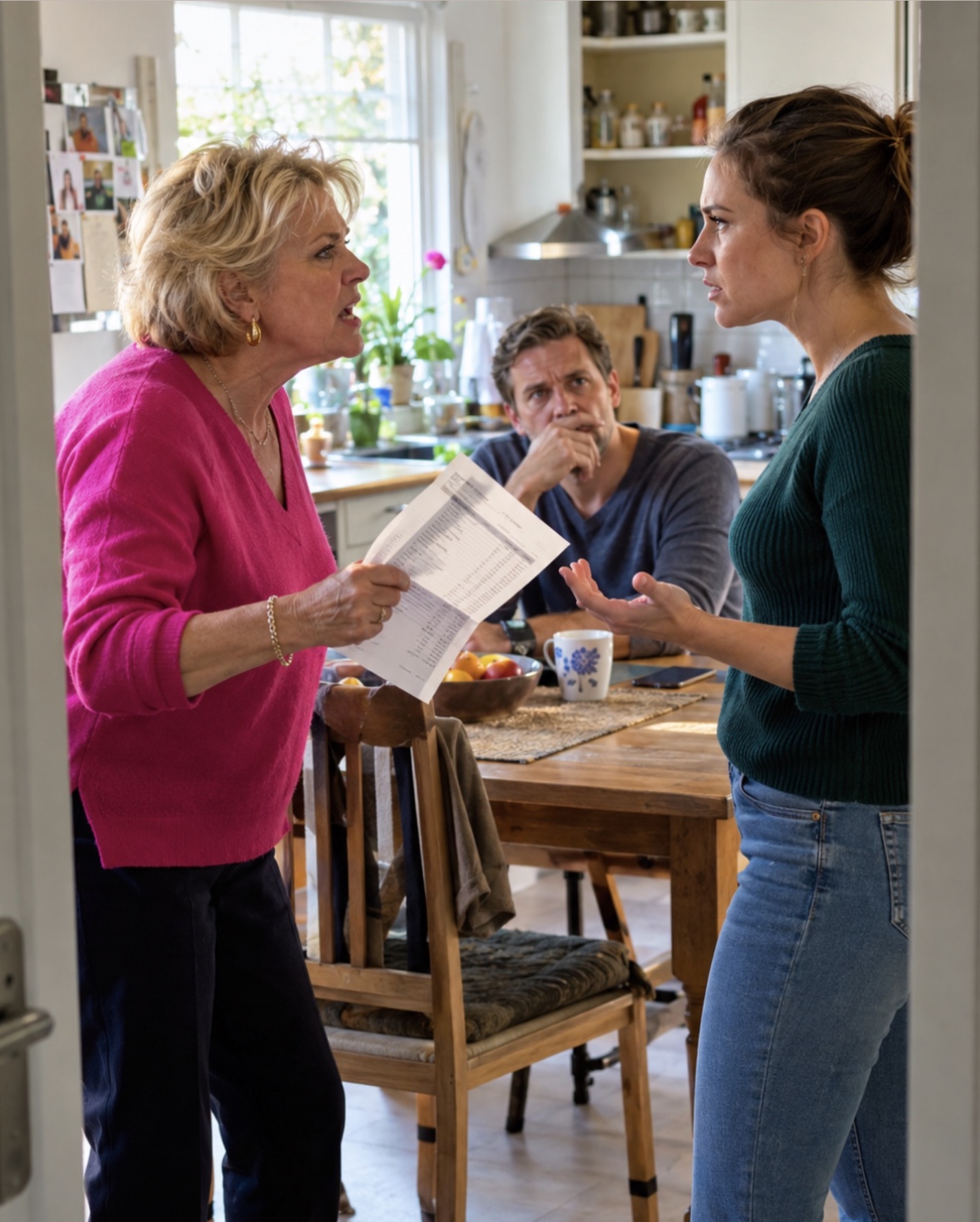
When Brigitte said it, she was standing in the middle of our kitchen with my bank statement in her hand.
Not hers.
Not her son’s.
Mine.
She held the sheet between two fingers as though it were evidence in a criminal investigation and waved it in front of my face.
“Eighty-four euros for shoes!” she exclaimed. “Eighty-four! And then you wonder why Jonas has to work overtime all the time.”
I looked at the bank statement first, then at my husband.
Jonas was sitting at the kitchen table, staring into his coffee.
“Where did you get that?” I asked.
Brigitte ignored me.
“I always told my son he should marry a woman who knows how to handle money.”
“Mom,” Jonas muttered.
“No. I’m talking now!”
She turned back to me.
“You’re not a wife. You’re a leech. You latched onto my son and you’re bleeding him dry.”
It wasn’t the first time Brigitte had insulted me.
But it was the first time she’d done it while I knew that the following Monday, €612 was supposed to leave my account to pay for her problems.
So I leaned against the kitchen counter and said calmly,
“Then stop asking this leech to pay your bills.”
For the first time in months, our kitchen went completely silent.
Jonas lifted his head.
Brigitte blinked.
“What is that supposed to mean?”
“Exactly what I said.”
She gave a short, shrill laugh.
“And what bills of mine are you supposedly paying?”
I looked at Jonas.
His face went pale.
That was when I realized he hadn’t told her.
And suddenly I understood why.
We lived in a terraced house on the outskirts of Hanover. Nothing luxurious, nothing particularly impressive. About 118 square meters, a small garden, and a garage where Jonas had been claiming for two years that he was “eventually” going to put up shelves.
I worked as a project coordinator for a midsize logistics company. Jonas was an electrician and had started a small business with a former coworker.
When we married six years earlier, we earned roughly the same amount.
Now I earned a little more.
That had never bothered me.
Apparently, it bothered Brigitte.
She constantly talked about Jonas “providing for the family.”
Whenever I corrected her, she waved me off.
“Oh, all this modern accounting. At the end of the day, the man is still responsible for his family.”
For a long time, I tried to laugh about it.
Until the previous winter, when Brigitte started regularly asking Jonas for money.
First it was €180 for an extra heating bill.
Then €260 for a car repair.
Then an electricity bill.
Then new glasses.
Then, supposedly, a broken washing machine.
Jonas gave her the money.
At least, that was what I thought.
It wasn’t until April that I realized the money was actually coming from my personal account.
It happened so casually that I hadn’t thought much of it.
We were sitting on the couch one evening when Jonas asked,
“Can you transfer Mom the €340? I’ve got two big supplier invoices this month.”
So I did.
After all, Brigitte was his mother.
In May, it was €290.
In June, €470.
In July, €215.
And now, at the end of August, it was supposed to be €612.
A building maintenance charge for her apartment.
“Just this once,” Jonas had said.
I’d agreed.
Until that Sunday.
Brigitte was still standing in our kitchen.
“Jonas?” she asked.
He rubbed the back of his neck.
“Mom, Klara has covered a few things for you over the last couple of months.”
“A few things?”
“Bills.”
“My bills?”
“Yes.”
She looked at me as if I had done something inappropriate.
“Why?”
That question surprised me.
Not thank you.
Not how much?
Just:
Why?
“Because Jonas asked me to.”
She immediately turned toward him.
“You let your wife pay my bills?”
“Mom, it’s our money.”
“Apparently not!”
She slapped my bank statement onto the table.
“She clearly keeps very careful records.”
I picked it up.
“You took this from my office.”
“It was lying there.”
“In a drawer.”
“The drawer was open.”
It hadn’t been.
Before I could answer, however, her phone rang.
Brigitte looked at the screen and walked into the hallway.
I heard only fragments.
“No… Monday.”
A pause.
“I said Monday.”
Another pause.
Then, more quietly:
“I’ll sort it out.”
When she returned, her expression had changed.
The anger was gone.
Something else had replaced it.
Nervousness.
“I have to go.”
“Because of the bill?” I asked.
She grabbed her handbag.
“What bill?”
“The €612.”
“Yes. Of course.”
Jonas stood up.
“I’ll drive you.”
“No.”
Too fast.
Too sharp.
She put on her jacket and left.
When the door closed behind her, Jonas remained standing there.
“What was that?” I asked.
“No idea.”
“Jonas.”
“What?”
“Why doesn’t your mother know I’ve been paying her bills?”
He sighed.
“Because she wouldn’t accept help from you.”
I laughed.
“She’s been accepting it for five months.”
“You know what she’s like.”
“No. Apparently, I don’t.”
I put the bank statement on the table.
“And how did she get into my paperwork?”
Jonas didn’t answer.
Then something occurred to me.
“Does she still have a key?”
He looked away.
That was answer enough.
I had given Brigitte a spare key eighteen months earlier when we went to Denmark for two weeks. Afterward, she claimed she’d returned it.
Apparently, she’d made a copy.
“I’m changing the lock tomorrow,” I said.
“Now you’re overreacting.”
I stared at my husband.
“Your mother goes through my drawers.”
“She saw a piece of paper.”
“In my office.”
“Klara…”
“And she calls me a leech while I’m paying her electricity bill.”
He said nothing.
“Do you think that’s normal?”
“No.”
“Then tell her.”
Again, silence.
That was Jonas’s problem.
He wasn’t a bad man.
He was simply a man who had grown up believing that keeping the peace meant never disagreeing with his mother.
The next morning, I didn’t transfer the €612.
For the first time in months.
At 10:17 a.m., Jonas texted me.
Have you paid Mom’s bill yet?
I replied:
No.
Three minutes later:
Why not?
Because I want to see the bill first.
No response for a while.
Then:
Why?
I stared at the message.
Because it’s my money.
Nothing after that.
That afternoon, Brigitte messaged me.
No hello.
Just:
Jonas says the transfer still hasn’t gone through.
I replied:
Please send me the bill.
She read the message immediately.
No answer.
Jonas came home late that evening.
He put down his work bag and said,
“Mom called.”
“What a surprise.”
“She feels humiliated.”
“Because I want to see a bill before I pay it?”
“You know what she’s like.”
“I’m getting a little tired of hearing that sentence.”
He opened the refrigerator.
“It’s only €612.”
“Then you pay it.”
“My business account is tight right now.”
“Then your mother can pay her own bill.”
He closed the refrigerator again.
“She doesn’t have the money.”
“Why?”
“I don’t know.”
That was the first moment I became genuinely suspicious.
Brigitte received a decent widow’s pension. Since her husband’s death, she also rented out a small apartment in her sister’s house in Celle.
She didn’t live extravagantly.
But she wasn’t poor either.
📌 If you want to know why Brigitte suddenly needed money every single month, keep reading in the first comment. 👇
On Tuesday morning, I did something I’d never thought would be necessary.
I opened our household spreadsheet and searched for every payment connected to Brigitte over the previous months.
There were more than I remembered.
€180 for heating.
€340 for a washing machine.
€290 for a car repair.
€470 for an electricity adjustment.
€215 for glasses.
Plus three smaller transfers of €90, €120, and €160.
Total: €1,865.
Not including the latest €612.
I printed the list.
Then I noticed something.
Two transfers didn’t have invoice numbers in the payment reference.
They simply said:
“For Mom.”
I texted Jonas:
Please bring me every bill of your mother’s that we’ve paid when you get home tonight.
His reply came two hours later.
I don’t have all of them.
Which ones do you have?
Don’t know. I’ll have to check.
That same afternoon, an unknown number called me.
“Mrs. Weber?”
“Yes?”
“This is Mr. Lenz from Krämer and Lenz Property Management.”
The name meant nothing to me.
“It concerns Mrs. Brigitte Weber.”
“My mother-in-law?”
“Exactly. She listed your number as a contact.”
“What is this about?”
A brief pause.
“The outstanding special assessment.”
“What special assessment?”
“For the roof repairs.”
I reached for a pen.
“How much?”
“€612.”
So the bill was real.
For a moment, I felt ashamed for doubting her.
Until Mr. Lenz continued.
“However, that’s only the final installment.”
“The final installment?”
“Yes. The total was €3,060. Four installments have already been paid.”
I frowned.
“By whom?”
“Mrs. Weber.”
“When?”
He gave me four dates.
January.
March.
May.
July.
Every one paid on time.
I wrote them down.
“Then why is the final installment outstanding?”
“That, of course, I can’t tell you.”
“I understand.”
Before hanging up, I asked:
“Does my mother-in-law have any other outstanding debts with you?”
“I’m afraid I’m not permitted to disclose that.”
Of course.
But the four paid installments were enough.
Brigitte had had money.
In July, she had paid €612 herself.
That same month, I had supposedly transferred €215 for her new glasses.
And €470 for an electricity bill.
That evening, I put the list in front of Jonas.
“Explain this.”
He sat down.
“What?”
“Your mother paid four installments of €612.”
“So?”
“So she had money.”
“Maybe she did then.”
“And at the same time, she needed €470 from me.”
He rubbed his forehead.
“Klara, I don’t know.”
“What exactly don’t you know?”
“What she does with her money.”
“But you ask me to pay her bills.”
“She’s my mother.”
“That doesn’t answer my question.”
Suddenly Jonas raised his voice.
“What do you want me to say? That I keep financial records on my mother?”
“No. I want to know why I have to.”
He stood up.
“I can’t stand this suspicion.”
“Then help me get rid of it.”
He didn’t.
On Wednesday, I had the lock cylinder replaced.
Jonas was angry.
Brigitte was even angrier.
She came to our house that evening and immediately discovered her key no longer worked.
I opened the door.
“You changed the lock?”
“Yes.”
“Without telling my son?”
“He lives here. He has a new key.”
“And me?”
“You don’t.”
Her face turned red.
“I’ve helped you for years!”
“How?”
“I watered your plants! I accepted packages! I looked after the house!”
“And opened my drawers.”
“You’re paranoid.”
“Then you don’t need a key.”
She pushed past me.
“Where’s Jonas?”
“Still at work.”
Brigitte stopped in the hallway.
“You’re trying to isolate him from me.”
I nearly laughed.
“Because you don’t have a key to our house anymore?”
“You simply don’t understand family.”
“Maybe not.”
I folded my arms.
“But I understand bank transfers.”
That hit a nerve.
She went quiet.
“Why have you needed money every month?”
“That’s none of your business.”
“Then paying your bills is none of mine.”
“I never asked you to pay them.”
The sentence hung in the air.
I stared at her.
“What?”
“I asked Jonas.”
“And he asked me.”
“That’s not my fault.”
“You knew the money came from me.”
Brigitte looked away.
And I knew.
“You did know.”
No answer.
“How long?”
“This is ridiculous.”
“How long?”
She reached for her handbag.
“I don’t have to listen to this.”
I didn’t stop her.
But before she left, I said,
“I’m not paying the €612.”
She stopped.
“You will.”
“No.”
“You want me to get into trouble with the property management company?”
“You managed the first four installments. You can manage the fifth.”
Her expression suddenly hardened.
“You have no idea what’s happening in this family.”
Then she left.
I couldn’t stop thinking about that sentence.
But the truth didn’t come from Brigitte.
Or Jonas.
It came from his younger brother, Matthias.
Matthias lived in Bremen and rarely attended family gatherings. I liked him precisely because, unlike Brigitte, he never asked questions that were none of his business.
He called during my lunch break on Friday.
“Klara, do you happen to know if Mom is asking Jonas for money again?”
I didn’t answer.
“So that’s a yes.”
“Why are you asking?”
He sighed.
“Because she asked me too.”
“How much?”
“A thousand.”
I sat down.
“For what?”
“No idea. First it was the dentist. Then the car.”
“Did you give it to her?”
“No.”
“Why not?”
A pause.
“Because I already did in the spring.”
“How much?”
“Two thousand four hundred.”
I felt cold.
“For what?”
“Supposedly a tax bill.”
“Did you see the paperwork?”
“No.”
We both fell silent.
Then Matthias said,
“Klara, something isn’t right.”
On Saturday, Jonas drove to Celle to see his mother.
I stayed home.
He returned three hours later.
Quiet.
He sat on the sofa.
“You were right.”
Those were words I had never wanted to hear.
“About what?”
“The money.”
I sat opposite him.
“What happened?”
He took out his phone and placed it on the table.
There was a photograph of a bank document on the screen.
I read the heading first.
Then the amount.
€18,700.
“What is that?”
“A loan.”
“Your mother’s?”
He nodded.
“For what?”
“At first she wouldn’t tell me.”
“And then?”
Jonas pressed his lips together.
“For Lara.”
Lara was his niece.
Matthias’s daughter.
Nineteen years old.
A university student in Göttingen.
“What does Lara have to do with this?”
“Nothing.”
Now I was completely lost.
Jonas ran both hands through his hair.
“Mom gave her money last year.”
“How much?”
“Fifteen thousand.”
“For what?”
“An apartment.”
I stared at him.
Lara lived in student housing.
“What apartment?”
“There isn’t one.”
Then he told me the whole story.
The previous autumn, Brigitte had decided Lara needed “something of her own” for the future.
Without discussing it with Matthias, she took out a loan.
She intended to use the money as a down payment on a small apartment, supposedly as an investment for her granddaughter.
But before she bought anything, she transferred €12,000 to a man.
A supposed financial adviser.
She had met him through a Facebook group.
He promised to multiply her money within six months.
Jonas spoke so quietly I almost didn’t hear him.
“The money is gone.”
I leaned back.
“A scam?”
“Yes.”
Brigitte had been ashamed.
So she told no one.
Instead, she took out smaller loans, delayed bills, borrowed from Matthias and Jonas, and tried to keep making the payments.
“And my transfers?”
Jonas looked at me.
“She used them to cover other expenses so she could keep enough money for the loan payments.”
“So the washing machine…”
“Wasn’t broken.”
“The car repair?”
“Never happened.”
“The electricity bill?”
He shook his head.
I stood up and walked to the window.
Outside, our neighbor was trimming his hedge.
Everything looked completely normal.
“Did you know?”
“No.”
“Nothing?”
“I knew she had debt. I didn’t know why.”
I turned around.
“How long have you known she had debt?”
Jonas didn’t answer.
“How long?”
“Since May.”
I gripped the windowsill.
“Since May.”
“Yes.”
“So for months, you let me pay your mother’s bills even though you knew she was in debt.”
“I thought they were normal debts.”
“Normal debts?”
“Klara…”
“And you didn’t tell me.”
“She didn’t want anyone to know.”
“But apparently my money was allowed to know.”
He looked at me.
That sentence landed.
“That was wrong.”
“Yes.”
“I was only trying to help.”
“No.”
My voice was suddenly calm.
“You were trying to protect your mother from feeling ashamed. And you decided I could pay the price for that.”
Jonas said nothing else.
On Sunday, we went to Brigitte’s together.
Matthias was there too.
So was his wife, Sandra.
For the first time, the four of us sat around Brigitte’s living-room table without her being able to control who knew what.
She brought coffee.
Nobody drank it.
Matthias started.
“Mom, we need to sort this out.”
Brigitte sat down.
“There’s nothing to sort out.”
“You owe me €2,400.”
She looked at Jonas.
“You owe him money too.”
Then she looked at me.
I placed my list on the table.
“And €1,865 to me.”
Brigitte’s face reddened.
“I don’t owe you anything. You paid voluntarily.”
Jonas looked up.
“Mom.”
“What? It’s true.”
I could have become angry.
Strangely, I wasn’t.
Not anymore.
“Then we won’t call it a debt,” I said.
“Fine.”
“But there won’t be any more money.”
She laughed bitterly.
“Of course. Now that I’m struggling, you all show your true colors.”
Matthias slammed his hand against the table.
“Mom, you transferred twelve thousand euros to a stranger!”
“I wanted to do something for Lara!”
“Lara didn’t ask you to!”
“Someone has to think about her future!”
“I do. I’m her father.”
Brigitte began to cry.
Not loudly.
She simply sat there while tears rolled down her cheeks.
For the first time, she didn’t look angry.
Only exhausted.
“After your father died,” she said suddenly, “I was scared.”
Nobody interrupted her.
Her husband had died five years earlier.
He had always handled contracts, insurance, and investments.
Afterward, Brigitte constantly felt as though she understood nothing.
The man online had told her she could finally “build something herself.”
He praised her.
Told her she was intelligent.
Told her banks wanted to prevent ordinary people from building wealth.
“When I realized it was a scam,” she said, “I couldn’t tell you.”
Matthias exhaled heavily.
“So you lied to us.”
“I was going to pay it back.”
“With what?”
She stared at the table.
“I thought I could fix it.”
Then something happened none of us expected.
Brigitte stood, walked into her bedroom, and returned carrying a folder.
She placed it in front of us.
Inside were all the loan agreements.
Every overdue notice.
Every transfer.
And at the very back, a police report.
Dated three months earlier.
“I reported him,” she said.
Jonas flipped through the documents.
“Why didn’t you tell us?”
“Because I was ashamed.”
She looked at me.
“Especially in front of you.”
“Why me?”
Brigitte swallowed.
“Because you’re better with money than I am.”
I said nothing.
Then she said the thing that surprised me most.
“That’s why I was always criticizing you.”
Matthias stared at her.
Brigitte continued.
“The shoes. Your vacations. Your salary. I pretended you were irresponsible with money because I didn’t want anyone to notice what a terrible mistake I’d made.”
I thought about the bank statement.
Her insults.
The word “leech.”
Suddenly, everything made sense.
It wasn’t excusable.
But it made sense.
“You could have just asked me for help,” I said.
“I know.”
“Instead, you went through my drawers.”
She nodded.
“Yes.”
“And insulted me.”
Another nod.
Then she said,
“I’m sorry.”
Not:
I’m sorry if you felt hurt.
Not:
That’s not what I meant.
Simply:
“I’m sorry.”
That afternoon, we made a plan.
Not a pleasant one.
But a realistic one.
Brigitte sold her second car, an old Golf she had barely driven in months.
Matthias helped her negotiate a lower monthly payment with the bank.
Jonas agreed that no more money would ever be given without seeing the actual paperwork first.
I paid nothing.
And the €612?
Brigitte paid it herself.
Not immediately.
She called the property management company and arranged two installments.
Three weeks later, I received a bank transfer.
€100.
From Brigitte.
Payment reference:
“Repayment to Klara.”
I called her.
“You don’t have to pay me back immediately.”
“Yes, I do.”
“Then at least take your time.”
She was quiet for a moment.
“Klara?”
“Yes?”
“Those eighty-four-euro shoes.”
I smiled.
“What about them?”
“Are they at least comfortable?”
“Very.”
“Then they probably weren’t such a bad purchase.”
It wasn’t some dramatic reconciliation.
We didn’t suddenly become best friends.
Brigitte never got her key back.
My bank statements now live in a locked cabinet.
And Jonas and I had several very uncomfortable conversations before I could trust him again when he said, “I’ve told you everything.”
But something did change.
Four months later, at Christmas, we were all at Brigitte’s again.
She had made potato salad. Matthias brought sausages. Lara talked about university.
At some point, Brigitte asked,
“Should I pay you for dessert?”
Jonas laughed.
“Mom, you made the dessert.”
“Then I’ll send Klara an invoice.”
Everyone laughed.
So did I.
Brigitte looked at me.
“Don’t worry. I’ll include the receipt.”
And that may have been the first time I truly believed she understood what I had been trying to say all along.
It had never really been about €612.
It wasn’t about her debts.
It wasn’t even about the insult.
It was about the fact that help is only help when you’re honest enough to ask for it.
Anything else isn’t family helping family.
It’s just another bill that someone, eventually, will have to pay.