

When my mother-in-law texted me at 7:14 on a Tuesday morning and asked me to come for coffee alone, I read the message three times before answering.
Not because Patricia and I hated each other.
That would almost have been easier.
In ten years of marriage to her son, Ben, Patricia had never insulted me outright, never barged into our house without knocking, never told me how to raise our children. She was polite in the precise way some people are polite when they have decided that intimacy is unnecessary.
At Christmas she hugged me because everyone was hugging.
On birthdays she gave thoughtful gifts with the receipts tucked inside.
If Ben and I visited her bungalow in Harrogate, she asked whether I wanted tea or coffee, but she rarely asked how I was.
And she had certainly never invited me anywhere without him.
Her message said:
Can you come by around eleven? Just you, please. I need to show you something before I speak to Ben.
That last sentence made my stomach tighten.
I worked three days a week as an accounts administrator for a dental supplier in Leeds, and Tuesday was one of my days at home. Ben was at his office near Wellington Place. Our two children were at school.
I told myself Patricia was probably updating her will.
She was sixty-eight, healthy, stubbornly independent and obsessed with paperwork. She kept every household receipt in labelled envelopes and still had the instruction booklet for a microwave she threw away in 2009.
Maybe she wanted me to be an executor.
Maybe she had received a frightening test result.
Maybe she was finally selling the bungalow.
None of those possibilities explained the recorder.
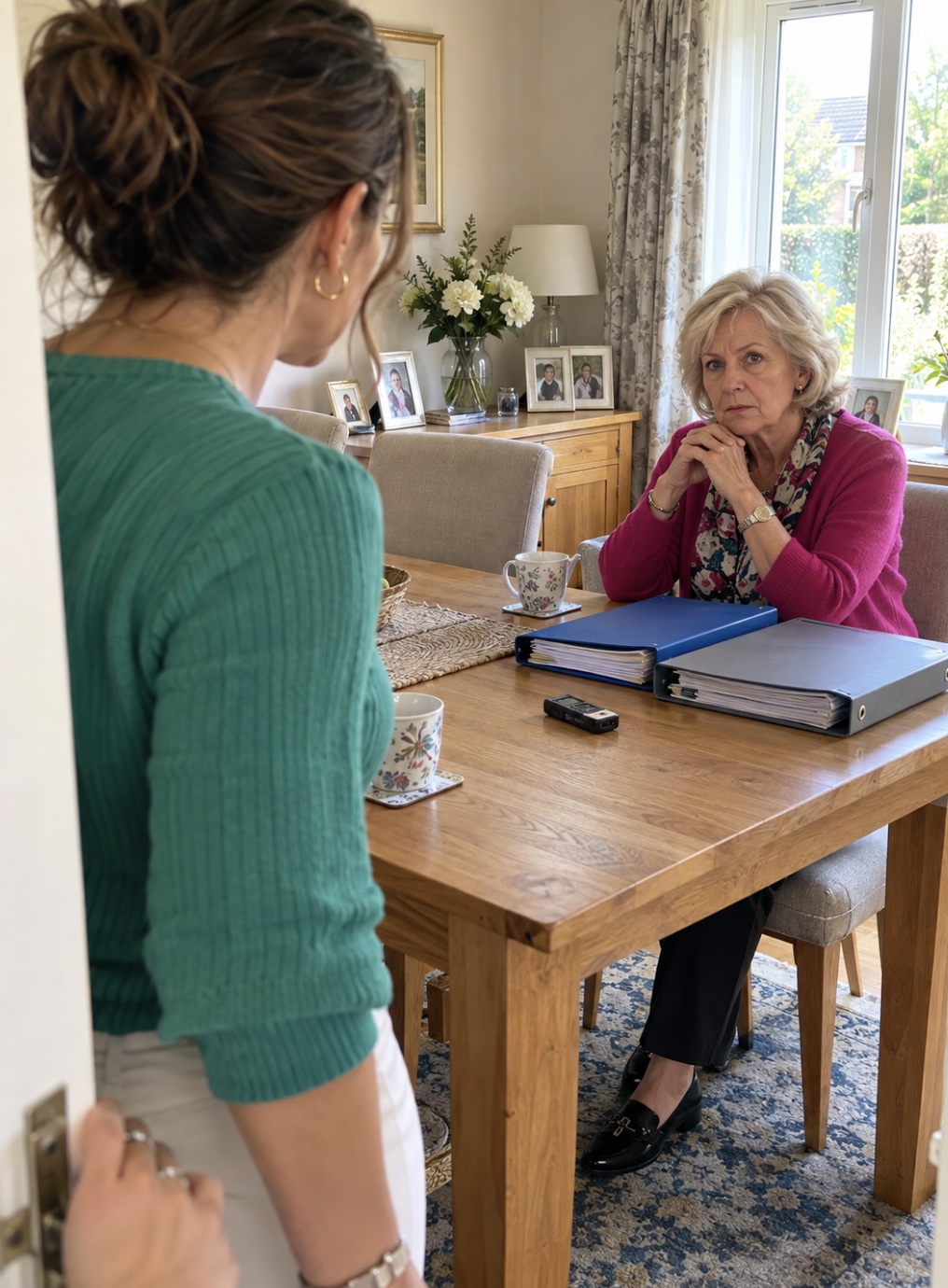
It was the first thing I saw when she led me into the dining room.
A small black digital recorder sat beside two thick folders on the oak table.
One folder was blue.
The other was grey.
Two mugs of coffee were waiting beside them.
Patricia closed the door behind me.
“Sit down, Claire.”
I stayed standing.
“What’s happened?”
“Nothing has happened this morning.”
“This morning?”
She looked at me for a second, then pulled out a chair.
“Please.”
I sat.
She didn’t.
She crossed to the sideboard, checked something through the front window and then returned.
That tiny movement frightened me more than anything else.
“Patricia, what is this?”
She sat opposite me.
“I want you to listen before you react.”
“To what?”
She touched the recorder but didn’t switch it on.
“First I need to ask you something. Has Ben ever told you that I gave him money when you bought your house?”
The question was so ordinary compared with the atmosphere in the room that I nearly laughed.
“No.”
Her face changed.
Not dramatically. Patricia rarely showed anything dramatically.
But her mouth went still.
“How much money?” I asked.
“Twenty-eight thousand pounds.”
I stared at her.
“That’s impossible.”
“No.”
“We had our deposit.”
“You had most of it.”
I knew exactly how we had bought that house.
We had scraped together savings for years. I had sold the little flat I owned before meeting Ben and put nearly all the equity into the deposit. Ben contributed savings from his old job in Sheffield. We bought our semi-detached house in Horsforth in 2018.
Every number was burned into my memory because for the first two years I had been terrified of the mortgage payment.
“There was no twenty-eight thousand pounds,” I said.
“There was.”
“Then where did it go?”
Patricia slid the blue folder toward me.
I didn’t open it.
She did.
Inside were bank statements.
At the top of one page, highlighted in yellow, was a transfer made seven weeks before we completed on the house.
£28,000.
From Patricia Walker.
To Benjamin Walker.
My mouth went dry.
“What was it for?”
“The house.”
“But it didn’t go into the deposit.”
“I know.”
I looked up.
Something cold passed through me.
“How do you know?”
“Because I asked your solicitor.”
“You did what?”
“Not recently. At the time.”
“You contacted our solicitor?”
“I didn’t ask for confidential information. I asked whether money I had transferred had been declared as a gifted deposit. They wouldn’t tell me anything specific, of course. So I asked Ben.”
“And?”
“He said you had decided to keep my money separate for renovations.”
I almost laughed again, but no sound came out.
We hadn’t renovated anything.
For the first year we lived with magnolia walls, a broken fence and a kitchen whose cupboard doors had been painted by the previous owner.
“We paid for everything ourselves.”
“I know that now.”
“How?”
Patricia looked at the grey folder.
That was when I noticed her fingers were trembling.
Patricia’s hands never trembled.
“Because three weeks ago,” she said, “Ben asked me for another thirty thousand.”
I felt as if someone had quietly removed the floor beneath my chair.
“For what?”
“He said you were in trouble.”
“What kind of trouble?”
“Tax debt.”
I stared at her.
“I don’t have a tax debt.”
“I know.”
“How could you possibly know?”
“Because he told me something different two days later.”
My pulse had started pounding in my ears.
“What did he tell you?”
“That you had secretly borrowed money against the house.”
“That’s ridiculous.”
“I know.”
I pushed my chair back.
“Then why am I here? Why haven’t you called him?”
Patricia reached across the table and put one finger on the recorder.
“Because yesterday he came here.”
I stopped moving.
“He didn’t know I had started checking things.”
“What things?”
“His stories.”
She pressed the button.
A small red light appeared.
For several seconds there was only the sound of furniture moving.
Then I heard Ben’s voice.
Calm. Familiar. Irritated.
“Mum, this isn’t complicated. Claire doesn’t know I’m asking you.”
I went completely still.
Patricia’s recorded voice answered.
“Why not?”
“Because she’d be embarrassed.”
“About what?”
There was a pause.
Then Ben said:
“About what she’s done.”
Patricia stopped the recording.
I stared at her.
“What did he say I’d done?”
She didn’t answer immediately.
That hesitation told me the answer was worse than I expected.
📌 What Patricia played next changed the meaning of ten years of marriage — the continuation is in the first comment.
“He said you’d been taking money from the children’s savings accounts.”
For a few seconds I couldn’t understand the sentence.
Then I did.
I stood so quickly my coffee spilled.
“He said what?”
Patricia reached for a cloth, but I pushed it away.
“No. Leave it. Tell me exactly what he said.”
“He said you’d taken almost nineteen thousand pounds over the last two years.”
Our children, Sophie and Jack, had savings accounts started by both sets of grandparents. Birthday money, small monthly transfers, Christmas cheques from relatives.
I handled the accounts.
Ben knew that.
“They have more money now than they did two years ago.”
“I know.”
“You checked?”
“Yes.”
My anger turned sharply toward her.
“How?”
“I asked Ben to show me evidence.”
“And?”
“He sent me screenshots.”
My stomach tightened.
“Screenshots of what?”
She opened the grey folder.
There were printed pages inside.
The first showed an account with Sophie’s name at the top and withdrawals highlighted in red.
£2,000.
£3,500.
£1,200.
Another page showed Jack’s account.
I stared at them for nearly a minute before realizing what was wrong.
“That isn’t their bank.”
Patricia nodded.
“Our children’s accounts are with Nationwide. These look like Halifax.”
“I discovered that yesterday morning.”
My skin prickled.
“So he made them?”
“I don’t know who made them.”
“Patricia.”
“I’m telling you what I know.”
She took a breath.
“I asked Ben to come here yesterday because I said I was prepared to lend him the money, but only if he explained everything while I recorded it.”
“And he agreed?”
“He didn’t know I was recording at first.”
My eyes snapped to hers.
“You recorded him secretly?”
“In my own house, yes.”
There was no apology in her voice.
I should have objected.
Instead I said, “Play it.”
She did.
Ben’s voice filled the room again.
At first he sounded impatient.
Then persuasive.
He told his mother that I had become “unpredictable with money” since my father died three years earlier.
That was almost clever.
My father’s death had broken me for a while. Ben had seen me cry in supermarkets because I noticed the biscuits Dad used to buy. He had taken over school runs, cooked dinners, sat beside me through probate meetings.
Now, on the recording, he was using that grief as evidence that I had secretly stolen from our own children.
Then Patricia asked:
“If Claire took nineteen thousand, why do you need thirty?”
Another silence.
“Because there are other things.”
“What things?”
“Credit cards.”
“How much?”
“About eleven.”
“Whose name?”
A longer pause.
“Ours.”
“What do you mean, ours?”
“Mine mostly.”
Patricia paused the recording again.
I looked at her.
“He admitted it?”
“Eventually.”
I sat back down.
The room felt too warm.
“What kind of debt?”
“I asked that too.”
She turned several pages in the grey folder and slid a sheet toward me.
It was a credit report.
Ben’s.
Six credit cards.
Two personal loans.
One finance agreement.
The total outstanding balance made me grip the edge of the table.
£47,380.
I whispered, “No.”
Patricia said nothing.
“That can’t be right.”
“I thought the same.”
“Ben earns nearly sixty thousand a year.”
“I know.”
“We don’t live like this.”
“I know.”
“He doesn’t gamble.”
Patricia’s eyes shifted.
It was only for a fraction of a second.
But I saw it.
“What?”
“Claire—”
“What?”
She folded her hands.
“I don’t think this started as gambling.”
That sentence made no sense.
“What does that mean?”
Patricia pushed the recorder toward me again.
This time she didn’t press play.
“You should do it.”
I looked at the little triangle button.
Then I pressed it.
At first there was only Ben breathing.
Then Patricia said, “Where did the twenty-eight thousand go?”
His answer came so quietly I had to lean closer.
“Paul.”
I frowned.
I knew only one Paul close enough to our family for Ben to use his first name without explanation.
His older cousin.
Paul Walker.
Forty-two.
Divorced.
Two children.
For years Ben and Paul had been almost brothers.
Then, around 2019, they suddenly stopped spending time together.
Ben told me they had “grown apart.”
On the recording Patricia said, “You gave Paul twenty-eight thousand pounds?”
“I lent it.”
“For what?”
“He was in trouble.”
“What kind of trouble?”
“Business debt.”
“When?”
“2018.”
My stomach twisted.
The same year we bought our house.
Patricia asked, “Did Claire know?”
“No.”
“And has Paul paid you back?”
Silence.
Then:
“Some.”
“How much?”
Another pause.
“About nine.”
“Where is it?”
Ben said nothing.
Patricia’s recorded voice grew sharper.
“Where is the nine thousand pounds?”
Ben answered:
“I used it.”
“For what?”
And then he said the words that finally made Patricia look away from me across the table.
“To keep paying him.”
I stopped the recorder.
“What does that mean?”
She said, “Keep listening.”
I didn’t want to.
I pressed play anyway.
Slowly, messily, Ben explained.
Paul’s “business debt” had not been business debt.
He had been betting heavily.
Football. Online casinos. Horse racing. Anything.
When Paul’s wife discovered it, she threatened to leave with the children.
Paul begged Ben for help.
Ben used Patricia’s £28,000.
He told himself it was temporary.
Paul promised repayment within six months.
Instead, Paul asked for more.
When Ben refused, Paul threatened to tell me about the original loan.
And Ben panicked.
That was the part I couldn’t understand.
Not yet.
Why would the truth about lending his cousin money frighten him enough to keep paying for eight years?
Then the recording answered it.
Patricia asked him exactly that.
And Ben said:
“Because the money wasn’t Mum’s biggest problem.”
“What does that mean?”
A long silence.
Then Ben said:
“I signed Claire’s name.”
Every muscle in my body locked.
Patricia stopped the recording herself.
“The twenty-eight thousand wasn’t technically a gift,” she said.
I looked at her.
“It was a loan agreement.”
I could barely hear my own voice.
“I never signed any loan agreement.”
“I know.”
She opened the blue folder again.
Under the statements was a document.
Two pages.
The heading read:
Family Loan Agreement.
Lender: Patricia Walker.
Borrowers: Benjamin Walker and Claire Walker.
At the bottom was my name.
And beside it, a signature.
It looked enough like mine that someone who had seen my writing only occasionally might believe it.
But it wasn’t mine.
I touched the page.
“He forged this?”
“Yes.”
“And you believed it for eight years?”
Patricia’s face tightened.
“I watched him bring the paper into this room. He told me you’d signed it at home because you were putting Sophie to bed.”
I felt sick.
Sophie had been three then.
I could picture myself in our old rented house, probably folding tiny pyjamas or packing boxes for the move, while Ben sat somewhere copying my signature.
“Why would he do that?”
Patricia’s eyes filled for the first time.
“Because I wouldn’t lend the money to him alone.”
I stared at her.
She looked down.
“I trusted you more.”
That sentence broke something inside me.
For ten years I had assumed Patricia barely liked me.
But when her son had asked for £28,000, she had agreed only because she thought I was equally responsible for paying it back.
“You thought I owed you money all these years?”
“Yes.”
“And you never mentioned it?”
“Because he was making the repayments.”
I froze.
“What repayments?”
“Four hundred pounds a month. Usually.”
My mind started calculating automatically.
“From where?”
“I thought from your joint finances.”
“They’re not.”
That was when Patricia looked genuinely afraid.
Our salaries went into separate current accounts and we transferred agreed amounts into a joint household account.
There was no missing £400 each month from that account.
I took out my phone.
I opened Ben’s and my shared spreadsheet.
Mortgage.
Council tax.
Gas.
Electricity.
Insurance.
Food.
Children.
Everything looked normal.
Patricia said quietly, “Claire, don’t call him yet.”
I barely heard her.
“Where is he finding four hundred pounds a month?”
“I think that is why he has the credit cards.”
I looked at the debt report again.
Suddenly the structure became visible.
Ben had borrowed from one place to repay another.
He had used Patricia’s loan to rescue Paul.
Then he had borrowed privately and on credit cards when Paul demanded more.
He had repaid Patricia with borrowed money.
When Paul occasionally repaid him, Ben used it to cover other debts.
It had become a machine that needed constant feeding.
And now the machine was collapsing.
“But why blame me?” I asked.
Patricia looked exhausted.
“Because he needed thirty thousand pounds quickly, and he knew I wouldn’t lend him anything else after I discovered what happened with Paul.”
“So he told you I stole from my children.”
“Yes.”
Something about that hurt more than the forged signature.
Debt was fear.
Forgery was cowardice.
But inventing a story about me stealing from Sophie and Jack required imagination.
He had sat somewhere and decided exactly what kind of woman I needed to become in his mother’s eyes.
“I’m leaving him,” I said.
Patricia closed her eyes for a moment.
“I thought you might.”
I stood.
Then she surprised me.
She reached across the table and caught my wrist.
“Not yet.”
I pulled away.
“Don’t tell me to protect him.”
“I’m not.”
“Then what?”
She turned the recorder over.
“There’s another twelve minutes.”
I stared at it.
“I’ve heard enough.”
“No,” she said. “You haven’t.”
I almost walked out.
Instead, I pressed play one last time.
Near the end of the recording, Patricia asked Ben a question I hadn’t considered.
“What happens if Claire finds out?”
Ben answered immediately.
“She won’t.”
“And if she does?”
Silence.
Then a chair scraped.
His voice came back quieter.
“If she leaves, I sell the house.”
My heart stopped.
Patricia said, “You can’t sell a jointly owned house without her.”
“I know.”
“So what are you saying?”
Another pause.
Then Ben said:
“I’ve already spoken to someone about remortgaging my share.”
I stopped the recorder.
“That’s not possible.”
“Not the way he thinks.”
Patricia pulled one final document from the grey folder.
A printed email chain.
Ben had contacted a specialist finance broker.
He had described our house as having approximately £210,000 equity.
He had said we were separating.
We weren’t.
He had said I intended to buy him out.
I didn’t.
And he had asked whether short-term finance could be raised against his beneficial interest while “the divorce was being finalized.”
There was no divorce.
Not yet.
I sat there for a long time.
Then I started laughing.
Not because anything was funny.
Because ten years of ordinary mornings suddenly looked completely different.
Ben kissing me goodbye.
Ben reminding Jack about football boots.
Ben texting me to ask whether we needed milk.
Ben standing beside me at my father’s funeral.
And somewhere underneath all of it, hidden in credit agreements and lies, was another life I had never seen.
Patricia switched off the recorder.
“I’m sorry.”
I looked at her.
“For what?”
“For believing him long enough to check whether you might actually have taken the children’s money.”
That honesty hurt, but strangely, I respected it.
“At least you checked.”
“I should have asked you directly.”
“Yes.”
She nodded.
“Yes.”
We sat without speaking.
Then I asked, “Why invite me here instead of confronting him together?”
Patricia looked toward the two folders.
“Because if I called both of you, he would control the conversation.”
She pushed them across the table.
“These are copies. The originals are in my solicitor’s office.”
I stared at her.
“You already have a solicitor involved?”
“The forged agreement has my name on it too.”
For the first time that morning, I understood that Patricia had not invited me there merely as a mother-in-law.
She had invited me as the other person her son had deceived.
Two days later, Ben came home at six twenty and found me sitting at our kitchen table.
There were no suitcases by the door.
No screaming.
No dramatic scene.
Just me.
And one photocopy.
The family loan agreement.
He looked at it and went pale.
“Where did you get that?”
That was the first thing he asked.
Not what is this.
Not let me explain.
Where did you get that?
I knew then there was nothing left to investigate emotionally.
Only practically.
“I had coffee with your mother.”
He sat down without being asked.
For nearly an hour, he talked.
Some things matched Patricia’s recording.
Some didn’t.
Paul had not threatened him as much as Ben had implied.
Ben had continued helping partly because he was ashamed to admit the original mistake.
Then later, when the debts grew, he started gambling himself.
Not much at first.
He thought he could win enough to clear one card.
Then another.
Then the loan.
He never did.
He cried when he told me.
I cried too.
But I didn’t comfort him.
That surprised both of us.
For ten years, whenever Ben fell apart, my first instinct had been to move closer.
That evening, I stayed on my side of the table.
We did separate.
Slowly.
Carefully.
With solicitors, bank statements, credit checks and a level of administrative detail that made the emotional catastrophe feel strangely domestic.
Ben moved into a small rented flat near Kirkstall.
The house was eventually sold.
After the mortgage and legal costs, I used my share of the equity to buy a smaller place close to the children’s school.
Patricia did something I never expected.
She wrote off my supposed half of the old £28,000 loan completely and pursued Ben alone for the remaining balance.
“I never lent that money to you,” she told me. “I lent it to a version of you that he invented.”
The strangest part came six months after that first coffee.
Patricia invited me again.
Same bungalow.
Same dining table.
This time there were no folders.
No recorder.
Just coffee and a plate of supermarket shortbread.
I almost smiled when I saw the empty table.
She noticed.
“No paperwork today,” she said.
“Are you sure?”
“Almost.”
She reached into her cardigan pocket.
I groaned.
She laughed.
It was the first time I had ever heard Patricia laugh with me instead of politely around me.
She handed me a small envelope.
Inside was a photograph of Sophie and Jack taken in her garden the previous summer.
On the back, Patricia had written:
Some families survive by pretending nothing happened. I hope ours survives because we stopped pretending.
I read it twice.
Then I looked at her.
“For ten years,” I said, “I thought you didn’t like me.”
Patricia raised one eyebrow.
“For ten years, Claire, I thought you didn’t like me.”
And absurdly, after everything her son had done, that was the moment I finally cried.