



My mother-in-law said those words while holding one of Javier’s shirts between two fingers as though it were a piece of evidence.
“A normal wife irons her husband’s shirts herself!” For a few seconds, I didn’t answer. It was Sunday morning. Javier and I had invited his sister, Lucía, and her husband over for lunch. My mother-in-law, Carmen, had arrived an hour earlier than expected, as she often did.
I was in the kitchen preparing lunch when I heard her open the door to our bedroom.
A few minutes later, she came back into the living room carrying one of Javier’s blue shirts.
It was slightly wrinkled.
Nothing dramatic.
Javier planned to wear it to the office the next day and had simply left it on a chair so he could iron it later.
Himself.
But to Carmen, that wrinkled shirt apparently represented definitive proof that I had failed as a wife.
“Look at this, Javier!” she exclaimed when her son walked into the living room. “Are you really going to work in a shirt like this?” Javier looked at the shirt.
Then at his mother. “No. I’ll iron it tonight.”
Carmen gave an incredulous laugh. “You?”
“Yes. Me.”
She immediately turned toward me.
“And what will Elena be doing while you’re ironing?”
I slowly put down the knife I had been using to chop vegetables.
“Elena is making lunch for everyone.”
“I’m not talking about today. I mean in general.”
At that moment, I knew exactly where this conversation was going.
Javier and I had been married for twelve years.
And throughout those twelve years, Carmen had always had very specific ideas about what a wife was supposed to do.
A wife should cook.
Clean.
Do the laundry.
Iron.
Lay out her husband’s clothes.
Remember his appointments.
And preferably know what he needed before he even had to ask.
The only problem was that Javier and I had never run our marriage that way.
We both worked full-time.
We paid the bills together.
We did the shopping together.
And we divided the housework without keeping score.
Whoever had time took care of whatever needed to be done.
It worked perfectly well for us.
Apparently, it didn’t work for Carmen.
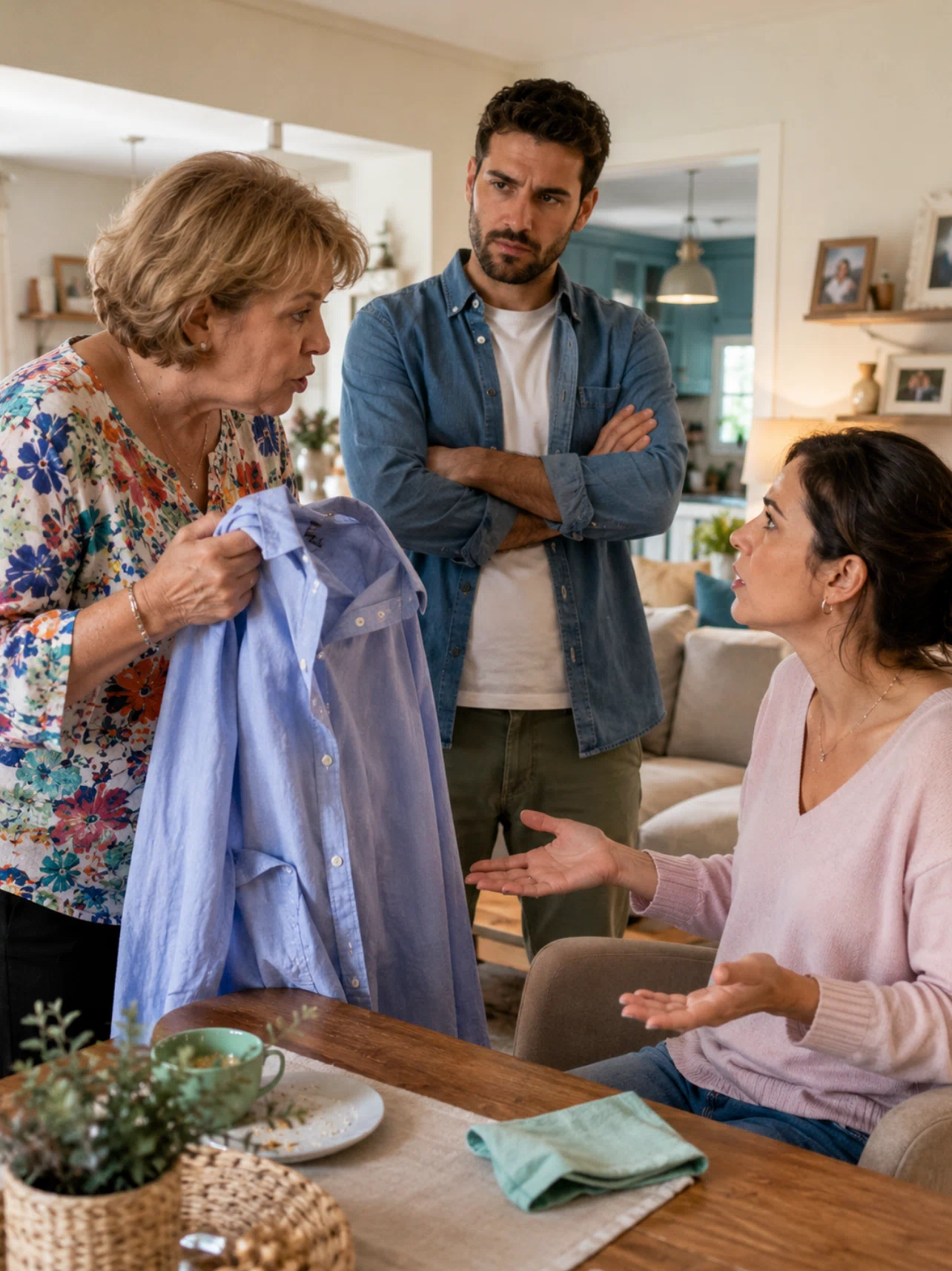
“I really don’t understand women these days,” she continued. “You all want to be independent, but you completely forget about your husbands.”
I turned toward her.
“Javier doesn’t look particularly neglected.”
He was sitting on the sofa with his coffee.
He raised his cup slightly.
“I can confirm that. I’m doing fine.”
I had to stop myself from laughing.
Carmen didn’t find it funny at all.
“This isn’t a joke. I always prepared Javier’s father’s clothes. Every morning, his shirt was clean and ironed.”
“Mom…”
“What? It’s true!”
Just then, the doorbell rang.
Lucía and her husband had arrived.
Naively, I hoped that would put an end to the discussion.
I was wrong.
Lucía had barely put down her bag when Carmen was already holding up the famous shirt for her to inspect.
“Look at this.”
Lucía looked at it.
“What about it?”
“It’s wrinkled!”
Lucía shrugged.
“Then Javier can iron it.”
Carmen’s expression changed instantly.
“Have you all lost your minds?”
Lucía’s husband lowered his head to hide his grin.
I went back into the kitchen.
I wanted to finish preparing lunch and avoid a pointless argument.
But Carmen followed me.
“Elena, I’m talking to you.”
“I’m listening.”
“Doesn’t it bother you at all that your husband has to iron his own shirts?”
“No. Not at all.”
“Unbelievable.”
I took the baking dish out of the oven.
“Why?”
“Because he’s your husband!”
I placed the dish on the counter.
“Exactly. My husband. Not my eight-year-old son.”
The kitchen suddenly went silent.
Lucía had followed her mother and was now standing in the doorway.
Carmen folded her arms.
“That’s exactly what I mean. You don’t feel any need to take care of him.”
Now Javier came into the kitchen too.
“Mom, stop.”
“Why should I stop? I’m only saying what everyone is thinking.”
Lucía raised an eyebrow.
“Please don’t speak for me.”
Carmen ignored her.
She kept looking at her son.
“You work all week. You come home tired. And then you still have to iron your own shirts?”
Javier was silent for a moment.
Then he asked:
“What about Elena?”
“What about her?”
“She works all week too.”
Carmen pressed her lips together.
“That’s different.”
That made me look up.
“Why?”
She hesitated.
Only for a second.
“Because a woman simply knows better how to take care of a household.”
I couldn’t help smiling.
“Funny. My paycheck has never asked whether I’m a woman before paying half the mortgage.”
Lucía burst out laughing.
Even Javier grinned.
Carmen’s face turned red.
“It’s always about money with you people! Nowadays, you turn everything into some kind of calculation.”
“No,” I replied. “You’re the one turning a wrinkled shirt into a marital crisis.”
She opened her mouth, but Javier spoke first.
“Elena’s right.”
Carmen spun toward him.
“Of course you’re defending her.”
“I’m not defending her. I’m explaining how we live.”
He took the shirt from his mother’s hand.
“I iron my shirts. Elena irons hers. Sometimes she irons mine if she already has the iron out. Sometimes I iron her clothes. Nobody keeps score.”
“Your father would never have…”
“I’m not Dad.”
He said it calmly.
But Carmen immediately fell silent.
Javier draped the shirt over the back of a chair.
“And Elena isn’t you.”
For several seconds, nobody said anything.
Then Carmen let out a heavy sigh.
“Fine. Do whatever you want. But don’t come complaining to me in ten years when you realize your marriage doesn’t work anymore.”
Something tightened inside me.
For years, I had simply tolerated comments like that.
For the sake of keeping the peace.
Because Javier often said:
“You know what my mother is like.”
Yes.
I knew exactly what she was like.
And that was precisely why I was tired of pretending I couldn’t hear her comments.
I dried my hands on a kitchen towel and turned toward her.
“Carmen, I’d like to ask you something.”
She looked at me.
“What?”
“What exactly does a normal husband do for his wife, in your opinion?”
She frowned.
“What do you mean?”
“You just gave us a detailed explanation of what a normal wife is supposed to do. She cooks, cleans, does the laundry, irons, prepares her husband’s clothes… Fine. So what does he do?”
Carmen was silent.
“He works.”
“So do I.”
“He provides for his family.”
“So do I.”
“That’s not the same.”
I slowly shook my head.
“That’s exactly the problem.”
Carmen took a deep breath.
“You always have to have the last word.”
“No. I just want you to stop judging the quality of our marriage by how many shirts I iron for Javier.”
Javier stepped up beside me.
This time, he wasn’t joking anymore.
“Mom, Elena and I are happy with the way we live.”
“Until the day you’ve had enough.”
“Enough of what? Knowing how to use an iron?”
Lucía burst out laughing again.
Carmen shot her an angry look.
“This isn’t funny!”
“It’s a little funny,” Lucía replied.
Carmen turned back to me.
“I simply believe that a normal wife irons her husband’s shirts herself.”
This time, I didn’t even have to think about my answer.
“And I believe that a normal grown man is perfectly capable of ironing his own shirts.”
Silence fell instantly.
Carmen stared at me.
Javier looked at his shirt and then at me.
And completely unexpectedly, he smiled.
“Just for the record,” he said, “Mom taught me how to iron when I was seventeen.”
Lucía’s eyes widened.
“Seriously?”
Javier nodded.
I looked at Carmen.
She avoided my gaze.
“That was different.”
“Why?” I asked.
This time, nobody could hold back their laughter.
Even Carmen realized that her own logic had backed her into a corner.
Annoyed, she placed her bag on a chair.
“Fine. Do whatever you want.”
“That’s exactly what we were planning to do,” Javier replied.
Eventually, we all sat down to eat.
The atmosphere was still a little tense for the first few minutes, but soon the conversation moved on to other things.
Still, something had changed.
After lunch, I was clearing away the plates when Javier came into the kitchen.
He put a cup in the dishwasher.
“You know what?”
“What?”
“I’m going to iron that shirt right now.”
I laughed.
“Why now?”
He glanced toward the living room, where his mother was talking to Lucía.
“Because I don’t think I’ve ever wanted to iron a shirt this badly in my entire life.”
Twenty minutes later, Carmen walked past the laundry room.
Javier was standing at the ironing board with the iron in his hand.
He looked at his mother.
“See, Mom? You really did raise me well.”
Carmen stopped for a few seconds.
Then she shook her head and walked away.
I stood in the kitchen smiling.
Because that day, for the first time in a long while, nobody had tried to convince Carmen of anything.
Nobody had asked for her permission.
We had simply shown her something very simple:
In our home, taking care of each other didn’t mean serving each other.
And a wrinkled shirt had never destroyed a marriage.
Trying to dictate how two grown adults should live their life together, however, could very well tear a family apart.