



The fork touched the edge of the plate with such a quiet click that, for a second, nobody at the table moved.
We were having Sunday lunch at my in-laws’ place in a small village outside York, the sort of place where people still left muddy boots by the back door and knew exactly whose curtains had changed since Christmas.
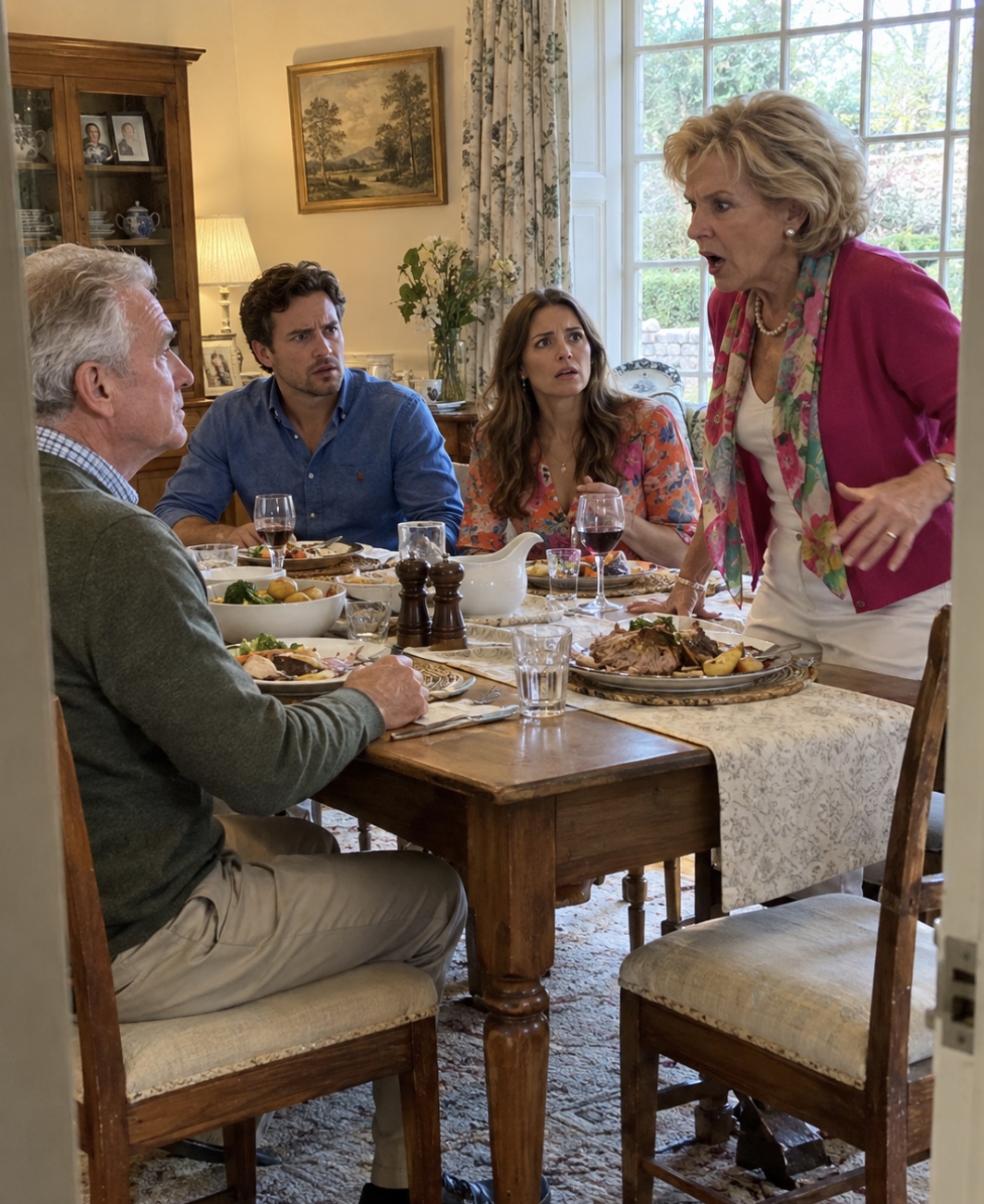
My mother-in-law, Margaret, had spent the entire meal talking about “the family house.”
She always called it that.
Never “our house.” Never “the cottage.” Always “the family house,” as though it were a stately home with portraits of ancestors in the hall rather than a four-bedroom stone house with a leaking gutter and a conservatory added in 1998.
My husband, Daniel, was cutting roast beef for our seven-year-old daughter, Millie, when Margaret said it.
“After I die, Daniel gets the house. Only Daniel.”
I looked up.
Daniel stopped cutting.
His sister, Rachel, who was sitting opposite me, gave a short laugh because she clearly thought it was another one of Margaret’s dramatic declarations.
But Margaret wasn’t smiling.
She lifted her wine glass and added, “It’s important to keep property in the proper bloodline.”
That phrase landed exactly where she intended it to.
I had been married to Daniel for eleven years.
Apparently, that still left me outside the “proper bloodline.”
Rachel frowned.
“What about me?”
Margaret barely glanced at her daughter.
“You’ve got your own life in Leeds.”
“And Daniel hasn’t?”
“That’s different.”
Nobody needed to ask why.
Daniel had a wife and daughter Margaret had never fully accepted as part of the family.
Rachel leaned back in her chair.
“So your grand plan is to leave the whole house to your son because I live forty minutes away?”
Margaret’s mouth tightened.
“I’m entitled to decide what happens to my property.”
That was when my father-in-law, Peter, calmly put down his fork.
“Which property?”
Margaret turned.
Peter wiped the corner of his mouth with his napkin.
“The house,” she said.
“Yes, I heard you. Which house?”
“This house, obviously.”
Peter looked at her for several seconds.
Then he said, in the same tone he might have used to comment on the weather:
“The one that never belonged to you?”
I had known Peter for thirteen years.
He was not a confrontational man.
He was the sort of person who apologised to furniture after bumping into it.
Daniel once told me that, in thirty-five years of marriage, he had never heard his father raise his voice at Margaret.
He didn’t raise it that day either.
Which somehow made the silence worse.
Margaret stared at him.
Rachel lowered her glass.
Daniel said, “Dad?”
Peter picked up a roast potato, placed it on his plate and cut it in half.
“Eat your lunch.”
Margaret’s chair scraped against the floor.
“What exactly are you trying to do?”
Peter sighed.
“Nothing.”
“You’ve just humiliated me in front of everyone.”
“No. You made an announcement about giving away something that isn’t yours.”
Her face went bright red.
I looked at Daniel.
He looked genuinely confused.
We all knew Peter and Margaret had lived in that house since Daniel was a toddler. Every family Christmas, birthday, barbecue and funeral tea had happened there.
I had always assumed they owned it together.
Apparently, so had Daniel.
Margaret stood.
“I’m not discussing private finances at the table.”
Peter nodded.
“Good idea.”
She left the room.
A door slammed upstairs.
For several seconds, nobody spoke.
Then Rachel whispered, “What the hell was that?”
Peter looked at her.
“Your mother being your mother.”
Daniel pushed his plate away.
“Dad. What did you mean?”
Peter stared at his hands.
“Not today.”
That answer created more questions than the original argument.
On the drive home, Daniel barely spoke.
Millie sat in the back listening to an audiobook through headphones while rain streaked across the motorway.
I waited until we were twenty minutes away from the village.
“What do you think he meant?”
“No idea.”
“You never asked who owned the house?”
“Why would I?”
“Because your mother has been talking about leaving it to you since before we got married.”
He turned toward me.
“She has?”
I almost laughed.
“Daniel, she told me at our wedding that one day I’d be ‘living under her roof even when she was gone.’”
His expression changed.
“She said that?”
“While I was holding a champagne glass.”
He looked back at the road.
“That sounds like Mum.”
I watched the fields blur past the window.
There was another reason the conversation unsettled me.
Three months earlier, Margaret had started behaving strangely about our finances.
She had asked whether we had life insurance.
Then whether our mortgage was fixed-rate.
Then whether Millie was named in our wills.
At the time, I thought she was being intrusive.
Now I wondered if there was something else behind it.
Two days later, Peter called Daniel.
Not Margaret.
Peter.
He asked him to come over alone on Wednesday evening.
Daniel told me at breakfast.
“You should go,” I said.
“You’re not curious?”
“Of course I’m curious.”
He gave me a tired smile.
“You’re terrible at pretending not to be.”
“I’m excellent at it.”
“You checked the Land Registry website last night.”
I froze.
Daniel laughed for the first time since Sunday.
I had checked.
And I had found something strange.
The house was not registered in either Margaret’s or Peter’s name.
The registered owner was listed as Harcourt Property Trust.
I had never heard of it.
Neither had Daniel.
📚 What Peter revealed next changed the meaning of every family argument we’d had — the rest continues in the first comment. 👇
On Wednesday night, Daniel returned home just after ten.
I was in the kitchen loading the dishwasher.
He came in, took off his coat and sat down without saying anything.
That frightened me more than if he had come home angry.
“What happened?”
He rubbed both hands over his face.
“My grandparents bought the house.”
“Your mum’s parents?”
“No. Dad’s.”
That made sense.
Peter had grown up locally.
Margaret had grown up in Sheffield.
Daniel continued.
“My grandfather bought it in 1979. Dad moved in with Mum after they got married.”
“So why the trust?”
“Because Grandad didn’t trust Mum.”
I stared at him.
Daniel gave a humourless laugh.
“Apparently she doesn’t know the full story.”
Peter’s father, George, had been a builder.
Not wealthy, exactly, but comfortable. He had owned two rental properties and a small construction firm.
When Peter married Margaret, George gave them the use of the house.
But not the ownership.
“He thought Mum was obsessed with status,” Daniel said. “Dad says she kept pressuring him to put the house in their names.”
“Did he?”
“No.”
George eventually created a trust.
The house would remain available for Peter to live in for the rest of his life.
After Peter’s death, it would not go to Margaret.
It would pass in equal shares to Daniel and Rachel.
I sat down opposite him.
“So your mother has spent thirty years believing she owns a house your grandfather deliberately prevented her from owning?”
“More or less.”
“Does she know you and Rachel inherit it?”
Daniel shook his head.
“She thinks Dad owns it outright and that she’ll inherit from him.”
That explained the confidence.
The speeches.
The “family property” remarks.
The comments about me benefiting from “her sacrifices.”
But one thing didn’t make sense.
“Why hasn’t Peter told her?”
“He tried once.”
“When?”
“Nineteen years ago.”
Apparently Margaret had reacted so badly that Peter backed down.
She had accused him of betraying her and claimed the arrangement proved his family had never accepted her.
After that, they simply stopped discussing it.
Peter paid the bills.
Margaret decorated, renovated and behaved like the owner.
Everyone let the fiction survive.
Until Sunday.
“What happens now?” I asked.
Daniel gave me a strange look.
“That’s the problem.”
Peter had not invited Daniel over merely to explain the trust.
He had shown him a letter.
Three weeks earlier, Margaret had contacted a local estate agent.
Without telling Peter.
She had requested a valuation of the house.
Her plan was to persuade Peter to sell and move to a smaller bungalow.
Nothing illegal in itself.
Except Margaret had already told the agent she was the owner.
She had even discussed an asking price.
£620,000.
“Why would she sell now?” I asked.
Daniel looked down at the table.
“Because she promised someone money.”
“Who?”
He didn’t answer immediately.
“My cousin Liam.”
I knew Liam.
He was Margaret’s sister’s son, thirty-one, charming when he wanted something and permanently involved in some “business opportunity.”
In five years he had tried property development, imported garden furniture, cryptocurrency coaching and luxury dog accessories.
“What did she promise him?”
“Two hundred thousand.”
I actually laughed.
Not because it was funny.
Because the number was absurd.
“For what?”
“He wants to open a restaurant in Manchester.”
“And Margaret thinks she can sell a house she doesn’t own and give him two hundred thousand pounds?”
“She thinks she’ll convince Dad.”
There was more.
Liam had already paid a non-refundable deposit on a lease.
£18,000.
Based partly on Margaret’s promise that the investment money was coming.
Suddenly Sunday lunch looked completely different.
Her declaration that “only Daniel” would inherit the house had not been generosity.
It had been strategy.
She wanted Daniel to believe the house was his future inheritance so he would support a sale now.
If Peter downsized, Margaret intended to argue that part of the released money could help “the younger generation.”
Except the younger generation she meant was not Daniel.
It was Liam.
The following Sunday, we were summoned back.
Rachel came too.
Margaret had made tea but nobody drank it.
Peter placed a brown folder on the dining table.
Margaret looked exhausted but defiant.
“I think this whole thing has been blown wildly out of proportion.”
Rachel folded her arms.
“You tried to sell Dad’s house.”
“Our house.”
Peter opened the folder.
“No.”
Margaret’s jaw tightened.
“Oh, for God’s sake.”
He slid a copy of the trust deed across the table.
She didn’t touch it.
“I’ve lived here thirty-seven years.”
“Yes.”
“I raised children here.”
“Yes.”
“I paid for the kitchen.”
“With money from our joint account.”
“I chose every curtain, every carpet, every piece of furniture.”
Peter looked at her sadly.
“That doesn’t change the title deeds.”
Margaret turned to Daniel.
“And you’re comfortable with this?”
“With what?”
“With your wife sitting there enjoying my humiliation.”
I hadn’t said a word.
Daniel’s expression hardened.
“Leave Claire out of it.”
“Of course you’d say that.”
Peter interrupted.
“This isn’t about Claire.”
“It is always about Claire.”
That was when Rachel slammed her palm on the table.
“No, Mum. It’s always about you deciding who counts as family.”
Margaret stared at her daughter.
Rachel’s voice shook now.
“You were ready to tell everyone Daniel was getting the house and I was getting nothing. Then we discover you couldn’t leave him the house if you wanted to.”
“I was trying to protect family property.”
“From me?”
Margaret said nothing.
“From Claire?” Rachel continued. “From Millie? Who exactly are you protecting it from?”
Margaret’s face crumpled for half a second.
Then hardened again.
“You don’t understand.”
Peter closed his eyes.
“I think it’s time they did.”
Margaret turned sharply toward him.
“Peter.”
“No.”
It was the first firm “no” I had ever heard from him.
He walked to the sideboard and pulled out another envelope.
Inside were old bank statements and a handwritten letter.
George, Peter’s father, had not created the trust only because he disliked Margaret’s attitude toward money.
There had been a specific reason.
In 1988, six years after Peter and Margaret married, George had discovered that Margaret had borrowed heavily without telling Peter.
Credit cards.
A personal loan.
Money from friends.
Almost £24,000.
An enormous amount at the time.
She had used much of it helping her younger sister, Susan.
Liam’s mother.
Susan had been in a disastrous relationship and constantly short of money.
Margaret kept rescuing her.
Peter had known about some of it.
Not all.
George had paid off the debts on one condition: the house would be protected permanently through a trust.
Margaret’s eyes filled with tears.
“That was nearly forty years ago.”
Peter nodded.
“And now you’ve promised Susan’s son two hundred thousand pounds from the same house.”
Nobody spoke.
The pattern was too obvious to ignore.
Margaret looked toward the window.
“I was trying to help him.”
Peter’s voice softened.
“I know.”
“He has a real chance with this restaurant.”
“You said the same thing when Susan opened the beauty salon.”
Margaret flinched.
“You said the same thing when she bought the shop.”
“That was different.”
“And when Liam started the furniture company.”
“He was twenty-four.”
“And when he needed money after the crypto business.”
Daniel leaned forward.
“How much have you given him?”
Margaret said nothing.
Peter answered.
“About forty-six thousand over seven years.”
Daniel went pale.
“From where?”
“Our savings.”
That finally broke something in the room.
Not because of the money alone.
Because Peter sounded tired.
Not angry.
Tired.
He had spent decades protecting his wife from her own instinct to rescue relatives, while she had spent those same decades telling everyone he lacked ambition.
I remembered countless dinners where Margaret mocked Peter for being cautious.
“We’d still be using candles if Peter controlled everything.”
“Peter thinks spending money is a criminal offence.”
“Peter would rather die with money in the bank than enjoy life.”
Now those jokes looked cruel.
Margaret started crying.
Not dramatically.
Quietly.
“I didn’t know how to say no to them.”
Peter looked at her.
“You learned how to say no to your own daughter easily enough.”
Rachel stood up.
That sentence hit hardest.
She walked into the garden.
I followed a minute later.
Rain had started again, light and cold.
Rachel was standing beneath the conservatory awning.
“I don’t even want the bloody house,” she said.
“I know.”
“That’s not the point.”
“I know.”
“She looked me in the face and told me my brother mattered more because he was her son.”
“You’re her daughter.”
Rachel laughed bitterly.
“Exactly.”
Inside, voices remained low.
There was no screaming.
No dramatic ending.
Real families rarely explode neatly.
They fracture along lines that were already there.
Over the following weeks, several things changed.
Peter contacted the trustees and updated all correspondence so nothing concerning the property could be discussed without his solicitor present.
Liam did not get his £200,000.
His restaurant lease collapsed.
For a while he blamed Peter.
Then Margaret.
Then Daniel.
Eventually, apparently, he found another investor for a much smaller venture.
Margaret barely spoke to us for two months.
When she finally did, she asked Daniel to come for coffee.
He refused to go without Rachel.
That mattered.
For years Margaret had treated her children like separate pieces on a chessboard.
Daniel was the responsible son.
Rachel was the emotional daughter.
Liam was the boy who needed saving.
I was the outsider.
Peter was the obstacle.
Once everyone stopped accepting those roles, her influence shrank surprisingly quickly.
But there was one final surprise.
Almost a year later, Peter called a family meeting again.
Margaret sat beside him this time.
They looked nervous.
Peter explained that he had decided to move.
Not because Margaret wanted to release money.
Because the stairs were becoming difficult for him and the garden was too much work.
The trust permitted the property to be sold if Peter wished to relocate.
Everyone waited.
Margaret looked at Rachel.
Then at Daniel.
Then at me.
“I owe all of you an apology.”
Nobody rescued her from the silence.
She continued.
“I spent years talking about this house as if owning it made me important.”
Her hands twisted together.
“And when I discovered it was never mine, what hurt most wasn’t losing money. It was realising I had built half my identity around something I never possessed.”
Rachel’s eyes filled with tears, but she didn’t look away.
Margaret swallowed.
“I was wrong about the inheritance. And I was wrong about who counts as family.”
Then she turned to me.
Especially me.
“I’ve treated you like a guest for eleven years.”
I didn’t tell her it was fine.
Because it wasn’t.
Instead I said, “Yes.”
She nodded.
“I know.”
That was probably the first completely honest conversation we ever had.
The house sold the following spring.
The money stayed inside the trust.
Peter and Margaret moved into a two-bedroom bungalow twenty minutes away.
Smaller kitchen.
No grand dining room.
No staircase.
No symbolic “family house” for Margaret to control.
And strangely, she became easier to be around.
Not perfect.
People don’t transform because of one confrontation.
She still gave unsolicited advice.
Still criticised supermarket tomatoes.
Still thought every child needed a cardigan after five o’clock.
But she stopped talking about inheritance.
One evening, months after the move, we were sitting in her new garden while Millie chased bubbles across the grass.
Margaret watched her granddaughter and smiled.
“I spent thirty-seven years worrying about who would get that house when I died.”
I looked at her.
“And?”
She shrugged.
“Turns out none of us even live there anymore.”
Peter, sitting beside her with a cup of tea, smiled.
“That’s usually what happens to houses.”
Margaret rolled her eyes.
But this time, she laughed.
And for the first time since I had known her, there was no argument hiding underneath it.