



The first time my mother-in-law saw what my grandmother had left me, she laughed so loudly that the solicitor stopped sorting his papers.
“That’s it?” Margaret said, looking from me to the scratched walnut box sitting on the desk. “All those years, and she leaves you something from a charity shop?”
I didn’t answer.
My grandmother, Evelyn Hartley, had died three weeks earlier at eighty-seven in the small terraced house in York where she had lived since the late 1960s. She had never been rich, but she had been careful. She wore the same winter coat for fifteen years, reused wrapping paper, kept buttons sorted by colour in old biscuit tins and could tell you exactly how much a loaf of bread had cost in 1989.
Everyone assumed she had savings.
Margaret certainly did.
My husband, Daniel, had told her years ago that Grandma Evelyn owned her house outright, and from that moment on Margaret seemed to have developed a curious interest in my grandmother’s finances.
She would say things like, “Property prices in York have gone mad,” or, “A woman living alone doesn’t need much, does she?”
Grandma noticed.
Grandma noticed everything.
At the solicitor’s office, my cousin Peter received £8,000. A local animal rescue received £5,000. Grandma’s neighbour, Mrs Carter, received her antique sewing machine and a handwritten letter.
And I received the jewellery box.
No money.
No share of the house.
Nothing else.
Margaret leaned closer to me as we stepped outside into the drizzle.
“Well,” she said, pulling up the collar of her cream raincoat, “I suppose you can always put it on eBay.”
Daniel gave her a warning look.
“Mum.”
“What? I’m being practical.”
I carried the box against my chest all the way to the car.
It was heavier than it looked.
The wood was dark and badly scratched around the brass clasp. Inside, the red velvet lining had faded almost brown. There were two empty compartments, a narrow drawer and a tiny mirror clouded with age.
No jewellery.
No letter.
Nothing.
That evening Margaret came back to our house because Daniel had invited her for dinner.
I hadn’t wanted company, but he said his mother was “only trying to help.”
Margaret sat at our kitchen island drinking white wine while I turned the box over in my hands.
“You know,” she said, “some elderly people become very sentimental towards the end. They lose track of value.”
I looked at her.
“My grandmother knew exactly what she was doing.”
Margaret smiled.
“Of course.”
That smile irritated me more than the laughter had.
After dinner, Daniel washed up while Margaret wandered into the sitting room.
I followed ten minutes later and found her holding the box.
“Please put that down.”
She looked surprised.
“I was only looking.”
“It belongs to me.”
“I know that.”
She placed it on the coffee table.
Then she tapped the lid with one fingernail.
“Perhaps there’s a secret fortune inside.”
She laughed again.
I took the box upstairs.
At half past eleven, when Daniel was asleep, I sat on the bedroom floor with the box in my lap.
I don’t know why.
Maybe because Margaret’s joke had lodged in my head.
Maybe because I remembered something Grandma once told me when I was ten.
We had been doing a jigsaw puzzle at her kitchen table, and I had complained that two pieces looked exactly the same.
Grandma had said, “When something doesn’t fit, don’t force it. Look at what you’re not seeing.”
I ran my fingers over the velvet.
The lining inside the bottom compartment felt uneven.
I pressed one corner.
It lifted.
My heart started beating faster.
The velvet had been glued down, but the glue was old and brittle. I eased it back carefully.
Underneath was a thin piece of cardboard.
Beneath that lay a small brass key.
And a folded strip of paper.
On it, in Grandma’s handwriting, were five words.
Not the bank.
Ask for Arthur.
📜 What I found next changed everything — the rest is waiting in the first comment. 👇
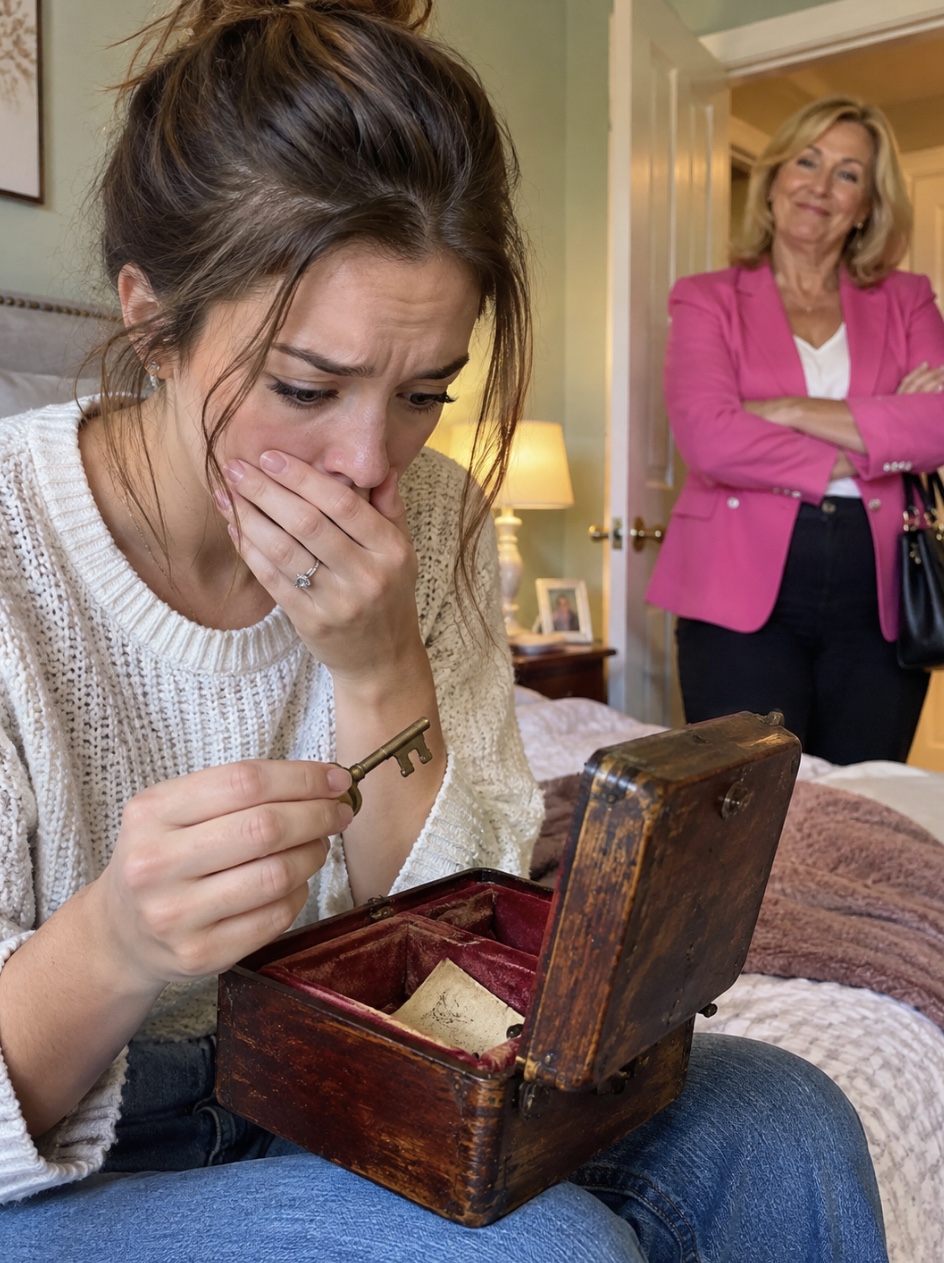
I stared at the message for almost a minute.
Arthur?
I knew no Arthur.
The following morning I called Peter.
“Did Grandma know anyone called Arthur?”
There was a pause.
“Arthur who?”
“I don’t know.”
“Maybe someone from church?”
Grandma hadn’t attended church for years.
I tried Mrs Carter.
She went quiet.
That was the first moment I realised she knew something.
“Mrs Carter?”
“I think,” she said carefully, “you should go to your grandmother’s house.”
“The solicitor has the keys.”
“Not the front door.”
I looked at the brass key in my hand.
“What does it open?”
“You need to see for yourself.”
“Mrs Carter—”
“Your grandmother made me promise.”
She hung up.
By lunchtime I was standing outside Grandma’s house on a narrow street not far from the city walls.
The property was due to be sold, and the solicitor had given me permission to collect several personal items before clearance.
Daniel came with me.
I hadn’t told Margaret.
Inside, the house smelled exactly as I remembered: furniture polish, old paper and the lavender sachets Grandma kept in drawers.
We searched for nearly an hour.
Cupboards.
Desks.
The shed.
Nothing fit the key.
Finally Daniel said, “Maybe it isn’t for something here.”
Then I remembered Grandma’s pantry.
At the back, behind shelves of jam jars and tins, was a narrow wooden panel.
As a child, I had assumed it covered pipes.
We moved the shelves.
There was a tiny brass keyhole halfway down.
My hands started shaking.
The key turned.
Behind the panel was a shallow cupboard built into the wall.
Inside sat a grey metal cash box.
And on top of it was an envelope.
My name was written across the front.
Daniel whispered, “Bloody hell.”
I opened the letter first.
My darling Claire,
If you are reading this, then you ignored anyone who told you the box was worthless. Good.
There are things people reveal about themselves when they believe there is nothing to gain.
I read that line twice.
Then I continued.
The metal box does not contain money. Before you become disappointed, understand that what is inside matters more than money.
There is a key taped beneath the lid. It belongs to locker 214 at York Central Storage. Ask for Arthur Bell.
My stomach dropped.
There was another key.
Daniel stared at me.
“This is insane.”
“No. This is Grandma.”
We opened the cash box.
Inside were old photographs, receipts, property documents and a thick notebook secured with an elastic band.
The first page was dated 1987.
Grandma had kept financial records for decades.
Not just hers.
My mother’s.
My uncle’s.
Mine.
Daniel turned pages slowly.
There were notes beside certain entries.
Claire — university rent, £1,800.
Claire — deposit help, £4,000. Refused repayment.
Peter — business loan, £6,500. Repaid.
Then we found Margaret’s name.
Daniel stopped breathing for a second.
Margaret Ellis — £12,000.
Loan requested through Daniel.
I stared at him.
“What is this?”
He looked genuinely confused.
“I don’t know.”
The entry was dated eight years earlier, two years before our wedding.
Beneath it Grandma had written:
Purpose claimed: urgent mortgage arrears.
Funds transferred.
Never acknowledged by M.E.
A later note had been added in darker ink.
Information received that no mortgage arrears existed.
I looked at Daniel.
“What did your mother borrow twelve thousand pounds for?”
“I swear to you, I didn’t know she borrowed anything.”
“But Grandma says it was through you.”
Daniel sat down hard on a dining chair.
Then his face changed.
“Wait.”
He rubbed both hands over his forehead.
“Years ago Mum told me she was in trouble financially. She asked if I knew anyone who might lend her money. I mentioned it to your grandmother because she was always saying people should ask for help before things got worse.”
“You arranged it?”
“I passed on Mum’s number. That’s all.”
“Did you ever ask what happened?”
“She told me she sorted it.”
We drove to York Central Storage that afternoon.
It wasn’t a bank or some dramatic underground vault. It was a perfectly ordinary self-storage facility on an industrial estate beside a tyre shop.
At reception, I asked for Arthur Bell.
The man behind the desk looked up.
“I’m Arthur.”
He was in his late sixties, with silver hair and heavy black glasses.
When I gave him Grandma’s name, his expression softened.
“Evelyn’s granddaughter.”
“You knew her?”
“For thirty years.”
He asked for identification, checked several documents and led us down a corridor.
Locker 214 was small.
Inside were four archive boxes.
That was all.
Arthur handed me an envelope.
“She left instructions that only you could collect these.”
“Do you know what’s inside?”
“No. Evelyn valued privacy.”
The boxes contained letters, bank statements, photographs, contracts and copies of emails.
The deeper I went, the less I understood why Grandma had hidden them.
Then I found a brown envelope marked MARGARET.
Inside was the answer.
Margaret had not borrowed £12,000 to save her home.
She had used the money as part of a deposit on a small flat in Scarborough.
A flat none of us knew existed.
There was a photocopy of the purchase agreement.
Margaret Ellis.
Sole owner.
Daniel looked stunned.
“She owns a flat?”
Apparently she had owned it for eight years.
But that wasn’t the worst part.
There were letters between Grandma and Margaret.
The first was polite.
Dear Mrs Ellis,
As the agreed repayment date passed four months ago, I would appreciate an update.
Margaret replied that she was “still recovering financially.”
A year later, Grandma wrote again.
Margaret claimed she had been caring for a sick relative and could not repay anything.
But Grandma had attached property records showing that the Scarborough flat had been rented to holidaymakers throughout that same period.
Then came one final letter.
This one was from Margaret.
Evelyn,
I suggest we stop pretending this was ever a formal loan. You chose to help because Claire and Daniel were going to marry eventually. Families help each other. I will not discuss this again.
Daniel whispered a swear word.
I felt strangely calm.
Grandma had written one sentence across the bottom.
Character is clearest when people believe kindness has no witnesses.
We didn’t confront Margaret immediately.
That was Daniel’s idea.
“I want to hear what she says without showing her anything.”
Two days later, he invited her for Sunday lunch.
She arrived carrying flowers and a lemon tart.
The jewellery box was sitting deliberately on the sideboard.
Margaret spotted it.
“You kept that thing?”
“Yes,” I said.
She smiled.
“Sentimental value?”
“Something like that.”
During lunch Daniel brought up finances casually.
“Mum, did Grandma Evelyn ever lend you money?”
Margaret froze for less than a second.
Then she laughed.
“Me? Good heavens, no.”
“Never?”
“Of course not.”
I watched her cut the tart.
Perfectly straight slices.
“What a strange question.”
Daniel looked at me.
I got up, went to the sideboard and returned with a photocopy of the transfer record.
Margaret’s face changed.
Not dramatically.
That made it worse.
Her eyes narrowed slightly.
She put down the knife.
“Where did you get that?”
“So you remember now?”
She stared at Daniel.
“This is private.”
“You said it never happened.”
“It was years ago.”
“What did you need twelve thousand pounds for?”
Margaret’s voice hardened.
“That is none of Claire’s business.”
“My grandmother gave you the money.”
“And she had plenty.”
The room went silent.
I had expected denial.
Excuses.
Maybe embarrassment.
I hadn’t expected that.
Margaret folded her arms.
“She owned a house worth hundreds of thousands. Twelve thousand meant nothing to her.”
“It meant enough for you to lie about why you needed it.”
She looked at me.
“You have no idea what was happening in my life.”
“The Scarborough flat?”
Her face drained.
Daniel pushed his chair back.
“You own a flat in Scarborough?”
She glared at me.
“What else did that woman keep?”
That woman.
Not Evelyn.
Not Grandma.
That woman.
And suddenly I understood why Grandma had left me a battered empty box.
She hadn’t been testing whether I was clever enough to find hidden keys.
She had been testing something else.
Who would mock what appeared worthless.
Who would search it without permission.
Who would lie when there seemed to be no evidence left.
Margaret stood up.
“I don’t have to justify my finances to either of you.”
Daniel’s voice was quiet.
“You borrowed money under false pretences.”
“I intended to repay it.”
“Eight years ago.”
“The property was an investment.”
“With someone else’s money.”
She looked at him sharply.
“I did it for the family.”
“How?”
She hesitated.
Then the real reason came out.
Margaret had bought the flat because she believed property was the only reliable pension.
Her divorce settlement had been smaller than she expected, and she had been terrified of getting older without security.
Instead of admitting that, she invented mortgage arrears because she assumed Grandma would refuse to fund an investment.
“She would have judged me,” Margaret said.
I almost laughed.
“Grandma did lend you the money.”
“Yes.”
“Which means she didn’t judge you for needing help. She judged you for lying.”
Margaret grabbed her handbag.
At the door she turned back.
“So what now? You’re going to sue me over money from a dead woman?”
“No,” I said.
That surprised her.
Daniel looked at me too.
I continued.
“You’re going to repay her estate.”
Margaret laughed nervously.
“After eight years?”
“There’s a signed loan agreement in the storage box.”
Her smile disappeared.
Grandma had kept the original.
Interest-free.
Repayable within three years.
Margaret had signed every page.
Six weeks later, the flat in Scarborough went on the market.
Margaret could have fought it. The solicitor told us recovery might become messy, expensive and unpleasant.
Instead, Daniel told her he wanted nothing to do with her until she dealt with it.
That mattered more than legal letters.
The flat sold that winter.
The £12,000 returned to Grandma’s estate.
But Grandma’s will contained one final instruction that nobody had noticed because it only became relevant if a specific debt was recovered.
Any recovered money from Margaret Ellis was not to be divided among relatives.
It was to go to the same animal rescue Grandma had already supported.
When I read that clause, I laughed for the first time in months.
Grandma hadn’t wanted revenge.
She hadn’t even wanted the money back for us.
She had simply refused to let a lie become the final version of the truth.
A week after everything was settled, I cleaned the old jewellery box.
Very carefully.
I repaired the loose hinge and replaced the crumbling velvet with dark green fabric, but I left every scratch in the wood.
Daniel asked why.
“Because the scratches are part of it.”
Today the box sits on the bookshelf in our sitting room.
It contains no secret keys anymore.
Just Grandma’s fountain pen, one photograph of us together and the first note she hid beneath the lining.
Not the bank.
Ask for Arthur.
Margaret has been to our house only twice since then.
She never mentions the box.
But both times, I noticed something.
She doesn’t laugh at it anymore.