



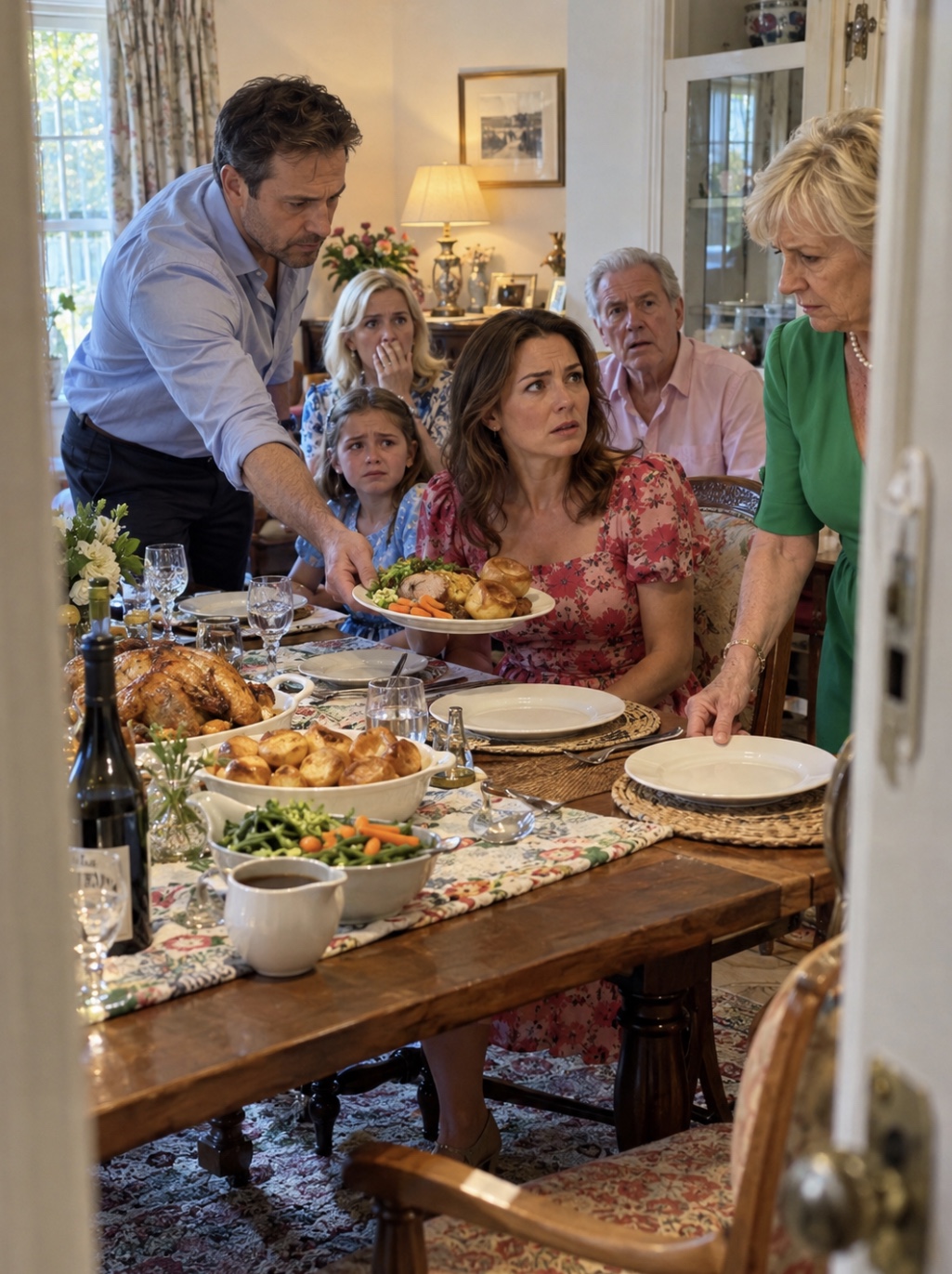
My mother-in-law served roast beef to eleven people that Sunday evening. Everyone received thick slices of meat, Yorkshire puddings, roast potatoes and gravy.
Everyone except me.
When she reached my place, she put down a completely empty white plate.
Then she straightened her cardigan, looked directly into my eyes and said, loud enough for the entire dining room to hear, “There’s nothing for you, Rachel. You’re no longer part of this family.”
Nobody laughed.
My eight-year-old daughter stopped chewing. My sister-in-law stared at her wineglass. Somewhere behind me, the dishwasher gave a little electronic beep.
And my husband, who had spent the previous three weeks barely speaking to me, quietly stood up.
Without a word, he lifted his full dinner plate, walked around the table and placed it in front of me.
Then he took my empty plate and sat down in my chair.
His mother went absolutely still.
“Daniel,” she whispered. “Don’t.”
He picked up his knife and fork.
“Go on, Mum,” he said calmly. “Tell everyone why.”
I had been married to Daniel Whitmore for twelve years, and until that evening, I would have sworn that nothing could make his mother lose control of her own dining room.
Margaret Whitmore was sixty-eight, a retired primary school headteacher who lived in a beautiful Victorian house on the outskirts of York. She ironed tea towels, kept handwritten birthday calendars and could make you feel like a disappointing pupil simply by looking over the top of her glasses.
When Daniel and I first met, she had been perfectly pleasant.
Not warm, exactly. But pleasant.
She remembered that I disliked mushrooms, bought my daughter little books from the independent bookshop on Stonegate and never arrived at our house without bringing something she’d baked.
The trouble began the previous November, after Daniel’s father, Peter, suffered a stroke.
Peter survived, but he needed rehabilitation and much more help at home. Margaret refused to consider carers initially. She insisted that she and her husband had always managed perfectly well.
Daniel’s younger sister, Claire, lived in Leeds and worked shifts as a radiographer. Daniel was a self-employed electrician, and his workdays often stretched into the evening.
I worked four days a week as an administrator at a dental practice.
So naturally, the responsibility began falling on me.
At first, it was small things.
Could I collect a prescription? Could I bring Peter home from a hospital appointment? Could I pick up groceries because Margaret’s car had a flat tyre?
Then it became regular visits, laundry, phone calls to the GP surgery and hours spent sorting out confusing letters from the council.
I didn’t mind helping Peter.
He was a gentle man who had once taught my daughter, Sophie, to identify garden birds. Even after the stroke affected his speech, he still managed to make her laugh by pretending the pigeons were important visitors who required formal introductions.
But Margaret gradually began treating my time as though it belonged to her.
One Thursday, she called while I was at work.
“Your father-in-law needs taking to his appointment tomorrow.”
“I can’t, Margaret. I’ve got patients booked in all morning.”
A pause.
“I suppose your employer is more important than your family.”
I tried to explain that I wasn’t a dentist and couldn’t simply cancel the whole practice’s appointments.
She hung up.
The next day, Claire took Peter instead.
Margaret barely spoke to me for a week.
Daniel noticed the tension, but whenever I mentioned it, he gave the same exhausted answer.
“Mum’s frightened. Dad’s not himself. She doesn’t mean half of what she says.”
I believed him longer than I should have.
Then, in February, Peter was admitted to hospital again with a chest infection.
That was when everything changed.
I visited him one afternoon after work. Margaret had gone home to collect some clothes, and Daniel was picking Sophie up from school.
Peter was sitting beside the window, watching a bus pull away from the hospital entrance.
He struggled to speak but managed to ask me for his spectacles.
When I handed them over, he pointed to his bedside drawer.
Inside was a small brown envelope.
My name was written across the front.
“Rachel,” he said slowly. “You… keep.”
I assumed it contained an old photograph or a letter he wanted me to deliver.
But when I opened it at home, I found a folded sheet of paper with several handwritten lines and a bank statement.
The statement showed an account I didn’t recognise.
The handwritten note contained four words that made my stomach tighten.
Ask Margaret about David.
I had no idea who David was.
When I asked Daniel, he frowned.
“David?”
“Yes. Your dad wrote it.”
Daniel stared at the paper for several seconds.
Then he said, “That was my brother.”
I looked at him.
“You have a brother?”
“Had.”
He sat down at the kitchen table.
“He died when he was little. Before I was born.”
That was the first time in twelve years of marriage I had heard that Daniel’s parents had another child.
I waited for him to say more, but he shook his head.
“Mum doesn’t talk about him.”
“Why would your dad ask me about him?”
“I don’t know.”
And when I suggested showing the note to Margaret, Daniel’s expression changed.
“Please don’t. Not yet.”
I should explain something about Daniel.
He wasn’t a weak man. He could be stubborn, especially when it came to work, and he had once argued for six months with a builder who refused to pay an outstanding invoice.
But around his mother, he seemed to become a different person.
He spoke more softly, avoided disagreements and often apologised even when he had done nothing wrong.
I used to think it was simply respect.
After Peter’s note, I began wondering whether it was something else.
Three days later, Margaret turned up at our house without warning.
Sophie was upstairs doing her homework, and Daniel was out pricing a rewiring job.
Margaret stood in the hallway holding her handbag tightly against her ribs.
“Peter says he gave you something.”
I felt a little chill.
“He gave me an envelope.”
“I’ll have it.”
“He asked me to keep it.”
“Peter is confused, Rachel.”
“He seemed quite clear.”
Her face tightened.
“Give it to me.”
I had never heard her speak to me like that before.
I said I wanted to talk to Daniel first.
She took one step closer.
“You’re interfering in matters that have nothing to do with you.”
“Your husband gave me the envelope himself.”
“And my husband isn’t well.”
Then she said something that stayed with me.
“You’ve always been very clever at making yourself indispensable. But don’t mistake being useful for belonging.”
I stood there, completely stunned.
She left without another word.
That evening, Daniel came home unusually quiet.
When I told him what had happened, he listened without interrupting.
Then he asked where I’d put the envelope.
“In my desk drawer.”
He nodded.
And for the first time in our marriage, I saw him look genuinely frightened of something inside his own family.
A week later, he began sleeping in the spare room.
He said he needed space because he was exhausted from everything happening with his father.
He started taking long evening walks and occasionally drove to his parents’ house without telling me until afterwards.
He barely touched the meals I cooked.
When I asked whether he wanted to talk about our marriage, he said, “I need you to trust me for a little longer.”
It was an awful thing to hear from someone who wasn’t telling you the truth.
Then Margaret invited us for Sunday dinner.
I didn’t want to go.
Daniel insisted.
“Please, Rachel. Just this once.”
“Your mother practically threw me out of her house last week.”
“I know.”
“Then why are we going?”
He looked at me for a long moment.
“Because everybody needs to be there.”
There was something in his voice that stopped me arguing.
I agreed, although I told him that if Margaret insulted me again, Sophie and I would leave.
He nodded.
“That’s fair.”
At six o’clock on Sunday, we arrived at the Victorian house on Fulford Road.
Claire was there with her husband, Mark, and their teenage son. Margaret’s sister, Aunt Joan, had come from Harrogate. Two family friends were sitting in the conservatory with drinks.
Peter was back from hospital and resting in his usual armchair.
He gave me a weak smile.
Then he looked at Daniel.
Daniel nodded almost imperceptibly.
I noticed it.
Margaret noticed it too.
The whole meal felt strangely rehearsed.
Everyone was polite, but conversations stopped whenever Daniel came into the room.
Margaret kept glancing at the grandfather clock in the hallway.
When she finally called us to the table, I realised she’d arranged the place settings herself.
My name card was at the far end, beside the kitchen door.
I sat down.
Daniel was opposite me.
Margaret brought out the roast beef.
One plate after another.
Until she reached mine.
And then she delivered the sentence that made my daughter burst into tears.
“There’s nothing for you, Rachel. You’re no longer part of this family.”
Daniel stood up.
He exchanged our plates.
And when he asked his mother to explain herself, she gripped the back of her chair so tightly that her knuckles turned white.
What happened next made me realise the empty plate hadn’t been a spontaneous insult.
It was the final move in something that had been unfolding for decades.
👇 The moment that changed everything is in the first comment. 🕯️
“Daniel, sit down,” Margaret ordered.
He didn’t move.
“Not until you tell Rachel what this is really about.”
Claire looked from her mother to her brother.
“What on earth is going on?”
Margaret gave a short, brittle laugh.
“Your brother has become rather dramatic since his wife started poking around in private matters.”
I felt heat rise in my face.
“I’m not poking around. Peter gave me an envelope.”
At the mention of his name, Peter shifted in his chair.
Margaret immediately turned towards him.
“You don’t need to concern yourself, darling.”
He shook his head.
Slowly, with visible effort, he said, “I… do.”
The room went silent.
Daniel pulled a folded document from his jacket pocket.
“Mum told me three weeks ago that Rachel had been trying to take money from Dad.”
I turned sharply towards him.
“What?”
He looked at me.
“She said you’d persuaded him to sign something while he was confused. That you’d asked questions about a bank account because you wanted access to his savings.”
I could barely breathe.
“Daniel, I never—”
“I know.”
He said it firmly.
“I checked.”
Margaret’s face changed.
“Checked what?”
“Dad’s records. The account. The paperwork he’d asked Rachel to keep.”
Claire put down her fork.
“Could somebody please start from the beginning?”
Daniel took a deep breath.
Then he asked his mother a question.
“Who is David Mercer?”
Margaret looked as if someone had struck her.
Aunt Joan closed her eyes.
And Peter began to cry.
I had imagined many possibilities since reading that note.
An old family dispute.
An inheritance.
A relative they had fallen out with.
But Daniel’s question surprised me.
“Mercer?” I repeated. “I thought David was your brother.”
“He was,” Daniel said.
Margaret pushed her chair back.
“This discussion is finished.”
“No,” Peter managed.
His voice was faint, but the word carried across the table.
Margaret turned to him.
“Peter, please.”
He shook his head again.
Daniel unfolded the paper.
“Dad left instructions with his solicitor last year. They weren’t about his will. They were about a charitable fund he wanted to establish.”
Claire looked bewildered.
“What charitable fund?”
“One in David’s memory.”
Margaret stared at the tablecloth.
Daniel continued.
“David was four when he died in 1982. He wasn’t Dad’s biological son, and Dad didn’t meet Mum until afterwards.”
The room was so quiet I could hear Sophie sniffling beside me.
Margaret looked at Daniel with an expression I had never seen before.
Not anger.
Something closer to terror.
Daniel’s voice softened.
“Mum, you told us David died in a road accident.”
“He did,” she whispered.
“That’s not what the records say.”
Aunt Joan suddenly spoke.
“Daniel, that’s enough.”
He turned towards her.
“You knew?”
She pressed her lips together.
“Your mother suffered terribly.”
“That wasn’t my question.”
Joan looked away.
Margaret rose from her chair.
“I will not sit here while you drag up the worst day of my life.”
She started towards the kitchen.
Then Peter spoke again.
“Stay.”
It took him several attempts.
But he said it.
And Margaret stopped.
Later, I would learn that Daniel had spent the previous three weeks visiting his father’s solicitor, examining old documents and speaking with his aunt.
He hadn’t been avoiding me because he believed Margaret’s accusations.
He’d been trying to find out how much of what his father had written was true.
He had handled it badly. He knew that.
But what he discovered was something his family had carefully avoided discussing for more than forty years.
David hadn’t died in a road accident.
He had drowned in a reservoir near Margaret’s childhood home.
On the afternoon it happened, Margaret had been working in a nearby shop. David was supposed to be with his father, her first husband, Andrew Mercer.
Andrew had told police he briefly left the boy playing near the water.
By the time he returned, David was missing.
The inquest recorded an accidental death.
But Margaret had never forgiven Andrew.
After their marriage collapsed, she moved to York, married Peter and began a new life.
She rarely mentioned David.
When Daniel and Claire were old enough to ask about the photographs in an old album, she told them he’d been killed in a car accident.
It was a lie.
Not because she was hiding a crime.
Because the real memory was