



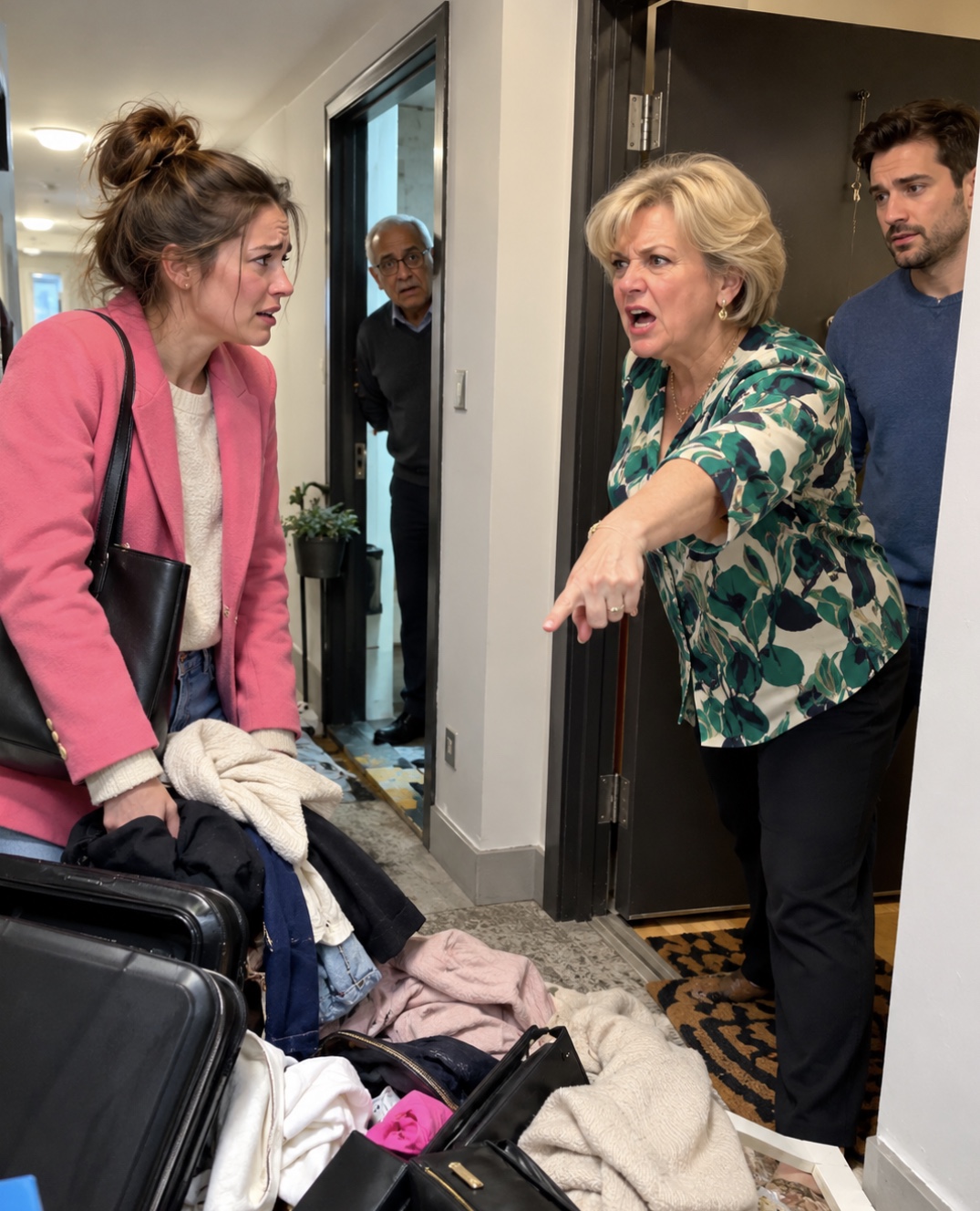
The first thing that hit the floor was my winter coat.
It landed in a heap beside the lift, one sleeve twisted beneath it, while my mother-in-law stood in the doorway of the flat with both hands on her hips as if she had just thrown out a bag of rubbish.
“Take it,” Margaret snapped. “And take the rest of your things as well.”
For a few seconds, I simply stared at her.
I had just come home from work.
It was a wet Thursday evening in Manchester, the kind where the rain seemed too light for an umbrella but somehow still managed to soak the shoulders of your coat. I had spent forty minutes on the tram, stopped at Tesco for milk, and climbed the stairs because the lift had been making a terrible grinding noise all week.
And now my suitcase was sitting outside my own front door.
“Margaret,” I said slowly, “what are you doing?”
“What does it look like?”
Behind her, my husband Daniel stood near the kitchen doorway.
He wouldn’t meet my eyes.
That frightened me more than Margaret’s shouting.
“Daniel?”
He rubbed the back of his neck.
“Mum’s upset.”
I almost laughed.
“Your mother is throwing my clothes into the corridor.”
Another jumper flew past Margaret’s shoulder and landed beside the coat.
“She’s been disrespectful for months,” Margaret said. “I’ve had enough.”
“You don’t live here.”
Her face changed.
Only slightly, but enough.
“I beg your pardon?”
“You don’t live here,” I repeated. “You’re staying here temporarily because your boiler broke.”
Margaret gave a short, humourless laugh.
“My son lives here.”
“So do I.”
“And whose family do you think made this possible?”
There it was.
The sentence she had been circling around for nearly three weeks.
Margaret had arrived with one medium suitcase and two shopping bags after a pipe burst in her semi-detached house in Stockport. The insurance company had arranged repairs, and Daniel had told me she would stay with us for “four or five nights.”
That had become nineteen days.
In nineteen days, she had rearranged the kitchen cupboards, replaced my coffee with decaf because “you’re too tense already,” invited her sister for Sunday lunch without asking me, and moved my work files out of the spare room because she wanted “somewhere peaceful to read.”
Still, I had kept quiet.
Mostly because Daniel kept saying the same thing.
“She’s had a shock, Emma.”
“She’s stressed.”
“It’s only temporary.”
But that morning, Margaret had sent me a message while I was at work.
We need to talk about your attitude this evening.
I had ignored it.
Apparently, that had been the final offence.
“You’re behaving like a guest who forgot herself,” Margaret said now.
I put the milk down on the landing before I dropped it.
“A guest?”
“Yes.”
Daniel finally looked at me.
“Emma, maybe just go to your sister’s tonight.”
I stared at him.
“My sister lives in Leeds.”
“Then maybe a hotel.”
I could actually hear my pulse.
“A hotel?”
“Just until everyone calms down.”
Everyone.
As though the three of us had equally lost our minds.
Margaret reached behind the door and dragged out another bag.
This one was mine too.
My laptop charger hung from the top.
“Don’t touch that,” I said.
“You can’t order me around.”
“Put it down.”
“No.”
“Margaret.”
She opened the bag and tipped it.
My charger, notebook, makeup bag, a framed photograph, and a small jewellery box hit the carpet.
The photograph cracked.
Daniel flinched.
I didn’t.
Something inside me had suddenly gone very still.
“Pick that up,” I said.
Margaret folded her arms.
“You’re not in a position to make demands.”
That was when the door opposite opened.
Mr Patel, our neighbour, leaned out.
He was a quiet man in his late sixties who lived with his wife. We usually saw him carrying shopping bags or watering the little pots of herbs outside his kitchen window.
He looked at my clothes.
Then at Margaret.
Then at me.
“Everything all right?”
“No,” I said.
“Yes,” Margaret said at the same time.
Mr Patel frowned.
Margaret lifted her chin.
“This is a family matter.”
He looked down at the broken photograph near his slippers.
Then he said, very calmly, “She still doesn’t know?”
Margaret’s expression tightened.
“Know what?”
Mr Patel looked at Daniel.
Daniel went pale.
And suddenly, I realised the question hadn’t been directed at me.
It had been directed at him.
📖 What Mr Patel knew changed everything — keep reading in the first comment 👇
Daniel stepped into the corridor.
“Mr Patel, please.”
But Mr Patel had already understood something from his face.
“Oh,” he said quietly. “So you haven’t told either of them.”
“Told us what?” Margaret demanded.
Daniel grabbed my wrist.
“Emma, can we go inside?”
I pulled away.
“No.”
“Please.”
“No. Whatever this is, you can say it here.”
Margaret looked between us.
“What’s going on?”
Mr Patel seemed uncomfortable now.
“I shouldn’t have said anything.”
“You already did,” I said.
He sighed.
“Your late aunt was a very kind woman.”
Margaret blinked.
“My aunt?”
He shook his head.
“Not yours.”
He looked at me.
“Emma’s.”
I felt my stomach drop.
“My Aunt Ruth?”
He nodded.
Aunt Ruth had died the previous year.
She was my father’s older sister, unmarried, stubborn, funny, and fiercely private. She had lived in Liverpool most of her life and had worked as a hospital pharmacist. When I was a child, she sent me books for birthdays instead of toys and always wrote my name inside the cover in blue ink.
She had left me a small amount of money.
Or at least that was what Daniel had told Margaret when she once asked why we had been able to replace the bathroom so soon after moving in.
“What does Aunt Ruth have to do with this building?” I asked.
Mr Patel looked at Daniel again.
Daniel closed his eyes.
Margaret was losing patience.
“For heaven’s sake, somebody speak.”
Daniel finally said, “We need to go inside.”
This time I agreed.
Not because he had convinced me.
Because suddenly I did not want half the building hearing the answer.
I gathered nothing from the floor.
Margaret started to move towards the door.
I put out my arm.
“You wait.”
Her mouth fell open.
“What?”
“You wanted me out. You can wait in the corridor for two minutes.”
“You cannot be serious.”
“I’m very serious.”
Daniel whispered, “Emma…”
I ignored him.
Mr Patel quietly stepped back into his flat.
I went inside.
Daniel followed.
I shut the door behind us.
For ten seconds neither of us spoke.
Then I said, “Start talking.”
Daniel sat down.
I remained standing.
“The flat was originally bought by Aunt Ruth.”
I stared at him.
“What?”
“Years ago. As an investment.”
“That’s impossible.”
“No.”
“She lived in Liverpool.”
“She owned two rental properties in Manchester.”
My mind started rearranging years of memories.
We had moved into this flat shortly before our wedding.
Daniel had told everyone we were renting from “a family connection” while saving for a deposit.
Two years later, he told me the landlord had decided to sell.
We had stayed.
I had assumed Daniel had negotiated something.
Whenever I asked about the paperwork, he said his solicitor was sorting it.
I had trusted him.
“What exactly are you telling me?”
Daniel’s voice dropped.
“She transferred ownership before she died.”
“To whom?”
He stared at the floor.
I already knew.
But hearing it still felt unreal.
“To you.”
I sat down opposite him.
The silence in the room felt enormous.
“That’s not possible.”
“It is.”
“No. I would know.”
“You should have known.”
I laughed once.
There was no humour in it.
“You think?”
Daniel pressed his hands together.
“Ruth contacted me first because she wanted it handled discreetly.”
“Why would she contact you?”
“She knew you hated talking about money. She thought you’d refuse.”
That part, at least, sounded like Aunt Ruth.
I had refused help from her twice.
Once when she offered to pay part of my university debt and once when she offered us money for the wedding.
She had called me “annoyingly independent.”
“When did she transfer it?”
“Six months before she died.”
“And I signed nothing?”
“You didn’t need to for the transfer.”
“Who is on the Land Registry?”
“You.”
I actually felt cold.
“Only me?”
“Yes.”
I stared at him.
“So when you told your mother this flat belonged to us…”
He swallowed.
“I never said exactly that.”
“You let her believe it.”
He said nothing.
That silence was answer enough.
I stood.
Daniel stood too.
“Emma, please understand. Mum has always been obsessed with property. If she knew—”
“If she knew what? That the woman she just tried to throw out owns the place?”
He winced.
“I was going to tell her.”
“When?”
“I don’t know.”
“Before or after she moved her things into my spare room?”
He looked away.
I opened the front door.
Margaret was still standing outside.
My clothes were around her feet.
“Well?” she demanded.
I stepped back.
“Come in.”
She entered like someone expecting an apology.
Instead, I closed the door and said, “The flat is mine.”
She stared at me.
“I’m sorry?”
“Legally mine. Aunt Ruth owned it. She transferred it to me before she died.”
Margaret turned towards Daniel.
He didn’t deny it.
Her face changed in stages.
Confusion.
Disbelief.
Then anger.
“You knew?”
Daniel nodded.
“And you let me stand out there looking like a fool?”
I almost admired how quickly she made herself the victim.
“You were throwing my belongings onto the landing,” I said.
Margaret ignored me.
“Daniel, how could you keep this from me?”
“Because it wasn’t your business.”
That was the first useful thing he had said all evening.
Margaret looked genuinely wounded.
“Not my business? You’re my son.”
“And it still isn’t your flat.”
She gave me a sharp look.
“This changes nothing about the way she speaks to me.”
I laughed.
“It changes quite a lot.”
“You think owning four walls gives you the right to humiliate me?”
“No. But it gives me the right to decide who sleeps inside those four walls.”
Her expression froze.
Daniel looked at me.
“Emma.”
I ignored him.
“Your boiler repair finished three days ago.”
Margaret blinked.
That got him too.
“What?” Daniel asked.
I picked up my phone.
“The insurance contractor called here on Monday. They couldn’t reach you, Margaret, so they called the alternative number you gave them.”
Daniel looked at his mother.
She flushed.
“They said the house was habitable again Monday afternoon.”
“It still smells damp.”
“They said the industrial dryers were removed Tuesday morning.”
“That doesn’t mean—”
“You told us your kitchen ceiling was still open.”
“It needs decorating.”
I stared at her.
“So you lied.”
Margaret’s mouth tightened.
“I needed somewhere to stay.”
“No. You wanted somewhere to stay.”
“That is not the same thing.”
“It is when you’re using someone else’s home.”
Daniel turned to her.
“Mum, why didn’t you tell me?”
She looked at him as though he had betrayed her.
“Because you would have sent me back.”
“Yes,” I said. “Exactly.”
She drew herself up.
“You’re enjoying this.”
“No. I’m exhausted.”
That was the truth.
I wasn’t triumphant.
I wasn’t even angry anymore.
I was simply tired of being treated like the unreasonable person in my own home.
Margaret looked around the sitting room.
At the lamp I had chosen.
The sofa I had paid to recover.
The shelves I had painted.
Perhaps for the first time, she understood that none of it belonged to Daniel by default simply because he was her son.
Then something occurred to her.
“If this flat is only yours,” she said, “what protection does Daniel have?”
I looked at him.
Interesting.
That was her first instinct.
Not embarrassment.
Not apology.
Ownership.
Daniel answered before I could.
“I pay towards bills. That’s all.”
Margaret’s head snapped towards him.
“What do you mean, that’s all?”
“It means exactly that.”
“You’ve been living here for years.”
“Yes.”
“And you have no share?”
“No.”
She looked horrified.
I suddenly understood something that had bothered me for years.
Whenever Margaret visited, she asked oddly specific questions.
Had we remortgaged?
What was the flat worth now?
Did we have life insurance?
Would we move somewhere larger?
Daniel always laughed them off.
I had thought she was nosy.
Now I realised she had been building a picture in her head.
And in that picture, Daniel owned half of everything.
Maybe more.
“You need a solicitor,” she said immediately.
Daniel stared at her.
“What?”
“You’ve paid towards this home. You must have rights.”
“Mum.”
“You cannot be left with nothing if this marriage—”
“Enough.”
His voice was sharp enough to stop her.
For the first time that evening, Daniel looked angry.
Not uncomfortable.
Not embarrassed.
Angry.
“She is my wife. Stop talking like I’m waiting to collect something from her.”
Margaret shook her head.
“You’re naïve.”
“No,” he said. “I’ve been cowardly.”
That surprised me.
He turned to me.
“I should have told you everything as soon as Ruth died.”
“You should have.”
“And I should never have let Mum stay this long.”
Margaret gasped.
“Daniel.”
He continued.
“And I definitely should not have asked Emma to leave tonight.”
I folded my arms.
“No, you shouldn’t have.”
He nodded.
There was no defence.
“I’m sorry.”
Margaret made a disgusted sound.
“Oh, wonderful. So now we all bow down because she has a title deed?”
I looked at her.
“No.”
I opened the door.
“We just stop pretending you have authority you don’t have.”
She stared at the doorway.
“You’re throwing me out?”
“I’m asking you to go home.”
“At nine o’clock at night?”
“It’s seven forty.”
She checked the clock involuntarily.
I almost smiled.
Daniel went to the spare room.
Margaret followed him.
“What are you doing?”
“Packing your things.”
“You will do no such thing.”
“Mum, your house is fifteen minutes away.”
“It is not ready.”
“I’ll drive you.”
“You’re choosing her over me.”
Daniel stopped.
“No. I’m choosing not to let you behave like this.”
Margaret looked at me.
Then she walked into the hallway, lifted my coat from the landing, and handed it to me.
It wasn’t an apology.
But it was close to an admission that she understood the balance had changed.
Ten minutes later, she left with her suitcase.
Daniel drove her home.
I stayed behind.
The flat was painfully quiet.
I gathered my clothes from the corridor.
Mrs Patel came out while I was picking up the broken photograph.
“I’m sorry,” she said.
“You heard everything?”
She smiled faintly.
“These walls are not as thick as the estate agent claimed.”
I laughed for the first time that evening.
Then she held out an envelope.
“My husband asked me to give you this.”
Inside was a Christmas card.
Old.
Five years old.
From Aunt Ruth.
I recognised her handwriting instantly.
Emma — one day you’ll learn that accepting help doesn’t make you dependent. It only matters who thinks the help gives them power over you.
I read the sentence twice.
“How did he get this?”
“Ruth gave it to him when she visited the flat.”
“She came here?”
“Several times.”
I looked at Mrs Patel.
“Why?”
“She was checking the building before she bought it.”
I blinked.
“The building?”
Mrs Patel smiled.
“Not the building. This flat. Sorry.”
My heart slowed again.
For one second I had thought—
She laughed.
“You should have seen your face.”
“Please don’t tell me there’s another surprise.”
“One small one.”
I groaned.
She pointed towards the locked storage room at the end of the hall.
“Your aunt bought that too.”
I stared at the door.
“The storage room?”
“Yes.”
I started laughing.
Not because it was funny.
Because after the strangest evening of my married life, discovering I owned a dusty storage cupboard somehow felt perfectly ridiculous.
Daniel came back just before nine.
He found me sitting at the kitchen table with the Land Registry record open on my laptop.
He put his keys down.
“Mum’s home.”
“How was the drive?”
“Silent.”
“Good.”
He sat opposite me.
I turned the laptop around.
“There’s something else.”
His face fell.
“What?”
I pointed.
“Aunt Ruth didn’t transfer the flat six months before she died.”
Daniel looked at the screen.
“She transferred it three years ago.”
He went still.
“What?”
“Three years.”
“That can’t be right.”
“It is.”
He took the laptop.
The colour drained from his face.
I watched him carefully.
“You didn’t know?”
“No.”
And I believed him.
Then I remembered something.
Three years earlier, Aunt Ruth had taken me to lunch when Daniel was away for work.
She had asked strange questions about whether I felt secure.
Whether Daniel’s family respected boundaries.
Whether I understood what financial independence actually meant inside a marriage.
At the time, I thought she was being dramatic.
Now I knew she had already made the transfer.
“You really didn’t know,” I said.
“No.”
“So who told you it happened last year?”
Daniel looked up.
“The solicitor handling her estate.”
I frowned.
“That makes no sense.”
It took two phone calls the next morning to understand why.
Aunt Ruth had instructed the solicitor not to tell me while she was alive.
She believed I would try to reverse the transfer.
After her death, the solicitor contacted Daniel because Ruth had named him as the person who should make sure I actually read the documents.
He had misunderstood the timing.
Or perhaps, I suspected, had not read carefully enough.
Which meant Aunt Ruth had quietly given me the flat while still alive and then spent three years waiting to see whether I would ever discover it myself.
That was exactly the sort of irritating thing she would do.
A week later, I had the locks changed.
Not because Margaret had a key.
She didn’t.
But because I wanted one clear moment where the home felt unquestionably mine again.
Daniel paid for the locksmith.
Margaret didn’t visit for almost two months.
When she finally did, she rang the buzzer downstairs.
She didn’t use Daniel’s key.
She didn’t call from the pavement demanding to be let in.
She rang.
I answered.
“It’s Margaret.”
“I know.”
A pause.
Then she said, “May I come up?”
That single word mattered more than any apology she could have forced herself to give.
May.
I pressed the button.
When she reached the door, she was holding a small plant.
A rosemary bush in a blue ceramic pot.
“For the kitchen,” she said.
“Thank you.”
She stepped inside, then stopped.
“Shoes off?”
I almost laughed.
“Yes, please.”
She removed them.
We were never close after that.
But we became civil.
And more importantly, clear.
Daniel and I changed too.
Not magically.
Trust does not repair itself because someone says sorry.
We met with a financial adviser.
We wrote down exactly who owned what.
We made wills.
We had several ugly arguments about why he had hidden information from me because he was afraid of his mother’s reaction.
But at least the arguments were honest.
Six months later, I cleaned out Aunt Ruth’s storage room.
It contained two folding chairs, a broken lamp, boxes of old pharmacy journals and, at the very back, a battered suitcase.
Inside were twenty-seven books.
Every one of them had my name written inside the cover in blue ink.
On top was a note.
If you’re reading this, you finally opened the cupboard.
Typical.
I sat on the dusty floor and laughed until I cried.
Then I carried the books upstairs, placed them on the shelf in the sitting room, and kept the note beside them.
Because Aunt Ruth had been right.
Accepting help had never been the dangerous part.
The dangerous part was letting other people convince you that help had bought them a share of your life.