



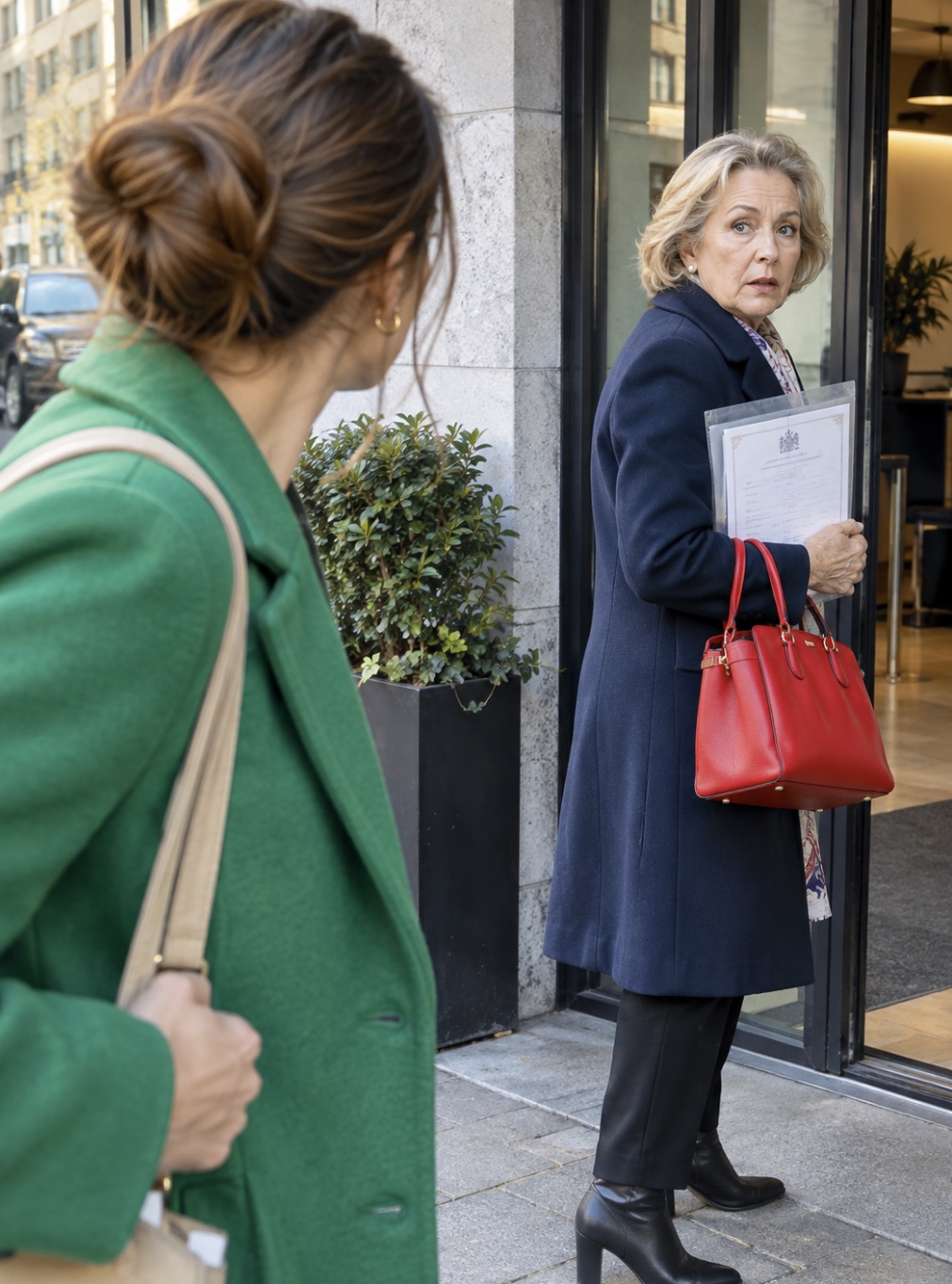
The first thing I noticed was my mother-in-law’s red handbag.
It was impossible to miss. Bright leather, gold clasp, the same bag she carried to every family lunch because, according to her, “a proper handbag should outlive at least two governments.”
I saw it on a chair outside a notary’s office in central Manchester at eleven twenty on a Tuesday morning.
Five minutes earlier, my husband had texted me:
Mum’s still got a temperature. I’m dropping soup round after work.
I stared at the handbag, then at the woman sitting beside it.
Susan.
My mother-in-law.
Healthy enough to be wearing lipstick, heeled boots and a navy wool coat.
And in her lap, partly sticking out of a transparent folder, was a photocopy of my marriage certificate.
I almost walked straight past her.
Not because I hadn’t recognised her, but because my brain refused to connect the things I was seeing.
Susan had cancelled Sunday lunch two days earlier because she was supposedly “too ill to get out of bed”. She had called my husband, Tom, that morning and told him her temperature was 38.7. She had even declined his offer to take her to the GP.
And now she was sitting outside a solicitor-and-notary practice with proof that her son and I were legally married.
“Susan?”
Her head snapped up.
For one second, her face showed something I had never seen on it before.
Fear.
Then it vanished.
“Rachel.”
She closed the folder quickly.
Too quickly.
“What are you doing here?”
It was such a strange question that I nearly laughed.
“I work three streets away.”
That was true. I managed procurement for a construction consultancy near Deansgate, and I had come out during lunch to have a statutory declaration witnessed for a professional accreditation application.
Susan gave a tiny nod.
“Right.”
I looked toward the brass plaque on the wall.
Hargreaves & Cole Notaries.
Then back at her.
“I thought you were in bed.”
“I was.”
“You have a fever.”
“I’m better.”
“In three hours?”
Her mouth tightened.
Susan hated being questioned. She preferred statements that sounded like questions.
You’re not really wearing that, are you?
You’re still renting out your old flat, aren’t you?
You and Tom do have wills, surely?
She stood and tucked the folder under her arm.
“I had an appointment I couldn’t cancel.”
“What kind of appointment?”
“Private.”
I nodded slowly.
“And you needed our marriage certificate for it?”
Her eyes flicked to the folder.
There it was again.
Fear.
Then irritation.
“You shouldn’t stare at other people’s papers, Rachel.”
“It has my name on it.”
Before she could answer, a receptionist opened the door.
“Mrs Whitaker?”
Susan turned immediately.
“Yes.”
“The notary can see you now.”
I looked at the receptionist.
Then at Susan.
Mrs Whitaker was my surname.
Susan’s surname was Bennett.
She had been divorced from Tom’s father for almost twenty years.
The receptionist hesitated.
Susan recovered faster than I did.
“She means me.”
Then she walked inside.
I stood in the corridor, frozen.
That should have been the moment I called Tom.
Instead, I did something I am still not sure I’m proud of.
I waited.
I told myself I was only staying because my own appointment was at noon. But when Susan came out twenty-five minutes later, I was sitting in a café across the road with an untouched flat white in front of me.
She didn’t see me.
She stood beneath the awning, opened the folder and checked a document.
Then she photographed it with her phone.
I could see only the back page from where I sat.
There was a large blue stamp.
She slid the document away, ordered a taxi and left.
At 12:08, I walked into the same office.
The receptionist smiled.
“Rachel Whitaker?”
“Yes.”
This time, hearing my name made my stomach turn.
While I waited, I tried to see if anything had been left on the counter.
Nothing.
My appointment took seven minutes.
Before leaving, I asked as casually as I could, “Was that my mother-in-law here earlier?”
The receptionist’s smile disappeared.
“I’m afraid I can’t discuss another client.”
“Of course.”
She hesitated.
Then she said, “If you believe someone may have presented themselves as you, you should speak to a solicitor.”
My skin went cold.
“I didn’t say she presented herself as me.”
The receptionist looked down at her keyboard.
“No. You didn’t.”
📌 Things were already wrong, but what I found next changed the entire reason Susan had been there — keep reading below.
I called Tom from the pavement.
He answered on the second ring.
“Hey. Everything okay?”
“Where’s your mum?”
A pause.
“At home, presumably. Why?”
“I just saw her.”
“Where?”
“At a notary’s office.”
Silence.
“She had our marriage certificate.”
Another silence.
Then, “Why would she have that?”
“I was hoping you could tell me.”
“I can’t.”
His voice sounded genuinely confused.
That mattered.
Tom was not good at pretending. After nine years together, I knew the difference between his guilty silence and his bewildered silence.
“When did you last give her any paperwork with my name on it?”
“I haven’t.”
“Our marriage certificate?”
“No.”
“Passport copy?”
“No.”
“Anything?”
“Rachel, no.”
I heard office noise behind him.
Then he lowered his voice.
“Come home early.”
That evening, Susan ignored three calls from Tom.
At half six, she texted him:
Sleeping. Speak tomorrow.
Tom showed me the message.
“She’s lying.”
“Yes.”
He rubbed both hands over his face.
Our marriage had never been perfect, but our problems were ordinary ones: whose turn it was to book the boiler service, why Tom bought expensive coffee machines and then drank instant, whether we would ever move out of the semi-detached house we had bought four years earlier in Sale.
Susan had always been intrusive, but in a polished way.
She didn’t arrive unannounced.
She asked for information.
Constantly.
How much did the house cost?
Whose name was on the mortgage?
Did I still own the small flat in Salford that I had bought before meeting Tom?
Had we changed beneficiaries on our pensions?
Was the house held jointly or as tenants in common?
I had always assumed she was nosy.
That night, for the first time, I wondered if she had been collecting details.
Tom went to her house at eight.
She did not answer.
Her car was gone.
At nine fifteen, he came home furious.
“She’s definitely not there.”
“How do you know?”
“Curtains open. No lights. No car.”
He threw his keys on the kitchen worktop.
Then something changed in his expression.
“My dad.”
“What about him?”
“When he died, Mum handled some of the paperwork.”
Tom’s father, Martin, had died unexpectedly from a stroke three years earlier. Although Susan and Martin had divorced long before, they had remained civil, mostly because of Tom.
“Why would that matter?”
“There was a file with copies of family documents. Birth certificates, the divorce papers, stuff like that.”
“And our marriage certificate?”
“Might have been. Dad kept everything.”
I sat opposite him.
“What exactly was she doing at a notary using your surname?”
Tom looked at me.
“I don’t know.”
The next morning, Susan finally called.
Tom put her on speaker.
She sounded offended before he had even asked a question.
“I’m not discussing this if Rachel is listening.”
“She is listening.”
“Then call me later.”
“No.”
There was a pause.
Tom rarely said no to her that quickly.
“Mum, why were you at Hargreaves & Cole?”
“That is none of your business.”
“You had our marriage certificate.”
“It’s a public record.”
“Why?”
“I needed to prove you were married.”
“To whom?”
“Tom, I am sixty-four years old. I do not need permission to conduct my affairs.”
“Were you pretending to be Rachel?”
Susan laughed.
It sounded forced.
“Don’t be ridiculous.”
“Then why did they call you Mrs Whitaker?”
This time there was no answer.
Tom’s face changed.
“Mum?”
“I have to go.”
She ended the call.
At ten thirty, I contacted a solicitor recommended by a colleague.
Her name was Priya Shah.
I explained everything.
She listened without interrupting, then asked questions that seemed unrelated.
Did Susan have copies of our passports?
Possibly.
Did she know my date of birth?
Definitely.
Did she know the address of my Salford flat?
Yes.
Was it mortgaged?
No.
That answer made Priya pause.
“You own it outright?”
“Yes.”
I had bought the one-bedroom flat at twenty-eight, lived there for five years, then rented it out after marrying Tom.
Its value was around £185,000.
“Check the Land Registry title today,” Priya said.
My stomach dropped.
“Why?”
“Because if someone is gathering certified proof of identity, marriage and address, property is one possibility.”
I paid three pounds online and downloaded the title register.
Nothing looked wrong.
I was still the registered owner.
I almost laughed from relief.
Then Priya called again.
“Check whether there are any pending applications or restrictions.”
There was no obvious way to do that online without making further enquiries.
She handled it.
That afternoon, she rang me.
“There is a pending application.”
I sat down.
“For what?”
“A restriction.”
“What does that mean?”
“Someone is attempting to register an interest affecting the property.”
“Who?”
“I don’t know yet.”
The room seemed to tilt.
Tom, standing by the kitchen door, went pale.
Priya continued.
“I’m filing an urgent objection and identity alert. Do not contact your mother-in-law until we have the documents.”
It took two days.
Those two days were worse than knowing.
Susan continued sending ordinary messages to the family group.
A photo of daffodils in her garden.
A complaint about council tax.
A link to a recipe for lemon drizzle cake.
Tom did not reply.
On Thursday afternoon, Priya emailed us a scanned copy of the application.
The applicant was not Susan.
It was a company called Northbridge Family Lending Ltd.
Neither of us had ever heard of it.
The application claimed that the company held a beneficial interest in my flat arising from a £72,000 loan made to “Rachel and Thomas Whitaker” six years earlier.
There was a loan agreement.
Our names.
Our old address.
My date of birth.
Tom’s signature.
And mine.
Except I had never signed it.
Tom stared at his signature for nearly a minute.
“That looks like mine.”
“Did you sign this?”
“No.”
“Are you sure?”
“Rachel.”
“I have to ask.”
“No. I have never borrowed seventy-two grand from anyone.”
Attached was a notarised declaration.
It stated that Susan Bennett, acting under authority from the borrowers, had confirmed the marriage and identity details.
The document she had obtained on Tuesday was part of the supporting evidence.
I felt sick.
But Priya was strangely calm.
“This is crude in some ways,” she said, “and sophisticated in others.”
“What does that mean?”
“It means someone has enough authentic information to make a false claim look plausible.”
Tom whispered, “My mother.”
“Possibly. But don’t assume she invented it.”
We found out who had three days later.
Northbridge Family Lending Ltd had been incorporated eight months earlier.
Its sole director was Peter Lawson.
The name meant nothing to me.
It meant everything to Tom.
He stared at the Companies House record and said, “Oh, God.”
“Who is he?”
“My mum’s partner.”
I blinked.
“Susan doesn’t have a partner.”
“Apparently she does.”
Tom sat back.
“I’ve met him.”
“When?”
“Twice. She introduced him as someone from her walking group. Peter.”
Susan had been seeing him for almost a year.
Secretly.
And Peter had debts.
Large ones.
We learned most of the story from Susan herself.
Not because she confessed willingly.
Because Priya sent a formal letter warning that the Land Registry application appeared fraudulent and that we were considering reporting the matter to Greater Manchester Police.
Susan arrived at our house the same evening.
No fever.
No lipstick this time.
She looked ten years older.
Tom did not invite her to sit down.
She did anyway.
“I didn’t know about the forged signatures.”
I nearly laughed.
“You submitted documents for a seventy-two-thousand-pound claim against my property.”
“I thought it was legitimate.”
“How?”
Susan looked at Tom.
“Peter said Martin had made an investment years ago.”
Tom frowned.
“My dad?”
“He said your father had lent Rachel money before you married.”
I stared at her.
“Your ex-husband, whom I met twice in my life, lent me seventy-two thousand pounds?”
Susan’s face crumpled slightly.
“When you say it like that—”
“How else would anyone say it?”
Tom stepped between us verbally, not physically.
“Mum. Start at the beginning.”
And she did.
Peter had told Susan he worked with private lenders and distressed estates. He claimed Martin had once invested money through an informal arrangement that had never been properly documented.
According to Peter, after Martin’s death, the debt had passed into his estate but had been overlooked.
Peter said he had discovered paperwork indicating the money had helped fund my Salford flat.
None of that was true.
But Susan wanted it to be.
Because Peter had also told her that if the old debt could be legally recognised, Tom—as Martin’s only son—could eventually recover the money.
“You thought you were getting money for us?” Tom asked.
Susan looked down.
“At first.”
There it was.
“At first,” I repeated.
Susan’s eyes filled with tears.
After a few months, Peter’s story had changed.
He told Susan the claim could be purchased from Martin’s estate records through his company, then secured against the flat.
In exchange, Susan would receive £20,000 when the flat was eventually sold.
“And you agreed?” I asked.
She said nothing.
Tom sat down hard on a dining chair.
“You tried to put a secret seventy-two-thousand-pound claim on Rachel’s home for twenty grand?”
“I wasn’t taking the flat.”
“You were putting a legal obstacle against it.”
“I didn’t understand it that way.”
“You didn’t want to understand it.”
That was the sentence that broke her.
Susan began crying.
Not delicately.
Not the controlled tears I had seen her use during arguments.
She covered her face with both hands.
“I’ve lost money.”
Tom became still.
“How much?”
Susan did not answer.
“How much, Mum?”
“Forty-six thousand.”
The room went silent.
She had transferred Peter £46,000 over nine months.
Some of it came from savings.
Some from a fixed-rate bond.
£12,000 came from an equity-release facility she had quietly taken against her own house.
Peter had promised high returns.
Then, when repayment dates passed, he told her one final deal would recover everything.
My flat was that deal.
The marriage certificate mattered because Peter needed to establish the legal connection between Tom and me.
The notary appointment mattered because Susan had agreed to sign a declaration confirming details she knew to be true while deliberately avoiding asking whether the underlying debt was true.
“Why use my married name?” I asked.
Susan looked ashamed.
“Peter said it would make the paperwork simpler.”
“Did you sign anything as Rachel Whitaker?”
“No.”
Priya later confirmed that Susan had not actually impersonated me, although the receptionist had clearly misunderstood the role she was claiming to have.
It did not make me feel much better.
The police investigation took months.
Peter Lawson turned out not to be a sophisticated financial criminal.
He was simply experienced enough at lying to find people who wanted to believe him.
There were four other victims.
Two were widows.
One was his former business partner.
The forged loan agreement was traced to a template he had used in another property dispute.
The Land Registry application was cancelled.
My flat was safe.
Susan recovered only part of her money.
She sold her car, repaid the equity-release balance as far as she could, and downsized eighteen months later.
But that was not the unexpected part.
The unexpected part came from Tom’s father.
While reviewing Martin’s estate papers, a solicitor found an envelope that Susan had never seen.
Inside was a handwritten note and a bank statement.
Martin had left Tom £30,000 in a savings account that was supposed to be transferred directly to him after probate.
It never had been.
The account had been closed six weeks after Martin’s death.
The money had gone to Susan.
When Tom confronted her, she did not deny it.
“I meant to give it to you.”
“When?”
“I don’t know.”
“You kept Dad’s money for three years.”
“I was frightened of being left with nothing.”
It was, in a strange way, the final truth we needed.
Peter had not transformed Susan into someone dishonest.
He had found someone who had already spent years convincing herself that money could be moved, borrowed, delayed and hidden as long as she believed her reason was good enough.
Tom did not speak to her for nearly six months.
I spoke to her once.
She came to return an old box of wedding photographs.
At the door, she said, “You must hate me.”
I thought about it.
“No.”
She looked surprised.
“I don’t trust you.”
That hurt her more.
I could see it.
“But I don’t hate you.”
She nodded slowly.
Then she gave me the box.
Before leaving, she said, “I really did have a fever that Sunday.”
I stared at her.
For a second, neither of us moved.
Then, against every expectation, I laughed.
Susan laughed too.
It didn’t repair anything.
It wasn’t forgiveness.
But it was the first honest moment we had shared in years.
I still own the Salford flat.
Tom and I now keep important documents locked away, and both of us receive property alerts if anyone tries to register something against either home.
Susan lives in a smaller bungalow in Cheshire and sends us birthday cards instead of financial advice.
Sometimes I think about that Tuesday morning and the red handbag outside the notary’s office.
If I had arrived ten minutes later, I would never have seen her.
If I had accepted her lie about the fever, the restriction might have been registered before we knew anything was wrong.
People talk about family betrayals as if they always begin with hatred.
Ours didn’t.
It began with embarrassment.
Then secrecy.
Then one small lie told to protect another.
By the time the truth appeared, it was carrying a marriage certificate in a transparent folder.