



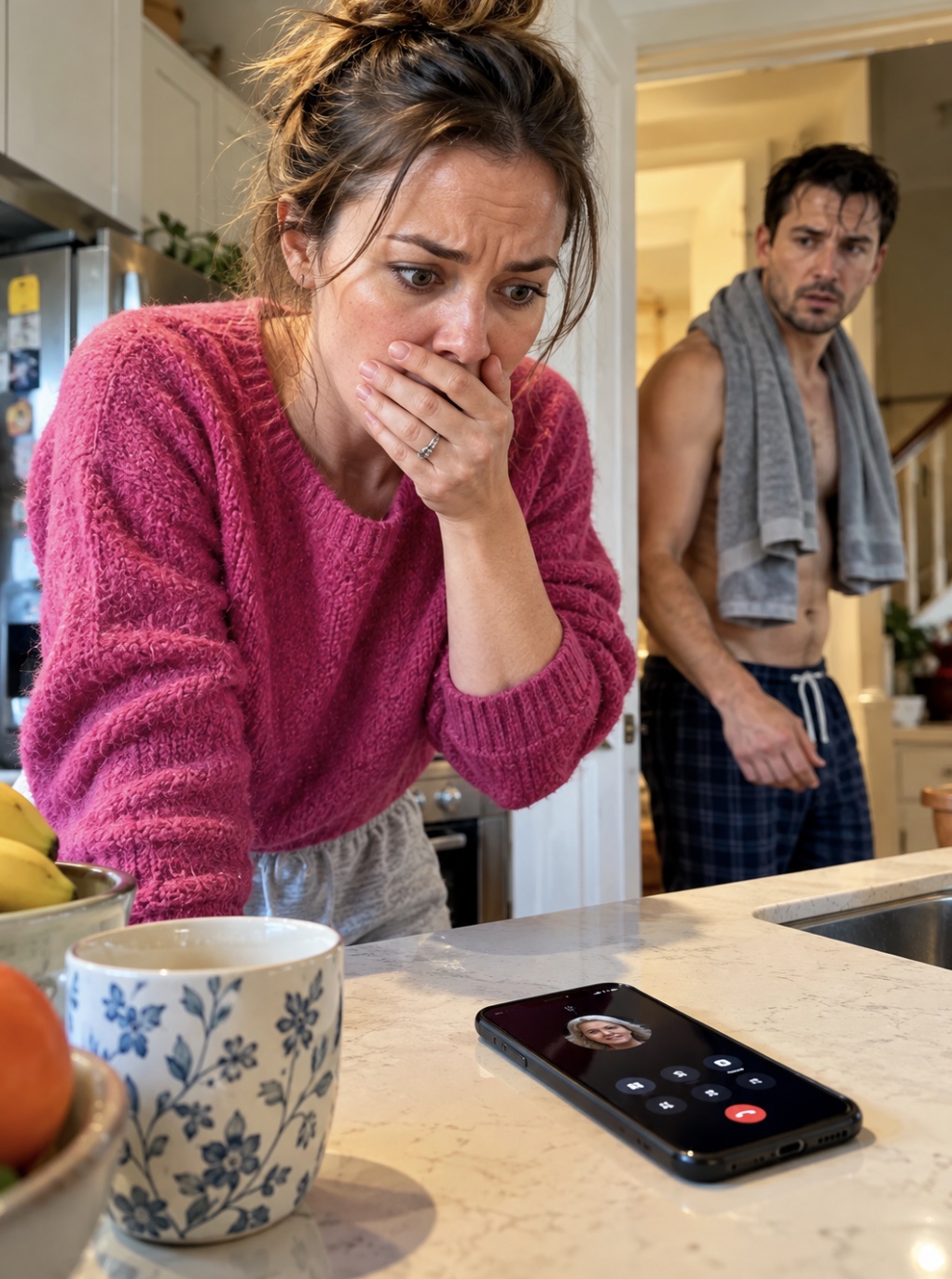
The voice came from my husband’s phone at 6:42 on a Wednesday morning, while I was standing barefoot in our kitchen with a slice of toast burning under the grill.
“I told your wife everything,” my mother-in-law said.
There was a pause.
Then my husband, Daniel, answered in a voice so low I almost didn’t recognise it.
“You did what?”
I froze with one hand on the kettle.
Daniel was upstairs in the shower. His phone lay face-up on the kitchen island because he’d been listening to a podcast while making coffee. Somehow he must have answered his mother by accident before going upstairs, or perhaps she had rung while the phone was still connected to his earbuds. Either way, the call was live.
His mother, Margaret, continued.
“She needed to know. I wasn’t going to keep covering for you.”
My stomach tightened.
Daniel said something I couldn’t hear over the rush of water from upstairs.
Margaret replied sharply, “Don’t you dare blame me. You had months to explain it.”
I stared at the phone.
Months.
Explain what?
Then the shower stopped.
I stepped back so quickly that my hip hit the cupboard handle.
Margaret was still talking.
“And don’t ring me later pretending this conversation never happened. Claire knows now. She knows all of it.”
I reached for the phone.
Before I could touch it, the call ended.
For perhaps five seconds, I simply stood there listening to the smoke alarm begin its first warning chirp as my toast blackened.
Nobody had told me anything.
And my name was Claire.
Daniel came downstairs ten minutes later dressed for work, his damp hair combed back, a navy jumper over his shirt. He looked exactly as he had every weekday morning for the past eleven years.
“Something burning?”
“Toast.”
He opened the back door to let the smoke out.
I watched him.
He didn’t look guilty.
That made it worse.
We lived outside York in a red-brick semi we had bought six years earlier, the sort of house with two bathrooms if you generously counted the downstairs loo and a garden just long enough to require a lawnmower but not long enough to justify complaining about it.
We had a nine-year-old daughter, Sophie, who spent most mornings looking for something she had definitely left “right there”, and a six-year-old son, Max, who was currently obsessed with Premier League stickers despite knowing almost nothing about football.
Our marriage was not dramatic.
That had always been one of the things I liked about it.
Daniel worked as a surveyor for a commercial property firm. I worked four days a week doing accounts for a regional furniture company. We disagreed over ordinary things: whether the heating needed to be on, whose turn it was to take the recycling out, how much screen time constituted a moral collapse.
I had never checked his phone.
I had never needed to.
That morning, I nearly asked him at least three times.
Instead, I said, “Your mum rang.”
He looked up immediately.
“When?”
“While you were in the shower.”
Something changed in his face.
Not panic.
Recognition.
“Oh.”
“Is everything all right?”
He picked up his coffee.
“Yeah. Probably something about Sunday.”
“What’s happening Sunday?”
“Mum wants us over for lunch.”
He said it too smoothly.
I waited.
Nothing else came.
He kissed my cheek, shouted goodbye to the children, and left at 7:28.
At 7:31, I opened our banking app.
I’m not proud of that being my first move, but fear is rarely dignified.
Our joint account looked normal.
Mortgage.
Council tax.
Tesco.
Petrol.
School dinner payment.
A £23.40 charge from an Indian takeaway I’d forgotten about.
Savings looked normal too.
No giant withdrawals. No hidden credit card payments. No obvious affair financed through boutique hotels and expensive restaurants.
I checked our mortgage balance, our holiday savings, even the Junior ISAs we had opened for the children.
Nothing.
By nine that morning I had imagined an affair, secret debt, a second family, a gambling problem, an illegitimate child, a criminal conviction, and—during a particularly unproductive twenty minutes—a completely absurd theory involving Daniel having secretly lost his job.
At 10:15, Margaret texted me.
Morning love. Just checking Sunday still works? Roast chicken around one. xx
I stared at the message.
She had supposedly told me “everything”.
Now she was asking about roast chicken.
I replied:
Yes, one is fine. xx
Then I added:
Did you need to talk to me about anything else?
The three dots appeared.
Disappeared.
Appeared again.
Finally:
No, nothing urgent. See you Sunday. xx
My skin went cold.
That confirmed it.
Whatever she believed she had told me, she now knew she hadn’t.
And she was choosing not to correct that mistake.
That evening Daniel arrived home carrying flowers.
Not roses. A bunch of tulips from Marks & Spencer, still with the price label half peeled off.
“For no reason,” he said when I raised an eyebrow.
“Since when do you buy flowers for no reason?”
“Since I realised I’m apparently expected to have reasons.”
He smiled.
I smiled back.
And hated myself for playing along.
Over dinner, Sophie complained that her friend Ava had been allowed to dye the ends of her hair purple. Max dropped peas into his water glass. Daniel talked about a warehouse development near Leeds.
Nothing unusual.
Until Sophie said, “Dad, are we still going to Grandma’s new place?”
Daniel’s fork stopped halfway to his mouth.
I looked at her.
“What new place?”
Sophie frowned.
“Grandma’s other house.”
Daniel set down his fork.
“There isn’t another house.”
“Yes, there is.”
“Sophie,” he said gently, “what are you talking about?”
“The one with the yellow door.”
Silence.
I looked at Daniel.
He looked genuinely confused.
“When did Grandma show you a house with a yellow door?” I asked.
“Last week.”
“You didn’t see Grandma last week.”
“Yes, I did.”
My pulse quickened.
Sophie rolled her eyes with the weary superiority of a nine-year-old forced to explain basic facts to adults.
“When Dad picked me up from dance late. Grandma was in the car.”
Daniel went very still.
I remembered the evening. I’d been at Max’s school parents’ meeting. Daniel had collected Sophie from dance at half seven.
“You saw Mum?” I asked him.
Daniel nodded slowly.
“For five minutes.”
“At a house with a yellow door?”
He rubbed his jaw.
“It’s complicated.”
That was the moment fear hardened into anger.
“Apparently everything is.”
The children looked between us.
Daniel glanced at them and lowered his voice.
“Not now.”
He was right about that.
But after they were in bed, I stood in the kitchen doorway and said, “I heard your mother this morning.”
His back was to me.
He didn’t move.
“I heard her say she told me everything.”
Still nothing.
“She said she wasn’t going to keep covering for you.”
He closed his eyes.
“Claire—”
“What did she think she’d told me?”
He turned around.
And for the first time that day, I saw fear.
Not the frantic fear of someone caught cheating.
Something quieter.
He looked exhausted.
“I was going to explain.”
“When?”
He didn’t answer.
“When, Daniel?”
“After Friday.”
“What happens Friday?”
He looked towards the ceiling, as if our sleeping children might somehow hear through the floor.
Then he said, “Please give me two days.”
I laughed once because the alternative was shouting.
“You want me to wait two days after hearing your mother say she’s been covering for you for months?”
“Yes.”
“Why?”
“Because if I tell you now, I might make something worse before I know whether it’s actually happening.”
That sentence frightened me more than anything else.
“What’s happening?”
He shook his head.
“I can’t.”
I stared at him.
“You can. You’re choosing not to.”
📌 What Daniel was hiding wasn’t what Claire feared — and the truth begins to surface in the first comment below. 👇
I slept in the spare room.
At least, I tried.
By half two I was scrolling through old photographs on my phone, looking for clues in pictures that suddenly felt like evidence.
Christmas at Margaret’s.
Daniel’s birthday.
A weekend in Whitby.
School sports day.
Margaret holding Max on her lap.
Margaret beside Sophie outside York Minster.
Our families had never been especially close, but Margaret had always been dependable. Slightly controlling, yes. A woman who would rearrange your dishwasher while complimenting your cooking. But she had never been cruel to me.
My own parents lived in Devon. Margaret was the nearby grandmother. She collected the children from school occasionally, remembered dentist appointments, brought over soup when we had flu.
Which made the lie worse.
The next morning, I did something I had never done before.
I followed my husband.
Not dramatically.
No sunglasses. No rented car.
I simply left ten minutes after him and kept far enough behind that I could pretend coincidence if necessary.
His office was normally a thirty-minute drive towards Leeds.
He didn’t go there.
Instead, he drove west through two villages and stopped outside a small terraced house in Tadcaster.
The front door was yellow.
My heart began pounding.
I parked farther down the street.
Daniel sat in his car for nearly a minute before getting out.
A woman opened the yellow door.
She was perhaps seventy.
Small, white-haired, wearing a pale green cardigan.
Daniel hugged her.
Not politely.
Not romantically.
He held her the way people hold family.
Then another person appeared behind her.
A man in his early thirties.
And when I saw him, every thought in my head stopped.
He looked like Daniel.
Not identical.
But enough.
Same height.
Same dark eyebrows.
Same slightly crooked smile.
The man slapped Daniel lightly on the shoulder, and they went inside.
I took a photograph through the windscreen.
Then immediately felt ashamed.
For twenty minutes I sat there.
Finally, I drove away.
At lunchtime I called Margaret.
“Can I come over?”
She hesitated.
“Now?”
“Yes.”
“Is everything all right?”
“No.”
That got me inside her house fifteen minutes later.
Margaret lived alone in a bungalow in Haxby after Daniel’s father, Peter, died four years earlier. The house still felt as though he might walk in from the garden at any moment. His boots were still in the utility room. His old reading glasses sat beside a stack of National Geographic magazines.
Margaret made tea.
I didn’t touch mine.
“Who lives in the house with the yellow door?”
Her face drained of colour.
For several seconds she said nothing.
Then she sat down.
“Oh, God.”
“Who is he?”
She looked towards the photograph of Peter on the mantelpiece.
“I thought Daniel told you.”
“No.”
“I thought that was why he was furious with me yesterday.”
“Who is he?”
Margaret pressed both hands around her mug.
“His name is Adam.”
“Adam who?”
“Adam Fletcher.”
“And why does he look like my husband?”
Her eyes filled with tears.
“Because Peter was his father.”
I felt something shift beneath me, though the chair hadn’t moved.
“Daniel has a brother?”
“Half-brother.”
“Since when does he know?”
“Three months.”
Three months.
The exact phrase from the phone returned to me.
You had months to explain it.
I almost laughed from sheer disbelief.
“Peter had another son?”
Margaret nodded.
“Before Daniel was born?”
“No.”
That single word changed the room.
I stared at her.
Margaret wiped her eyes.
“Adam is thirty-two.”
Daniel was thirty-nine.
“So Peter had an affair.”
“Yes.”
“With the woman in that house?”
Margaret nodded.
“Her name is Ruth.”
My anger suddenly found a target.
“And you knew?”
“Not then.”
“When?”
Margaret looked down.
“Six years ago.”
I stood.
“Six years?”
“Claire—”
“You knew my husband had a brother for six years?”
“I knew Peter had a son. I didn’t know where he was.”
“That’s a distinction you’re making because it helps you.”
She flinched.
I didn’t care.
“How did Daniel find out?”
“After Peter died, I found letters.”
I stared at her.
“You found them four years ago.”
“Yes.”
“And you waited until three months ago?”
Margaret began crying properly then, silently, which only made me angrier.
“Why?”
“Because Peter begged me not to say anything.”
“He was dead.”
“I know.”
“Then who exactly were you protecting?”
She whispered, “Daniel.”
I shook my head.
“No. You were protecting Peter.”
That landed.
She covered her mouth.
After a moment, she said, “There’s more.”
Of course there was.
There is always more when somebody says there’s more.
Peter’s affair with Ruth had lasted just over a year. Margaret discovered it when Daniel was eight.
Peter ended the affair.
Ruth was pregnant.
Margaret knew about the pregnancy.
That was the part she had never told anyone.
Peter sent money for several years, then Ruth moved away. Contact faded. Eventually, according to Margaret, Peter claimed Ruth had married and wanted him out of Adam’s life.
Margaret chose to believe him.
Then after Peter’s death she found a bundle of letters hidden behind old tax paperwork.
Letters from Ruth.
Birthday photographs.
School reports.
A university graduation picture.
Peter had never lost contact.
He had simply moved it into secrecy.
“But what does any of this have to do with Daniel hiding something from me?” I asked.
Margaret stared into her tea.
“Because Adam contacted him.”
“I know that.”
“No. You don’t understand.”
She took a breath.
“Adam didn’t contact Daniel because he wanted a brother.”
My chest tightened.
“Why did he contact him?”
“Because Ruth is ill.”
“What kind of ill?”
“Kidney failure.”
I sat down again.
Margaret continued.
“She needs a transplant. Adam isn’t compatible.”
I understood before she finished.
“No.”
“Daniel was tested.”
I looked at her.
“No.”
“He didn’t tell you because he didn’t want to frighten you before he knew whether he was a match.”
I stood again so quickly my chair scraped across the floor.
“When was he tested?”
“Last month.”
“And Friday?”
“He gets the final results.”
The room blurred.
Not from tears.
From rage.
“He was going to donate a kidney without telling me?”
“No. Testing isn’t agreeing.”
“He has two children.”
“I told him that.”
“He has a wife.”
“I told him that too.”
“You covered for him.”
Margaret closed her eyes.
“Yes.”
I wanted to shout.
Instead, I said quietly, “What did you think you had told me?”
She looked confused.
“Yesterday afternoon I left you a voicemail.”
“You didn’t.”
“I called your number.”
“Which number?”
Margaret reached for her mobile.
She showed me the call log.
Claire – 16:18.
I checked the number.
It wasn’t mine.
One digit was wrong.
Margaret had been calling an old number saved under my name for years.
Someone had apparently answered.
Margaret, believing it was me, had spoken for almost four minutes.
She had told a complete stranger that Daniel had discovered his father had another son and was being tested as a possible kidney donor for that man’s mother.
I nearly laughed.
It was too absurd.
Then I remembered something.
“The flowers.”
Margaret frowned.
“What?”
“He brought me flowers.”
She winced.
“He thought you knew.”
That almost made it worse.
I left without finishing my tea.
Daniel came home at six.
I was waiting at the kitchen table.
The children were at our neighbour Jenny’s under the pretence that I had a headache.
I had placed the photograph I took outside the yellow door in front of me.
Daniel saw it and stopped.
“You followed me.”
“Yes.”
He put down his keys.
“Claire—”
“Sit.”
He did.
I told him I knew everything.
Adam.
Ruth.
Peter.
The affair.
The testing.
Friday.
Daniel listened without interrupting.
When I finished, I said, “Were you planning to donate?”
“I don’t know.”
“That’s not an answer.”
“It’s the only honest answer I have.”
“You went through testing.”
“Yes.”
“Without telling me.”
“Yes.”
“Why?”
He stared at the photograph.
“Because the first test was just blood typing.”
“And the second?”
“More blood tests.”
“And then?”
“Scans.”
I closed my eyes.
“Daniel.”
“I know.”
“No, I don’t think you do.”
His voice cracked slightly.
“I met a brother I didn’t know existed. I found out Dad lied to all of us for thirty years. I found out Mum knew more than she admitted. Then I met Ruth and she looked at me and started crying because apparently I have my father’s eyes.”
He stopped.
I said nothing.
Daniel looked at me.
“I didn’t know how to bring any of that home.”
“So instead you brought none of it home.”
“Yes.”
It was such a simple answer that it disarmed me.
He rubbed his face.
“I kept thinking I’d tell you after the next thing. After I met Adam. After I met Ruth. After the first test. Then after the scan. Every time I waited, it became harder to explain why I’d already waited.”
“And if you’re a match?”
He looked towards the window.
“I don’t know.”
“That’s not a decision you make alone.”
“I know.”
“Do you?”
He nodded.
Then said something I didn’t expect.
“I hope I’m not.”
I stared at him.
He whispered, “That’s the truth I hate most.”
For the first time, I saw what he had actually been carrying.
Not heroism.
Not some noble secret plan.
Fear.
If he wasn’t compatible, Ruth might die.
If he was compatible, everyone would look at him as though the morally correct choice had already been made.
And somewhere inside that impossible decision were Sophie and Max.
Me.
His job.
His own health.
A woman whose relationship with his father had shattered his mother’s marriage.
A brother who was almost a stranger.
“I don’t know what a good person is supposed to do with that,” Daniel said.
Neither did I.
Friday morning, I went with him.
We sat in a beige consultation room at St James’s in Leeds while a transplant coordinator went through the results.
Daniel was compatible.
Not perfect.
But compatible enough for further assessment.
He took my hand.
Hard.
The coordinator explained that nothing would happen quickly. Psychological assessment. Independent donor review. More testing. Daniel could withdraw at any stage, privately, without anyone being told the reason.
That mattered more than I expected.
Outside the hospital, Daniel said, “I’m not deciding today.”
“Good.”
“And I’m not doing another appointment without telling you.”
“Also good.”
Then I said, “I want to meet Adam properly.”
We met him the following week in a café by the river in York.
He arrived early.
He looked even more like Daniel across a table.
But within ten minutes, the differences became obvious.
Adam spoke faster. Laughed louder. Put too much sugar in his coffee.
Eventually he said, “I need you to know something.”
Daniel stiffened.
Adam looked at him.
“I don’t want your kidney.”
Daniel blinked.
“What?”
“Mum does.”
We both stared at him.
Adam continued.
“When she contacted you, I thought she wanted answers about Dad. I didn’t know she’d ask about testing until after she’d already done it.”
“Then why didn’t you stop it?”
“I tried.”
“No, you didn’t.”
Adam looked ashamed.
“I didn’t try hard enough.”
Daniel pushed his chair back slightly.
Adam said, “Because part of me thought—if you offered, maybe I could live with accepting it.”
Nobody spoke.
Then Adam added, “But I can’t.”
His voice shook.
“My whole life, my mum told me Peter didn’t choose us because he already had a family. Now I find you, and the first thing she does is ask that family for something.”
Daniel’s face changed.
All the resentment I had seen in him over the previous week softened.
Adam looked down.
“I want a brother. I don’t want a donor.”
That was the beginning of the decision.
Not the end.
Daniel still attended two more appointments.
Ruth was later added to a paired donation programme, where incompatible donor-recipient pairs can be matched with others.
Daniel eventually withdrew from direct donation.
Only four people knew why.
Me.
Daniel.
The transplant team.
And, eventually, Adam.
Margaret did not know.
Neither did Ruth.
Six months later, Ruth received a kidney through the exchange programme.
Daniel and Adam were not suddenly best friends.
That would have been too neat.
They met for football occasionally. Took the children to the Railway Museum. Argued once over Peter’s old watch. Went nearly a month without speaking after Adam made an insensitive joke about Margaret.
In other words, they became something that looked far more like real brothers than either of them expected.
As for Margaret, forgiveness took longer.
One Sunday, almost a year after that morning in the kitchen, she came over carrying a lemon drizzle cake and an old cardboard box.
Inside were Peter’s letters.
All of them.
“I’m done keeping things because I think I know what everyone else can handle,” she said.
Daniel looked at me.
Then at his mother.
“Good.”
Margaret hesitated.
“There’s one more thing.”
I actually groaned.
She almost smiled.
“It’s not a secret.”
“What is it?”
She pulled out her phone.
“I finally deleted your old number.”
For a second nobody reacted.
Then Daniel laughed.
I did too.
Even Margaret.
And I thought about that strange morning when I heard her say she had told me everything.
She hadn’t.
Not even close.
But in the end, that mistake exposed something larger than an affair or a hidden brother or a hospital test.
It exposed the way secrets grow.
One person hides something to protect another.
The next person hides the hiding.
Then someone else waits for the right moment.
Before long, everyone is living beside the truth instead of inside it.
Daniel and I still disagree about ordinary things.
Heating.
Recycling.
Screen time.
He still leaves mugs in the study.
I still buy cushions he says we don’t need.
But there is one rule in our house now that neither of us breaks.
No waiting for the perfect moment to tell the truth.
Because we learned that the perfect moment usually arrives disguised as a disaster.