



The first thing my mother-in-law said when I opened the door was, “Don’t set four places. Set five.”
She was standing on our front step in a bright green coat, holding a bakery box from a place in Bath she normally complained was “criminally overpriced.” Behind her, my husband Daniel was carrying two bottles of wine and looking at the floor.
I stared at him.
“Five?”
Daniel gave me the smallest possible shrug.
That was when his mother, Patricia, smiled.
Not warmly. Triumphantly.
“I’ve invited someone.”
It was a Sunday evening in Bristol, the sort of wet October evening when every coat in the hallway dripped onto the tiles and the windows turned black before six. I had spent half the afternoon making roast chicken, rosemary potatoes, cauliflower cheese and a sticky toffee pudding because Patricia had spent the previous three months telling Daniel that I had “stopped making an effort.”
Apparently working full-time as an operations manager and caring for my father after his hip replacement did not count as effort.
I stepped aside.
“Who?”
Patricia handed me the bakery box.
“Someone Daniel ought to know better.”
Daniel’s head snapped up.
“Mum.”
“What? I’m not saying anything terrible.”
“You said this was dinner.”
“It is dinner.”
“With Emma and me.”
Patricia slipped off her coat and hung it on the peg that clearly said GUESTS, then moved it to mine instead.
“I simply thought another person might improve the atmosphere.”
That should have warned me.
But with Patricia, nearly every sentence sounded like a warning.
Daniel and I had been married for seven years. We had bought our narrow red-brick terrace in South Bristol four years earlier, and from the outside our marriage looked ordinary: two jobs, mortgage, supermarket arguments, one second-hand Volvo, no children, and a kitchen renovation we had been postponing since interest rates went up.
But that summer, something between us had shifted.
Daniel had started working later. I had stopped asking why.
Patricia had become bolder.
She made little comments about women who “knew how to keep a marriage alive.” She sent Daniel photos of old university friends with messages like, “Lucy still looks wonderful, doesn’t she?” Once, while I was standing next to him, she showed him a picture of a smiling brunette at a charity garden party and said, “Now there’s a woman with some spark.”
Daniel told her to stop.
But he said it gently.
That was part of the problem.
At seven twelve, the doorbell rang.
Patricia straightened in her chair.
“Oh, perfect.”
She actually checked her lipstick in the reflection of the dark kitchen window.
I looked at Daniel.
“Who is it?”
“I genuinely don’t know.”
Patricia went to answer the door before either of us could move.
A woman’s voice floated from the hall.
“Patricia, I’m sorry, parking was—”
Then silence.
A long, unnatural silence.
I walked out of the kitchen.
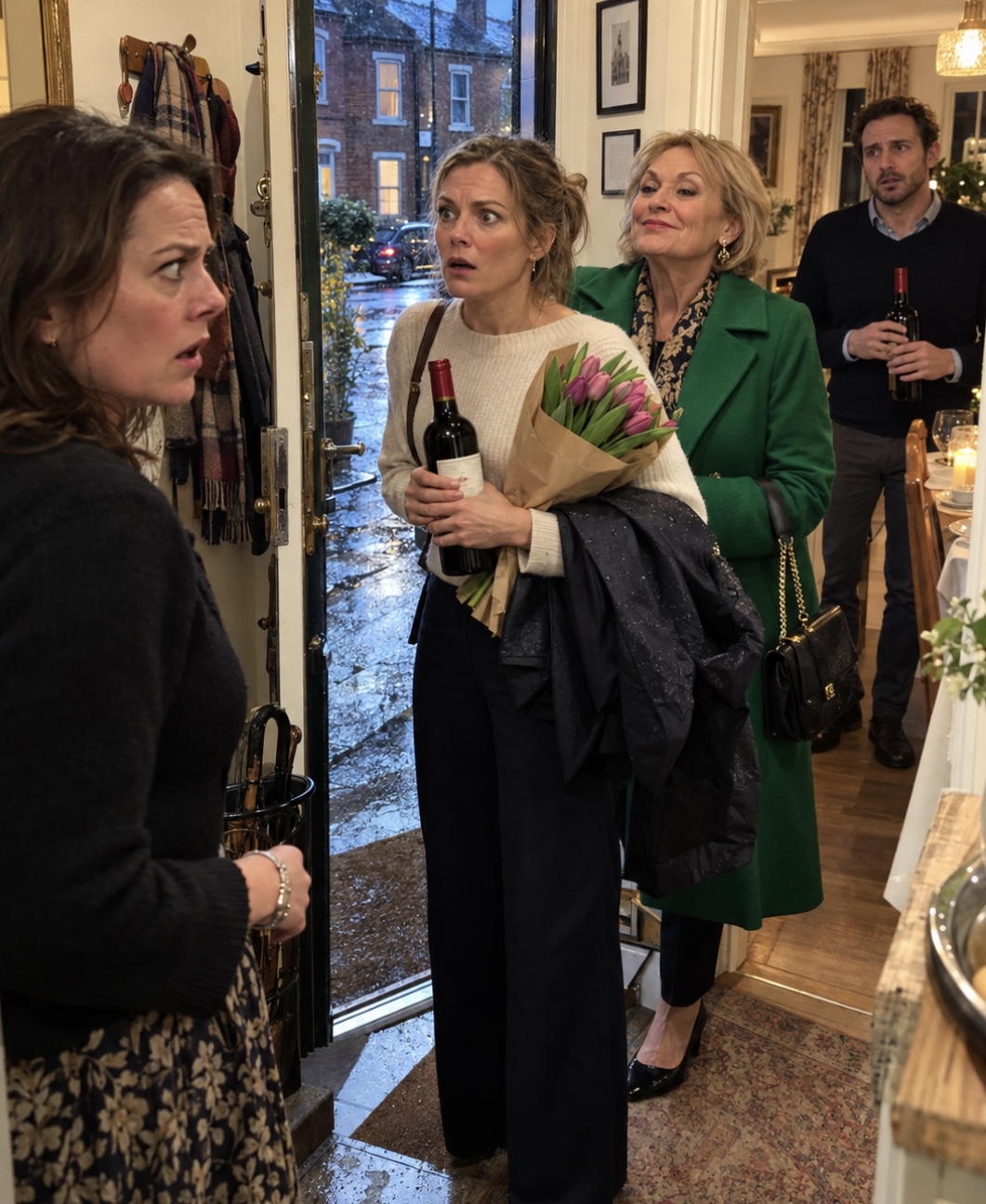
The woman standing just inside our front door was probably in her late thirties. Tall, dark blonde hair tied loosely at the back, navy trousers, cream jumper, rain on her shoulders. She held a bottle of red wine in one hand and a bunch of supermarket tulips in the other.
Her face changed the second she saw me.
Not confusion.
Recognition.
“Emma?”
Patricia turned.
“You know each other?”
The woman stared at me.
“Oh my God.”
I hadn’t seen her for nearly nine years, but I recognised her too.
“Rachel.”
Daniel came into the hall.
“Who’s Rachel?”
Patricia looked annoyed now, as though reality had deviated from her seating plan.
Rachel gave a strange laugh.
“Well. This is awkward.”
“That depends,” I said. “Why are you here?”
Patricia answered for her.
“I invited her.”
Rachel’s eyes flicked toward Patricia.
“You said this was a small family dinner.”
“It is.”
“You didn’t mention Emma.”
“Why would I?”
Rachel slowly lowered the flowers.
“Because Emma used to be my boss.”
Daniel looked between us.
“What?”
“Not exactly,” I said.
Rachel exhaled.
“No. Not exactly.”
Patricia clapped her hands once.
“Well, isn’t this funny? Bristol is such a village.”
Nobody laughed.
Then she said the sentence that made the entire evening impossible to misunderstand.
“I was telling Daniel only last week that Rachel is exactly the sort of woman he should have married. In fact, I told him I’d already chosen his next wife.”
Daniel went white.
“Mum!”
Patricia waved him away.
“Oh, don’t look so dramatic. It was a joke.”
“You said it again in front of Emma.”
“Yes, because Emma understands humour.”
I put the bakery box down on the hall table.
“No. Emma understands English.”
Rachel’s expression hardened.
She looked directly at Patricia.
“You invited me here as a date for a married man?”
Patricia frowned.
“Don’t be ridiculous. I invited you to dinner. Whatever happens after that is entirely up to grown adults.”
Daniel muttered something I had never heard him say to his mother before.
Patricia ignored him.
What bothered me most, though, wasn’t her performance.
It was Rachel.
Because Rachel wasn’t embarrassed in the way a stranger would have been.
She looked frightened.
And she kept glancing at me as if she was waiting for me to mention something.
Something neither Patricia nor Daniel knew.
We went back into the kitchen because standing in the hall forever would not improve anything. Patricia insisted on serving wine as though she had merely brought an extra guest, and Daniel spent several minutes opening and closing drawers without actually finding anything.
Rachel sat opposite me.
I could feel her watching.
Finally Daniel said, “So how do you two know each other?”
Rachel rubbed her thumb against the stem of her glass.
“We worked at the same company.”
“Which company?”
“Harland Facilities.”
Daniel turned to me.
“You never mentioned her.”
“There were three hundred people there.”
Rachel gave a dry laugh.
“I wasn’t exactly forgettable.”
I met her eyes.
“No.”
Patricia leaned forward immediately.
“Oh?”
Rachel looked down.
“That was a long time ago.”
For the first time that evening, Patricia seemed delighted by genuine tension.
“Well now I absolutely have to hear this.”
“You really don’t,” I said.
Rachel took a sip of wine.
Daniel looked at me.
“What happened?”
“Nothing relevant to tonight.”
Rachel said quietly, “It might be relevant.”
That was the moment I knew she had not come only because Patricia had invited her.
She wanted something.
And whatever it was, she had decided the second she saw me that she might finally get it.
📖 What Rachel had been keeping for years was only beginning to surface — keep reading in the first comment. 👇
Patricia spent dinner trying to turn the evening into an interview.
She asked Rachel about her job, her flat in Clifton, whether she liked skiing, whether she cooked.
I nearly laughed when she asked that.
Rachel noticed.
“What?”
“Nothing.”
“No, go on.”
Patricia smiled brightly.
“Yes, Emma. Share.”
I put down my fork.
“Rachel once set fire to the staff microwave with a foil takeaway container.”
Daniel burst out laughing before he could stop himself.
Rachel covered her face.
“I’d forgotten that.”
“I hadn’t.”
Even I smiled.
For about ten seconds, the atmosphere became almost normal.
Then Patricia ruined it.
“Well, nobody’s perfect. Though Rachel’s clearly done very well for herself.”
Rachel looked at her.
“What exactly did you tell me about Daniel?”
Patricia paused.
Daniel froze.
Rachel continued.
“You said he was separated.”
The room went silent.
I looked at Daniel.
He stared at his mother.
“Mum.”
Patricia’s face barely moved.
“I said things were difficult.”
“You said separated,” Rachel replied.
“I may have said effectively separated.”
“You also said Emma had moved out.”
My hands went cold.
Daniel pushed his chair back.
“What the hell?”
Patricia’s composure finally cracked.
“Oh, for heaven’s sake, must everyone be so literal?”
“Yes,” I said. “In this particular situation, I think literal would be useful.”
Daniel stood.
“We are not separated.”
Patricia sighed.
“You’re unhappy.”
“According to who?”
“According to your face every time I see you.”
“I’m tired because I work.”
“You barely speak about her.”
“I don’t discuss my marriage with you because you do things like this.”
Patricia’s mouth tightened.
“Fine. Attack me.”
Rachel stood too.
“I should go.”
I surprised myself.
“No. Stay.”
Everyone looked at me.
Rachel slowly sat back down.
I turned to her.
“You recognised me before you recognised the situation. Why?”
She stared at the untouched food on her plate.
Then she reached into her handbag.
“I didn’t know if I should contact you.”
Patricia looked suddenly alert.
“About what?”
Rachel pulled out a brown envelope.
It had my name written on it.
Not printed.
Written.
In black ink.
Emma Clarke.
Daniel frowned.
“What is that?”
Rachel placed it on the table between us.
“I found it six weeks ago.”
“Where?”
“In my mother’s house.”
My stomach tightened.
Rachel’s mother, Susan, had also worked at Harland Facilities. Payroll department. Quiet woman. Kind eyes. Always wore colourful scarves and brought homemade shortbread at Christmas.
She had died that spring.
I knew because someone from the old office had posted about it online.
Rachel pushed the envelope toward me.
“My mum kept it in a file marked ‘2017 grievance.’”
Daniel looked at me.
“What grievance?”
I didn’t answer.
Because suddenly I remembered.
The year I left Harland.
The year everyone thought I had resigned because I’d been offered better money elsewhere.
That was only half true.
Rachel looked at Patricia.
“I think you need to stop talking for a bit.”
Patricia’s face went stiff.
“This is my son’s house.”
“No,” I said. “It’s our house.”
Rachel nodded toward the envelope.
“And that is exactly why this matters.”
I opened it.
Inside were photocopies.
Emails.
Expense records.
Two witness statements.
And a handwritten letter from Susan.
The first sentence made me stop breathing for a second.
Emma, I owe you the truth about what happened after you left.
Daniel leaned closer.
“What is it?”
Nine years earlier, I had been a junior operations supervisor at Harland. Rachel had worked under me on a temporary contract. She was clever, fast and chaotic. She was also being blamed for missing petty cash from a project office.
One thousand eight hundred pounds disappeared over three months.
The regional manager, Colin Mercer, claimed Rachel had signed for part of it.
She denied it.
I believed her.
Not because I liked her—we argued constantly—but because the numbers did not fit.
I began checking invoice dates and expense approvals.
Then I found something worse.
Colin had been moving money between supplier accounts and petty cash reports to cover private expenses. Football tickets. Hotels. Restaurants. Fuel.
When I raised it with HR, I was told not to make accusations without proof.
Three days later, I was accused of accessing confidential payroll records without authorisation.
I hadn’t.
But someone had used my login.
I was given a choice: formal disciplinary investigation or a confidential exit agreement with a neutral reference.
I took the exit.
I was twenty-nine, terrified, paying rent alone, and convinced that fighting would ruin my career.
I never told Daniel the full story. We had only been dating for a year.
I told him there had been “office politics.”
Eventually, I stopped thinking about it.
Or tried to.
Rachel had been dismissed two months later.
That part I had not known.
I looked up at her.
“You lost your job?”
She nodded.
“They said the missing money still pointed to me.”
“But Colin—”
“Got promoted.”
Daniel swore softly.
Patricia shifted in her chair, obviously irritated that nobody was discussing her romantic matchmaking anymore.
I unfolded Susan’s letter.
She had discovered the truth later.
Payroll access logs proved the login used to frame me had come from Colin’s desktop.
There were also reimbursement forms authorised under codes he should not have had.
Susan reported it internally.
Nothing happened.
Then, years later, the company was bought by a larger facilities group. Old records were reviewed during an audit.
Colin quietly resigned.
No police.
No apology.
No letter to me.
No correction for Rachel.
Susan had copied everything before retirement.
Rachel spoke carefully.
“Mum wanted to contact you. She never did. She thought you’d want to forget it.”
“I did want to forget it.”
“I know.”
“Then why bring this tonight?”
“I didn’t bring it tonight.”
I looked at the envelope.
Rachel shook her head.
“It was already in my handbag because I’ve been carrying it around for weeks like an idiot. I kept thinking I’d post it.”
Daniel sat down slowly.
“So this has nothing to do with my mother?”
Rachel gave him a humourless smile.
“Your mother found me on LinkedIn.”
Patricia stiffened.
“She was recommended to me.”
“By whom?”
Patricia hesitated.
Rachel answered.
“Someone from her bridge club knows my aunt.”
That was so aggressively Patricia that I almost laughed.
Rachel continued.
“She messaged me. Told me about her son. Said his marriage had basically ended but he hadn’t ‘found the courage to formalise it.’”
Daniel looked physically sick.
“Mum, what is wrong with you?”
Patricia finally raised her voice.
“What is wrong with me? I’m trying to stop you wasting your life!”
“With my wife?”
“You’re miserable!”
“No. I’ve been stressed.”
“You never used to be like this.”
“Because seven years ago I didn’t have a mortgage, twelve people reporting to me, and a mother conducting recruitment interviews for my replacement wife!”
Rachel looked at me.
“I’m really sorry.”
I believed her.
That surprised me.
Patricia pushed back from the table.
“This is absurd. I was only trying to introduce two people.”
“One of whom is married,” Rachel said.
“One of whom is my son.”
“That doesn’t improve it.”
Patricia grabbed her handbag.
Then she turned on me.
And that was when the real reason behind months of comments finally came out.
“You knew.”
I frowned.
“Knew what?”
“That he wanted children.”
Daniel went still.
I looked at him.
Of all the subjects Patricia could have chosen, she had found the one we had avoided for nearly two years.
Not because of infertility.
Not because of tragedy.
Because Daniel had changed his mind.
When we married, neither of us wanted children.
At thirty-eight, he had begun to wonder if he did.
I still didn’t.
We had talked about it carefully, painfully, honestly.
No decision had been made.
And apparently Daniel had told his mother.
My voice dropped.
“You discussed that with her?”
Daniel looked ashamed.
“Once.”
Patricia jumped in.
“He needs a family.”
“He has a family.”
“You know what I mean.”
“Yes,” I said. “I do.”
Rachel stood.
“No. I’m leaving.”
This time I didn’t stop her.
Patricia’s voice followed her.
“You told me you wanted children!”
Rachel turned in the doorway.
“I said I might want children. I did not say I wanted yours.”
I actually laughed.
Daniel did too.
Patricia did not.
Rachel put on her coat, then came back to the table for one second.
She tapped the envelope.
“There’s a solicitor’s name on the last page. Mum spoke to her before she died. She thought both of us might be entitled to have our employment records corrected. Possibly compensation. I don’t know.”
I stared at her.
“Why didn’t you just email me?”
Rachel smiled faintly.
“Because nine years ago I accused you of protecting management.”
I remembered.
She had screamed it at me in the car park on my last day.
I had been too frightened to tell her I had tried to protect her.
“I was wrong,” she said. “Mum found out you were the only person who tried.”
Then she left.
Patricia followed ten minutes later, but not before Daniel asked for her key to our house.
She stared at him as if he had slapped her.
“You’re serious?”
“Yes.”
“I’m your mother.”
“I know.”
“You’re choosing her over me?”
Daniel looked at me, then back at Patricia.
“No. I’m choosing boundaries over chaos.”
She left without the bakery box.
For almost a minute after the door closed, neither of us spoke.
Rain ticked against the kitchen window.
The chicken was cold.
The cauliflower cheese had developed a skin.
Daniel sat down opposite me.
“I didn’t know she was doing this.”
“I believe you.”
He looked relieved.
“I’m still furious with you.”
The relief vanished.
“For telling her about the children thing?”
“Yes.”
“I know.”
“And for not shutting this down earlier.”
“I thought ignoring her would make it stop.”
“It made her think she had room.”
He nodded.
There wasn’t much else to say that night.
The strange part was that Patricia’s disastrous dinner did not destroy our marriage.
It forced us to stop being vague.
Within a month, Daniel and I started seeing a counsellor—not because Patricia told us we were unhappy, but because we had two real questions we had been avoiding.
Children.
And whether love was enough if two people’s futures had started pointing in different directions.
The answer was not romantic.
It was honest.
Six months later, Daniel moved into a rented flat twelve minutes away.
There was no affair.
No screaming.
No dramatic betrayal.
We simply accepted something before resentment could turn it ugly.
He wanted the possibility of becoming a father.
I knew, finally and completely, that I did not want to become a mother.
We separated kindly.
A year later, we divorced.
Patricia told people I had “refused to give Daniel a family.”
Daniel corrected her every single time.
As for Rachel, the envelope changed both our lives in a quieter way.
Harland’s parent company eventually reviewed the records. They issued written corrections to both our employment files and paid confidential settlements after mediation.
It wasn’t a fortune.
It wasn’t revenge.
But nine years after being told I had imagined what happened, I received a letter stating that I had acted in good faith and should never have been placed under disciplinary threat.
Rachel received one clearing her of responsibility for the missing money.
We met for coffee after signing the final documents.
She raised her cup.
“To Patricia.”
I nearly choked.
“Absolutely not.”
Rachel laughed.
“Come on. Without her, I might still be carrying that envelope around.”
“That does not make her a hero.”
“No. Definitely not.”
She stirred her coffee.
“Still. Life is strange.”
It was.
Especially because two years after that dinner, I received a Christmas card from Daniel.
There was a photograph inside.
Daniel, smiling beside a woman I had never met, holding a baby girl in a knitted red hat.
For one terrible second, I thought Patricia had finally got what she wanted.
Then I turned the card over.
Daniel had written:
Her name is Sophie. Anna and I are exhausted and happy. Mum tried to suggest three other names, so naturally we ignored all of them.
Underneath, in different handwriting, Anna had added:
I’ve been warned about Patricia.
I laughed so hard I had to sit down.
Then I noticed one final line from Daniel at the bottom.
By the way, Mum still claims she has “excellent instincts about women.”
I looked across my flat at the framed letter from Harland that I had kept not because I was bitter, but because I wasn’t ashamed anymore.
Patricia had once announced that she had chosen my replacement.
Instead, the woman she brought to replace me returned a piece of my past I thought I had lost forever.
And in the end, nobody got the future Patricia had planned for them.
Which was probably the healthiest thing that happened to any of us.