



The first thing I noticed was not what my mother-in-law said.
It was my husband’s face.
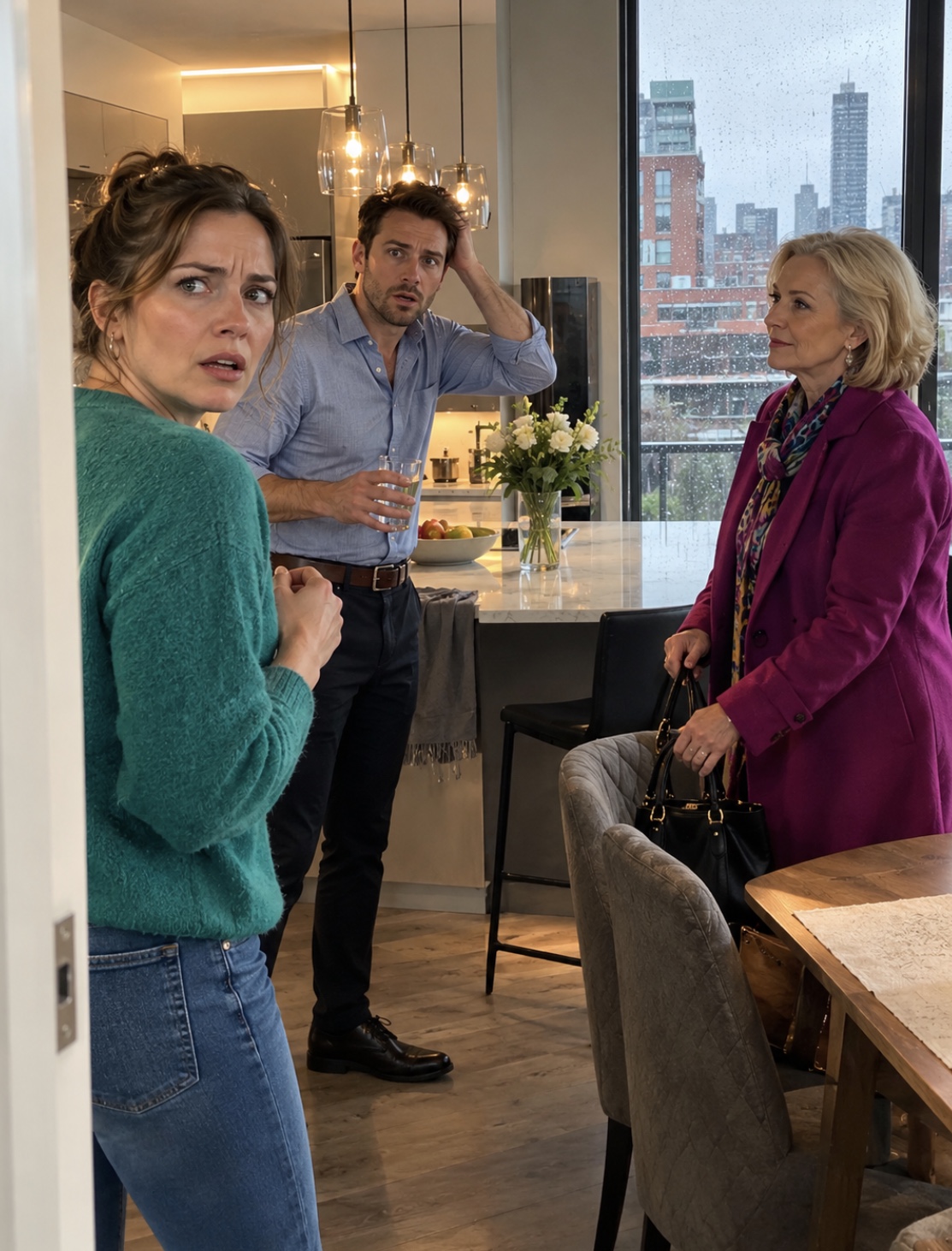
One second, Luke was standing beside the kitchen island in our flat in Manchester, opening a bottle of sparkling water. The next, his hand stopped halfway to the glass, and all the colour drained from his cheeks.
His mother, Patricia, either didn’t notice or pretended not to.
“I’ve already found a buyer for your apartment,” she said calmly.
She placed her handbag on one of our dining chairs and began taking off her gloves.
Outside, November rain tapped against the windows. The heating had been running all afternoon, but suddenly the room felt cold.
I looked at her.
Then at Luke.
“What buyer?”
Patricia gave me the kind of patient smile people use when they think you’re being deliberately slow.
“For the flat, Emma. A very decent couple. Cash buyers, apparently. They’re renting in Didsbury at the moment and want something closer to the city centre.”
I laughed once.
Not because anything was funny.
Because my brain had rejected the sentence.
“Our flat isn’t for sale.”
Patricia’s eyes flicked toward Luke.
Only for a moment.
But I saw it.
And so did he.
Luke put the bottle down too quickly. It struck the counter with a hard crack.
“Mum,” he said quietly. “What exactly have you done?”
That was when I stopped looking at Patricia.
I looked at my husband.
Not angry yet.
Not frightened.
Just alert.
There are moments in a marriage when you realise the conversation happening in front of you began long before you entered the room.
This was one of them.
Patricia removed her coat and draped it neatly over the back of the chair.
“I haven’t done anything dramatic,” she said. “I spoke to someone I know. That’s all.”
“Who?”
“Daniel Kerr.”
Luke shut his eyes.
I knew the name.
Not personally, but enough.
Daniel worked for a small independent estate agency in Sale. He had sold Patricia’s house after Luke’s father died five years earlier. Patricia still mentioned him occasionally because, according to her, he had achieved “twenty thousand over what the neighbours said it was worth.”
I folded my arms.
“You spoke to an estate agent about selling our home?”
“I asked him what it might fetch.”
“Why?”
Patricia sighed.
“Emma, please don’t make this theatrical.”
Luke looked at her sharply.
“Mum.”
She ignored him.
“You two are sitting on an asset that has increased substantially in value. You keep complaining that you need more space. You’ve talked about moving.”
“We talked about moving in maybe two years,” I said. “Not selling next week.”
“The couple are prepared to move quickly.”
My stomach tightened.
“What couple?”
Patricia opened her handbag.
Luke stepped forward.
“No.”
The word came out harder than I had ever heard him speak to her.
Patricia froze.
Luke stared at the bag.
“What’s in there?”
She stared back.
Neither of them moved.
And suddenly I understood something.
Whatever was happening, Luke knew more than I did.
“Luke,” I said.
He turned toward me.
I had been married to him for six years. I knew his embarrassed face, his guilty face, his worried face, the face he made when he’d forgotten to pay the council tax or left wet clothes in the washing machine overnight.
This was different.
This was fear.
“Tell me,” I said.
He rubbed both hands over his face.
Patricia sat down.
“Oh, for heaven’s sake.”
“Don’t,” Luke snapped.
The sharpness of it startled all three of us.
He pulled out the chair opposite his mother but remained standing behind it.
“Emma, there’s something I should have told you.”
Every muscle in my back stiffened.
Patricia immediately said, “It isn’t nearly as serious as he’s making it sound.”
“That’s not your decision,” Luke said.
I stared at him.
“What should you have told me?”
He opened his mouth.
Nothing came out.
Patricia did it for him.
“The deposit.”
I felt my shoulders drop slightly.
“The deposit?”
“When you bought this place.”
Luke looked sick.
Patricia continued.
“Part of the deposit came from me.”
I frowned.
“No, it didn’t.”
Luke and I bought the flat four years after we married. I had put in £29,000 from savings and a small inheritance from my grandmother. Luke had put in £31,000 from what he told me was money saved from bonuses, investments, and the sale of some shares from his old job.
The mortgage was in both our names.
The property was in both our names.
We split every payment equally.
At least, that was what I believed.
Patricia crossed one leg over the other.
“Luke’s £31,000 wasn’t entirely his.”
I turned to him.
“How much?”
He swallowed.
“Twenty-four.”
“Twenty-four hundred?”
He didn’t answer.
My chest tightened.
“Luke.”
“Twenty-four thousand pounds.”
The room went completely still.
I could hear the fridge humming.
I looked at Patricia.
“You gave him twenty-four thousand?”
“Yes.”
“As a gift?”
Patricia glanced toward Luke.
He looked at the floor.
My stomach dropped.
“As a loan?” I asked.
No one answered.
“Luke?”
He pulled the chair out and finally sat down.
“Mum gave me the money when we were struggling to get the mortgage approved at the amount we wanted.”
“We weren’t struggling,” I said.
“The affordability check changed after the interest-rate adjustment.”
“I remember. We reduced the offer.”
“I didn’t want to lose the flat.”
“So you borrowed £24,000 from your mother and didn’t tell me?”
“It wasn’t supposed to be a loan.”
Patricia shifted in her chair.
“That isn’t quite accurate.”
Luke turned on her.
“You said I could treat it as my early inheritance.”
“I said we would sort it out later.”
“No. You said, ‘Your father would want you to have it.’”
“And your father would also have expected some responsibility.”
My pulse began pounding in my ears.
“How long have you two been discussing this?”
Luke looked at me.
“Not long.”
Patricia said at exactly the same time, “Since August.”
It was November.
I stepped away from the kitchen island.
“Three months?”
Luke stood again.
“Emma—”
“Don’t touch me.”
He stopped.
Patricia exhaled dramatically.
“This is precisely why Luke didn’t tell you straight away.”
I turned to her.
“Straight away?”
She realised too late that she’d said too much.
I looked back at Luke.
“There’s more.”
He said nothing.
“There is, isn’t there?”
📌 What Luke admitted next changed the meaning of everything Patricia had just said — keep reading below.
Luke sat back down.
“In August Mum told me she needed some of the money returned.”
“Some?”
“Fifteen thousand.”
“For what?”
Patricia answered.
“That is personal.”
I laughed again.
“This entire conversation is about selling my home to repay money I didn’t know existed, but your reason is personal?”
“It involves my finances.”
“And this involves mine.”
Luke spoke quickly.
“She said she needed it because she was helping Claire.”
Claire was Luke’s younger sister.
Thirty-four, divorced, one son, and permanently surrounded by financial emergencies that somehow always became Patricia’s emergencies too.
I closed my eyes for a moment.
“Helping Claire with what?”
Patricia looked offended.
“She’s trying to start again.”
“That’s not an answer.”
Luke said, “She wants to buy the house she’s renting.”
“How much does she need?”
He hesitated.
“Thirty thousand.”
I looked at Patricia.
“And you thought fifteen of that should come from us?”
“It isn’t coming from you. It’s money I gave Luke.”
“Four years ago.”
“Yes.”
“With no written agreement?”
Patricia’s expression changed.
Only slightly.
But I saw it.
Luke saw it too.
“What?” he asked.
She reached for her handbag.
This time Luke didn’t stop her.
She took out a cream folder.
My heart began beating faster.
Patricia laid three sheets of paper on the table.
The first was a bank transfer confirmation from 2022.
£24,000.
From Patricia’s account to Luke’s.
The second was a typed document.
I picked it up.
At the top, it said:
FAMILY LOAN AGREEMENT.
Borrower: Luke Harrison.
Lender: Patricia Harrison.
Amount: £24,000.
Repayment: upon sale or refinancing of the property purchased using the funds, or upon written request by the lender.
At the bottom was Luke’s name.
And a signature.
I looked at him.
“You signed this?”
His face had gone from pale to grey.
“No.”
Patricia stiffened.
“Luke.”
He grabbed the document.
“I have never seen this.”
“Oh, don’t be ridiculous.”
“I’ve never seen it.”
“It was done when I transferred the money.”
“No, it wasn’t.”
“You signed it at my house.”
“I did not.”
Their voices were rising.
I took the document from Luke and looked at the signature again.
It resembled his.
But after six years of signing mortgage papers, birthday cards, delivery forms, passport renewals and every other boring piece of adult life together, I knew his signature.
Luke always looped the H in Harrison back into the first r.
This signature didn’t.
“Where did you get this?” I asked.
Patricia’s mouth tightened.
“It’s genuine.”
“That wasn’t my question.”
“It was prepared at the time.”
“By who?”
“A solicitor.”
“Which solicitor?”
She paused.
Luke laughed bitterly.
“Mum.”
Patricia stood.
“I am not going to sit here and be interrogated.”
“Yes, you are,” I said.
For the first time, she looked at me with something other than irritation.
I pulled the third sheet closer.
It was an email printed from several weeks earlier.
From Daniel Kerr, the estate agent.
The subject line read:
Indicative buyer interest – Deansgate apartment.
The email said a private buyer might be willing to make an offer around £410,000 subject to viewing and confirmation of ownership.
Confirmation of ownership.
I read the phrase twice.
Then I looked up.
“You gave an estate agent our address.”
Patricia said nothing.
“You told him we were considering selling.”
Nothing.
“You showed him this loan agreement, didn’t you?”
Luke stared at her.
Patricia’s confidence finally cracked.
“I simply demonstrated that I had a financial interest.”
“You don’t have a financial interest in the property,” I said.
“If my money helped purchase it, I certainly do.”
“That is not how property ownership works.”
“You aren’t a solicitor.”
“No, but our names are on the Land Registry, yours isn’t.”
She picked up the papers.
Luke took them from her.
“No. These stay here.”
Her face changed instantly.
“Give those back.”
“No.”
“Luke.”
“No.”
He held the folder against his chest.
“For the first time tonight, I need to know what’s true.”
Patricia looked at him as if he had betrayed her.
I almost felt sorry for her.
Almost.
She left ten minutes later after telling Luke he was being manipulated and telling me I was “very clever at turning things around.”
Luke didn’t answer.
When the door closed, I walked into the bedroom.
He followed.
“Emma.”
I opened the wardrobe and pulled down an overnight bag.
“What are you doing?”
“I’m going to my sister’s.”
“Please don’t.”
“I need to think.”
“I can explain.”
“You’ve been explaining for an hour.”
“I mean the money.”
I dropped the bag onto the bed.
“Fine.”
He leaned against the doorframe.
“When we found this flat, I wanted it more than I should have. You’d already put your grandmother’s money into the deposit. I didn’t want you to think I couldn’t match what you were bringing.”
I stared at him.
“So you lied because your ego was embarrassed?”
“Yes.”
The simplicity of the answer stopped me.
He didn’t defend himself.
“I told Mum I needed help. She transferred the £24,000. She said Dad would have wanted me to have it. There was no paperwork. No repayment schedule. Nothing.”
“Why didn’t you tell me later?”
“Because every month that passed made it worse.”
“That is not an explanation.”
“I know.”
“And August?”
He sat on the edge of the bed.
“She called me and said she wanted £15,000 back. I told her we didn’t have it sitting around. She said we should remortgage.”
“And you said?”
“No.”
“Then?”
“She started sending me property valuations. She said if we sold this place, after clearing the mortgage, we could buy somewhere cheaper outside Manchester and repay her.”
“You discussed selling our home with her.”
“I argued about selling our home with her.”
“Without telling me.”
“Yes.”
I zipped the bag harder than necessary.
He looked exhausted.
“There’s one more thing.”
I stopped.
Of course there was.
He pulled out his phone and opened his banking app.
Then he showed me a transfer.
£8,000.
Sent three weeks earlier.
To Patricia Harrison.
I stared at the screen.
“You gave her eight thousand pounds?”
“From my personal savings.”
“We’re married, Luke.”
“I know.”
“Eight thousand pounds isn’t personal-savings territory.”
“I know.”
“Why?”
“To make her stop.”
I looked at him.
“Did it work?”
He gave a humourless laugh.
We both knew the answer.
I stayed at my sister Rachel’s house for four nights.
During that time Luke did something I hadn’t expected.
He didn’t send endless messages.
He didn’t beg.
He didn’t blame Patricia.
He sent me one text the first night.
I’ve booked an appointment with a solicitor tomorrow. I’m going to find out exactly what Mum has done and I’ll send you everything. No excuses.
The next afternoon, he emailed me a scanned file.
The solicitor had confirmed what I already suspected: Patricia had no ownership rights over our flat. Even if the original £24,000 could somehow be proven to be a loan, she could seek repayment from Luke, but she couldn’t independently sell the property.
More importantly, the so-called loan agreement had problems.
The solicitor named on the document existed.
But his firm had not prepared it.
The reference number printed at the bottom belonged to an unrelated conveyancing matter from two years later.
Luke called Patricia.
He put the conversation on speaker with his solicitor’s permission and recorded it.
I wasn’t there.
He played it for me later.
At first Patricia denied everything.
Then she claimed Daniel had misunderstood.
Then she said Claire had helped “tidy up” the paperwork because Luke was being difficult.
That sentence led to the real story.
And the real story was stranger than anything I had guessed.
Claire had not asked Patricia for £30,000.
She had asked for £5,000.
Her landlord was selling the house she rented, but Claire had no intention of buying it. She needed money for a deposit, moving costs and some old credit-card debt before applying for a different rental.
Patricia had decided Claire should buy.
Without telling Claire.
She calculated that if Luke repaid £15,000, Patricia added another £10,000, and Claire somehow found the remaining £5,000, they could create enough of a deposit to approach a broker.
Claire had refused.
So Patricia began planning around her.
The fake loan agreement had not been created because Patricia wanted to sue Luke.
It had been created to pressure him.
And the “cash buyers” did not exist.
Not exactly.
Daniel had mentioned one couple looking for flats in our building.
Patricia had transformed that casual information into a supposedly ready buyer because she believed that if Luke felt a sale could happen quickly, he might agree.
But one question remained.
Why had Luke turned so pale the instant Patricia mentioned the buyer?
I asked him that when I returned home.
He was sitting at our dining table with every bank statement from the previous four years printed and arranged in folders.
The sight would have been funny under different circumstances.
“Because I’d called Daniel two weeks before,” he admitted.
My stomach tightened again.
“You did what?”
“Not to sell.”
“Then why?”
“To ask what the flat was worth.”
I stared at him.
He continued quickly.
“I was panicking. Mum kept saying I owed her money. I knew you’d never agreed to the loan. I knew I’d lied. I thought if the flat had increased enough, maybe there was a way to release equity, pay Mum something, and tell you afterwards.”
For several seconds I couldn’t speak.
There it was.
Not Patricia’s manipulation.
Not Claire.
Not the forged document.
The part that belonged entirely to my husband.
“You considered borrowing against our home without telling me.”
“I considered it.”
“Did you do anything?”
“No.”
“Did you fill out forms?”
“No.”
“Speak to a broker?”
“No.”
“Why did you stop?”
He looked at me.
“Because I heard myself explaining it to Daniel.”
I said nothing.
“He asked whether you agreed to the valuation. I said I hadn’t discussed it with you yet. There was this silence on the phone. Then he said, ‘Luke, I wouldn’t go further without talking to your wife.’”
He rubbed his face.
“I realised I was becoming Mum.”
That sentence landed harder than anything else he had said.
Not because it excused him.
Because it didn’t.
For the next month, our marriage became very boring.
And that saved it.
There were no dramatic reconciliations.
No flowers.
No weekend away.
We sat at the kitchen table every Sunday evening with bank statements.
We listed every account.
Every savings pot.
Every old debt.
Every subscription.
Every transfer over £500 for the previous four years.
Luke contacted his bank and changed all his passwords because Patricia had once helped him manage an account after his father died and he couldn’t remember what information she still knew.
We saw a couples therapist twice a month.
Luke transferred nothing else to Patricia.
He also asked her, in writing, to confirm whether she believed the remaining £16,000 was a genuine debt.
Her reply was three pages long.
Most of it was about respect.
None of it answered the question.
Then, just before Christmas, something unexpected happened.
Claire came to our flat.
Alone.
I had always assumed she knew more than she admitted.
I was wrong.
She sat at our table crying with embarrassment.
“I didn’t ask her to do any of this.”
“I know,” I said.
“She told me Luke had offered to help.”
Luke closed his eyes.
Claire looked at him.
“She told me you wanted to sell and move closer to her.”
“What?”
“She said Emma wanted a house anyway.”
I almost laughed.
Patricia had created three separate versions of reality and handed each of us a different one.
Then Claire took an envelope from her handbag.
Inside was a cheque for £4,000.
Luke stared at it.
“What’s this?”
“The money Mum gave me last month.”
He pushed it back.
“No.”
Claire pushed it toward him again.
“She said it was from you.”
His expression changed.
“She gave you four thousand of the eight I transferred?”
Claire nodded.
“I haven’t spent it.”
Luke looked at me.
And suddenly the whole structure became clear.
Patricia had demanded repayment because she wanted to help Claire.
Luke had secretly sent £8,000.
Patricia had given half to Claire while claiming Luke had offered it voluntarily.
Then she continued demanding more.
Not because there was a debt.
Because once Luke paid something, Patricia could treat that payment as proof the debt existed.
The £8,000 wasn’t merely money.
It was leverage.
The following week Luke’s solicitor sent Patricia a formal letter stating that the payment had been made under family pressure and did not constitute acknowledgement of any loan agreement.
Patricia called seventeen times that evening.
Luke didn’t answer.
Instead, he sent one message.
We will talk when you’re ready to tell the truth without changing it depending on who is in the room.
She didn’t contact us for six weeks.
In February, a handwritten letter arrived.
Not from a solicitor.
Not from an estate agent.
From Patricia.
She admitted there had never been a signed agreement.
She admitted creating the document with Claire’s old printer after finding a family-loan template online.
She admitted exaggerating the buyer.
She did not apologise for everything.
That would have been too easy.
She wrote that she had panicked because she believed Claire was “falling behind in life” and Luke was “the only one in the family with enough stability to help.”
But near the end was one sentence I read three times.
I kept telling myself I was protecting my children when what I was actually doing was deciding things for them.
Luke cried when he read it.
I didn’t.
My anger had changed by then.
It had become quieter.
More useful.
We didn’t forgive Patricia immediately.
We also didn’t cut her off forever.
For nearly four months, we saw her only in public places.
Coffee shops.
Restaurants.
Once, a garden centre where she spent twenty minutes talking about hydrangeas because none of us knew how to begin discussing the actual problem.
Eventually, boundaries became ordinary.
She stopped receiving information about our savings.
She stopped having a spare key.
She stopped being included in conversations about property.
And Luke stopped using silence as a way to delay conflict.
The £8,000 was harder.
Claire returned the £4,000 Patricia had passed to her.
Patricia returned another £2,000 over the next three months.
The final £2,000 Luke told her not to repay.
At first I was furious.
Then he explained why.
“I want there to be no amount left between us,” he said. “Not owed. Not expected. Not remembered every Christmas.”
I understood.
A year later we did sell the flat.
That was the part Patricia found hardest to believe.
We sold it because we wanted to.
Together.
The market had risen, my job had become partly remote, and we found a three-bedroom semi-detached house near Altrincham with a tiny garden, a terrible bathroom and a kitchen we loved immediately.
When we accepted the buyer’s offer, Luke and I were sitting on the floor eating takeaway because we had already packed the dining table.
His phone buzzed.
A message from Patricia.
Claire must have told her.
Luke showed it to me.
Congratulations. I hope the move goes smoothly. I promise I am not arranging the removal company.
I laughed.
Luke did too.
Then he became serious.
“Do you think that’s progress?”
I took another chip from the box.
“Ask me when she doesn’t request our new postcode before we’ve moved.”
He smiled.
But there was one last detail neither of us had expected.
Two days before completion, Daniel, the estate agent Patricia had originally contacted, called Luke.
He wanted to know whether we had sold.
Luke said yes, through a completely different agency.
Daniel laughed.
“Probably for the best.”
Then he paused.
“There’s something I always wondered.”
“What?”
“When your mum called me last year, she kept referring to the flat as yours.”
Luke frowned.
“It was ours.”
“I know. That’s why I asked her whether your wife was happy to sell.”
“What did she say?”
Daniel hesitated.
“She said, ‘Emma doesn’t need to know until there’s something worth agreeing to.’”
Luke told me that evening.
For a moment I expected to feel angry again.
Instead, I looked around our half-empty living room.
Boxes everywhere.
Pale rectangles on the walls where pictures had hung.
Four years of our life being dismantled and carried away piece by piece.
Then I looked at Luke.
“Funny,” I said.
“What is?”
“She was right about one thing.”
He waited.
“There was something worth agreeing to.”
He looked confused.
I pointed around the room.
“This.”
“Our move?”
“No.”
I took his hand.
“The fact that nobody gets to make decisions about our life before both of us are in the room.”
Luke squeezed my fingers.
Outside, rain streaked down the windows just as it had the night Patricia announced she had found a buyer for a home that had never been hers to sell.
This time, however, there were no secrets left inside it.
And when we locked the door for the final time, we both knew exactly who had made that decision.