



On my thirty-eighth birthday, my mother-in-law arrived at our house forty minutes late, carrying a bouquet of white lilies and a stiff envelope pressed tightly against her chest as though it contained court papers.
I knew the moment I saw her: she hadn’t come just to eat cake.
For four years, we had lived in a small terraced house in Suresnes, about twenty minutes from Paris when traffic was kind to us. I hadn’t planned anything elaborate for my birthday. Just a table in the garden, a leek quiche I had made that morning, roast chicken ordered from the neighborhood deli, two bottles of Burgundy, and a strawberry cake my husband, Thomas, had bought from the bakery down the street.
My sister Camille was there with her partner, along with two of Thomas’s friends and our neighbor from number 14, Mrs. Delmas.
Everyone called her Jeanne.
She was over seventy, with short silver hair and that very French ability to tell you terrible things in a perfectly calm voice.
“Your rosebush is going to die if you keep watering it at noon.”
“Your gate doesn’t close properly.”
“The fiber-optic technician left his van in front of my garage for thirty-seven minutes.”
But she was also the first person to feed our cat when we went away, collect our packages, or appear at the door with a still-warm cherry clafoutis because she had “made too much.”
My mother-in-law, Monique, had never liked her much.
I had never understood why.
Monique put the flowers on the sideboard without kissing me.
“Happy birthday, Claire.”
Then she looked at the table.
“You’ve already started?”
“We were waiting for you before dessert,” Thomas said.
“Oh.”
That single word already sounded like an accusation.
Monique removed her navy coat, folded it over the back of a chair, and finally placed the envelope in front of her.
I saw Thomas look at it.
His face went slightly pale.
The change was so subtle that no one else seemed to notice.
I did.
“What is it?” I asked him.
He shook his head.
“No idea.”
Monique smiled.
“Oh, I think you do.”
The mood around the table changed immediately.
Camille gave me a look that said, Here we go again.
It wasn’t the first time Monique had chosen a family gathering to settle some grievance.
At Christmas, she had asked in front of everyone why Thomas and I hadn’t given her a spare key to our house.
At Easter, she had explained that “some women gradually separate a son from his family.”
At my sister’s daughter’s christening, she had asked Thomas whether he intended to “finally become a father someday.”
I had learned not to react too quickly.
I served her a slice of strawberry cake.
“Can we just have a peaceful meal today?”
“That’s exactly why today is a very good day to talk,” she replied.
Thomas put down his fork.
“Mom.”
“What? I haven’t said anything yet.”
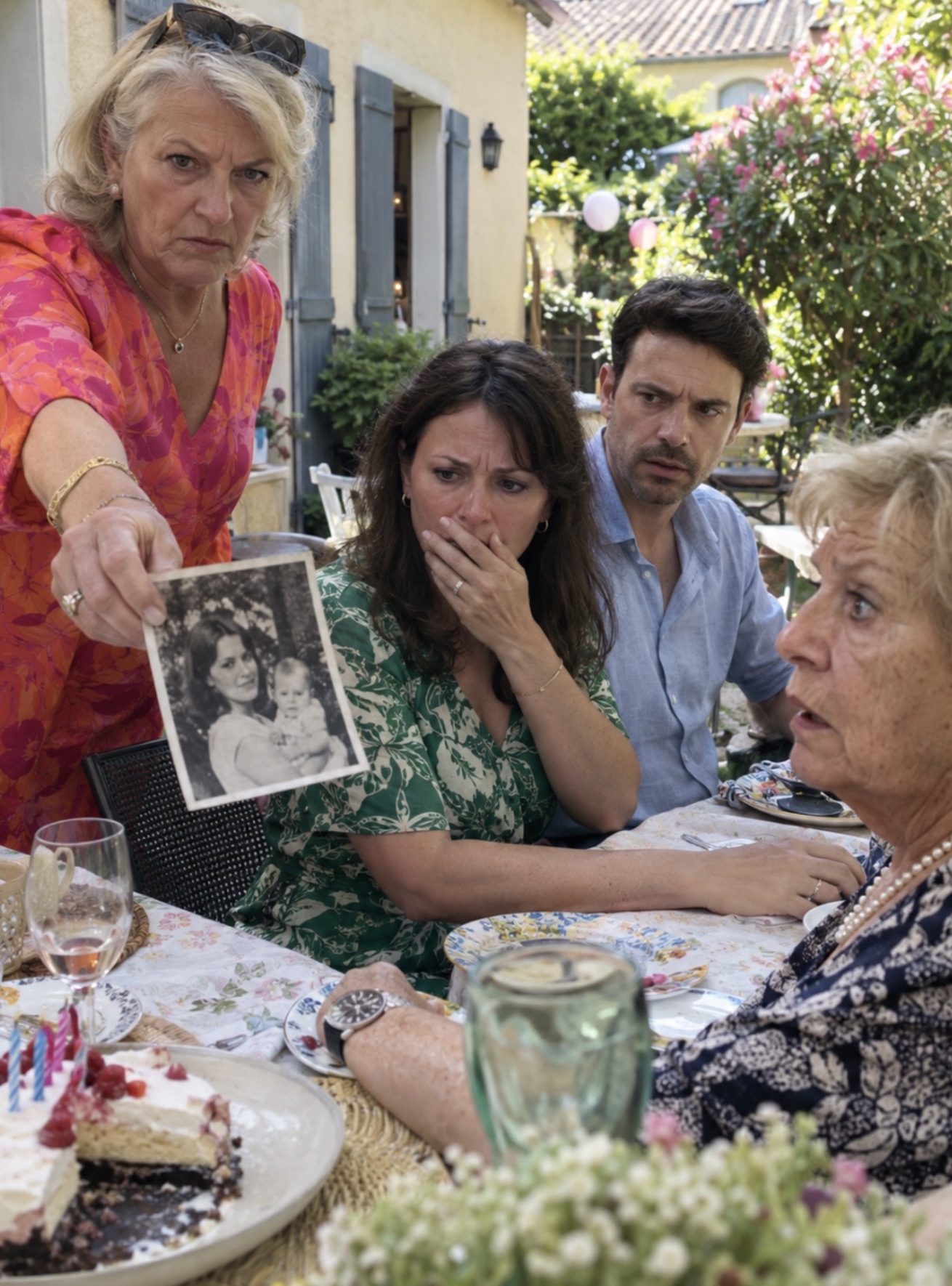
She opened the envelope.
From it, she pulled an old photograph.
Not a photocopy. Not a recent print.
A real glossy photograph, slightly yellowed around the edges.
Three people were standing in front of a house.
A young man.
A dark-haired woman in her thirties.
And a little boy.
I looked at Thomas.
The boy looked remarkably like him.
The same light-colored eyes.
The same dimple in his left cheek.
“Is that you?” I asked.
Thomas didn’t answer.
Monique picked up her glass.
“It’s time my daughter-in-law finally discovered who doesn’t belong here.”
Nobody moved.
All I could hear was a car passing in the street.
At first, naturally, I thought she meant me.
It fit her usual behavior perfectly.
I folded my arms.
“All right. Then explain.”
Monique placed one finger on the woman in the photograph.
“This woman’s name was Isabelle.”
Thomas suddenly stood.
“Mom, that’s enough.”
I had never seen my husband react like that.
His face had gone almost completely white.
“Sit down,” Monique said.
“You have no right to do this in my house.”
She gave a short laugh.
“Your house?”
Then she looked at me.
“You see, Claire? That’s exactly the problem. Ever since he’s been with you, everything has become ‘his house,’ ‘his life,’ ‘his decisions.’”
I was about to answer when Jeanne Delmas, who hadn’t said a word until then, leaned toward the photograph.
Her glasses slipped slightly down her nose.
She picked it up between two fingers.
And her expression changed.
“Where did you get this?” she asked.
Monique stiffened.
“That’s none of your concern.”
But Jeanne was no longer listening.
She was staring at the dark-haired woman.
For a long time.
Then she whispered:
“Isabelle Morel.”
Thomas closed his eyes.
Monique practically snatched the photograph from Jeanne’s hands.
“You’re mistaken.”
Jeanne slowly raised her head.
“No.”
The entire table was silent.
“I’m not mistaken. She lived in Rueil, on Rue des Bons-Raisins. A little house with green shutters. I worked with her for almost three years.”
Monique stood so quickly that her chair scraped across the patio stones.
“That’s enough.”
“No,” Jeanne replied. “I think this is just beginning.”
📩 What happened next took a turn nobody around that table could have imagined — the rest is waiting in the first comment. 👇
I looked at Thomas.
“Who is Isabelle?”
He ran a hand over his face.
“Claire…”
“Who is she?”
Monique immediately cut in.
“A woman who tried to destroy our family.”
Jeanne gave a small shake of her head.
“That isn’t how I remember her.”
Monique turned on her.
“You know nothing.”
“Maybe. But I know she often talked about her son.”
Thomas sat down again.
All the color had drained from his face.
I took his hand.
It was ice-cold.
“Thomas?”
He looked at his mother.
“What exactly were you planning to tell her?”
Monique pressed her lips together.
“The truth.”
“Which truth?”
“That some people enter a family and take a place that was never theirs.”
This time Camille spoke.
“Sorry, but none of us understands what you’re talking about.”
Monique stared at me.
“Claire thinks she knows her husband. She thinks everything began when she met him at thirty-two. But she knows nothing about what came before.”
“Mom,” Thomas said. “Stop.”
“No. You’ve refused to open your eyes your whole life.”
She pushed the photograph toward me.
“Isabelle was his mother.”
It felt as though someone had suddenly switched off every sound in the garden.
I looked at Thomas.
Then Monique.
Then the photograph.
“His mother?”
Monique gave me a hard smile.
“His biological mother.”
I couldn’t think of anything to say.
Thomas had never presented Monique as anything other than his mother.
His father, Gérard, had died of a heart attack eight years earlier. Monique appeared in every family photograph: holidays in Brittany, Thomas’s birthdays, his First Communion, his first days of school.
I had never seen Isabelle.
“Why did you never tell me?” I asked Thomas.
“Because I barely knew anything myself.”
Monique let out a short laugh.
“Of course.”
Thomas turned toward her.
“I was six when she left.”
“When she abandoned you.”
Jeanne put down her glass.
“That isn’t what she used to say.”
Monique glared at her.
“Will you stop interfering?”
“Not if you’re using a dead woman to humiliate someone on her birthday.”
A chill ran down my spine.
“She’s dead?”
Thomas nodded.
“She died fifteen years ago.”
“You knew?”
“I received a letter after she died.”
Monique froze.
I didn’t miss it.
“What letter?” she asked.
Thomas looked at her.
“The one Dad gave me.”
The silence that followed was even heavier.
Monique slowly sat down.
“Gérard gave you a letter?”
“Yes.”
“When?”
“Three months before he died.”
That was when I realized Monique no longer controlled the conversation.
She had arrived with her photograph, her prepared story, her dramatic announcement.
But now she was discovering something herself.
Thomas got up and went inside.
A few minutes later, he returned carrying a small metal box.
I knew that box.
He kept it at the back of his study.
I had always assumed it contained papers connected to his father.
He took out an envelope folded into quarters.
“Dad told me to read this only when I was ready.”
Monique held out her hand.
“Give it to me.”
Thomas stepped back.
“No.”
He opened the letter.
“Isabelle explained that she hadn’t left voluntarily.”
Monique sighed loudly.
“Of course.”
“She wrote that the two of you had made an agreement.”
Monique said nothing.
“What agreement?” I asked.
Thomas silently read several lines.
Then he looked up.
“Isabelle was twenty-four when I was born. She had just divorced. She worked in a pharmacy in Rueil. She was struggling financially.”
Jeanne nodded slightly.
“Yes. I worked in the same shopping center.”
Thomas continued.
“Dad met her shortly afterward. They lived together for a while. And then Mom…”
He looked at Monique.
“Monique couldn’t have children.”
Camille slowly put down her fork.
No one dared interrupt.
“Dad wanted to stay with Isabelle,” Thomas continued. “But things were complicated. And according to the letter, Monique offered to help them financially.”
Monique slammed her palm against the table.
“That’s a lie!”
Thomas placed the letter in front of her.
“Read it.”
She didn’t touch it.
Jeanne asked:
“Did Isabelle mention an apartment?”
Thomas turned toward her.
“Yes.”
The neighbor closed her eyes for a second.
“Then it really is her.”
Monique stood again.
“You’re making all of this up.”
Jeanne remained seated.
“No. Isabelle told me a woman had offered to pay her debts and help her move to Lyon if she agreed to let the boy stay with his father.”
Nausea rose in my throat.
“You mean she… bought her departure?”
Monique turned toward me.
“Don’t be ridiculous.”
“Then explain it.”
She began nervously gathering her things.
“I raised Thomas. I took him to school, to the doctor, to music lessons. I was there when he was sick. I was there when he graduated. I was there when his father died.”
Her voice was trembling now.
“Isabelle wasn’t.”
“Because you prevented her from being there?” Jeanne asked.
Monique stood perfectly still.
Thomas unfolded a second sheet of paper.
“She tried to come back.”
For the first time, my mother-in-law genuinely seemed to lose her composure.
“What?”
“There were letters.”
“What letters?”
Thomas put the sheet down.
“Dad kept nine of them.”
Monique stared at the paper as though it were a snake.
“Impossible.”
“Why is it impossible?”
She didn’t answer.
Then Thomas asked the question he had apparently been carrying for a long time.
“Were you intercepting them?”
Monique looked away.
That was her answer.
Thomas stepped backward.
I had never seen him so shaken.
“For years?”
“You were a child.”
“For how many years?”
“I was protecting you.”
“From what?”
“From her!”
Jeanne slowly shook her head.
“She sometimes came to Paris.”
Monique spun toward her.
“How could you possibly know that?”
“Because in 1998 I ran into her at Saint-Lazare. She told me she had come to see her son.”
Thomas had been nine years old.
I watched his face collapse.
“She came?”
Jeanne nodded.
“She told me she had been asked not to come to your school anymore. She was afraid of causing a scene in front of you.”
Thomas sat down.
I placed a hand on his shoulder.
Monique’s eyes were full of tears now, although none of us knew whether they came from shame, anger, or fear.
“I did what was necessary,” she finally said.
Thomas raised his head.
“Necessary for whom?”
She didn’t answer.
Then I remembered what she had said when she arrived.
“It’s time my daughter-in-law finally discovered who doesn’t belong here.”
Suddenly I understood that she hadn’t only been talking about me.
In Monique’s mind, there had always been someone who had to be “the extra person.”
First Isabelle.
Then me.
Any woman who occupied an important place in Thomas’s life became a threat.
“Why did you bring this photograph today?” I asked.
Monique wiped her eyes.
“Because I’m tired of watching you behave as though this family belongs to you.”
“And what was the photograph supposed to prove?”
She hesitated.
“That Thomas had already been abandoned once by a woman who claimed to love him.”
Thomas gave a humorless laugh.
“Except that wasn’t true.”
“She took the money.”
Jeanne answered before he could.
“You’re forgetting something.”
Everyone turned toward her.
“Isabelle paid it back.”
Monique went pale.
“What?”
“I helped her make the transfers.”
Monique stared at her, speechless.
Jeanne explained that in the early 2000s, Isabelle had contacted her again. She had found a stable job at a laboratory near Lyon. For almost five years, she had regularly sent money to Gérard.
“She said she didn’t want to owe anyone anything.”
Thomas searched through the metal box.
He pulled out several photocopied bank statements.
“Is this it?”
Jeanne looked at the figures.
“Yes.”
Monique sank into her chair.
Thomas was staring at her with an expression I had never seen before.
Not anger.
Something worse.
Quiet disappointment.
“Dad knew everything.”
Monique whispered:
“Your father was weak.”
“No. Dad was ashamed.”
Nobody spoke for several seconds.
Then Jeanne asked me for the photograph.
I handed it to her.
She turned it over.
On the back, almost faded away, someone had written a sentence in blue ink.
Jeanne read it aloud.
“For Thomas, when he is old enough to be told the whole story.”
Beneath the sentence was a date.
Thomas had been eight years old.
Monique began to cry.
Not loudly.
She simply covered her face with her hands.
I thought Thomas would tell her to leave.
To my surprise, he remained seated.
“Did you love me?” he asked.
Monique looked up.
“More than anything.”
“Then why did you do it?”
“Because I was afraid.”
Her voice was barely audible.
“When your father told me he might leave me for her, I panicked. I thought that if she disappeared, everything would become normal. Then you started calling me Mom. I thought I had won.”
She looked at the photograph.
“But every time she came back, I was afraid you would choose me less.”
Thomas said nothing.
Jeanne stood.
“I think I should leave you now.”
Before going, she leaned toward Thomas.
“Isabelle spoke about you with great pride. I want you to know that, at least.”
He nodded, unable to answer.
The other guests gradually left.
The strawberry cake remained almost untouched.
When only the three of us were left, Monique put her coat back on.
At the door, she turned toward me.
“You must be happy.”
“About what?”
“Finding out that I’m the monster in this story.”
I shook my head.
“It isn’t up to me to decide what you are.”
Then I added:
“But you came here intending to humiliate me with that photograph. And in the end, the photograph told a very different story.”
She lowered her eyes.
Thomas didn’t kiss her goodbye.
He simply said:
“I need time.”
After she left, we sat in the kitchen for a long time.
It was almost midnight when Thomas picked up the old photograph again.
“You know what the strangest thing is?” he asked.
“What?”
“I always wondered why Mom hated Mrs. Delmas.”
I looked toward the neighboring house, where a light was still glowing behind the curtains.
Thomas ran his thumb over Isabelle’s face.
“Now I know.”
Two weeks later, Jeanne brought us a small box.
She had found it in her attic.
Inside were four postcards Isabelle had sent from Lyon.
On each one, she had written a few lines about Thomas.
She had sent them to Jeanne because she no longer knew where she could write to her son without the letters disappearing.
The last postcard was dated only a few months before her death.
It contained a single sentence that made me cry.
“If he ever believes I left because I didn’t love him, just tell him that some people leave a home because they are driven away, not because they stop loving the people who remain there.”
Thomas framed the postcard.
Not in the living room.
Not to provoke his mother.
He simply placed it on a shelf in his study.
A few months later, Monique came back to our house.
No envelope.
No photograph.
No dramatic announcement.
She brought a jar of apricot jam and stood on the doorstep.
“May I come in?”
For the first time since I had known her, she asked.
Thomas looked at her for a long moment.
Then he opened the door a little wider.
It wasn’t forgiveness.
It wasn’t forgetting.
But perhaps it was the beginning of something more honest.
And from that day on, Monique never again used the expression “someone who doesn’t belong.”
Perhaps because she had finally understood that in a family, the real danger isn’t always the person who arrives.
Sometimes, it’s the person who decides for everyone else who has the right to stay.