



My mother-in-law had never called me after ten at night in the twelve years I had known her, so when my phone lit up at 1:17 a.m. with “Margaret,” I sat upright before I even answered.
Beside me, my husband, Daniel, was asleep on his stomach, one arm hanging over the edge of the bed.
“Hello?”
For several seconds, all I heard was Margaret breathing.
Then she whispered, “Claire, I need you to come over.”
I looked at the clock again.
“What happened? Are you ill?”
“No.”
“Did you fall?”
“No. Please don’t wake Daniel.”
That sentence made my skin go cold.
Margaret lived twenty minutes from us in a red-brick semi outside York. She was sixty-eight, fiercely independent and almost painfully proper. This was a woman who apologised to supermarket trolleys when she bumped into them.
“Why can’t I tell him?”
“Because I need to speak to you first.”
“About what?”
Another pause.
“There’s someone here.”
I got out of bed.
“Who?”
“I think you should see her yourself.”
“Margaret, if someone has broken into the house, call the police.”
“She hasn’t broken in.”
Her voice cracked slightly.
“She knocked.”
I dressed in jeans and yesterday’s jumper, left Daniel a note saying Margaret felt unwell, and drove through nearly empty streets under a hard October rain.
During the entire journey, I tried to invent ordinary explanations.
An old friend.
A confused neighbour.
Someone connected to Margaret’s late husband, Peter.
But when Margaret opened the front door, she looked ten years older than she had at Sunday lunch three days earlier.
Her grey hair, normally neat even at home, was loose around her face.
“She’s in the kitchen,” Margaret said.
I stepped inside and heard the ticking of the hall clock.
“Who is she?”
Margaret didn’t answer.
The kitchen light was glaringly bright.
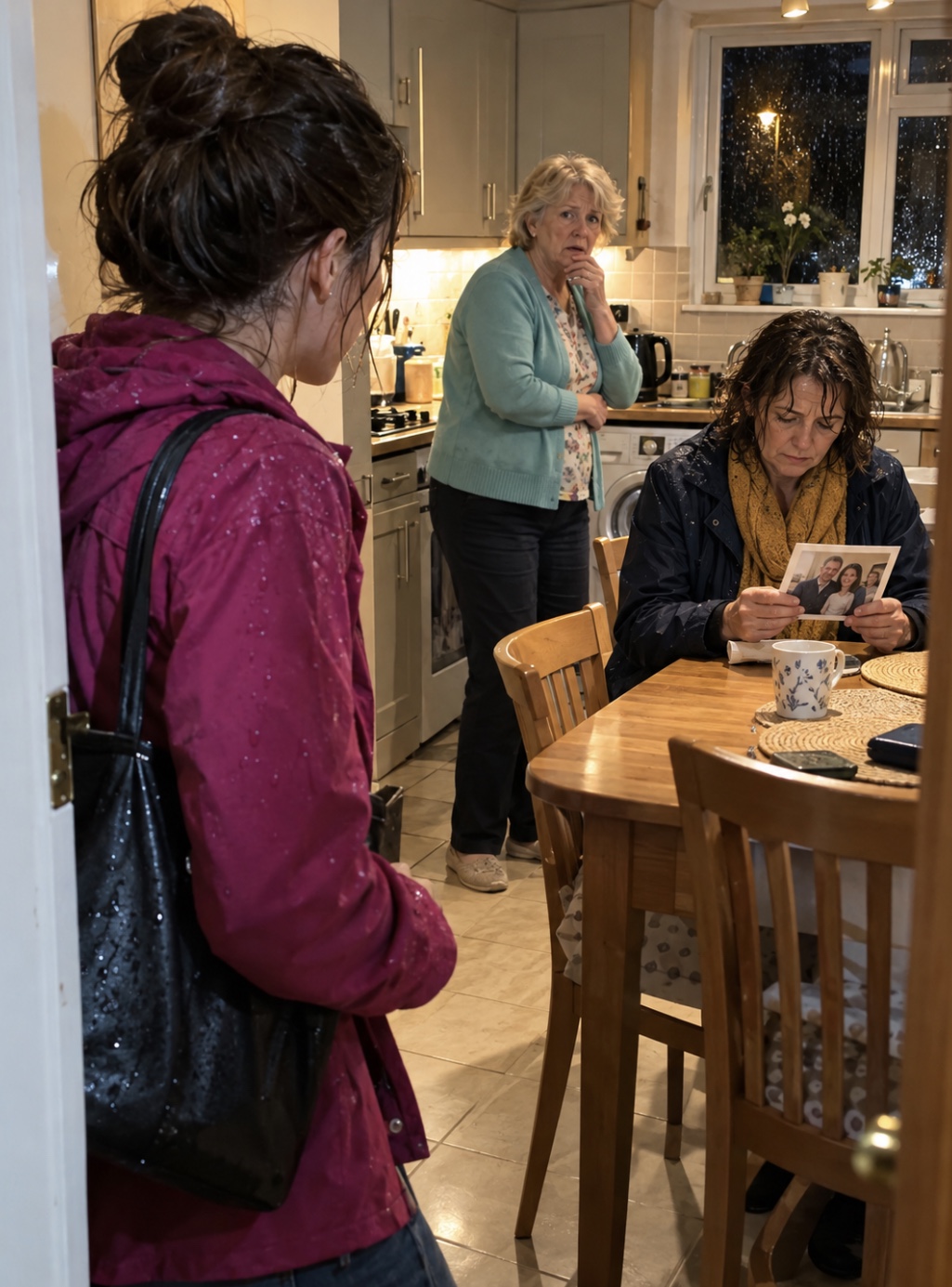
A woman sat at the table with both hands around a mug of untouched tea.
She looked about forty-five. Maybe fifty. Dark blond hair, wet from the rain. Navy coat. No handbag that I could see.
In front of her lay one of Margaret’s framed photographs.
Our photograph.
It had been taken six years earlier during Christmas at Margaret’s house.
Daniel stood behind me with one hand on my shoulder. Our daughter Sophie, then four, was on his hip. Margaret and Peter stood beside us. Everyone smiling.
The strange woman had removed the photograph from the frame.
She was staring at Daniel’s face.
When she looked up at me, I felt an unpleasant jolt of recognition without knowing why.
Not that I knew her.
Something about her eyes.
Grey-green.
Like Daniel’s.
Margaret shut the kitchen door.
“This is Helen Mercer,” she said.
The woman gave me a tense smile.
“Thank you for coming.”
I didn’t sit down.
“Why are you holding a photograph of my family?”
Helen carefully placed it on the table.
“Because I needed to know I had the right people.”
“That doesn’t answer my question.”
Margaret pulled out a chair.
“Claire, sit.”
“No. Not until somebody tells me what is happening.”
Helen looked at Margaret.
“You haven’t told her anything?”
“I didn’t know what to tell her.”
Helen took a breath.
“I came because of Peter.”
Margaret flinched at her husband’s name.
Peter had died eighteen months earlier after a stroke. He had been seventy-one.
A quiet, funny man who repaired clocks as a hobby and always remembered exactly how I took my coffee.
“What about Peter?” I asked.
Helen reached into her coat pocket and put an envelope on the table.
It was old, cream-coloured, slightly yellow at the edges.
Written across the front in black ink were two words:
For Helen.
I knew the handwriting.
Peter’s.
Margaret gripped the edge of the counter.
“I found her outside,” she said quickly. “She’d been sitting in her car for almost an hour before she knocked.”
Helen shook her head.
“I was trying to decide whether I should leave.”
“Maybe you should have,” Margaret said.
The bitterness in her voice startled me.
I finally sat.
“Helen, who are you?”
She looked at me.
Then at the photograph.
“My mother died three weeks ago.”
“I’m sorry.”
“While clearing her flat, I found a box of letters.”
She touched the envelope.
“They were from Peter.”
The room went completely still.
My first thought was an affair.
An old affair.
Perhaps Margaret had discovered that her husband had cheated years ago and was too ashamed to tell Daniel.
I almost felt relieved.
Unpleasant, yes.
But survivable.
Then Helen said, “They began in 1976 and stopped in 1980.”
Margaret whispered, “Before Daniel was born.”
Helen nodded.
Daniel was forty-three.
Born in 1983.
“What does this have to do with him?” I asked.
Helen closed her eyes briefly.
“My mother’s name was Anne Mercer. She and Peter were together before he married Margaret.”
Margaret’s face hardened.
“I knew that.”
I turned to her.
“You did?”
“He told me he’d had a serious girlfriend before me. Everyone has a past.”
Helen looked at Margaret steadily.
“I don’t think he told you all of it.”
Margaret’s cheeks went pale.
I suddenly understood why she had told me not to bring Daniel.
“What didn’t he tell her?”
Helen slid one of the letters from the envelope.
“I was born in May 1979.”
The silence that followed felt physical.
I stared at Helen.
Then at the photograph.
Then at Margaret.
“No.”
Helen didn’t argue.
Margaret’s hands began trembling.
“My Peter would have told me.”
“Maybe eventually he wanted to.”
“He would have told me.”
Helen pushed the letter toward me.
“I’m not asking you to believe me because I turned up at one in the morning.”
I looked down.
The letter was dated September 1978.
I read only the first few lines before stopping.
Anne,
I’ve tried three times to write this and thrown every version away. If you are sure about the baby, then I need to know what you want from me…
I looked up.
Margaret had tears in her eyes.
But Helen wasn’t crying.
She looked exhausted.
“What do you want?” I asked.
“Nothing financially.”
“That’s not what I asked.”
“I want to know the truth.”
“Why now?”
“Because my mother spent forty-seven years refusing to tell me who my father was. Then I found his letters hidden behind the lining of an old suitcase.”
I looked again at Helen’s eyes.
Daniel’s eyes.
The resemblance was no longer something I could dismiss.
Then Margaret said something so quietly that I almost missed it.
“There was another letter.”
Helen turned sharply.
“What?”
Margaret looked at me, not Helen.
“After Peter died, I found something in his desk.”
My heartbeat quickened.
“What did you find?”
Margaret’s mouth tightened.
“A letter addressed to Daniel.”
📩 What Margaret had hidden for eighteen months changed everything — the rest of the story continues in the first comment. 👇
Helen stood so quickly her chair scraped the tile.
“You have a letter to Daniel?”
Margaret looked ashamed.
“I destroyed it.”
I stared at her.
“You what?”
“I panicked.”
“What did it say?”
“I didn’t read all of it.”
“That doesn’t make any sense.”
“It made enough sense.”
She covered her mouth with one hand.
“It mentioned Anne.”
Helen stepped backwards as if Margaret had struck her.
“You knew.”
“No.”
“You knew there was something.”
“I knew Peter had written to somebody called Anne before we met. I did not know about you.”
“But the letter?”
Margaret began crying.
“It said he had made a decision years earlier that he regretted. It said there were things Daniel should know after Peter was gone.”
“And you burned it?”
“I tore it up.”
I felt anger rise so fast that my face grew hot.
“Margaret, that letter belonged to Daniel.”
“I know.”
“No, I don’t think you do.”
She sank into a chair.
“I had just buried my husband. I hadn’t slept properly for weeks. I thought Peter was about to destroy my son’s memory of him from beyond the grave.”
Helen stared at her.
“Your son?”
Margaret froze.
Something about the way Helen said it changed the atmosphere again.
Helen reached down and picked up the Christmas photograph.
She pointed at Daniel.
“When I first found Peter’s name, I searched for him online. I found the obituary.”
She swallowed.
“That led me to Daniel.”
“So?”
“I thought Daniel might be Peter’s son.”
“He is,” Margaret said sharply.
Helen looked at her.
“Are you sure?”
Margaret’s face emptied.
I felt every hair on my arms lift.
“What are you talking about?” I said.
Helen reached into the inside pocket of her coat and produced another folded sheet.
“My mother left notes with the letters. Most were dates and addresses. But one page listed names.”
She put it down.
Peter Collins.
Anne Mercer.
Margaret Hayes.
Michael Hayes.
I recognised Margaret’s maiden surname.
I pointed at the fourth name.
“Who is Michael?”
Margaret stood abruptly.
“This is ridiculous.”
Helen didn’t move.
“My mother wrote beside his name: Ask Margaret.”
Margaret walked to the sink.
“Leave.”
“Margaret—”
“I said leave.”
Helen gathered the letters.
I stayed seated.
“I’m not leaving.”
Margaret looked at me.
“You have no right.”
“I’m married to Daniel. We have a child. If this involves his family history, then yes, I do.”
“This has nothing to do with you.”
“It became my business the moment you asked me to drive here in the middle of the night and keep it secret from my husband.”
That stopped her.
For a long time, rain tapped against the window.
Finally Margaret sat again.
“Michael was my older brother.”
I had heard of him.
Daniel had once mentioned an uncle who died young, before he was born.
“Car accident?” I asked.
Margaret nodded.
“1982.”
Helen leaned forward.
“My mother knew him?”
Margaret looked at the table.
“Yes.”
“How?”
“Peter introduced them.”
Then she told us the story.
Not quickly.
Not cleanly.
It came out in broken pieces.
In the late seventies, before Margaret and Peter married, they belonged to the same circle of friends in Leeds. Peter dated Anne. Margaret had recently moved there to train as a nurse. Michael, her older brother, visited often.
Peter and Anne broke up after what everyone believed was an argument about marriage.
Months later, Anne became pregnant.
Peter apparently believed the child was his.
But according to Margaret, Anne had also briefly been involved with Michael.
“No one talked about these things properly then,” Margaret said. “Not in our family.”
Helen’s expression barely changed.
“So Peter may not have been my father.”
Margaret nodded.
“But he thought he might be?”
“Yes.”
“And Michael?”
“I don’t know what Michael knew.”
Helen sat back.
I tried to process it.
“Then what does any of this have to do with Daniel?”
Margaret didn’t answer.
I knew before she spoke that there was one more layer.
“When Michael died,” she said, “his wife was pregnant.”
I blinked.
“What?”
“He had married a woman named Julia. They separated before his accident.”
She pressed both palms flat on the table.
“Julia gave birth four months after Michael died.”
My throat tightened.
“No.”
Margaret’s eyes filled again.
“She had a boy.”
Helen whispered, “Daniel.”
I actually laughed once, without humour.
“That’s impossible.”
Margaret stared at me.
“We adopted him.”
I couldn’t speak.
Daniel had never once said he was adopted.
Not once.
“You’re lying.”
“I wish I were.”
“You’re his mother.”
“I am his mother.”
“That’s not what I mean.”
“I raised him.”
“Does he know?”
“No.”
I stood.
My chair tipped backwards and hit the floor.
“You let him believe you gave birth to him for forty-three years?”
“We planned to tell him.”
“When? At sixty?”
Margaret began sobbing.
“Julia couldn’t cope after Michael died. She was twenty-two. No money, no family willing to help. She had severe depression after the birth. She asked us to take him temporarily.”
“And then?”
“She left England.”
“You adopted him?”
“Eventually.”
“Legally?”
“Yes.”
“But why hide it?”
Margaret shook her head.
“Because Peter loved him as his own. Because we were terrified Julia would change her mind. Because every year we waited, telling him became harder.”
Helen was staring at Daniel’s photograph again.
Then she said something I would remember for the rest of my life.
“If Michael was Daniel’s biological father…”
Margaret looked at her.
“…then Daniel might be my brother.”
Nobody moved.
Because suddenly the reason Peter had written a letter to Daniel became horrifyingly clear.
Maybe Peter had spent decades believing he might be Helen’s father.
Maybe later he learned that Michael could have been.
And Daniel, raised as Peter’s son, might actually have been Michael’s son too.
At 3:12 a.m., I drove home.
Margaret begged me not to tell Daniel immediately.
I told her she had until breakfast.
At 7:05, Daniel came downstairs holding my note.
“You vanished in the middle of the night because Mum felt ill?”
I was sitting at the kitchen table with cold coffee.
“She wasn’t ill.”
He frowned.
“What happened?”
I told him everything.
I expected shouting.
Instead, Daniel listened silently.
He asked only one question.
“Did Mum actually say I was adopted?”
“Yes.”
He walked outside into the back garden wearing slippers and no coat.
I watched him stand in the wet grass for nearly ten minutes.
Then he came back inside.
“I want proof.”
We obtained it.
Not quickly.
First came records.
His amended birth certificate. Adoption paperwork Margaret had kept in a locked metal box. Old letters. A solicitor’s file.
Julia was listed as Daniel’s birth mother.
Michael Hayes was listed as the presumed father.
Daniel found Julia through a tracing service.
She was alive.
Sixty-six years old and living near Exeter.
Their first phone call lasted nine minutes.
Their second lasted two hours.
Julia confirmed most of Margaret’s story.
Michael had believed Daniel was his.
But Julia admitted something Margaret had never known.
Michael had once told her about Anne.
About a baby born several years earlier.
A girl.
Helen.
So Daniel and Helen agreed to a DNA test.
The result came six weeks later.
They were not siblings.
They were first cousins.
Michael was Daniel’s father.
Peter was Helen’s.
The truth had been divided between four adults for nearly half a century, each person knowing only enough to cause damage.
Peter had apparently discovered through correspondence with Anne, late in life, that Helen was almost certainly his daughter. He had been trying to decide how to contact her when he died.
The destroyed letter to Daniel had not been a confession about Daniel’s parentage.
It had been Peter asking his son to find Helen if Peter never managed to do it himself.
Margaret had destroyed the one letter that might have saved everyone months of fear.
Daniel didn’t speak to her for almost three months.
Not because she had adopted him.
He told her repeatedly that being adopted changed nothing about how he felt about the childhood she had given him.
What he could not forgive was the choice she had made every year afterwards to keep deciding what truth he was allowed to know.
Helen stayed in our lives.
At first awkwardly.
Then gradually, naturally.
She had two grown sons. Sophie found the whole family connection impossible to explain and simply started calling Helen “Auntie Helen,” although technically she wasn’t.
The strangest moment came the following Christmas.
We were back in Margaret’s kitchen.
Same table.
Same window.
Same cupboard where Peter used to hide expensive biscuits from himself and then forget where he put them.
Margaret brought out the old Christmas photograph.
The one Helen had been holding that first night.
For months I had assumed Helen had brought it with her.
She hadn’t.
It had been sitting on Margaret’s sideboard when Helen arrived.
Helen had picked it up because Daniel looked like Michael.
Margaret placed the photograph back into its frame.
Then Helen took another picture from her handbag.
It showed Peter at about twenty-five, standing beside a battered Ford Capri, grinning at the camera.
She placed it beside the family photograph.
Daniel stared at both for a long moment.
Then he smiled.
“Dad always hated that car.”
Helen laughed.
“He wrote to Mum that it made him look sophisticated.”
Margaret laughed too.
It was the first time I had heard the two women laugh together.
Nothing about our family became simpler after that night.
Daniel gained a birth mother.
Discovered a dead biological father.
Found a woman who had spent almost fifty years wondering who her father was.
Margaret lost her son’s trust and had to rebuild it slowly, without demanding forgiveness.
But something else happened too.
We stopped protecting one another with lies.
That turned out to be harder than keeping secrets.
And much healthier.
A year later, Daniel found an old birthday card from Peter at the back of a drawer.
Inside, Peter had written just one sentence beneath the usual birthday message:
A family isn’t the story you begin with. It’s the truth you’re brave enough to keep telling each other.
Daniel read it twice.
Then he handed it to me.
Neither of us said anything.
We didn’t need to.
Because after that night, we finally understood exactly what Peter had meant.