



The first person to raise her voice at parents’ evening wasn’t an angry father, an exhausted teacher, or even one of the mothers who had been waiting forty minutes in the corridor.
It was my mother-in-law.
“She shouldn’t even be making decisions about him!”
Every head in the classroom turned.
My son, Oliver, was sitting two doors down in the school library with the other Year 5 children, supposedly finishing a reading activity while their parents met the teachers. I remember being grateful for that small mercy. At least he wasn’t standing beside me when Margaret pointed across the classroom and announced:
“That woman should not be raising my grandson.”
For a few seconds, nobody moved.
Mrs Patel, Oliver’s class teacher, still had one hand resting on a blue folder.
My husband, Daniel, stared at his mother.
I felt the heat rise from my neck to my face.
And Margaret, satisfied that she finally had everyone’s attention, pulled out the empty chair beside Daniel as though she had been invited.
She hadn’t.
Our parents’ evening was at a primary school in a quiet commuter town outside Reading, the kind of school with displays of laminated poetry in the corridor, muddy football boots under benches, and handwritten reminders about bringing £2 for the Christmas craft fair.
Margaret lived fifteen minutes away.
That was how she knew exactly when the meeting was.
Daniel had mentioned it during Sunday lunch without thinking.
“Thursday evening,” he had said. “Oliver’s teacher wants to discuss how he’s getting on with maths.”
Margaret had looked up from her roast potatoes.
“Why?”
“No idea yet.”
“Has he fallen behind?”
“We’ll find out Thursday.”
She immediately looked at me.
That look had become familiar over the years. It meant that whatever problem had just been mentioned would eventually be traced back to me.
Daniel and I had been married for seven years. Oliver was ten.
I was not his biological mother.
That part mattered to Margaret enormously.
To Oliver, much less.
His birth mother, Rachel, had died when he was three.
Daniel and Rachel had separated before Oliver’s second birthday, but they had co-parented well. After her death, Daniel became a single father overnight.
I met him almost two years later.
I never tried to replace Rachel. I never asked Oliver to call me Mum. I kept photographs of Rachel in his room because they belonged there. When he asked questions about her, Daniel and I answered them together.
When he was six, Oliver started calling me Mum on his own.
The first time it happened, I thought he’d made a mistake.
“Mum, where’s my red jumper?”
I froze in the hallway.
Then he froze too.
We looked at each other.
“You can call me Claire if you want,” I said quietly.
He shrugged.
“I know.”
Then he ran upstairs.
After that, it stuck.
Margaret hated it.
Not openly at first.
She would correct him with a smile.
“You mean Claire, darling.”
Oliver would frown.
“No. I mean Mum.”
Margaret would change the subject.
But little remarks followed.
“Rachel always packed healthier lunches.”
“Rachel would never have let him quit swimming.”
“Rachel understood how sensitive he is.”
Sometimes the comparisons were fair. Sometimes they were invented.
Daniel usually shut them down.
“Mum, stop.”
She always answered the same way.
“I’m only thinking of Oliver.”
For years, I told myself she was grieving.
Rachel had been part of the family for a long time. Margaret had known her since she was nineteen.
I could understand loyalty.
What I couldn’t understand was why loyalty had to mean hostility towards me.
That Thursday evening, Daniel and I arrived at school at 6:20.
Margaret arrived at 6:27.
We were sitting outside the classroom when she came down the corridor in a burgundy wool coat, carrying her handbag and looking completely unsurprised to see us.
Daniel stood.
“Mum? What are you doing here?”
She removed her gloves.
“I thought I should come.”
“Why?”
“Oliver is my grandson.”
“This is parents’ evening.”
“Yes.”
Daniel waited.
“So?”
“So I’m family.”
I could already feel the evening going wrong.
“You weren’t invited,” Daniel said.
Margaret’s mouth tightened.
“I’m not asking permission to care about my grandson’s education.”
Before Daniel could answer, Mrs Patel opened the classroom door.
“Mr and Mrs Harris?”
Then she noticed Margaret.
“Oh. Hello.”
Margaret stepped forward immediately.
“I’m Oliver’s grandmother.”
Mrs Patel hesitated just long enough for me to know she understood there was a problem.
“We only have ten minutes per appointment.”
“I’ll sit quietly.”
She did not sit quietly.
At first, the meeting was completely normal.
Mrs Patel explained that Oliver was doing well overall. His reading age was above average. His writing had improved. His maths results were fine, although he rushed when he felt under pressure.
“He gets anxious if he thinks he’s going to disappoint someone,” she said.
Margaret looked straight at me.
Mrs Patel continued.
“We’ve also noticed he sometimes asks for reassurance before starting tasks he already knows how to do.”
Daniel leaned forward.
“Is that new?”
“More noticeable this term.”
“Has anything happened at school?”
“Nothing significant that we’re aware of.”
I asked whether we should change anything at home.
Mrs Patel said consistency would probably help.
Nothing dramatic.
No crisis.
Then she added, “There is one thing Oliver mentioned during our wellbeing session.”
Margaret sat up.
“What?”
Mrs Patel looked at Daniel and me, not her.
“He said he worries about adults arguing because of him.”
My stomach dropped.
Daniel looked at me.
We didn’t argue about Oliver.
Not at home.
Then I knew.
Margaret.
Two weeks earlier, she had collected him from school because Daniel and I were both stuck at work.
When Oliver came home, he had been unusually quiet.
I asked whether everything was all right.
“Fine.”
“Did something happen at Nan’s?”
“No.”
I hadn’t pushed.
Now Mrs Patel said, “He specifically used the phrase, ‘People fight about who gets to be my proper family.’”
Daniel slowly turned towards his mother.
Margaret’s face changed.
Only slightly.
But enough.
“What did you say to him?” Daniel asked.
“Nothing inappropriate.”
“Mum.”
“I answered a question.”
“What question?”
“He asked about Rachel.”
I felt my hands go cold.
Daniel’s voice became quieter.
“What did you tell him?”
Margaret lifted her chin.
“The truth.”
📚 What happened next changed the whole conversation — the continuation is in the first comment. 👇
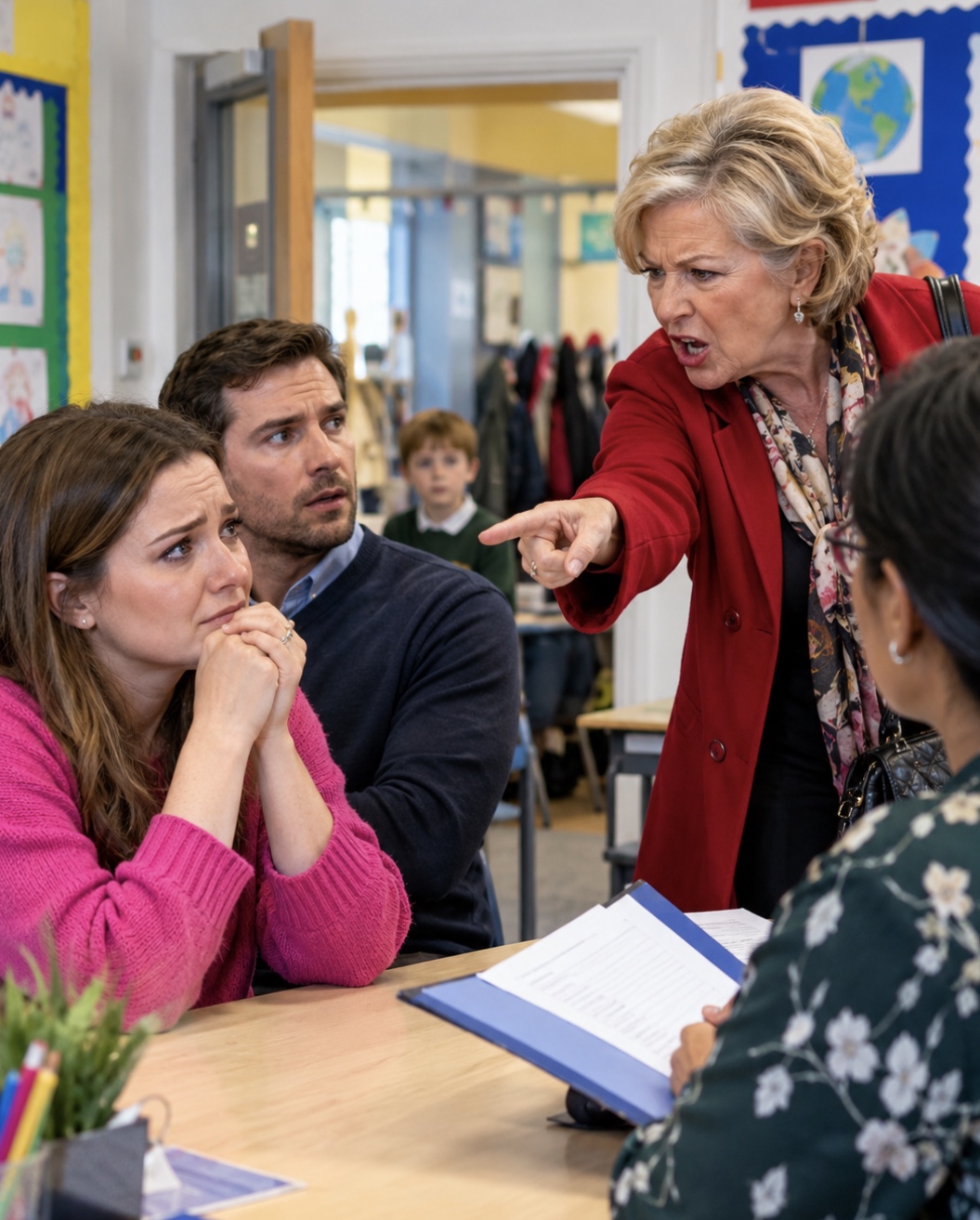
Mrs Patel gently closed the blue folder.
Daniel didn’t notice.
I did.
“What truth?” I asked.
Margaret looked at me.
“That you aren’t his mother.”
There it was.
Seven years of tension reduced to one sentence.
Daniel rubbed his forehead.
“He knows Claire isn’t his biological mother.”
“Does he?”
“Yes.”
“He calls her Mum.”
“Because he wants to.”
Margaret gave a small laugh.
“He’s a child. Children copy what they’re encouraged to do.”
I stared at her.
“I have never asked him to call me Mum.”
“You didn’t have to.”
“Margaret,” Mrs Patel said carefully, “this may not be the best place—”
“It is exactly the place,” Margaret replied.
Daniel’s chair scraped backwards.
“Mum, enough.”
But she had waited years for this moment.
I realised that afterwards.
She hadn’t come to hear about maths.
She had come because she had decided the school was part of the problem.
She opened her handbag and pulled out several folded sheets of paper.
“I’ve looked into this,” she said.
Daniel stared at her.
“Looked into what?”
“Parental responsibility.”
I genuinely thought I had misheard.
“What?”
“You sign school forms. You attend appointments. You make decisions.”
“Yes.”
“You aren’t his legal parent.”
Daniel went pale.
“Mum.”
“I’m only saying the school should know who actually has authority.”
Mrs Patel looked at me.
For the first time all evening, her expression wasn’t awkward.
It was concerned.
Daniel said, “Claire has been raising Oliver since he was five.”
“That does not make her Rachel.”
“No one said it does.”
Margaret’s voice suddenly became sharp.
“She isn’t his mother!”
The door was open.
Parents in the corridor heard her.
Someone stopped talking outside.
I could hear chairs moving in the next classroom.
Then Margaret pointed at me.
“That woman should not be raising my grandson.”
Silence.
Mrs Patel stood.
“Mrs Harris—”
“I am Mrs Harris,” Margaret snapped.
“No,” Daniel said. “You’re not his parent.”
Margaret looked at him as though he had slapped her.
“I am your mother.”
“And you are upsetting my son.”
“I am protecting him.”
“From Claire?”
“Yes.”
The word came too quickly.
Even Margaret looked surprised by it.
I had spent years trying not to make Daniel choose between us.
That evening, for the first time, I stopped protecting her from the consequences of what she said.
“From what exactly?” I asked.
Margaret turned towards me.
“From forgetting his real mother.”
My anger disappeared.
Just like that.
Because suddenly I understood.
Not everything.
But enough.
“This isn’t about Oliver forgetting Rachel,” I said. “This is about you thinking that if he loves me, it means there’s less room for her.”
Margaret’s eyes filled immediately.
“You don’t know what you’re talking about.”
“I think I do.”
“You weren’t there.”
“No.”
“You didn’t see Rachel in hospital.”
Daniel whispered, “Mum.”
“You didn’t see what happened to her.”
“No,” I said. “I didn’t.”
“You arrived afterwards and everything carried on.”
That sentence hurt more than the others.
Because for Margaret, that was exactly how it looked.
Her son remarried.
Her grandson began calling someone else Mum.
School forms had my handwriting on them.
Birthday cakes came from my kitchen.
Photos on the mantelpiece changed.
Life continued.
Rachel didn’t.
But grief did not excuse what Margaret had done.
Mrs Patel seemed to come to the same conclusion.
She opened the blue folder.
“I think there is something you should see.”
Margaret stopped.
Mrs Patel removed a plastic wallet containing photocopied pages.
“This is Oliver’s original reception transition file.”
Daniel frowned.
“Why do you have that?”
“His previous school sent records when he transferred here in Year 2.”
Oliver had attended another primary school briefly before Daniel moved closer to his new job.
Mrs Patel turned to one page.
“This was completed shortly after his mother died.”
Daniel went still.
I had never seen it.
Mrs Patel read carefully.
“Oliver was referred for bereavement support after repeatedly asking whether people disappear when families change.”
Margaret’s face lost colour.
Mrs Patel continued.
“There are notes from the family liaison worker.”
She looked at Daniel.
“Would you like to read this yourself?”
He took the page.
I watched his eyes move across it.
Then stop.
“What?” Margaret said.
Daniel didn’t answer.
“What does it say?”
He handed the sheet back.
Mrs Patel read one sentence.
“Oliver reported that his grandmother had told him, ‘Daddy might get another lady one day, but nobody else can ever be your mummy.’”
Margaret stared at her.
“That is true.”
Mrs Patel didn’t argue.
Instead, she turned the page.
“Two months later, Oliver told the counsellor he was frightened his father might marry because he believed liking a new partner would be ‘being bad to Mummy.’”
No one spoke.
My throat tightened.
Oliver had been four.
Long before he met me.
Long before Margaret had any reason to dislike me personally.
She had planted the fear first.
Mrs Patel continued.
“There’s another note after Claire entered Oliver’s life.”
I looked up sharply.
“What?”
“The school apparently observed him becoming less anxious.”
Margaret’s lips parted.
Mrs Patel read.
“Oliver told staff, ‘Claire says I don’t have to choose. Mummy Rachel is my mummy who died, and Claire is Claire, and loving Claire doesn’t make Rachel go away.’”
I looked down.
I remembered saying something like that.
Not those exact words.
Oliver had been five.
We had been making toast in Daniel’s kitchen when he suddenly asked whether his mother would know if he liked me.
I’d answered without thinking much about it.
Apparently he had remembered.
Mrs Patel turned another page.
“The final note says his sleep improved and the questions about ‘choosing families’ became less frequent.”
Margaret sat very still.
Daniel spoke first.
“So this started before Claire.”
Margaret stared at the desk.
“Mum.”
Nothing.
“You made him afraid before Claire even came into our lives.”
“I was grieving.”
“So was he.”
That stopped her.
Mrs Patel closed the folder.
“I’m not showing this to blame anyone. Grief affects families in complicated ways. But Oliver is ten now, and he is describing the same fear again.”
Margaret looked up.
“He told you that?”
“Yes.”
Mrs Patel spoke gently.
“He told our teaching assistant last week that he worries his grandmother will stop loving him if he calls Claire Mum.”
I closed my eyes.
Daniel swore under his breath.
Margaret whispered, “I never said that.”
“Children often react to more than exact words,” Mrs Patel said. “They notice tone, correction, tension.”
Margaret looked at me.
For once there was no challenge in her face.
Only shock.
Then the classroom door opened.
All four of us turned.
Oliver stood there.
A teaching assistant was behind him.
“Sorry,” she said. “He said he needed his water bottle.”
His bottle was on the desk beside Daniel.
Oliver looked from his father to me to Margaret.
He had obviously heard enough to know something was wrong.
“What happened?”
Nobody answered.
He walked into the room.
Margaret immediately wiped her eyes.
“Nothing, sweetheart.”
Oliver looked at her.
Then at me.
“Were you arguing about Mum again?”
The room went completely silent.
I could barely breathe.
Margaret whispered, “Which mum?”
Oliver frowned.
It was such an adult question to ask a ten-year-old that even Margaret seemed to realise it after she said it.
He pointed at me.
“Claire.”
Then he paused.
“And Mum Rachel.”
Margaret’s eyes filled again.
Oliver moved closer to her.
“I remember Mum Rachel.”
Margaret gave a broken little smile.
“You were so young.”
“I remember her yellow scarf.”
Daniel’s face changed.
Rachel apparently had worn one constantly.
“I remember her singing in the car,” Oliver said.
Margaret covered her mouth.
“And I remember the blue cup at her flat.”
Daniel nodded slowly.
“The plastic one.”
Oliver looked at Margaret.
“I’m not forgetting.”
Nobody moved.
Then he said the sentence that ended the argument better than any adult could have.
“I can remember Mum Rachel and still love Mum Claire.”
Margaret began to cry.
Not loudly.
Not dramatically.
She simply folded.
Oliver stood beside her uncertainly until she reached for his hand.
“I’m sorry,” she said.
He looked embarrassed.
Children often do when adults become emotional.
“Okay.”
“No,” Margaret said. “I’ve made something hard for you that shouldn’t have been hard.”
Mrs Patel looked away, giving them privacy.
Daniel put his arm around me.
Margaret looked up at us.
“I thought if we stopped saying Rachel’s name, she would disappear.”
“We never stopped saying it,” Daniel replied.
Margaret nodded.
“I know.”
Then she looked at me.
It wasn’t a miraculous apology.
There was no instant reconciliation.
Years of resentment don’t vanish inside a Year 5 classroom.
But she said something I had never expected to hear.
“I made you the enemy because you were proof that life continued.”
I swallowed.
“That wasn’t my choice.”
“I know.”
Parents were still waiting outside.
Mrs Patel glanced at the clock.
Our ten-minute meeting had lasted thirty-eight minutes.
The following week, Daniel set new rules.
Margaret was not allowed to collect Oliver alone for a while.
She hated that.
She accepted it anyway.
We also arranged several sessions with the school wellbeing lead for Oliver, and Margaret agreed—after resisting for several days—to speak with a bereavement counsellor recommended by her GP.
The strangest change happened at Christmas.
Every year, Margaret kept one photograph of Rachel on her sideboard.
That year, she brought us a copy.
“I thought Oliver might want this.”
It showed Rachel at twenty-six, standing on Brighton beach in a yellow scarf, laughing into the wind.
Oliver put the photo on the shelf in his bedroom.
Next to a picture of Daniel and me.
Margaret saw it.
For a second, I waited for the old expression.
The tight mouth.
The correction.
The invisible competition.
Instead she said, “That was her favourite scarf.”
Oliver smiled.
“I know.”
And that was the moment I finally understood what Mrs Patel’s old folder had revealed.
The secret was never that I had replaced Oliver’s mother.
The secret was that Margaret had spent years terrified that love worked like a chair at a crowded table: if someone new sat down, someone else had to disappear.
Oliver, at ten years old, understood something the adults had taken far longer to learn.
There had always been room for both.