



At 8:17 on a Saturday morning, my mother-in-law was standing outside our front door in a dressing gown under her winter coat, hammering the new lock with the side of her fist.
“Claire! Open this door right now!”
I was still barefoot.
My husband, Ben, was in the kitchen making coffee, frozen halfway between the kettle and the mugs.
The pounding came again.
“Ben! Tell your wife to stop playing games!”
I looked at him.
“Did you tell her we changed the lock?”
“No.”
“Did you give her a new key?”
“No.”
“Good.”
He rubbed his forehead.
“That doesn’t mean we should leave her in the hallway.”
We lived in a converted Victorian house in Bristol, split into four flats. Sound travelled through the building like gossip. I could already hear a door opening upstairs.
I walked to the entrance but kept the chain on.
When I opened it a few inches, Margaret pushed her face toward the gap.
“What have you done?”
“I changed the lock.”
“I can see that.”
“Then why are you asking?”
Her eyes widened.
Margaret was sixty-two, retired from a school office, always perfectly groomed and permanently convinced that calm disagreement was a personal insult.
She held up her old brass key.
“This is my son’s home.”
“It’s our home.”
“I’ve had a key for six years.”
“And now you don’t.”
She stared at me as if I had announced that I’d sold the building.
Behind me, Ben said quietly, “Mum, please don’t start shouting.”
That was the wrong sentence.
“I’m shouting because your wife has locked your own mother out!”
I nearly laughed.
“You don’t live here.”
“I come in to help.”
“No. You come in without asking.”
“That happened twice.”
“Last Tuesday. Thursday. And the Sunday before that.”
“I watered your plants.”
“You opened our bedroom window, reorganised the kitchen cupboards and threw away a jumper because you said it made Ben look unemployed.”
Ben looked down at his coffee.
Margaret’s voice dropped.
“So this is punishment?”
“It’s a boundary.”
“Oh, don’t use therapy words at me.”
The upstairs neighbor, Mr. Patel, appeared on the landing in slippers and pretended to inspect his post.
Margaret noticed him and immediately changed tactics.
“I only came because Ben left his gym bag at our house.”
She lifted a black holdall I hadn’t seen before.
Ben frowned.
“I haven’t used that bag in months.”
She glared at him.
“You always forget what you leave.”
Then she shoved the bag through the narrow gap.
I caught it before it fell.
“Thanks. We’ll see you tomorrow for lunch.”
She didn’t move.
“I want a new key.”
“No.”
“Claire.”
“No.”
“Ben?”
He hesitated for two seconds too long.
That was all Margaret needed.
“You see?” she said. “He doesn’t agree with you.”
Ben finally spoke.
“I do agree.”
Her expression changed so quickly it almost frightened me.
She stopped looking angry.
She looked hurt.
“You agree that your mother isn’t trustworthy?”
“That’s not what I said.”
“It’s exactly what you said.”
“No. I said you need to call before coming in.”
“I have never stolen anything from you.”
The hallway went completely silent.
I hadn’t accused her of stealing.
Not once.
And yet that was the word she chose.
I saw Ben register it too.
Margaret must have noticed, because she immediately lifted her chin.
“I know what Claire thinks of me.”
“What do I think of you?” I asked.
She turned away.
“Forget it.”
Then she marched downstairs, still wearing her dressing gown under her coat, and slammed the communal front door hard enough to shake the glass.
Ben let out a long breath.
“Well.”
I shut our door.
“Why did she say she’s never stolen anything?”
He shrugged, but not convincingly.
“She gets dramatic.”
I looked down at the gym bag.
“Is this yours?”
He unzipped it.
Inside were two old trainers, a rain jacket, a phone charger and a paperback.
“Technically.”
“Why would she bring this at eight in the morning?”
“No idea.”
He carried it to the bedroom.
For the next hour, we tried to pretend the morning was normal.
I made toast.
Ben cleaned the coffee machine.
At 9:23, someone knocked.
Not pounded.
Knocked.
Three quiet taps.
I opened the door.
Mr. Patel stood there holding a supermarket bag.
He was in his seventies, lived in the flat above us and knew absolutely everything that happened in the building while somehow never appearing nosy.
“Morning,” he said.
“Morning.”
“Is Ben here?”
“Yes.”
“Good.”
He glanced toward the stairs.
“May I come in for a minute?”
Something in his voice made me step aside immediately.
He carried the bag to the dining table and placed it down carefully.
It was one of those thick reusable bags from Waitrose, the green kind.
“What is that?” I asked.
Mr. Patel looked uncomfortable.
“I think these are yours.”
📌 What happened next changed the entire argument — keep reading in the first comment 👇
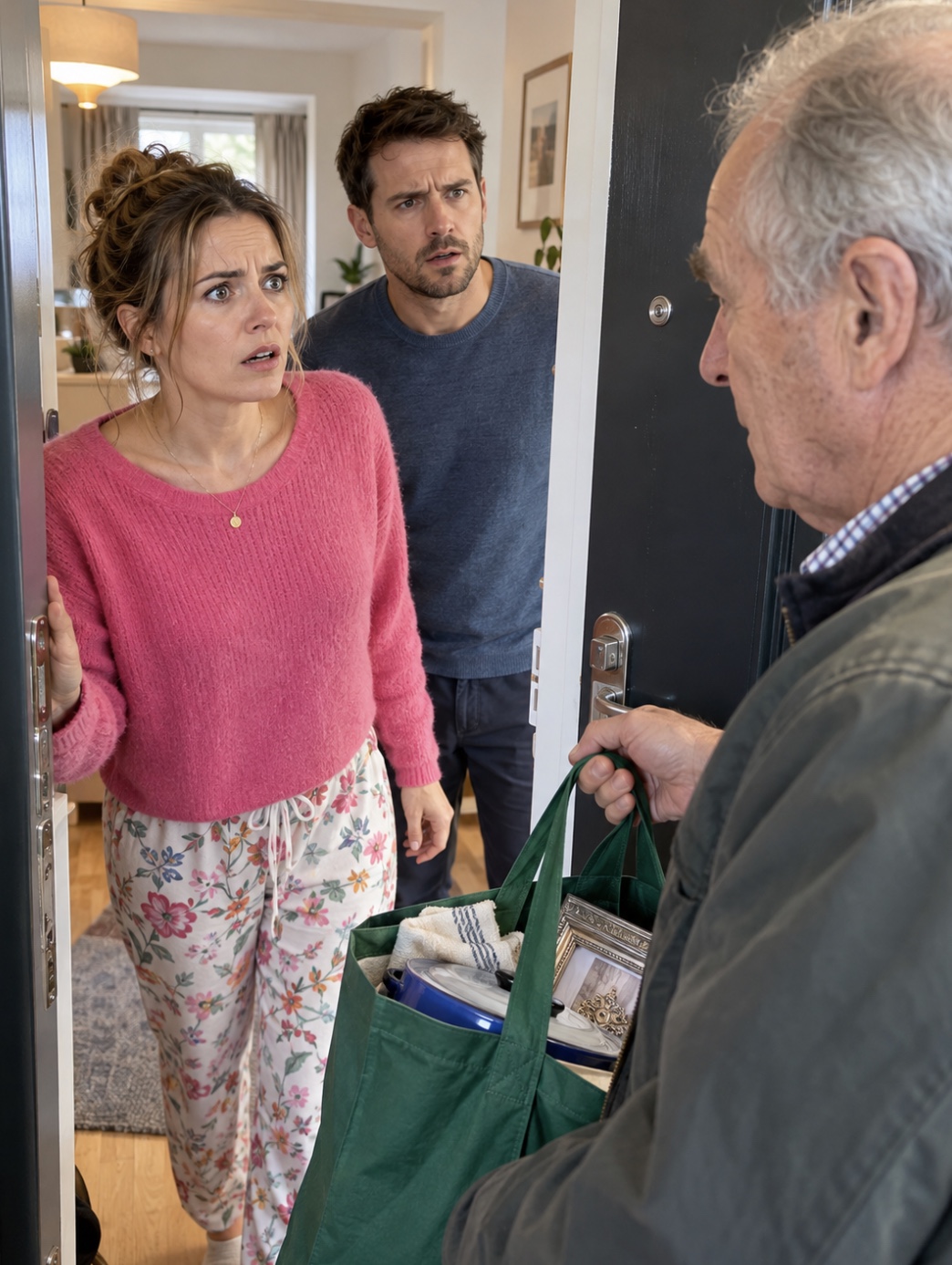
Ben came out of the bedroom.
“What’s going on?”
Mr. Patel opened the bag.
The first thing I saw was my blue Le Creuset casserole dish.
I actually laughed.
Not because anything was funny.
Because my brain refused to understand what I was seeing.
“That’s mine.”
“I thought so,” Mr. Patel said.
Underneath it were two linen tea towels, a cordless drill, a small silver photo frame, a bottle of expensive olive oil, three Christmas decorations, a set of steak knives and a wooden jewellery box.
I stopped breathing properly when I saw the jewellery box.
I grabbed it.
Inside were my grandmother’s pearl earrings.
I had been looking for them since February.
“Where did you get this?”
Mr. Patel pulled out a chair.
“A few months ago, your mother-in-law asked if she could leave a bag in my storage cupboard downstairs.”
Ben stared at him.
“My mum?”
“Yes. She said you were renovating and didn’t have room.”
“We’re not renovating.”
“I know that now.”
My hands were shaking.
Mr. Patel continued.
“At first it was one bag. Then another. I didn’t think much of it. I have quite a large cupboard and hardly use it. Then yesterday she came down with another box while you were both at work.”
Ben sat down.
“What was in it?”
“I didn’t look. But the bottom broke.”
My stomach tightened.
Mr. Patel pointed at the bag.
“Some things fell out. One of them was that photograph.”
I picked up the silver frame.
It was a photo of Ben and me taken on our wedding day in Bath. We had been looking for it for nearly a year.
“You knew this was ours?”
“I remembered it being on your hallway table.”
I looked at Ben.
His face had gone pale.
Mr. Patel cleared his throat.
“I asked Margaret why she was storing your belongings. She said you had told her to take some things to a charity shop.”
“I never told her that.”
“I suspected as much.”
He reached into his coat pocket and took out a folded sheet of paper.
“I wrote down what was left in the cupboard.”
There were fourteen items.
A lamp.
A toolbox.
A set of crystal glasses.
Two framed photographs.
A winter coat.
A boxed food processor.
A small rug.
Three storage containers.
A bottle of whisky.
And a ceramic serving bowl my mother had given us.
I read the list twice.
Then Ben took it from me.
“She’s been taking things from our home.”
Mr. Patel nodded slowly.
“I’m afraid so.”
“Why?”
“I can’t answer that.”
I could.
At least I thought I could.
Margaret was obsessed with decluttering.
She hated what she called “visual noise.”
Whenever she visited, she commented on everything.
Too many books.
Too many pans.
Too many blankets.
Why keep wedding cards?
Why own four serving dishes?
Why did we need a bread maker?
Once, when I was at work, she had filled three bin bags with things from our utility cupboard.
I made Ben drive to her house that evening and bring them all back.
She called me materialistic for a month.
But jewellery?
A drill?
Whisky?
Those weren’t clutter.
Those were things with value.
“Is everything still downstairs?” I asked.
“Most of it.”
“Most?”
Mr. Patel looked embarrassed.
“There were more bags before. She collected some.”
Ben stood up.
“Where did she take them?”
“I’m sorry. I don’t know.”
Ten minutes later we were in the basement.
The storage cupboard was behind the communal bikes.
Mr. Patel unlocked it.
There were four boxes and two bags pushed against the wall.
I recognised almost everything.
Some items I hadn’t even realised were missing.
A spare duvet.
My good kitchen scissors.
A camping stove.
A vintage desk clock Ben’s grandfather had owned.
Then I saw an empty John Lewis box with our name still on the delivery label.
“What was in this?”
Ben turned it over.
He went still.
“My headphones.”
“How expensive?”
“About three hundred quid.”
They had vanished in March.
We had assumed he had left them on a train.
Back upstairs, Ben called Margaret.
She rejected the first call.
Then the second.
On the third, she answered.
“What?”
Ben put her on speaker.
“Mum, why are our things in Mr. Patel’s cupboard?”
Silence.
Then: “What things?”
“Don’t do that.”
Another pause.
“I was helping you clear rubbish.”
“My grandfather’s clock is rubbish?”
“It doesn’t work.”
“My wife’s jewellery?”
“I was keeping it safe.”
“From what?”
“You two leave everything lying around.”
I snapped.
“You took pearl earrings out of my bedroom.”
“You never wore them.”
“That doesn’t make them yours.”
“I never said they were mine.”
“Then why were they in a bag hidden downstairs?”
“They weren’t hidden.”
Mr. Patel raised his eyebrows.
Ben picked up the inventory sheet.
“Where are my headphones?”
“I don’t know.”
“The ones we thought were stolen on the train.”
“Well, maybe they were.”
“Where is the whisky?”
“What whisky?”
“The bottle my company gave me for Christmas.”
Margaret sighed dramatically.
“Honestly, Ben, I can’t keep track of every little thing in your flat.”
“You didn’t need to keep track. You needed to leave them there.”
Then she said something I still remember word for word.
“I was going to put everything back.”
The room became quiet.
Ben sat down again.
“So you admit you took it.”
“That’s not what I meant.”
“You just said you were going to put everything back.”
“I was reorganising.”
“For months?”
“I was trying to help.”
I looked at the list.
“What happened to the items you already removed from the building?”
No answer.
“Margaret?”
“I gave some things away.”
Ben closed his eyes.
“What?”
“There was no point keeping them.”
“What did you give away?”
“A few kitchen things. Clothes. Some electronics.”
“My headphones?”
“I don’t remember.”
I could feel myself getting angry, but underneath the anger was something colder.
She had been walking through our home, deciding what we were allowed to keep.
And she had done it because she believed we would never stop her.
Ben said, “We’re coming over.”
“No.”
“We are.”
“You are not turning up here to interrogate me.”
“You turned up here this morning demanding a key.”
“That is different.”
“No, Mum. It isn’t.”
We drove to Margaret’s house in Keynsham.
She refused to open the door at first.
Then Ben told her he would call his father, who had gone fishing for the morning.
The door opened.
Margaret had changed clothes.
Navy trousers, cream jumper, pearls.
She looked calm again.
“Come in, then.”
Her dining room told the story before she did.
On the sideboard was our crystal decanter.
In the kitchen was my mother’s ceramic serving bowl.
And beside her television were Ben’s missing speakers.
He walked straight over to them.
“These are mine.”
Margaret folded her arms.
“You weren’t using them.”
“That isn’t the point.”
“You have a tiny flat. I have space.”
I looked around.
Then I noticed something strange.
On a chair near the conservatory door were cardboard boxes sealed with packing tape.
Each had a label.
KITCHEN.
LINENS.
ELECTRICAL.
I stared at them.
“You weren’t decluttering.”
She said nothing.
I stepped closer.
There were at least eight boxes.
“What were you doing?”
Margaret finally looked at Ben.
Not at me.
At him.
“I thought you were going to sell.”
Ben frowned.
“Sell what?”
“The flat.”
“We never said that.”
“You talked about moving.”
“Two years ago.”
“To somewhere bigger.”
“That doesn’t mean we’re selling now.”
Margaret’s mouth tightened.
Then came the explanation none of us expected.
She had been clearing things out because she believed Ben would eventually move back closer to her.
Not with me.
Without me.
Apparently, the previous Christmas, after an argument Ben and I had about work, he had gone to his parents’ house alone for a few hours.
He had said, “Sometimes I wonder if this is working.”
One sentence.
One bad evening.
Margaret had built an entire future around it.
She assumed our marriage was ending.
She began removing what she considered “Ben’s things” so I wouldn’t “take everything” if we separated.
Except most of what she took wasn’t Ben’s.
And she hadn’t told him.
“I was protecting you,” she said.
Ben looked devastated.
“From my wife?”
“I know how these things go.”
“No. You imagined how they might go.”
“I didn’t want you starting again with nothing.”
“We weren’t starting again.”
“You were unhappy.”
“For one night.”
“You stayed here until midnight.”
“Because Dad opened a bottle of wine and we watched Match of the Day.”
Margaret’s eyes filled with tears.
For the first time, she looked less controlling than frightened.
But fear didn’t excuse what she had done.
I pointed to the boxes.
“How much did you take?”
She whispered, “I don’t know.”
We spent three hours going through everything.
Some items were ours.
Some were Margaret’s.
Some she had bought specifically for Ben because she thought he would soon need his own place.
New towels.
Saucepans.
Bedding.
A toaster.
A kettle still in its box.
She had built him a starter home inside her dining room.
My missing belongings were mixed in with it.
The expensive headphones were gone.
So was the whisky.
So were two coats and a tablet we kept in a drawer for travelling.
Margaret eventually admitted she had sold several things online.
The total was £640.
She said she had kept the money “for Ben.”
Ben asked to see it.
She transferred every penny before we left.
The next day, we collected the rest of our belongings.
Ben also took back the spare key to his parents’ house that Margaret had given him years earlier.
She looked surprised.
“What are you doing?”
“Making this equal.”
“What does that mean?”
“It means you don’t have a key to our home, and I don’t need a key to yours.”
She tried to argue.
He didn’t.
For nearly two months, we saw her only in public.
Cafés.
Sunday lunch at a pub.
His father’s birthday.
She apologised to Ben first.
Then, eventually, to me.
It wasn’t a beautiful apology.
She didn’t suddenly become self-aware.
She still said things like, “I genuinely thought I was helping,” which irritated me every time.
But she paid for the missing items and never asked for another key.
Six months later, I came home from work and found a small parcel outside our door.
No note.
Inside was a second-hand replacement for the blue casserole dish she had taken.
The strange thing was, she had already returned the original.
I called Ben.
“Did your mum send this?”
He laughed.
“She rang me yesterday asking which size yours was.”
“Why didn’t she ask me?”
“She said you’d think she was interfering.”
I looked at the casserole dish.
Same colour.
Same size.
Completely unnecessary.
And somehow, very Margaret.
That evening I texted her.
“Thanks for the dish. We now officially have too many.”
She replied two minutes later.
“I know. But this time you can decide what leaves the flat.”
It was the closest thing to understanding I had ever heard from her.