



The first thing my mother-in-law did when she walked into our kitchen that Sunday was place three unopened envelopes beside my coffee mug.
“Electric, council tax, and broadband,” she said, taking off her cream raincoat. “They’re due this week.”
I stared at the envelopes, then at her.
“Okay.”
She frowned.
“Okay what?”
“Okay, they’re due this week.”
My husband, Adam, was standing at the counter slicing a loaf of sourdough. His hand stopped halfway through the second slice.
His mother, Denise, pulled out a chair.
“You two can sort them.”
There was no question in her voice.
No hesitation.
Just the calm confidence of someone placing a restaurant bill in front of the person she had already decided would pay it.
I looked at Adam.
He looked at the bread.
That told me everything.
We lived outside Leeds in a three-bedroom semi we had bought four years earlier. Nothing extravagant. One bathroom, a small back garden, a mortgage that had recently gone up by nearly £300 a month after our fixed rate ended, and a kitchen we had promised ourselves we would replace “next year” for three years running.
Adam worked as an electrical project manager. I worked four days a week for an insurance company and spent Fridays with our six-year-old daughter, Maisie, because after-school clubs, holiday clubs, and everything else seemed to get more expensive every time I checked.
Denise lived fifteen minutes away in a mortgage-free bungalow she had inherited from her aunt.
That detail mattered.
At the time, however, I said nothing about it.
Adam finally put the knife down.
“Mum, what do you mean, sort them?”
Denise gave him a look of genuine surprise.
“Pay them.”
The kitchen went quiet.
Even Maisie, colouring at the dining table, glanced up.
Adam laughed awkwardly.
“Mum, we don’t pay your bills.”
“Well, perhaps it’s time you started.”
She reached for the coffee I had made her without asking.
I could feel something unpleasant beginning in my stomach, because this was not completely new.
For nearly two years, money had been travelling quietly from our account to Denise.
Sometimes £80.
Sometimes £150.
Once £600.
There was always a reason.
Her boiler needed repairing.
Her car failed its MOT.
Her washing machine packed in.
Her energy direct debit had jumped.
Her dog needed dental treatment.
Her roof guttering was leaking.
Her freezer broke just after she had filled it.
There had even been £240 for “a nasty surprise from the water company,” which Adam later admitted he had never actually seen a bill for.
Every request arrived wrapped in urgency.
And guilt.
Mostly guilt.
Denise took a sip of coffee and looked at her son.
“You know what your father would have expected.”
Adam’s jaw tightened.
His dad had died eight years earlier.
Using him in an argument was one of Denise’s favourite methods.
“Dad wouldn’t expect me to pay all your household bills.”
“No, because your father understood family.”
That was when I spoke.
“How much are the three bills?”
Denise looked at me.
“Why?”
“You brought them here. I assume you know the amount.”
She reached into her handbag, pulled out her phone and read the figures.
“Electric is one hundred and eighty-six. Council tax is one hundred and seventy-nine. Broadband and television is ninety-four.”
I nearly laughed at the last one.
“Ninety-four pounds for broadband?”
“It includes television.”
“What television package?”
Denise looked offended.
“I don’t know, Rachel. Television.”
Adam sat down.
“Mum, we can’t just take over your bills.”
“Why not?”
“Because we have our own.”
“So?”
I remember thinking that one word told me more about our relationship with Denise than two years of arguments ever had.
So?
Our mortgage had increased.
So?
Maisie needed new school shoes.
So?
Our boiler was seventeen years old and made a noise like a tractor every time the heating came on.
So?
We were trying to rebuild the emergency savings we had emptied after Adam was between jobs for three months.
None of it existed in Denise’s mind because our money was still available somewhere, and therefore some of it belonged to her.
Then she said the sentence that changed the entire afternoon.
“A son is supposed to support his mother.”
Adam rubbed his face.
“Mum—”
“No. I’m serious. I shouldn’t have to ask. I raised you. I went without for you. Your father and I paid for everything when you were growing up.”
I put my mug down.
“You mean when he was a child?”
She turned toward me.
“Yes.”
“That’s usually how having children works.”
Adam closed his eyes.
Denise’s face hardened.
“This is between me and my son.”
“No, it isn’t. Not when the money comes from our household account.”
She leaned back.
“I knew you’d make it about money.”
I almost admired that.
She had brought three bills into my kitchen and demanded we pay them, but apparently I was the person making it about money.
Adam tried to calm things down.
“Mum, nobody’s saying we won’t help if you’re genuinely struggling.”
“I am struggling.”
“With what?”
“Everything.”
“Okay. Then let’s sit down and look at your income and outgoings.”
That suggestion came from me.
Denise stared at me as though I had asked to inspect her underwear drawer.
“My finances are private.”
“Then ours are too.”
Her mouth tightened.
She pushed the three envelopes closer to Adam.
“I’m not asking for a financial interrogation. I’m asking my son to do what decent sons do.”
And that was the moment I knew I was finally going to show her the folder.
I had created it three weeks earlier.
Not because I was planning a confrontation.
Because our accountant had asked us to review recurring family transfers while we were reorganising our savings.
At first, I had simply searched Denise’s name in our online banking.
Then I started adding the payments.
Then I added the ones Adam had made separately from his personal account.
Then the cash withdrawals he remembered giving her.
Then two credit card purchases.
By the time I finished, I had stared at the number for nearly a full minute.
I had printed everything.
Not because I wanted to humiliate her.
Because I wanted Adam to see it in black and white.
He hadn’t yet.
I stood up.
Denise watched me.
“Where are you going?”
“To get something.”
📌 What I placed on the table next changed the entire conversation — keep reading below.
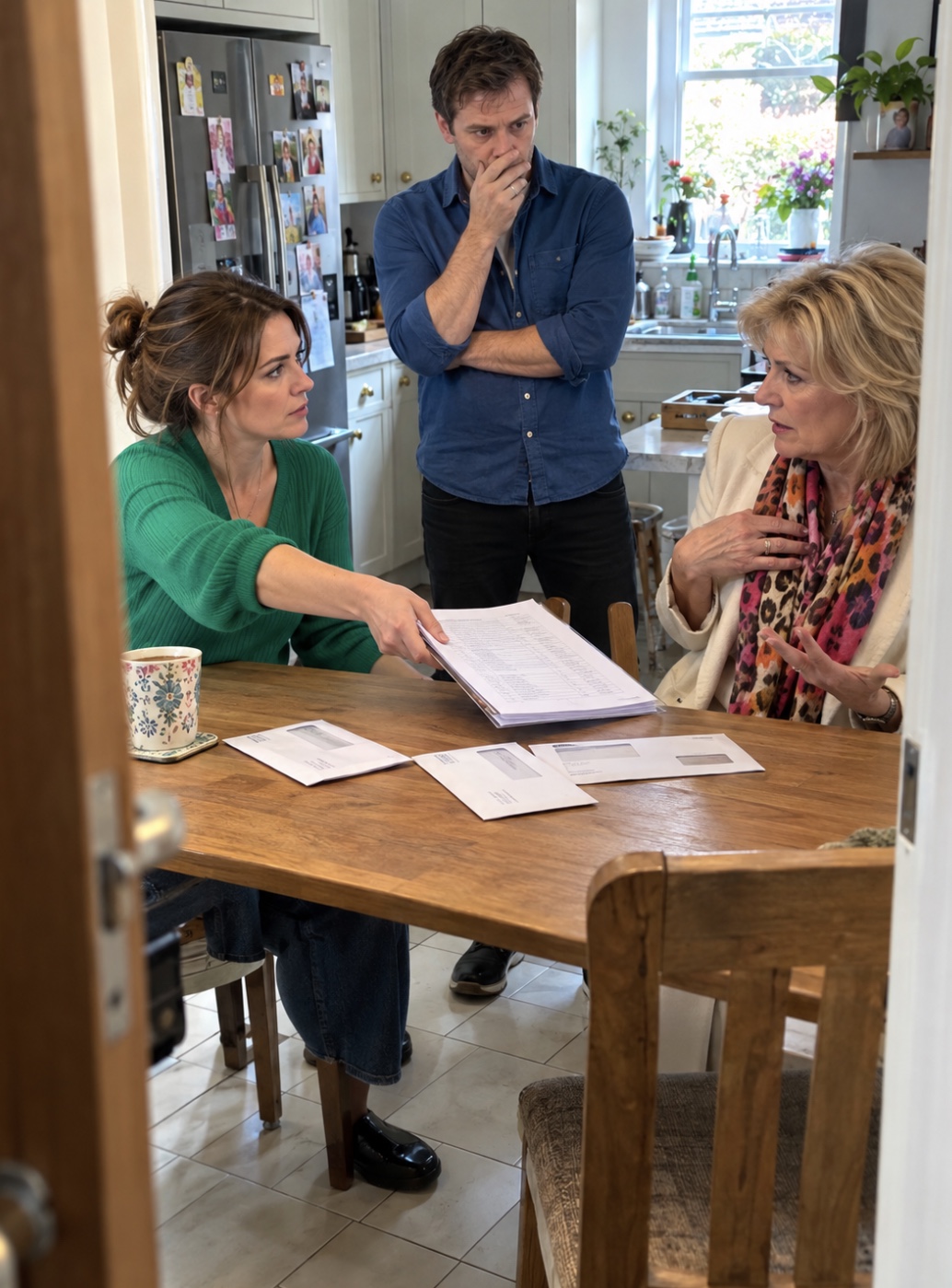
The folder was upstairs in the drawer of my desk.
Blue cover.
Clear plastic sleeves.
Twenty-seven separate payments.
When I returned to the kitchen, Denise was saying something about how expensive winter had been.
I sat down and placed the folder between us.
“What’s that?” Adam asked.
“Our transfers to your mum.”
His expression changed immediately.
Denise gave a short laugh.
“You’ve been keeping records?”
“The bank keeps records.”
I opened the first page.
January, two years earlier: £400 for a boiler repair.
March: £120 for car insurance.
April: £85 for groceries.
June: £300 toward a vet bill.
August: £250 for a new washing machine.
October: £600 for car repairs.
December: £200 “to help with Christmas.”
The next year continued.
£100.
£180.
£350.
£75.
£240.
£160.
Adam stopped me halfway down the second page.
“How much is it?”
I looked at him.
“You want the total?”
“Yes.”
“Seven thousand eight hundred and forty pounds.”
He stared at me.
Denise went completely still.
Adam actually laughed once, but there was no humour in it.
“What?”
“£7,840.”
“That can’t be right.”
“It is.”
“Mum?”
Denise’s face had turned pink.
“Well, that’s over two years.”
“Yes,” I said.
“That makes a difference.”
“It makes it £326 a month on average.”
She looked at Adam.
“Some of those were emergencies.”
“I know.”
“And some I was going to pay back.”
Adam opened the folder and began scanning the list.
“Which ones?”
Denise hesitated.
“The bigger ones.”
“Which ones?”
“I can’t remember every conversation.”
Neither could Adam.
That was the problem.
One payment at a time had felt manageable.
A hundred here.
Two hundred there.
A crisis every few months.
But when the entire pattern sat on paper, it looked very different.
Then Adam reached one line and frowned.
“Hotel?”
I knew exactly which one he had found.
£486.
Denise moved in her chair.
“That wasn’t a hotel.”
“Yes, it was,” I said.
Adam looked at me.
“How do you know?”
“Because I checked the reference.”
Denise’s eyes flashed.
“You checked?”
“You asked Adam for nearly five hundred pounds because you said you had an urgent plumbing problem.”
“I did.”
“The payment went directly to a hotel in York.”
Silence.
Adam looked at his mother.
“Mum?”
Denise crossed her arms.
“It was your aunt Sandra’s seventieth.”
“You told me your bathroom pipes had burst.”
“They had been leaking.”
“So why did I pay a hotel?”
“Because I had already paid the plumber and then didn’t have enough left for the weekend.”
Adam’s face changed.
Not dramatically.
That almost made it worse.
He simply looked tired.
“Mum, you lied.”
“I didn’t lie.”
“You said the money was for plumbing.”
“It was connected.”
I couldn’t stop myself.
“How?”
Denise snapped her head toward me.
“I don’t appreciate being spoken to like a criminal.”
“Nobody called you a criminal.”
“You’re sitting there with a dossier on me.”
“It’s our bank statement.”
“You’ve always resented helping me.”
That hit the exact nerve she intended.
Because for years, that was how every objection had ended.
Rachel resented her.
Rachel was cold.
Rachel counted pennies.
Rachel didn’t understand their family.
I had spent so much time trying not to look selfish that I had ignored how strange the arrangement had become.
Adam closed the folder.
“Why are your bills suddenly our responsibility?”
Denise looked at him.
“Because things are tight.”
“What changed?”
“Prices.”
“What else?”
“What do you mean?”
“You own your home. You get Dad’s pension. You get your own pension. You told me last year you had savings.”
“I do have savings.”
“How much?”
Her face closed immediately.
“That is none of your business.”
Adam stared at her.
“You want me to pay your council tax, but how much money you have is none of my business?”
“I’m entitled to have savings.”
“So are we.”
“I’m sixty-eight.”
“And we have a child.”
Denise pushed her chair back.
“I see what this is.”
I said nothing.
“This is Rachel.”
Adam’s head came up.
“No.”
“She’s turned you against me.”
“No.”
“She’s obsessed with that list.”
“I didn’t even know the list existed until five minutes ago.”
That stopped her.
Then he said something I had wanted him to say for a very long time.
“And that’s the problem.”
Denise blinked.
“What?”
“I didn’t know how much we’d given you because every time you asked, you made it sound like that one payment was the difference between you coping and not coping.”
Her voice softened.
“Adam, darling—”
“No. Don’t.”
He opened the folder again.
“You said you needed £350 because your energy account was in arrears.”
“It was.”
“Then three weeks later you went to Tenerife.”
She went quiet.
I hadn’t known about Tenerife when I made the list.
Adam had just connected that one himself.
“That holiday was already booked.”
“Then you couldn’t afford the holiday.”
“It was only five nights.”
“Mum.”
“I needed a break.”
“So did we.”
His voice cracked slightly on that sentence.
That surprised me.
Because I knew exactly what he meant.
The previous summer we had cancelled a weekend in Northumberland because our car needed two tyres and Maisie’s holiday club fees had been higher than expected.
That same month, Denise had asked for £200 toward a new cooker.
I suddenly remembered seeing photos online a week later of her at afternoon tea with two friends.
At the time, I had told myself not to be petty.
Now I wondered how many times “not being petty” had simply meant refusing to notice what was happening.
Denise stood.
“If helping your mother is such a burden, I’ll never ask either of you for anything again.”
It was the usual exit line.
Normally Adam would follow her.
Normally he would reassure her.
Normally she would leave with an apology she had somehow extracted from us.
This time he stayed seated.
“Okay.”
She froze.
I looked at him.
Denise turned slowly.
“What?”
“If that’s what you’re saying, okay.”
“You’d let me struggle?”
“No. If you genuinely can’t afford basic expenses, I’ll help you look at your finances. We can check whether you’re getting everything you’re entitled to. We can cancel things you don’t need. We can make a budget.”
Her lips parted.
“But I’m not blindly sending money anymore.”
The atmosphere in the kitchen changed completely.
Because Adam had finally separated two things Denise had spent years combining.
Helping.
And paying.
They were not the same.
Denise picked up her handbag.
“I cannot believe my own son is asking me to justify every pound.”
“You’re asking me to justify saying no.”
She left without the envelopes.
For the next four days, she did not call.
Adam was quieter than usual.
Not angry with me.
Not exactly.
Just embarrassed.
He went through the transfers himself one evening after Maisie was in bed.
Then he found another £1,120 from an account we rarely used.
The real total was £8,960.
He stared at the laptop.
“I could have put that into Maisie’s Junior ISA.”
I sat beside him.
“You didn’t know.”
“I should have.”
On Thursday night, Denise finally texted.
Can we talk tomorrow? Just Adam.
He showed me.
“What do you think?”
“I think you should go.”
He looked surprised.
“Really?”
“Yes.”
So he went to her bungalow on Friday after work.
He came back two hours later carrying a supermarket bag.
Inside were old birthday cards, childhood photographs, a school football trophy, and the watch his father had given him when he turned eighteen.
Denise had packed his things.
“She said if I’m going to treat her like a financial liability, she wants boundaries too.”
I stared at the bag.
“That’s awful.”
Adam shrugged, but his eyes were wet.
Then he handed me an envelope.
“She also gave me this.”
Inside was a bank statement.
Not hers.
A savings account in Adam’s name.
Balance: £14,300.
I read it twice.
“What is this?”
“I didn’t know it existed.”
The account had been opened when Adam was seventeen.
His dad had paid into it for years.
Denise had continued managing it after he died.
There were regular deposits.
Then, three years ago, the withdrawals began.
£500.
£800.
£1,200.
£300.
£2,000.
Again and again.
I looked up.
“Adam…”
“She admitted she’s been using it.”
“How much?”
“Just over eleven thousand.”
I felt cold.
“She was asking us for money while taking money from your savings?”
“Yes.”
“Why?”
He sat down at the kitchen table.
And then came the part neither of us expected.
Denise wasn’t broke.
She had been giving money to someone else.
Her younger brother, Martin.
Martin had a gambling problem.
Not the dramatic kind people notice immediately.
No casino stories.
No huge public disaster.
Just online betting, small loans, maxed credit cards and constant promises that he was “nearly sorted.”
Denise had spent years covering for him.
First with her own savings.
Then with Adam’s old account.
Then, when she became frightened of draining it completely, with money she asked us for.
“She said Uncle Martin owes her thirty-two grand,” Adam told me.
I didn’t know what to say.
“Does he?”
“She has messages. Bank transfers. Everything.”
“Why didn’t she tell you?”
“Because Dad hated his gambling. Apparently Dad made her promise never to give Martin money again.”
There it was.
The real reason behind the secrecy.
Not greed.
Not exactly.
Shame.
And denial.
Denise had not been asking us to support her.
She had been using us to keep supporting her brother.
The next Sunday, she came back to our kitchen.
No dramatic entrance this time.
No envelopes.
She looked older.
She had brought the paperwork herself.
For nearly three hours, the three of us went through everything.
She had £19,000 left in personal savings.
Her pension income covered her normal monthly expenses.
Her house was paid for.
Her problem was Martin.
Over four years, she had transferred him more than £40,000.
Some of it he had repaid.
Most of it he hadn’t.
When Adam asked why she kept sending money, Denise cried for the first time I had ever seen.
“Because every time I stopped, I thought that would be the time he lost his flat.”
Adam said quietly, “And every time I said no to you, you made me feel like a bad son.”
She covered her face.
“I know.”
Nobody spoke for a while.
Eventually I slid the three bills back toward her.
She gave a sad little laugh.
“Yes. I know.”
We didn’t pay them.
But we did help her.
Adam changed the password on the old savings account and transferred what remained into one only he controlled.
Denise contacted a gambling-family support service and finally told Martin she would not send him another pound.
The broadband package dropped from £94 to £31 after we discovered she had three sports add-ons she barely watched.
Her energy direct debit was also far higher than necessary because she had never submitted meter readings.
The council tax stayed exactly where it was.
Because some bills really are just bills.
Three months later, Denise came over for Maisie’s birthday.
She handed Adam an envelope.
He looked suspicious.
“What’s this?”
“Open it.”
Inside was a cheque for £2,000.
“Mum, you don’t have to—”
“Yes, I do.”
He looked at her.
She nodded toward me.
“Your wife was right to make that list.”
I nearly dropped the cake knife.
Denise noticed.
“Don’t enjoy it too much, Rachel.”
“I’m trying not to.”
She smiled.
Then she looked at Adam again.
“I spent years telling myself that helping Martin was loyalty. Then I expected you to prove your loyalty by helping me hide it.”
Adam folded the cheque carefully.
“I don’t need you to pay everything back immediately.”
“I know.”
She paused.
“But I need to start.”
That evening, after everyone left and Maisie was asleep, Adam stuck the old transfer list to the inside of our desk drawer.
Not because we needed it anymore.
Because he wanted to remember the lesson.
There is a difference between helping someone who is struggling and financing a problem they refuse to face.
And sometimes the most important thing you can put in front of a family member isn’t another cheque.
It’s the truth.