



The first thing I noticed was the smell of frying onions.
That was strange because I hadn’t cooked anything that evening.
The second thing I noticed was a man’s voice coming from our kitchen.
“Do you reckon there’s any more olive oil?”
I stopped in the hallway with my handbag still hanging from my shoulder.
My husband, Tom, was in Manchester for two nights for work.
I had left our flat in Bristol at seven forty that morning, locked the front door myself, checked it twice because the latch had been sticking, and gone straight to the office.
Nobody was supposed to be inside.
Then a woman laughed.
“Check the cupboard by the cooker. Margaret said they keep everything there.”
Margaret.
My mother-in-law.
I didn’t scream. I didn’t run outside. For some reason, the absurdity of hearing my mother-in-law’s name inside my locked flat made me move forward instead.
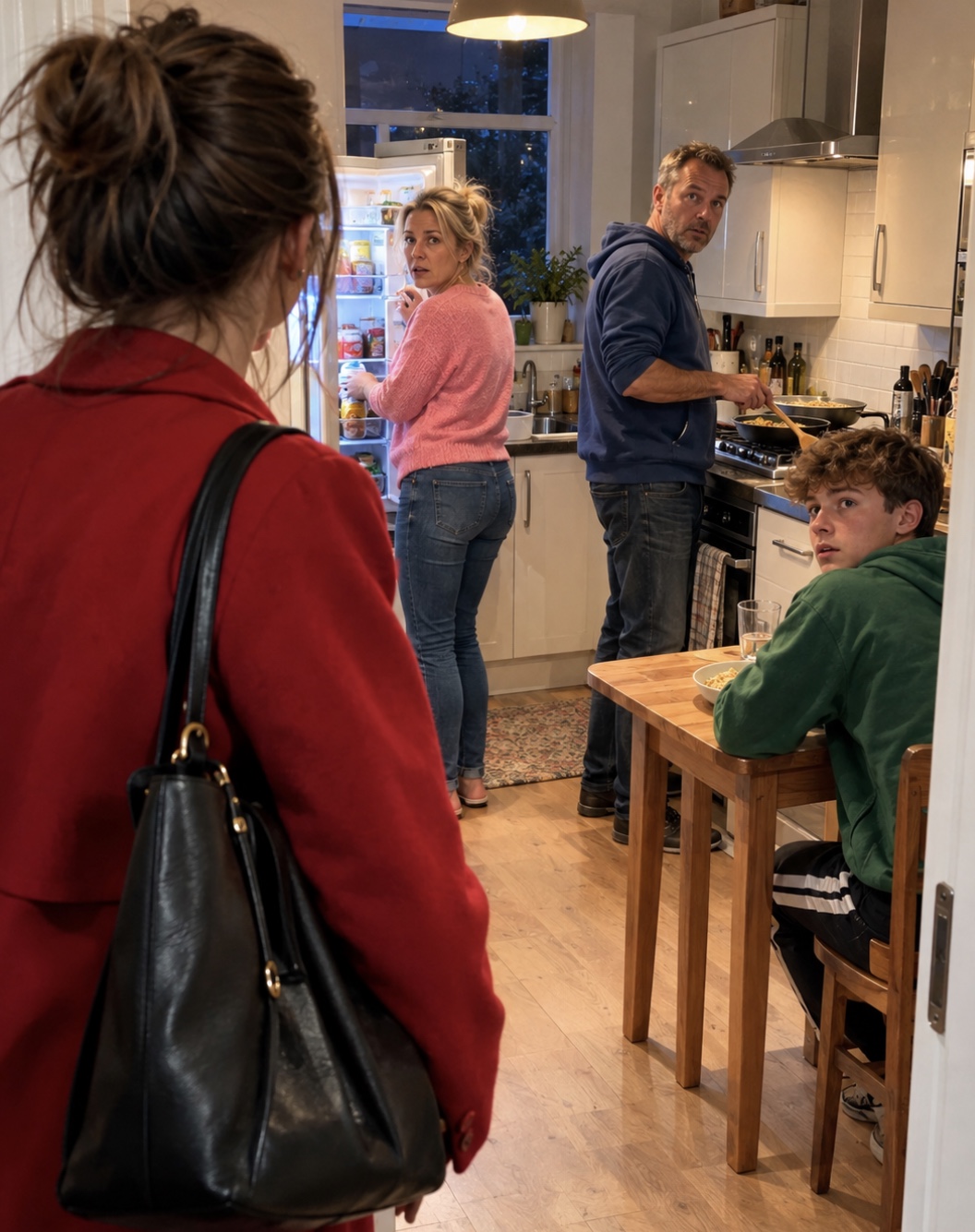
I stepped into the kitchen.
A man in his late fifties was standing over my frying pan.
A woman I vaguely recognised from two doors down was opening our fridge.
And sitting at our kitchen table was a teenage boy drinking orange juice from one of the glasses we’d bought for our wedding.
All three stared at me.
The woman shut the fridge.
“Oh!” she said. “You’re back early.”
I looked at the clock above the cooker.
It was 6:18 p.m.
“Early from what?”
The man slowly put down the wooden spoon.
The woman’s face changed.
That was the moment she realised something had gone very wrong.
“I’m Julie,” she said quickly. “From number twelve.”
“I know who you are.”
She smiled nervously.
“This is my husband, Neil. And our grandson, Connor.”
Connor lifted one hand awkwardly.
“Hi.”
I looked at the half-chopped mushrooms on my board, bread from my freezer defrosting beside the toaster and a bottle of wine standing open on the worktop.
Then I looked at Julie.
“How did you get into my flat?”
Nobody answered immediately.
Neil finally said, “We’ve got the spare key.”
My stomach tightened.
“What spare key?”
Julie gave him a look that clearly meant stop talking.
But it was too late.
“The one Margaret gave us.”
For several seconds, I genuinely thought I had misheard.
“My mother-in-law gave you a key to our flat?”
Julie started explaining too quickly.
“She only said it was for emergencies.”
“Is this an emergency?”
“No. Well—sort of.”
Neil cleared his throat.
“Our boiler’s gone.”
I waited.
“And?”
Julie looked embarrassed.
“The engineer can’t come until tomorrow. We haven’t got hot water and the cooker’s electric, but the power keeps tripping because there’s something wrong with the fuse box.”
“So you came here?”
“Margaret said we could.”
There it was.
Not asked.
Not suggested.
Said we could.
My own home had somehow become a community backup facility authorised by a woman who didn’t live there.
“Please leave.”
Julie blinked.
“What?”
“Take your food and leave.”
Neil straightened.
“Look, we don’t want any trouble.”
“Then don’t cook dinner in somebody else’s kitchen without permission.”
Connor was already standing.
“Nan, let’s go.”
Julie began gathering things, but she looked offended now rather than embarrassed.
“Margaret told us you wouldn’t mind.”
“I do mind.”
“Well, she said Tom wouldn’t.”
That sentence stayed with me.
Not we wouldn’t mind.
Tom wouldn’t.
As if Tom’s opinion counted for both of us.
They left six minutes later carrying a carrier bag full of half-cooked food.
Before Julie walked out, she placed a brass key on the hallway table.
“I suppose you’ll want this.”
I stared at it.
“Yes.”
After I locked the door behind them, I rang Tom.
He answered from his hotel room.
“Hey. Everything okay?”
“Did your mum give our neighbours a key?”
Silence.
Not confusion.
Silence.
That was worse.
“Tom?”
“She might have.”
I sat down on the stairs.
“What does ‘might have’ mean?”
He sighed.
“Apparently Julie once got locked out when Neil was away, and Mum thought it was sensible for neighbours to have emergency keys.”
“Our emergency key?”
“Yes.”
“Did you know?”
“I knew Mum had mentioned it.”
“Did you agree?”
Another pause.
“Not exactly.”
I laughed once, because otherwise I might have thrown the phone.
“So your mother gave strangers access to our flat, and nobody thought I should know?”
“They’re not strangers. They’re neighbours.”
“Tom, I have spoken to Julie maybe four times in three years.”
“They’re decent people.”
“They were frying mushrooms in my kitchen.”
“What?”
I told him exactly what I had found.
By the time I finished, he sounded less relaxed.
“She shouldn’t have told them they could use the flat.”
“She shouldn’t have had the authority to tell anyone anything.”
“I know.”
“No, I don’t think you do.”
He promised to speak to his mother.
I told him not to.
“I’ll speak to her myself.”
Margaret arrived the next morning at 9:10.
She didn’t knock apologetically.
She knocked the way she always did: three brisk taps followed by another two before anyone had time to answer.
When I opened the door, she was holding a bakery bag.
“I brought Chelsea buns.”
“Why did you give Julie our key?”
No hello.
No tea.
No pretending.
Margaret looked mildly irritated.
“Has she been talking?”
“She was in my kitchen.”
That stopped her.
“In your kitchen?”
“With Neil and their grandson.”
“Oh.”
I waited for an apology.
Instead she said, “Well, their boiler is broken.”
“That doesn’t give them permission to enter our home.”
“I told Julie she could heat something up.”
“You told her?”
“I knew Tom wouldn’t mind.”
“I live here too.”
Margaret’s expression hardened.
“Of course you do, Rachel.”
There was something about the way she said my name that made it sound like a technicality.
I held out my hand.
“I want every key you have.”
She didn’t move.
“What do you mean every key?”
“The spare key to this flat.”
“I need one for emergencies.”
“No.”
“What if there’s a leak?”
“We have a building manager.”
“What if you’re both away?”
“Then nobody comes in.”
She looked genuinely astonished.
“You’re being rather dramatic.”
I nearly answered, but then something occurred to me.
“Margaret, how many people have had that key?”
Her eyes shifted.
Only slightly.
But I saw it.
“How many?”
📌 What happened next made the spare key the smallest part of the problem — keep reading in the first comment. 👇
Margaret set the bakery bag on the console table.
“Nobody.”
“That’s not true. Julie had it.”
“I mean nobody else currently has it.”
Currently.
The word landed badly.
“Who had it before?”
She folded her arms.
“Oh, honestly, Rachel.”
“Who?”
She listed them reluctantly.
Our upstairs neighbour, Peter, when we went to Cornwall two summers ago.
Her sister Susan when Margaret had been feeding our cat.
A cleaner Margaret once arranged when I was recovering from surgery.
A plumber.
And, apparently, a university student called Ben who had stayed with Susan and watered our plants for ten days while Tom and I were abroad.
I had never met Ben.
“You gave somebody I’ve never met access to our home?”
“He’s Susan’s godson.”
“That means nothing to me.”
“He’s perfectly trustworthy.”
“How would you know?”
“I know Susan.”
I stared at her.
This wasn’t carelessness.
Margaret genuinely believed that anyone connected to her automatically became trustworthy enough to enter our home.
I changed the locks that afternoon.
Tom agreed immediately when I told him the full list.
He came home the following evening and apologised.
Properly.
“I should have stopped this ages ago.”
“What does that mean?”
He sat beside me on the sofa.
“My mum’s always been like this.”
“Giving away other people’s keys?”
“Managing things.”
He told me something I hadn’t known.
When Tom was twenty-four and renting his first flat, Margaret had copied his key without telling him.
She used to let herself in to leave groceries.
Then she began doing his laundry.
Then reorganising cupboards.
Once, she threw away three shirts because she thought they were too worn.
“I changed the lock eventually,” Tom said.
“And?”
“She didn’t speak to me for nearly a month.”
I looked at him.
“So when we moved here, why did you give her another key?”
He rubbed his forehead.
“Because I thought she’d changed.”
“No. Because saying no to her is exhausting.”
He didn’t argue.
That was the first time I felt we might actually fix the problem.
But three days later, Julie knocked on my door.
She looked uncomfortable.
“I thought you should know something.”
I invited her in, though not into the kitchen.
We sat in the living room.
Julie twisted the strap of her handbag around her fingers.
“I’m sorry about the other evening.”
“Thank you.”
“I genuinely thought you knew.”
“I believe you.”
She looked relieved.
Then she said, “There’s something else.”
My stomach tightened again.
Apparently Margaret had not simply given Julie an emergency key.
She had created what she called a “neighbour arrangement.”
For almost a year.
Margaret had told Julie and Neil that if Tom and I were ever away, they could use our allocated parking space.
That explained why we occasionally came home and found an unfamiliar car there.
She had also told them they could place parcels inside our hallway if nobody answered.
That explained two mysterious boxes I’d once found by the coat rack.
But then Julie said something that made my skin crawl.
“She also asked me to keep an eye on who came and went.”
I stared at her.
“What?”
Julie looked miserable.
“She said you’d had trouble in the building.”
“We haven’t.”
“I know that now.”
“What exactly did she ask you to watch?”
“She said if Tom was away and anyone came round, just mention it.”
There was a silence.
I understood before Julie finished.
Margaret wasn’t protecting the flat.
She was watching me.
“When did she ask you this?”
“Last winter.”
Last winter Tom had spent nearly three months travelling between Bristol and Leeds because his company was opening a new office.
I remembered Margaret’s odd comments during that period.
“You’ve been seeing a lot of friends lately.”
“Busy weekend?”
“Tom said you had people round.”
At the time, I assumed Tom had mentioned things casually.
Now I knew better.
“Did you report back to her?”
Julie shook her head.
“Once or twice at first. Then it felt strange.”
“What did you tell her?”
“That your friend with the red coat came round. And that a delivery driver came twice.”
My friend with the red coat was my younger sister, Hannah.
The delivery driver had been bringing flat-pack shelves.
Nothing scandalous.
But that wasn’t the point.
Margaret had turned the woman across the corridor into an unofficial observer.
I thanked Julie for telling me.
After she left, I rang Tom.
He came home early.
I expected him to defend his mother.
Instead he went pale.
“She asked Julie to watch you?”
“Yes.”
He stood completely still.
Then he said, “I need to tell you something.”
Apparently Margaret had suspected I was having an affair.
Not because of evidence.
Because of a misunderstanding.
The previous December, she had seen a man hug me outside a café.
The man was my cousin Nathan.
Margaret had never met him.
Instead of asking Tom or me, she had built a story around it.
She had asked neighbours to notice visitors.
And she had kept the key partly so she could, in her words to Tom, “step in if anything ever seemed wrong.”
Tom had found out two months earlier.
“You knew?”
“She told me she’d been worried.”
“And you didn’t tell me?”
“I told her she was being ridiculous.”
“That’s not the question.”
He looked ashamed.
“I didn’t want to create a huge row.”
There it was again.
Avoid Margaret’s reaction.
Absorb the consequences later.
That night Tom rang her on speaker.
He didn’t shout.
Maybe that was why the conversation was so effective.
“Mum, did you ask Julie to watch Rachel?”
Long silence.
Then Margaret said, “I wouldn’t use that word.”
“What word would you use?”
“I asked her to be observant.”
“Why?”
“You were away all the time.”
“And?”
Another silence.
“I saw Rachel with someone.”
I leaned forward.
“My cousin Nathan?”
Margaret sounded startled.
“He’s your cousin?”
“Yes.”
“Well, I didn’t know that.”
“You could have asked.”
“I didn’t want to embarrass anyone.”
I almost laughed.
Instead I said, “So you avoided embarrassing me by arranging neighbourhood surveillance?”
“Don’t be ridiculous.”
Tom interrupted.
“No, Mum. Stop.”
Margaret went quiet.
He continued.
“You gave out our key. You gave people permission to enter our home. You told them they could use our parking space. You asked Julie to report visitors to you.”
“I was trying to protect you.”
“From my wife?”
“I was worried.”
“That doesn’t make it acceptable.”
Margaret’s voice changed.
Softened.
It was the tone she used when she wanted to move from accusation to injury.
“I suppose I’m just the interfering old mother now.”
Tom closed his eyes.
Usually, that sentence worked.
I had seen it work dozens of times.
This time it didn’t.
“You’re my mum,” he said. “And I love you. But you crossed a line.”
She hung up.
For two weeks, we heard nothing.
Then a letter arrived.
Not a text.
A letter.
Margaret had written four pages by hand.
The first page was defensive.
The second explained how difficult she found it to stop “looking after” Tom.
The third surprised me.
She admitted that after her husband, David, died six years earlier, she had become frightened of losing relevance in her son’s life.
If she had a key, she had a role.
If she knew our schedules, she felt included.
If people called her when something happened in our building, she felt necessary.
Then came the line I didn’t expect.
“I confused being needed with being entitled.”
I read it twice.
Tom read it three times.
The final page was addressed directly to me.
There was no dramatic apology.
No demand for forgiveness.
Just something simple.
“I understand now that I treated your home as if it were an extension of my relationship with my son. It isn’t. It is yours and Tom’s, and I should have waited to be invited into it.”
Three weeks later, she came for Sunday lunch.
She rang the bell.
That sounds insignificant.
It wasn’t.
Margaret had spent years unlocking our door and calling, “It’s only me!”
This time she stood outside holding flowers.
When I opened the door, she didn’t step forward automatically.
“Hello,” she said.
“Hello.”
Then she asked, “May I come in?”
I moved aside.
“Yes.”
After lunch, Tom took the rubbish downstairs.
Margaret and I were alone in the kitchen.
She glanced at the new lock visible from the hallway.
“I suppose I won’t be getting one of those keys.”
“No.”
She nodded.
“Fair enough.”
Then, to my surprise, she smiled.
“Probably safer for everyone.”
I laughed.
Actually laughed.
And for the first time since I’d known her, Margaret didn’t look offended that I had drawn a boundary.
She looked relieved.
Six months have passed.
She still worries.
She still gives too much advice.
She still sends Tom links to articles about boiler servicing and reminds us when the weather forecast says frost.
But she knocks.
She doesn’t organise our neighbours.
She doesn’t know who visits unless we tell her.
And Julie and I are on surprisingly good terms now.
Last month, her boiler broke again.
This time she knocked on our door.
“Any chance I could fill the kettle?”
I stepped aside.
“Of course.”
She smiled.
“And don’t worry. I left my frying pan at home.”
The strangest thing is that the spare key never turned out to be the real problem.
The real problem was that nobody had ever told Margaret where helping ended and ownership began.
And maybe the reason things finally changed wasn’t because we changed the lock.
It was because, for once, we didn’t hand her another key to the boundary we had just built.