



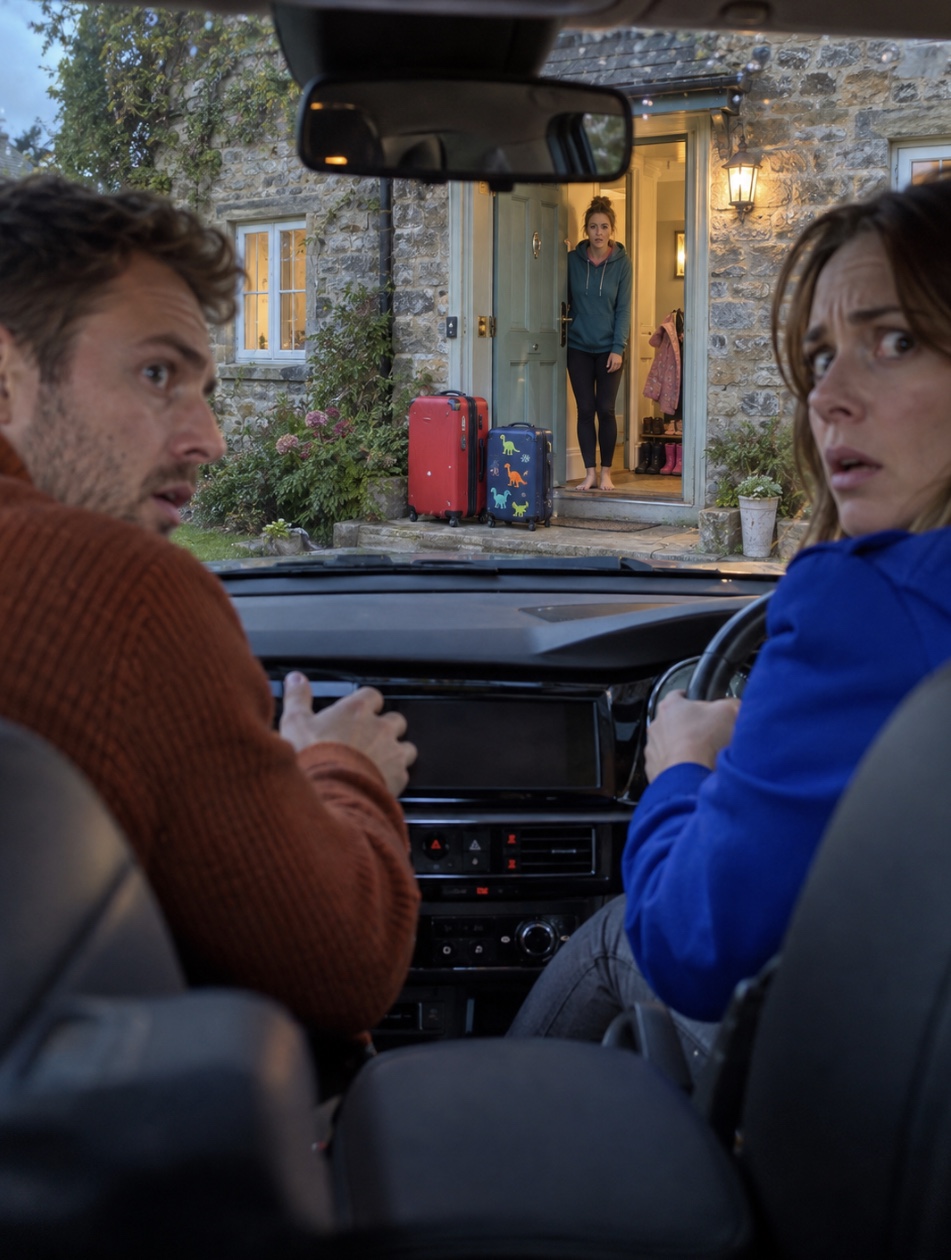
The first thing I noticed was the red suitcase.
It was standing upright on the porch of our little cottage in Northumberland, beside a smaller navy-blue one covered in dinosaur stickers.
I slowed the car.
“Are you expecting someone?” I asked.
Ben stared through the windscreen.
“No.”
It was just after seven on Friday evening. We had driven up from Leeds after work, crawling through traffic for nearly three hours because half the country seemed to have decided to escape for the weekend.
All I wanted was to get inside, put the kettle on and sit in the garden with a glass of wine while the last of the September light disappeared behind the stone wall.
Instead, there were two suitcases outside our front door.
And the curtains in the upstairs bedroom were open.
I knew I had closed them the previous Sunday.
Ben parked beside the old apple tree.
“Maybe Mum’s been here.”
I turned to him.
“Why would your mother bring luggage?”
He didn’t answer.
We got out.
Then I noticed something else.
There was a silver Vauxhall parked behind the shed.
I recognised it immediately.
“Ben.”
He stopped.
“That’s Rachel’s car.”
Rachel was his younger sister.
Thirty-six, recently separated from her husband, mother of two children, and the sort of person who could turn every inconvenience in her life into a family emergency requiring six adults and two vehicles.
Ben rubbed a hand over his face.
“She didn’t say anything to me.”
Neither had Margaret, his mother.
I walked up the three stone steps and took out my key.
It went into the lock.
But it wouldn’t turn.
I tried again.
Nothing.
For a strange second I thought I had the wrong key, even though the little brass tag clearly said COTTAGE.
Ben took it from me.
“Let me.”
He tried.
Then his expression changed.
“That’s not our lock.”
I looked closely.
He was right.
The old brass Yale lock had been replaced with a new black one.
I felt a cold little twist in my stomach.
“Someone changed the lock?”
Before Ben could answer, the door opened.
Rachel stood there barefoot, wearing leggings and one of Ben’s old university hoodies.
“Oh.”
That was all she said.
Behind her, I could see our hallway.
A child’s coat hung from the banister.
Three pairs of trainers were lined up by the wall.
A half-empty packet of biscuits sat on the little oak table my father had restored for us.
Rachel looked from me to Ben.
“You’re here.”
I almost laughed.
“Yes. We own the place.”
Her face tightened.
“I thought Margaret told you.”
Ben’s voice went very quiet.
“Told us what?”
Rachel stepped aside.
Her daughter Evie appeared behind her holding a mug.
Then eight-year-old Noah shouted from somewhere upstairs.
“Mum! Where’s my charger?”
Rachel closed her eyes for half a second.
“We’re staying here for a bit.”
I stared at her.
“A bit?”
“Just until things settle down.”
“What things?”
“Me and Callum.”
I knew she and her husband had been arguing. Everyone knew. Margaret had spent weeks reporting every detail as if she were providing live coverage from a war zone.
But nobody had mentioned Rachel moving into our cottage.
Ben looked around.
“Where did you get a key?”
Rachel hesitated.
“Mum.”
I folded my arms.
“And how did Mum get a key to a lock that didn’t exist last week?”
Silence.
That was when I knew this wasn’t a misunderstanding.
Ben stepped inside.
I followed him.
Our cottage wasn’t grand. It had two bedrooms, low ceilings, an old fireplace and a kitchen that still had uneven slate flooring.
We had bought it four years earlier after saving for nearly a decade.
It wasn’t an investment property.
It wasn’t a holiday let.
It was ours.
Our escape.
We came up most weekends, spent Christmas there every second year, planted herbs in the garden, repaired the stone wall ourselves and argued for six months over whether the kitchen cupboards should be green or cream.
Now there were cereal bowls in the sink.
A school timetable pinned to our fridge.
And on the kitchen counter was Margaret’s handwriting on a folded note.
I picked it up.
“Milk in fridge. Spare bedding washed. Heating set to 20. Rachel, ring me if you need anything. Mum xx.”
Ben read it over my shoulder.
His jaw tightened.
Rachel followed us into the kitchen.
“She was trying to help.”
I turned.
“By changing our locks?”
Rachel looked uncomfortable.
“She said you wouldn’t mind.”
“Did you think to ask us?”
“Mum said she’d handled it.”
Ben pulled out his phone.
“I’m calling her.”
Rachel suddenly became defensive.
“Please don’t start a massive row in front of the kids.”
I looked at her.
“A massive row?”
“I’ve had the worst week of my life, Claire.”
“And I’m sorry about that. But you’re standing in my kitchen after somebody changed my locks without permission.”
She shook her head.
“You make it sound criminal.”
I stared at her.
“What would you call it?”
Ben walked into the sitting room while the phone rang.
Margaret answered on the fourth ring.
I couldn’t hear her first words, but I heard Ben’s.
“Why did you change the locks on the cottage?”
A pause.
Then:
“No, Mum. Don’t ask me how we are. Answer the question.”
Rachel muttered, “Fantastic.”
Ben put the call on speaker.
Margaret’s voice filled the room.
“I didn’t change them personally. Colin from number twelve did it.”
I almost admired the distinction.
“Why?” Ben asked.
“Because the old lock was sticking.”
“No, it wasn’t.”
“Well, Rachel needed somewhere safe.”
I stepped closer.
“Margaret, why is Rachel living in our house?”
There was a pause.
Then she said, in the patient tone she used when explaining something to someone she considered slow:
“Because she’s left Callum.”
“I know that.”
“And she has two children.”
“I know that too.”
“So where did you expect her to go?”
I actually looked around the room, wondering whether she could hear herself.
“Perhaps she could have asked us?”
“Oh, Claire, don’t be difficult.”
That sentence did it.
Not the lock.
Not the suitcases.
Not even the fact that Rachel had apparently moved into our cottage without telling us.
It was the casual way Margaret said don’t be difficult, as though the only obstacle in the situation was my personality.
Ben spoke before I could.
“Mum, you had no right.”
“Don’t be dramatic.”
“You changed the lock on our property.”
“For family.”
“That doesn’t make it yours.”
Rachel suddenly snapped.
“Can everyone stop talking about me like I’m not here?”
We all went quiet.
She looked at Ben.
“I had nowhere else to go.”
“You could have called me.”
“I was embarrassed.”
“And Mum wasn’t?”
“She offered.”
I said, “She offered something that wasn’t hers.”
Rachel’s face hardened.
“You’ve got your house in Leeds. You barely use this place during the week.”
There it was.
The sentence I had somehow known was coming.
The justification.
The idea that because we weren’t physically present every day, our ownership became negotiable.
📖 Things became even stranger when we found out why Margaret had been so certain we couldn’t make Rachel leave — the rest is in the first comment. 👇
Ben ended the call with Margaret after telling her we would speak later.
Then he looked at Rachel.
“How long have you been here?”
“Since Tuesday.”
It was Friday.
Three nights.
“And Mum had the locks changed when?”
“Monday.”
I turned sharply.
“Before you even left Callum?”
Rachel looked away.
That was the first moment when something stopped making sense.
“You said you left him this week.”
“I did.”
“When?”
“Tuesday morning.”
“So your mother arranged a locksmith the day before?”
Rachel sat down at the kitchen table.
“She knew things were bad.”
Ben looked at her carefully.
“Did you plan this?”
“No.”
“Rachel.”
“I didn’t plan anything.”
Her eyes filled suddenly, and for the first time that evening, my anger shifted.
Not disappeared.
Shifted.
She looked exhausted.
Really exhausted.
There were shadows under her eyes and a fading bruise on the inside of her wrist.
I noticed Ben see it too.
He pulled out the chair opposite her.
“What happened?”
Rachel covered the mark with her sleeve.
“Nothing.”
“Did Callum do that?”
“No.”
Too quick.
Evie appeared in the doorway.
“Mum?”
Rachel straightened immediately.
“It’s fine, sweetheart. Go upstairs with Noah.”
Evie looked at the three of us, then went back up.
I lowered my voice.
“Rachel, if you needed somewhere safe, you could have called us.”
She stared at the table.
“I know.”
“Then why didn’t you?”
Her mouth tightened.
“Because Mum told me not to.”
Ben leaned back.
“What?”
Rachel rubbed both hands over her face.
“She said you’d say no.”
I felt something hard settle inside me.
“Of course she did.”
Rachel continued.
“She said Claire would make it about boundaries and ownership and all that.”
I almost smiled.
“At least she knows me.”
Ben didn’t.
“Why would Mum want you here specifically?”
Rachel looked at him.
“She said it made sense.”
“That isn’t an answer.”
Rachel started crying.
Not loudly.
Just suddenly.
“I didn’t know where else to go.”
The entire room changed.
Ben got up and made tea because that is what his family did in every crisis, no matter how absurd.
I sat opposite Rachel.
For the next twenty minutes, the story came out in pieces.
Callum had been controlling their money for months.
Then he had started checking her phone.
Then questioning where she had been.
On Monday night, an argument had escalated. He had grabbed her wrist hard enough to leave the mark.
She had taken the children to school Tuesday morning and never gone home.
Margaret had collected clothes for her.
I felt awful for being angry at Rachel.
But something still bothered me.
“Why did Margaret arrange the lock before Monday night?”
Rachel stopped.
Ben stopped pouring tea.
“What?” he asked.
I repeated it.
“If the argument happened Monday night, but Margaret had already arranged for Colin to change the lock that day, then this wasn’t a response to what happened.”
Rachel looked genuinely confused.
“She told me she called him Tuesday morning.”
Ben picked up his phone.
“I’m ringing Colin.”
Rachel groaned.
“Please.”
But Ben was already calling.
Colin was a retired joiner who lived two cottages down and had helped us fix the back door the previous spring.
He answered cheerfully.
“All right, Ben?”
“Hi, Colin. Quick question. When did Mum ask you to replace our front lock?”
There was a pause.
“Oh. About three weeks back.”
Nobody moved.
Ben’s voice changed.
“Three weeks?”
“Yeah. Said you’d approved it. I ordered the lock. Fitted it Monday because that was when it arrived.”
I stared at Rachel.
Rachel stared at Ben.
“Did she give you a reason?” Ben asked.
“Said you were going to start letting the place to family.”
My skin went cold.
Ben thanked him and hung up.
For several seconds, the only sound was the kettle clicking as it cooled.
Rachel whispered, “She told him what?”
Ben was already calling Margaret again.
This time she didn’t answer.
He tried again.
Voicemail.
Then I remembered something.
Three weeks earlier, Margaret had asked me a strange question over Sunday lunch.
Would we ever consider renting the cottage out?
I had laughed and said no.
She had asked why not.
I told her we liked having somewhere that was ours.
At the time, I hadn’t thought anything of it.
Now I opened the drawer beneath the phone table.
Our folder of cottage paperwork was still there.
But when I pulled it out, papers were out of order.
Ben saw my face.
“What?”
I started going through them.
Insurance.
Boiler service.
Water bill.
Survey.
Then I realised what was missing.
“The spare set of keys.”
“What?”
“We kept the original spare keys in here.”
Rachel looked from me to Ben.
“I didn’t know that.”
I believed her.
Ben went pale.
“Mum took them.”
We drove to Margaret’s house the next morning.
Rachel and the children stayed at the cottage.
Yes, stayed.
Because once we understood the real situation, neither Ben nor I was going to throw them out that night.
But we made one thing clear.
Rachel could stay temporarily because we were allowing it.
Not because Margaret had given her permission.
There was a difference.
A very important one.
Margaret opened her front door wearing a cream cardigan and the expression of someone expecting an apology.
“Have you calmed down?”
Ben walked past her.
“No.”
She looked at me.
“This is exactly what I was trying to avoid.”
I almost laughed.
“By secretly changing our locks?”
We sat in her immaculate dining room.
Margaret remained standing.
Ben placed the old key on the table.
“Why did you plan this three weeks ago?”
“I didn’t plan anything.”
“Colin says you did.”
Her face changed only slightly.
Enough.
“Mum.”
“All right.”
She sat.
“I knew Rachel was unhappy.”
“That doesn’t explain telling Colin we were letting the cottage to family.”
She folded her hands.
“I was trying to create a practical solution.”
“For a problem that hadn’t happened yet?”
She sighed.
“You two have a house. Rachel doesn’t.”
“She did three weeks ago,” I said.
Margaret looked irritated.
“You know what I mean.”
“No, actually.”
Then Ben asked the question that finally broke through her confidence.
“Did you tell Rachel to leave Callum because you’d already arranged the cottage?”
Margaret’s head snapped towards him.
“That’s ridiculous.”
“Did you?”
“Of course not.”
But she wouldn’t look at him.
And suddenly I understood.
Not everything.
But enough.
“You didn’t change the lock for Rachel,” I said.
Margaret turned to me.
“You changed it because you wanted control of the cottage.”
Her lips pressed together.
“That’s nonsense.”
“Then give us every copy of the new key.”
Silence.
Ben stared at her.
“How many copies are there?”
Margaret stood up.
“I will not be interrogated in my own home.”
“How many?”
“Three.”
“Who has them?”
“One with Rachel. One with me.”
“And the third?”
She didn’t answer.
Ben stood too.
“Mum.”
Finally she said:
“Your Aunt Susan.”
I actually laughed.
Not because it was funny.
Because it was insane.
“Aunt Susan has a key to our cottage?”
“She’s going up next month.”
“No, she isn’t.”
Margaret looked offended.
“She and Peter have tickets for a concert in Newcastle. Hotels are ridiculous now.”
I stared at her.
“You’ve been lending out our house?”
“Not lending. It’s family.”
“How many people?”
She hesitated.
That hesitation told me everything.
Ben went very still.
“How many people have stayed there?”
Margaret looked at the carpet.
“Only a few.”
“Who?”
It turned out “a few” meant six different sets of relatives over the previous eighteen months.
A cousin attending a wedding.
An aunt visiting friends.
Margaret herself twice.
Rachel once the previous Christmas when she and Callum had argued.
We had never known.
She had been taking the spare keys from our paperwork folder, using the cottage when we weren’t there, then returning them.
Three weeks earlier, when I casually told her we would never rent the place, Margaret apparently decided it was becoming “ridiculous” to keep sneaking keys back and forth.
So she arranged a new lock.
In her mind, she wasn’t stealing access.
She was formalising something she already believed she had.
Ben looked like somebody had punched him.
“That cottage is not a family holiday home.”
Margaret gave him a wounded look.
“I helped you buy it.”
I turned.
“No, you didn’t.”
“I gave you money.”
Ben frowned.
“When?”
“Five thousand pounds.”
“No, you didn’t.”
“Yes, I did.”
Then Margaret said something neither of us expected.
“When your grandfather died.”
Ben went silent.
His grandfather had died six years before we bought the cottage.
Margaret walked to a cabinet and pulled out an old envelope.
Inside were bank statements.
She pushed one across the table.
There it was.
A transfer of £5,000 into Ben’s old savings account.
He stared at it.
“I thought that was from Grandad.”
“It was.”
“Then it wasn’t from you.”
“I handled his finances.”
I suddenly understood why she had kept the paperwork.
Ben looked sick.
“Was that money left to me?”
Margaret didn’t answer.
He looked up.
“Mum.”
“Yes.”
“And you’ve been telling people you helped us buy the cottage because you transferred money Grandad left me?”
“I could have used it elsewhere.”
“No. You couldn’t. It was mine.”
Her face hardened.
“There is no need to be ungrateful.”
Ben stood.
“I’m not ungrateful. I’m horrified.”
For the first time since I had known him, he didn’t try to soften the argument.
He didn’t tell his mother he understood her intentions.
He didn’t say everyone was upset.
He simply said:
“You are never getting another key.”
Margaret stared at him.
“Rachel is my daughter.”
“And she can stay because Claire and I agreed she can stay.”
“What difference does it make?”
“All of it.”
We left ten minutes later with Margaret’s key, Aunt Susan’s key after a very awkward phone call, and the name of the locksmith who had made the third copy.
We changed the lock again that afternoon.
This time Ben and I were the only people with keys.
Rachel stayed for nine weeks.
Not “a bit.”
Not forever.
Nine weeks.
During that time she found a solicitor, sorted emergency finances, arranged a rental near the children’s school and slowly started putting her life back together.
Callum never came to the cottage.
Margaret tried twice to convince Rachel that moving into a rented house was “throwing money away” when she could simply remain at ours.
Rachel surprised all of us.
“No,” she told her.
“Claire and Ben helped me. That doesn’t make their house mine.”
Margaret didn’t speak to me for nearly a month after that.
The strangest thing happened the following spring.
Ben and I went up to the cottage for Easter.
It was the first genuinely warm weekend of the year.
The daffodils were out by the stone wall, and the apple tree had started to blossom.
When we arrived, there was a parcel on the porch.
For one terrible second, seeing something by the door made my stomach drop.
Then I recognised Rachel’s handwriting.
Inside was a small ceramic plaque.
Nothing expensive.
White clay, blue lettering.
Ben held it up and started laughing.
It said:
“PRIVATE PROPERTY — ASK BEFORE ENTERING.”
I laughed so hard I had to sit down on the porch step.
Then I found the note underneath.
“Thought you might need this. Thank you for giving me somewhere safe when I actually needed it — and for making sure I understood that kindness and entitlement are not the same thing. Love, Rachel.”
Ben sat beside me.
For a while we said nothing.
Then he screwed the plaque to the wall beside the front door.
Margaret saw it three weeks later.
She stared at it for a very long time.
Then she looked at me.
“Is that aimed at me?”
I smiled.
“Only if you don’t knock.”