



The first thing my mother-in-law said after my phone hit the kitchen tiles was not “I’m sorry.”
It was, “Good. Now there’s no evidence.”
For a few seconds, neither of us moved.
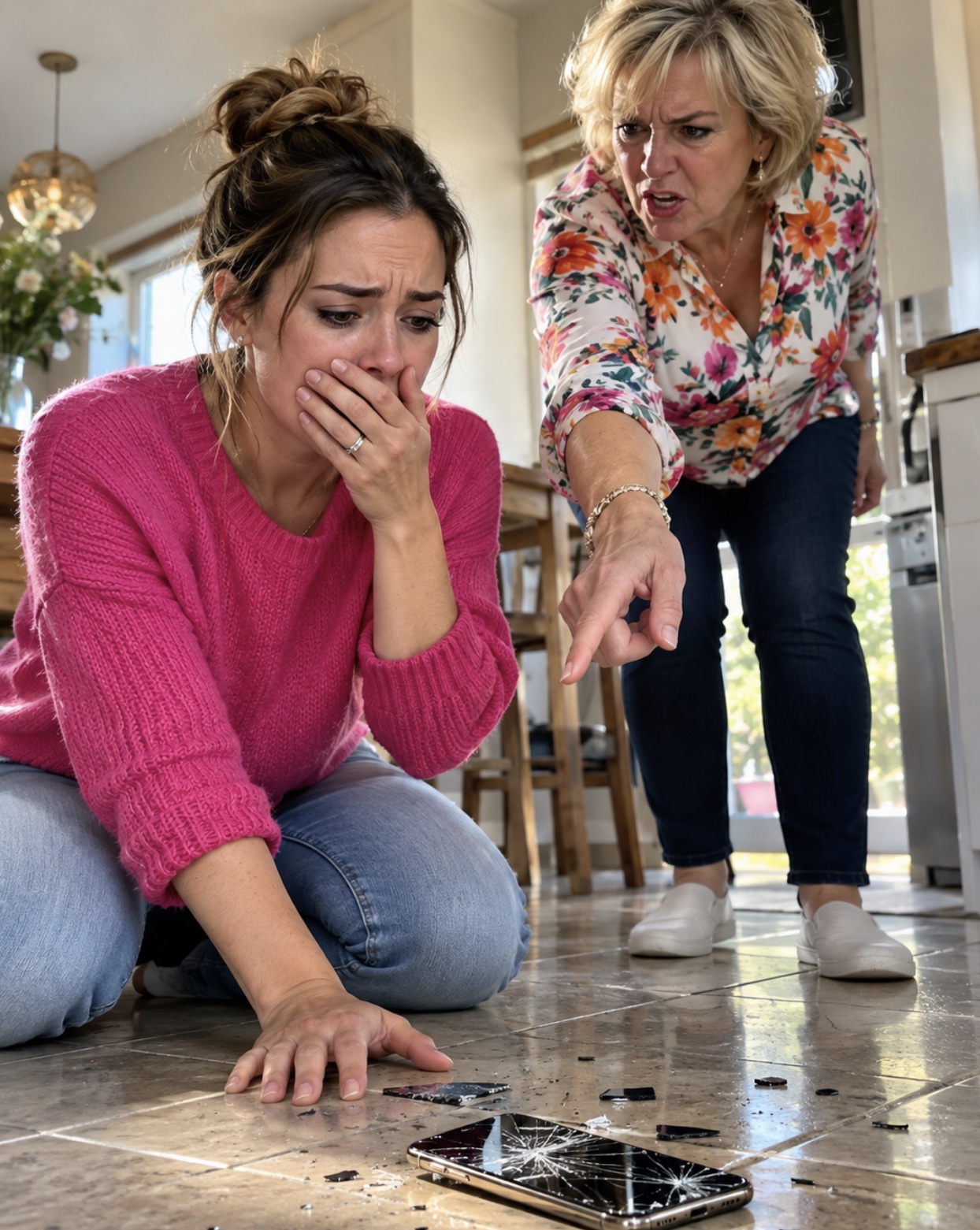
My phone lay face-down beside the dishwasher, the screen cracked into a white spiderweb. A tiny piece of black glass had skidded under the table. Across from me, Diane was breathing hard, one hand still raised from the movement she’d made when she snatched it from me and threw it.
Then her face changed.
Not regret.
Calculation.
She glanced toward the back door, then toward the hallway.
“Pick that up,” she said quietly. “Before Oliver gets home.”
I looked at her.
“Why?”
“Because this has gone far enough.”
“No,” I said. “I think it’s just gone far enough for you.”
I’m thirty-five, and until that afternoon I had spent nearly nine years telling myself that Diane was difficult but manageable.
That’s the phrase women use when they’re trying not to admit someone is slowly rearranging the boundaries of their life.
Difficult but manageable.
Diane lived twenty minutes away from us in a neat semi-detached house in Reading, with a tiny front garden, artificial grass and two hanging baskets she replaced every spring. She volunteered twice a week at a charity shop, made excellent roast potatoes and considered any disagreement with her to be evidence of poor upbringing.
My husband, Oliver, was her only son.
That explained a lot.
It did not excuse everything.
The problem had started three months earlier when Oliver’s father, Martin, was admitted to hospital after a minor stroke. He recovered well, but while he was there Diane began spending more time at our house.
At first, I understood.
She was frightened.
She would stop by after visiting hours, have tea, talk through the same details about blood pressure and medication and whether Martin would be allowed to drive again.
Then she started coming over when we weren’t home.
Diane had a spare key from years earlier, back when I was pregnant with our daughter, Maisie, and we thought it would be useful in emergencies.
Apparently, an emergency eventually came to mean wanting to borrow a baking tray.
Or dropping off washing powder.
Or checking whether our freezer was “making that strange noise again.”
I asked Oliver twice to get the key back.
He said he would.
He didn’t.
Then one Wednesday evening I came home from work and found Diane sitting at our dining table with a folder of bank statements.
Our bank statements.
Not originals. Printouts.
I froze in the doorway.
“What are those?”
Diane’s hand moved over the papers too quickly.
“Nothing.”
I walked closer.
They were copies of statements from the joint account Oliver and I used for household bills.
She folded them in half.
“Why do you have those?”
“Oliver left them out.”
“He did not.”
Her lips tightened.
There were three things you learned quickly about Diane.
She hated being questioned.
She hated being caught.
And she especially hated being caught by me.
“I was only trying to understand something,” she said.
“What?”
“How much you two are spending.”
I actually laughed because the alternative was shouting.
“Our finances are none of your business.”
“They become my business when my son tells me he’s stressed about money.”
That stopped me.
“Oliver told you that?”
She hesitated for half a second.
“Yes.”
That evening I asked him.
Oliver looked genuinely confused.
“I haven’t told Mum anything about money.”
“Nothing?”
“No. Why?”
I told him about the statements.
He stared at me for a long moment.
Then he opened the drawer beside our desk.
The envelope where we kept old account paperwork was gone.
He called Diane.
She denied taking anything.
Then she claimed Martin had accidentally picked up the documents.
Then she said perhaps I had moved them and forgotten.
By the end of the call, somehow I was the person “creating drama while the family was under stress.”
Oliver drove to her house.
He came back with the folder.
But something was wrong.
Several pages were missing.
I noticed because one statement showed a transfer from my personal savings account into the joint account.
The corresponding page showing where the money had later gone wasn’t there.
Oliver said it was probably an accident.
I didn’t believe that.
Two weeks later, I found out why.
A payment of £4,800 had been transferred from our joint savings account six months earlier.
I knew about the payment itself. Oliver had told me it was for some building work his father needed done after a leak.
What I didn’t know was that the money had never gone to a builder.
It had gone directly to Diane.
I confronted Oliver.
He looked ashamed before he even answered.
“She needed help.”
“With what?”
He rubbed his face.
“Dad had some credit card debt.”
“How much?”
“I don’t know exactly.”
“Then why did you send nearly five thousand pounds?”
“Mum said it was urgent.”
Our joint savings included money I had contributed.
We had been putting it aside to replace our ageing car.
“You didn’t ask me.”
“I know.”
“No, Oliver. You hid it.”
“She said she’d pay it back.”
“Has she?”
Silence.
That was the beginning of a month I would rather never repeat.
Diane began calling me “obsessed with money.”
She told Martin I was trying to make Oliver choose between his wife and his parents.
She told Oliver’s sister, Claire, that I was “keeping a spreadsheet of everything his mother had ever done for us.”
I wasn’t.
But after hearing that, I started one.
Dates.
Payments.
Messages.
Contradictions.
Not because I wanted revenge.
Because every conversation with Diane left me wondering whether I had remembered it correctly.
The worst part was how confidently she lied.
She would say, “I never said that.”
Or, “You’ve misunderstood.”
Or, “You’re twisting my words.”
Then I would spend hours wondering if perhaps I had.
So I began saving messages.
And, during important conversations, recording notes immediately afterward on my phone.
That was what Diane saw me doing the afternoon she smashed it.
She had arrived just after three.
Without warning.
Again.
I was working from home, finishing a report before collecting Maisie from school.
Diane walked in using the spare key.
I heard the door and came downstairs.
“You still have that key?”
She ignored the question.
“We need to talk.”
Her coat was still on. She had a large handbag tucked tightly under her arm.
“About what?”
“Oliver.”
My stomach tightened.
“What about him?”
“He’s stopped answering my messages.”
“That sounds like something you should discuss with Oliver.”
She walked past me into the kitchen.
“You’ve poisoned him against us.”
“I haven’t.”
“Oh, please.”
She dropped her bag onto a chair.
“Ever since that ridiculous business over the money—”
“You mean the £4,800 you still haven’t paid back?”
Her face changed instantly.
“There. That. That attitude.”
“What attitude?”
“The way you talk as though we’re strangers.”
I stared at her.
“You took money from our savings.”
“Oliver gave it to me.”
“Without telling me.”
“That’s between you and your husband.”
“Then stop involving yourself in my marriage.”
Her cheeks flushed.
For one second I thought she might leave.
Instead, she leaned closer.
“You think you’re clever, don’t you?”
I pulled out my phone.
Not to record her.
At least not initially.
I was checking the time because I had to leave for school in twenty minutes.
She saw the phone and pointed at it.
“What are you doing?”
“Checking the time.”
“You’re recording me.”
“I’m not.”
“You are.”
She stepped toward me.
“Give it here.”
I laughed in disbelief.
“No.”
“Give me the phone.”
“Diane, get out of my house.”
She reached for it.
I stepped back.
That was when I tapped the audio recorder.
Not secretly in some calculated way.
Pure instinct.
Because suddenly I was frightened by how angry she looked.
And because I had learned that fear was exactly when Diane became most convincing afterward.
📱 Things were about to get much worse — the rest of the story continues in the first comment 👇
I held the phone near my hip.
“Leave.”
Diane’s voice dropped.
“If you show Oliver anything I’ve said, you’ll destroy this family.”
“What exactly are you worried I’m going to show him?”
She stared at me.
And then she said something I was not expecting.
“The loan wasn’t for Martin.”
I stopped breathing.
“What?”
Her eyes moved immediately to the phone in my hand.
I said, “What was the money for?”
She shook her head.
“Nothing.”
“You just said—”
“I said nothing.”
“You said the loan wasn’t for Martin.”
“I misspoke.”
“Where did £4,800 go?”
She stepped toward me again.
“Turn that thing off.”
“Where did the money go?”
“Turn it off.”
“Diane—”
She grabbed my wrist.
I pulled away.
She caught the phone.
For half a second we both had hold of it.
Then she yanked it free and threw it down.
Hard.
The crack echoed around the kitchen.
And she said the sentence I would remember word for word.
“Good. Now there’s no evidence.”
The room became very quiet.
Except it wasn’t actually quiet.
Music was playing faintly in the living room.
A radio programme I’d asked our smart speaker to put on earlier.
I barely noticed it at the time.
Diane did not notice it at all.
She pointed toward the broken phone.
“You pushed me.”
“I didn’t touch you.”
“You grabbed me.”
“You grabbed my wrist.”
“If you tell Oliver otherwise, I’ll say you attacked me.”
I felt cold.
Not angry anymore.
Cold.
“You would lie about that?”
She picked up her handbag.
“I’d protect my family.”
Then she left.
I locked the door behind her.
My first thought was Maisie.
I drove to the school early, sat in the car park and cried for three minutes with both hands gripping the steering wheel.
Then I stopped.
Because I didn’t want my eight-year-old walking out of school and seeing my face like that.
When Oliver came home, I told him everything.
He looked at the phone.
Then at me.
“You recorded it?”
“I started to.”
“Can we recover it?”
“I don’t know.”
The phone still turned on, but the screen was almost unusable.
We plugged it into my laptop.
The recording file existed.
It lasted one minute and forty-three seconds.
Then it cut out at the moment the phone hit the floor.
The most important part was there.
Diane saying the money wasn’t for Martin.
Her demanding that I turn the phone off.
Her grabbing me.
But not her threat afterward.
Oliver listened twice.
His face went grey.
“I’m going to ring her.”
“No.”
“Laura—”
“Not yet.”
He looked at me.
That was when I remembered the speaker.
We had installed it mostly for music, timers and Maisie asking ridiculous questions before breakfast.
But a few months earlier Oliver had enabled a feature that kept short voice-interaction history for personalised responses.
I knew it did not simply record everything in the room.
Smart speakers aren’t secret surveillance devices.
Still, during the argument, I remembered something.
At one point I had shouted, “Stop.”
And immediately after that, Diane had said, “Turn that thing off.”
Could the device have been activated accidentally by something that sounded like its wake word?
Oliver opened the app.
There were several activity entries from that afternoon.
Most were useless.
Music requests.
Volume changes.
A misunderstood command.
Then there was an audio entry marked 15:17.
Transcription unavailable.
Duration: forty-seven seconds.
We played it.
At first, just background noise.
My voice, distant.
Then Diane.
Clear enough.
“…destroy this family.”
Then me.
“What exactly are you worried I’m going to show him?”
Pause.
“The loan wasn’t for Martin.”
Another pause.
Then movement.
“Turn that thing off.”
The device had apparently mistaken part of the conversation for a command and captured the following audio while trying to understand what we had asked.
It didn’t record the entire incident.
But it captured enough.
Oliver sat at the kitchen table and stared at the screen.
Then he whispered, “What did she use the money for?”
I had no answer.
The next morning, he went to see his father.
Not Diane.
Martin.
For the first time.
Oliver asked him directly about the supposed debt.
Martin looked confused.
“What credit card debt?”
Oliver showed him the bank transfer.
Martin went silent.
Then he closed the kitchen door.
That was when the real story came out.
Diane had been sending money to Claire.
Not for rent.
Not for bills.
For gambling.
Claire had developed a serious online betting problem after her divorce.
She had borrowed from two friends, maxed out a credit card and eventually asked Diane for help.
Diane panicked.
Instead of telling Martin or encouraging Claire to get professional help, she secretly covered the debts.
Then another.
Then another.
The £4,800 from us had been one of several payments.
Martin had discovered part of it months ago.
He thought Diane had promised to stop.
She hadn’t.
That was why she wanted the bank statements.
She was checking whether Oliver had discovered the transfer.
And there was something else.
The missing pages from the folder included proof that Diane had quietly transferred £1,200 back into our account three months later.
Then withdrawn almost the same amount again through a cash transfer Oliver had not noticed.
The money had been moving in circles.
Not sophisticated fraud.
Just desperation, secrecy and increasingly bad decisions.
When Oliver confronted Claire, she cried before he finished the first sentence.
She admitted everything.
She also said something none of us expected.
“Mum told me it was her money.”
Oliver stared at her.
“What?”
“She said you knew.”
“I didn’t.”
Claire covered her face.
“She said Laura controlled your accounts and would make a fuss if she found out.”
That sentence hurt almost more than the money.
Diane hadn’t just lied to me.
She had built different versions of reality for each person.
To Claire, I was controlling.
To Martin, the problem was finished.
To Oliver, his parents needed emergency help.
To me, there had never been a problem at all.
For two days, Diane called constantly.
Oliver did not answer.
Then she came to our house.
This time, she rang the bell.
Oliver went outside and closed the door behind him.
I could see them through the living-room window.
Diane talked for nearly fifteen minutes.
Oliver barely spoke.
Finally, she began crying.
Not dramatic crying.
Real crying.
Shoulders shaking.
He came back inside twenty minutes later.
“What happened?”
“She says she was protecting Claire.”
I waited.
“And?”
“And she says breaking your phone was unforgivable.”
I said nothing.
“She wants to apologise.”
“Not today.”
He nodded.
For the first time in our marriage, he didn’t tell me she meant well.
He didn’t ask me to forgive her.
He didn’t say she was stressed.
He simply said, “Okay.”
We changed the locks that afternoon.
Not as revenge.
Because someone who walks into your house during an argument and later threatens to rewrite what happened does not keep a key.
Diane paid for the phone.
She repaid the £4,800 over the next four months after Martin took control of their household finances temporarily.
Claire joined a support programme and asked the family not to lend her money directly anymore.
That part mattered to me.
Because helping someone is not the same as hiding what they are doing.
Diane and I did eventually speak.
It happened six weeks later at Martin’s house.
She had made tea.
Neither of us touched it.
“I thought if Oliver found out about Claire,” she said, “he’d hate her.”
“He doesn’t.”
“I know that now.”
“And the phone?”
Her eyes dropped.
“I was scared.”
“You threatened to accuse me of attacking you.”
“I know.”
“That wasn’t fear, Diane. That was a decision.”
She looked at me then.
There was no argument left in her face.
“I know.”
It was the first useful apology she had ever given me.
Not because it fixed anything.
Because she stopped explaining.
People often think apologies become stronger with more words.
Sometimes the opposite is true.
I did not forgive her that day.
I’m not sure forgiveness is one single moment anyway.
What changed first was smaller.
She stopped letting herself into our house.
She stopped asking Oliver about our bank account.
She stopped using Claire’s problems as an excuse for her own behaviour.
Months later, at Maisie’s birthday dinner, Diane handed me a box.
Inside was a new phone case.
I looked at her.
She gave a nervous little smile.
“Possibly a poor choice of gift.”
I laughed before I could stop myself.
“Possibly.”
It didn’t erase anything.
But it was the first time the memory felt slightly less sharp.
The broken phone is still in a drawer in my desk.
I kept it after transferring everything to the replacement.
Not as evidence.
I don’t need evidence anymore.
Oliver heard enough.
Martin knows enough.
Claire knows enough.
And Diane knows that if she ever tries to tell the story differently, there are too many people who remember what actually happened.
The strangest thing is that the smart speaker never captured the sentence she thought mattered most.
“Now there’s no evidence.”
It captured something more important.
The sentence before it.
The one she never meant anyone else to hear.
“The loan wasn’t for Martin.”
Sometimes the truth does not survive because you managed to record every word.
Sometimes it survives because one careless sentence finally connects all the lies that came before it.