



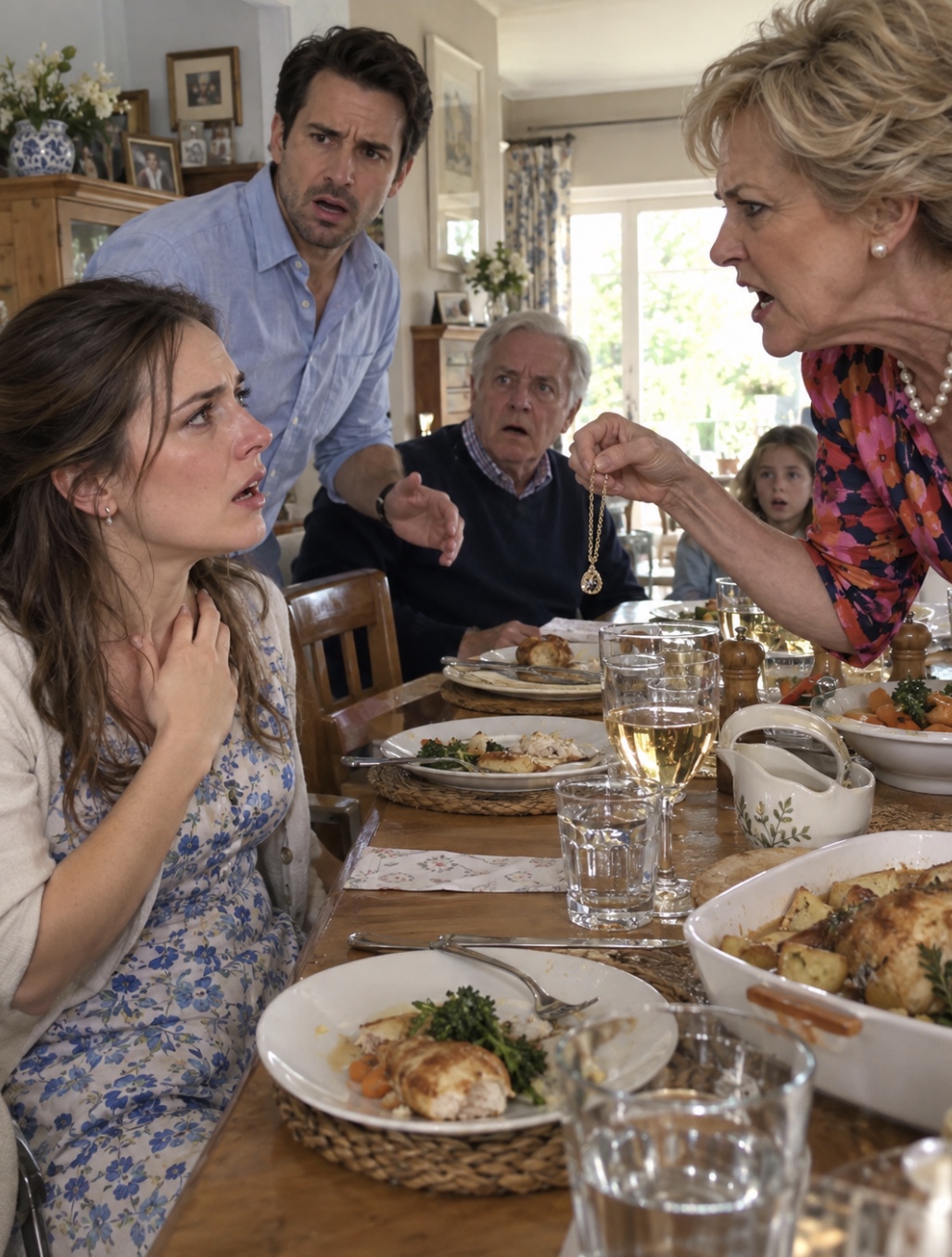
The chain snapped so sharply that for a second I thought someone had dropped a glass behind me.
Then the pendant hit the oak dining table, bounced once beside the gravy boat, and slid to a stop near my father-in-law’s plate.
“You have no right to wear that!”
Margaret’s voice cut through the Sunday lunch so violently that even my six-year-old daughter, who had been colouring at the far end of the table, froze with a green pencil in her hand.
My fingers went to my throat.
The broken silver chain hung from Margaret’s fist.
Across the table, my husband, Tom, stared at his mother as though she had suddenly become a stranger.
“Mum, what the hell are you doing?”
Margaret wasn’t looking at him.
She was staring at the pendant.
It was small, oval, and old-fashioned, with a dark blue enamel border and a tiny spray of forget-me-nots painted beneath the glass. Nothing expensive. At least I had never thought so.
I had found it three weeks earlier in a box of jewellery Tom’s grandmother had left behind after she died.
Or so I had been told.
“I asked you a question,” Margaret said to me, her face drained of colour. “Where did you get it?”
I swallowed.
“Your dad gave it to me.”
That was when everyone looked at Peter.
My father-in-law was sitting at the head of the table, one hand still wrapped around his wine glass.
He didn’t deny it.
Margaret turned slowly towards him.
“You gave her that?”
Peter closed his eyes for a moment.
“Yes.”
The silence that followed was worse than the shouting.
We were at Peter and Margaret’s house in a village outside York, a neat red-brick place with a conservatory, too many cushions, and a garden Margaret maintained with military precision. Sunday lunch there had been a family routine for years. Roast chicken, Yorkshire puddings, potatoes crisp enough to satisfy Peter, and usually at least one argument about something harmless: parking, heating bills, schools, supermarket prices.
Nothing like this had ever happened.
Tom stood up.
“Someone tell me what’s going on.”
Margaret dropped the broken chain onto the table.
“You knew?” she demanded of Peter.
“No.”
“You didn’t know she was wearing it?”
“No.”
“But you gave it to her.”
“Yes.”
Margaret let out a short, breathless laugh.
“Of course you did.”
I looked from one to the other.
The pendant had seemed almost insignificant when Peter handed it to me.
Three weeks earlier, I had helped him clear his late mother Joan’s bungalow near Harrogate. Joan had died in January at eighty-nine, and the bungalow had finally been sold. Tom had been working, Margaret claimed her back was too painful for boxes, so Peter and I spent a Saturday sorting cupboards before the clearance company arrived.
Near the end of the day, Peter found a biscuit tin at the back of Joan’s bedroom wardrobe.
Inside were costume brooches, cufflinks, two watches that no longer worked, and the enamel pendant wrapped in tissue paper.
“You should have this,” Peter had said.
“Me?”
He nodded.
“Mum would have liked you to have something.”
I had hesitated because Margaret was particular about family possessions.
“Shouldn’t you ask Margaret first?”
Peter had looked at me strangely.
“No. This one is mine to give.”
I thought that meant Joan had left it specifically to him.
So I accepted it.
I wore it for the first time that Sunday because we were having lunch with Peter and Margaret, and I thought Peter might be pleased.
Instead, Margaret had ripped it from my neck.
“Dad,” Tom said now, “why did you say it was yours to give?”
Peter looked towards my daughter, Sophie.
“Maybe we should talk somewhere else.”
Margaret snapped, “No. You started this. You finish it here.”
I pushed my chair back.
“I can take Sophie into the garden.”
“No,” Margaret said quickly.
Her anger seemed to collapse as suddenly as it had appeared.
She sat down.
For the first time, I noticed her hands were trembling.
Peter reached for the pendant.
Margaret slapped her palm down over it.
“Don’t touch it.”
Peter’s expression hardened.
“I’m not going to fight you over a necklace.”
“It isn’t a necklace.”
That sentence changed something in the room.
Tom glanced at me.
I knew he had heard it too.
This wasn’t about jewellery.
Peter got up and went to the sideboard. From the bottom drawer he pulled out an old brown envelope, the sort used for photographs years ago.
Margaret stared at it.
“You kept those?”
Peter nodded.
“Apparently, I should have thrown everything away and pretended none of it happened.”
“Peter.”
“No. Not this time.”
He took four photographs from the envelope.
The first was faded and slightly curled at the edges.
A young woman stood outside what looked like a hospital entrance, wearing a pale coat and holding a baby wrapped in a white blanket.
Around her neck was the pendant.
My pendant.
Except I had never seen the woman before.
📖 What Peter revealed next changed the meaning of that pendant completely — the continuation is in the first comment. 👇
Tom took the photograph.
“Who is she?”
Margaret stared at the table.
Peter answered.
“Her name was Rachel Bennett.”
The surname meant nothing to me.
But Tom’s face changed.
“Bennett? Like Uncle David’s old business partner?”
Peter shook his head.
“No.”
He paused.
“Rachel was my sister.”
Tom frowned.
“You don’t have a sister.”
“I did.”
Margaret stood so quickly that her chair scraped against the tiles.
“I’m not sitting through this.”
Peter looked at her.
“You tore jewellery off Anna’s neck in front of Sophie. You don’t get to walk away before explaining why.”
It was the first time I had ever heard him speak to Margaret like that.
She sat down again.
Peter told us the story slowly, and not cleanly.
There were corrections.
Interruptions.
Long silences.
Rachel had been Peter’s younger sister, born eleven months after him. She was clever, stubborn and, according to him, the person in the family least willing to behave the way everyone expected.
At nineteen, Rachel became pregnant.
Their father, who had been strict even by the standards of the early eighties, refused to let her remain at home unless she gave the baby up.
She refused.
Their mother Joan tried to help secretly, giving Rachel money and visiting her after the birth.
That explained the hospital photograph.
But six months later, Rachel died in a car accident on the A59 during heavy rain.
“What happened to the baby?” I asked.
Peter didn’t answer immediately.
Margaret did.
“He was adopted.”
Tom looked between them.
“Why have I never heard any of this?”
Peter rubbed his forehead.
“Because Dad said Rachel’s name was never to be mentioned again. Mum went along with it for years. By the time you were old enough to ask about the family, silence had become normal.”
“That still doesn’t explain Mum’s reaction.”
“No,” Peter said. “It doesn’t.”
Margaret looked at him furiously.
“You’re enjoying this.”
“Don’t be ridiculous.”
“You’ve waited years to make me look cruel.”
Peter’s voice softened.
“You don’t need my help with that today.”
Margaret flinched.
I almost felt sorry for her.
Almost.
Then she turned to me.
“That pendant should have stayed with Rachel’s family.”
“I thought Peter was Rachel’s family.”
“You know what I mean.”
Actually, I didn’t.
And judging by Tom’s expression, neither did he.
Peter slid the second photograph across the table.
It showed Rachel sitting on a sofa with a baby on her lap.
Beside her was a young Margaret.
I stared.
Margaret looked about twenty-three. Her hair was long and dark, nothing like the neat grey bob she wore now.
She had one arm around Rachel’s shoulders.
“You knew her,” Tom said.
Margaret’s mouth tightened.
Peter nodded.
“They were friends before Margaret and I met.”
Tom’s eyebrows rose.
“Mum introduced you?”
“No.”
Margaret whispered, “Stop.”
But Peter continued.
“Rachel introduced me to your mother.”
That was the first detail that truly shocked Tom.
He sat down again.
“So Mum knew your sister before she died.”
“Yes.”
Margaret covered her face for several seconds.
When she lowered her hands, she looked older.
“I loved Rachel,” she said.
Her voice was quieter now.
“She was my closest friend.”
Tom looked lost.
“Then why did you just behave like you hated her?”
Margaret looked at the pendant beneath her palm.
“Because that necklace was the last thing she wore the night before she died.”
I felt a chill.
“She wasn’t wearing it in the accident,” Peter said.
“No. Because she gave it to me.”
The room went still again.
Peter frowned.
“What?”
Margaret lifted her hand from the pendant.
“She gave it to me the evening before.”
Peter looked genuinely confused.
“That can’t be right. Mum had it.”
“Yes. Because I gave it back.”
“Why?”
Margaret took a long breath.
“Because I couldn’t stand looking at it.”
Now it was her turn to tell the story.
The night before Rachel died, she had visited Margaret in York. Rachel was exhausted, frightened about money, and considering whether she should contact her son’s father, a man who had disappeared as soon as she told him she was pregnant.
She had taken off the pendant and pressed it into Margaret’s hand.
“If anything happens to me,” Rachel had said, “keep this for Daniel.”
Daniel.
The baby.
Margaret had promised.
The following afternoon, Rachel was dead.
Margaret returned the pendant to Joan after the funeral because she couldn’t bear the responsibility.
“I was twenty-three,” she said. “I was terrified. Joan said she would keep it until the boy was older.”
Tom leaned forward.
“So where is Daniel?”
Margaret looked at Peter.
Peter was silent.
I felt my stomach tighten.
Tom noticed too.
“Dad?”
Peter took the third photograph from the envelope.
This one was newer.
Late nineties, perhaps.
A young man stood beside Joan in her garden.
He looked about eighteen.
Dark hair.
Tall.
Smiling awkwardly.
Tom picked up the photograph.
Then he stopped breathing.
The resemblance wasn’t perfect.
But it was enough.
The young man had Tom’s eyes.
Not similar eyes.
Tom’s eyes.
Same heavy upper lids. Same slightly crooked left eyebrow.
“What is this?”
Peter’s face crumpled.
For a moment he looked close to tears.
“That’s Daniel.”
Tom stared at him.
“And why does he look like me?”
Margaret whispered, “Peter, don’t.”
But I already knew.
Or thought I did.
The obvious conclusion was almost too dramatic to say aloud.
Peter shook his head quickly.
“No, Tom. I’m not his father.”
Tom looked almost offended.
“I didn’t say you were.”
“No. But I know how this looks.”
He pointed to the photograph.
“Daniel looked like Rachel. You look like Rachel too. She and I were siblings.”
The tension eased slightly, only to tighten again when Tom asked the obvious next question.
“Where is he now?”
Peter looked at Margaret.
Margaret stood and walked towards the conservatory doors.
Outside, rain tapped softly on the glass roof.
“He came here once,” she said.
Peter stared at her.
“What?”
She turned.
“1999.”
“You never told me.”
“I know.”
“He came to this house?”
“Yes.”
Peter’s voice rose.
“Why?”
“Because Joan gave him our address.”
“What did he want?”
“To know about Rachel.”
“And?”
Margaret looked as though she had been waiting twenty-seven years to answer.
“And I sent him away.”
Tom stood.
“You what?”
“He turned up without warning. You were four. Peter was at work. I panicked.”
“You sent an eighteen-year-old away when he came looking for his dead mother’s family?”
“I thought I was protecting this family.”
“From what?”
Margaret didn’t answer.
Peter suddenly understood before the rest of us.
“From your brother.”
Margaret closed her eyes.
That was the secret.
Not an affair.
Not hidden paternity.
Not stolen jewellery.
Something uglier because it was more ordinary.
Margaret’s older brother, Colin, had been Daniel’s biological father.
Rachel had never told the family publicly because Colin was already engaged to someone else when she became pregnant.
Margaret knew.
Rachel had confided in her.
After Rachel died, Margaret carried the secret alone.
Colin married, had two daughters, built a successful plumbing business in Leeds, and spent decades presenting himself as the dependable centre of the family.
When Daniel appeared in 1999, Margaret believed that allowing him into Peter’s family would eventually expose Colin.
“So you protected him,” Tom said.
Margaret’s voice broke.
“I protected everyone.”
“No. You protected Colin.”
“You don’t understand what families were like then.”
Peter laughed bitterly.
“That’s the excuse Mum used when she erased Rachel.”
Margaret looked at him.
He continued.
“And somehow you ended up doing exactly the same thing to her son.”
Margaret started crying then.
Not dramatically.
No sobbing.
Just silent tears rolling down her face while she kept her hands flat on the dining table.
I picked up the pendant.
The enamel was scratched where it had hit the table.
“You thought this belonged to Daniel,” I said.
Margaret nodded.
“And when you saw me wearing it…”
“I thought Peter had decided to give away the only thing Rachel had left for him.”
Peter looked shaken.
“I didn’t know any of this. Mum never told me Rachel gave it to Daniel.”
Margaret stared at him.
“She probably assumed I already had.”
That afternoon, Peter rang Joan’s old solicitor.
There was little they could do on a Sunday, but the following week we learned that Joan had left something behind.
Not money.
Not property.
A letter.
It had been held with her will, addressed to Peter, but because of an administrative mistake after Joan’s death, the solicitor’s office had filed it with older correspondence rather than sending it with the estate papers.
Peter collected it the following Thursday.
Joan had written it six years earlier.
Most of it was an apology.
For obeying her husband.
For allowing Rachel to become a forbidden subject.
For losing contact with Daniel after Margaret sent him away.
But there was also an address.
Daniel’s last known address.
Manchester.
Peter stared at the page for a long time.
“Twenty-seven years,” he said.
Tom answered, “Start with today.”
They wrote to him.
Nobody wanted to appear at his door unexpectedly.
Three weeks later, Peter received an email.
Daniel was fifty-one now.
He lived in Stockport, taught design technology at a secondary school, was married, and had two grown children.
He remembered going to Margaret and Peter’s house in 1999.
He remembered Margaret telling him that reopening the past would only hurt people.
And he remembered believing her.
What none of us expected was that he didn’t sound angry.
He sounded tired.
He agreed to meet Peter and Tom at a café halfway between York and Manchester.
I didn’t go.
Neither did Margaret.
When Tom returned that evening, he sat beside me on the kitchen floor while Sophie watched television in the next room.
“He looks like me,” he said.
“Still?”
“More than in the photo.”
I smiled.
“How was it?”
Tom thought about the question.
“Normal.”
That seemed to surprise him most.
“They talked about football. Schools. Gran. Rachel. Dad cried twice.”
“And Daniel?”
“He asked why nobody came looking for him.”
I touched Tom’s hand.
“What did your dad say?”
“The truth.”
A month later, Daniel came to York.
This time, Margaret was there.
She nearly cancelled three times.
When he arrived, she stood in the hallway unable to speak.
Daniel looked at her for a long moment.
Then he said, “Hello, Maggie.”
Apparently, that was what Rachel used to call her.
Margaret broke down.
Their conversation lasted nearly two hours behind closed doors.
We never asked exactly what was said.
Daniel later told Tom only one thing.
“I didn’t come for revenge. I came because I was tired of inheriting everybody else’s silence.”
The pendant now belongs to him.
That was my decision, not Margaret’s.
At our next family lunch, I placed it in its repaired chain inside a small jewellery box and slid it across the table.
Daniel opened it and smiled.
“My mum’s?”
I nodded.
“Yours.”
He didn’t put it around his neck.
Instead, he ran his thumb across the tiny blue flowers.
“My daughter’s pregnant,” he said. “First grandchild.”
Margaret looked up.
Daniel glanced at her.
“I think I know who should have it next.”
For once, Margaret didn’t try to control what happened.
She simply nodded.
And Peter, sitting beside her, quietly reached under the table and took her hand.
The pendant had passed through four people, three secrets, one death and nearly half a century of silence.
In the end, it wasn’t valuable because of who had owned it.
It mattered because, for the first time, nobody was hiding where it came from.