



The first time my mother-in-law announced to half our building that my husband had bought our flat, I was standing barefoot in the hallway holding a leaking bag of rubbish.
She said it loudly enough for the doors on both sides of the landing to open.
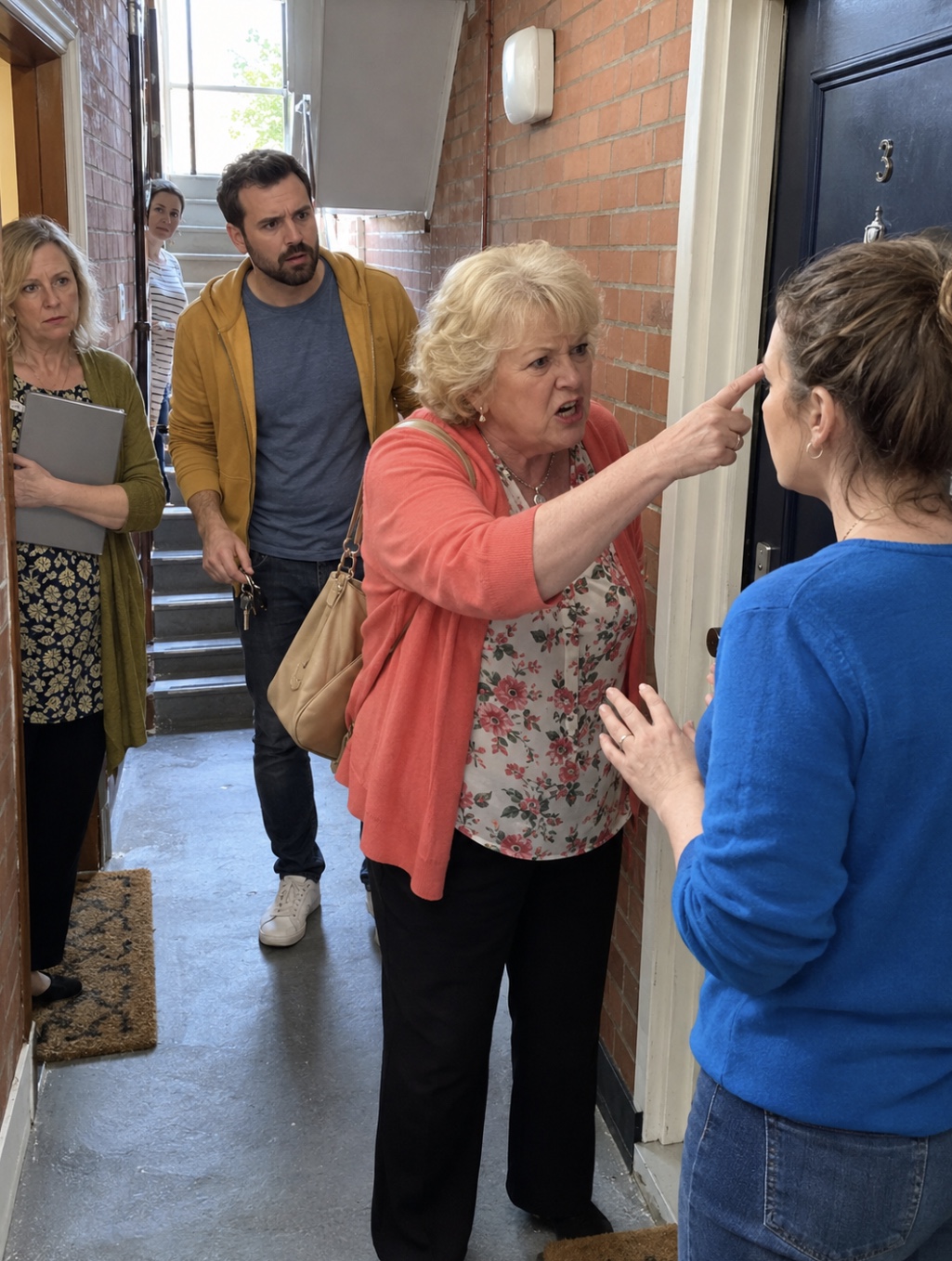
“My son paid for this place,” Denise said, jabbing one finger toward our front door. “Every brick of it. And now she thinks she can tell his own mother when she’s allowed to visit.”
There was a pause.
A very British sort of pause, where three people pretended they weren’t listening while listening with extraordinary concentration.
Mrs Patel from number 18 had just come upstairs with a shopping trolley. Mr Lewis from number 21 was checking his post. And Elaine Foster, who lived directly below us, had opened her door with a tea towel still over one shoulder.
I stared at Denise.
My husband, Adam, had gone downstairs to move his car. He had no idea his mother had followed me into the communal hall after I’d asked her to leave.
“Denise,” I said quietly, “please go home.”
She gave a short laugh.
“You’d like that, wouldn’t you?”
I was thirty-seven years old, worked four days a week as a radiographer at Queen’s Medical Centre in Nottingham, and had spent most of my adult life avoiding public arguments.
That afternoon, avoidance became impossible.
Denise turned toward Mrs Patel as if she’d found an audience.
“You know what she’s done? Changed the lock on the spare room. In my son’s own flat.”
“It’s my office,” I said.
“Our flat,” Adam’s voice corrected from the stairs.
He appeared behind his mother carrying his car keys.
Denise turned.
“Exactly. Your flat.”
“No,” he said. “Ours.”
She looked at him as if he’d betrayed an oath.
Then Elaine Foster, the neighbor downstairs, said something that seemed insignificant at the time.
“Denise,” she said, “perhaps you should be careful about making claims like that in the hallway.”
Denise snapped her head around.
“What claims?”
Elaine’s expression changed very slightly.
“Nothing.”
She went back inside and closed the door.
Six months later, I finally understood what she meant.
Adam and I had bought the flat in September 2021, a converted three-bedroom in an old red-brick building near Mapperley Park. It wasn’t glamorous. The sash windows rattled in winter, the boiler had a personality disorder, and the lift stopped working whenever someone looked at it too confidently.
But I loved it.
More importantly, I had worked for it.
Before meeting Adam, I had lived in a small rented place for nearly nine years and saved obsessively. When my grandmother died, she left me £34,000. I added that to my own savings, and when Adam and I bought our flat, I contributed £71,500 toward the deposit.
Adam contributed £29,000.
The mortgage was joint.
The deeds were joint.
The repayments came from our joint account.
None of this had ever been controversial between us.
Not until Denise decided to rewrite history.
At first she did it subtly.
“My Adam did well getting you two such a lovely place.”
Then:
“You were lucky he was in a position to buy.”
Then:
“Of course, Adam’s always been good with money.”
Eventually it became:
“My son bought that flat.”
I corrected her twice.
Adam corrected her three times.
She continued.
The real trouble began after Adam’s younger sister, Chloe, separated from her fiancé.
Chloe was thirty-two and suddenly needed somewhere to stay.
Denise volunteered our spare bedroom without asking us.
“Just for a month,” she said over Sunday lunch.
Adam immediately looked at me.
I said, “We’d need to talk about it.”
Denise’s fork stopped halfway to her mouth.
“What is there to talk about?”
“The room’s my office.”
“You work in a hospital.”
“I also report from home two days a week.”
“Then work at the kitchen table.”
Chloe looked embarrassed.
“Mum, leave it.”
But Denise didn’t.
Within a week, she had started telling relatives that I was refusing to help family.
Two weeks later, she arrived at our flat with Chloe and two suitcases.
No warning.
Adam opened the door and stared at them.
“What’s going on?”
“Chloe’s here.”
“I can see that.”
“For a few weeks.”
“We didn’t agree to that.”
Denise’s face hardened.
She glanced past him at me.
“Whose name is actually on this place, Adam?”
“Mine and Hannah’s.”
“But who bought it?”
That was the moment something changed.
Not in me.
In Adam.
He said, “Don’t ever say that again.”
Denise went bright red.
Chloe quietly picked up both suitcases and walked back toward the lift.
I felt sorry for her.
I didn’t feel sorry for Denise.
After that, her visits became increasingly strange.
She would turn up while Adam was at work and claim she had “just been nearby.”
Twice, Elaine from downstairs messaged me to say Denise had been sitting in her car outside for nearly an hour.
Once, Mrs Patel saw her photographing the building entrance.
Then packages started arriving in Chloe’s name.
Not one or two.
Dozens.
Bank letters.
Online orders.
A mobile phone contract.
I asked Chloe about them.
She sounded genuinely confused.
“Mum said you’d agreed I could use your address temporarily.”
“We didn’t.”
“I’ll change it.”
She did.
Or so I thought.
A month later, an official-looking envelope arrived addressed to Chloe Mercer at our flat.
I put it aside for Adam.
That evening, he held it under the kitchen light.
“This looks like council correspondence.”
“Open it?”
“It’s not ours.”
He called Chloe instead.
She went silent.
Then she said, “I think Mum tried to put me on the electoral register there.”
Adam closed his eyes.
“Why?”
“She said it would make things easier.”
“What things?”
“I don’t know.”
That answer bothered me more than anything else.
📌 What happened next started with one letter neither of us was supposed to see — the continuation is in the first comment. 👇
The following Saturday, Adam drove to Denise’s house.
He returned two hours later looking pale.
“She says Chloe needs proof of residence to apply for something.”
“What?”
“She won’t say.”
“Did Chloe know?”
“No.”
We sat at the kitchen table in silence.
I said, “Adam, this isn’t just your mum being difficult anymore.”
“I know.”
He rubbed both hands over his face.
“She keeps talking as if this place is somehow available to her.”
Three days later, I found out why.
I came home early after a cancelled training session and saw Denise standing outside the building with a man in a navy overcoat.
He was holding a laser measure.
My stomach dropped.
I stayed across the street.
Denise pointed toward our second-floor windows.
The man wrote something on a clipboard.
Then they went inside.
I followed.
By the time I reached the second floor, they were standing outside our front door.
Elaine was halfway up the stairs behind me.
Denise turned and froze.
“Hannah.”
“Who is he?”
The man looked between us.
“I’m Martin Shaw. Property assessor.”
“For what?”
Denise answered before he could.
“It’s nothing to do with you.”
That sentence was so absurd that I actually laughed.
“You’re standing outside my home with a property assessor.”
Martin cleared his throat.
“I was told the family was considering a transfer.”
I stared at him.
“A transfer of what?”
He looked at Denise.
Denise said, “Martin, perhaps another day.”
“No,” I said. “Today.”
Elaine reached the landing and stopped.
Denise’s expression sharpened.
“You’re making a scene again.”
“I’m asking why you’re trying to have my flat assessed.”
“Your flat?”
She laughed.
And there it was again.
“My son bought this place.”
This time, Elaine didn’t go inside.
She stood completely still.
Martin looked uncomfortable.
“I was given to understand Mr Mercer was the beneficial owner.”
“He’s one of two legal owners,” I said. “I’m the other.”
Denise waved one hand.
“On paper.”
I felt heat rise into my face.
“What does that mean?”
“You know perfectly well.”
“No. Explain it.”
She turned toward the stairwell.
By then Mrs Patel had opened her door again, and Mr Lewis had appeared above us.
Denise suddenly seemed energized by the attention.
“My son paid for this flat,” she announced. “She put her name on it because they were married.”
“That is not true,” I said.
“You had some inheritance.”
“Seventy-one thousand five hundred pounds.”
Her face flickered.
Only for a second.
But Elaine saw it.
So did I.
Then Denise said, “Inheritance, salary, whatever. Adam carried you for years.”
I heard footsteps below.
Adam.
He must have come home while we were arguing.
“What the hell is going on?”
Nobody answered immediately.
Then Martin said, “I think I should leave.”
Adam blocked the stairs.
“Why are you here?”
Martin showed him the clipboard.
“Your mother contacted me regarding an informal valuation.”
Adam looked at Denise.
“Why?”
She folded her arms.
“For Chloe.”
“What about Chloe?”
“She needs security.”
“For what?”
“A business loan.”
Adam stared at her.
Then laughed once.
“You tried to use our home as security for Chloe’s loan?”
“No one said use.”
“What exactly did you tell him?”
Denise didn’t answer.
That was when Elaine said, “I think I need to get something.”
Everyone looked at her.
She went downstairs.
Denise suddenly seemed nervous.
Not angry.
Nervous.
“What’s she doing?”
No one knew.
Elaine came back less than two minutes later carrying a thick grey folder.
The kind used for legal documents.
She held it against her chest.
“I’ve had this for six months,” she said.
Denise went white.
Actually white.
Adam looked at Elaine.
“What is it?”
Elaine didn’t answer him.
She looked directly at Denise.
“I told you not to involve me.”
My mother-in-law whispered, “You had no right to keep that.”
“Keep what?” I asked.
Elaine handed the folder to Adam.
Inside were photocopies of letters, printouts, handwritten notes and property documents.
The first page was an email from Denise to a mortgage broker.
The date was six months earlier.
Adam read aloud.
“Potential family-backed borrowing using equity in son’s property.”
I felt something cold move through me.
He turned the page.
Another email.
Denise had described our flat as being owned by Adam alone.
Another page showed an estimated value.
£318,000.
Then there was a handwritten note.
“Possible secured amount 55–65k. Chloe deposit/business.”
Adam looked at his mother.
“You’ve been planning this for six months?”
Denise’s mouth moved, but nothing came out.
Elaine said, “There’s more.”
The next document was worse.
It was a copy of a letter supposedly written by Adam.
It stated that he had purchased the property primarily with his own funds and that I had been added to the title for “marital convenience.”
At the bottom was a signature.
Adam’s signature.
Except it wasn’t his.
He stared at it.
“You forged this.”
Denise shook her head immediately.
“No.”
“Then who wrote it?”
“I was only exploring options.”
“You forged my signature.”
“I copied it because the broker wanted an example document.”
Martin, who had still not left, quietly said, “That is not something any legitimate broker would request.”
Denise glared at him.
Adam flipped through the remaining pages.
There were printouts of our building’s floor plan.
Land Registry entries.
Old property listings.
Notes about our approximate mortgage balance.
And then I saw something that made me sit down on the stairs.
A photocopy of my grandmother’s probate summary.
I had no idea how Denise had obtained it.
Beside the £34,000 legacy, she had written:
“Hannah contribution came from family money — can perhaps argue not earned.”
I looked at her.
“You researched my grandmother’s estate?”
Denise said nothing.
Elaine finally explained how she got the folder.
Six months earlier, Denise had visited when we were both at work.
She had told Elaine she was meeting a financial adviser and asked if she could leave “some paperwork” with her because she didn’t want to carry it around town.
Elaine agreed.
Denise returned later and collected what she believed was the folder.
But she took the wrong one.
Elaine’s husband had two identical grey folders from his bookkeeping business.
Denise had accidentally left hers behind.
Elaine noticed the mistake that evening.
She opened the folder looking for a name or phone number.
What she saw frightened her.
The next morning, she called Denise and said she had found private paperwork.
Denise came over, furious, and demanded it back.
But by then Elaine had scanned everything.
“I thought Hannah and Adam should know,” Elaine said, “but I also thought maybe I was interfering in something I didn’t understand.”
“Why didn’t you tell us?”
Her eyes filled with embarrassment.
“I should have.”
Then she looked at me.
“But every time I was about to, Denise told me the matter had been dropped.”
I turned to Denise.
“You’ve been speaking to her about this?”
Denise said, “I was trying to protect Chloe.”
“No,” Adam said.
His voice had changed.
Very calm.
“You were trying to steal leverage from us.”
“Don’t be ridiculous.”
“You forged my signature.”
“For your sister.”
“That makes it worse.”
Denise started crying.
Not quietly.
She said Chloe had been desperate after the breakup. She wanted to open a small beauty studio with a friend. The bank wouldn’t lend enough. Denise believed that if Adam helped, Chloe could start again.
“So you decided our home belonged to you?” I asked.
“No.”
“You told people Adam owned it.”
“I was simplifying.”
“You tried to establish that I had no meaningful stake in it.”
“I never intended to take anything from you.”
Adam lifted the forged letter.
“What do you call this?”
She had no answer.
Martin left first.
Mrs Patel went inside soon after.
Mr Lewis followed.
But Elaine stayed.
So did Denise.
For another forty minutes, Adam questioned her.
Eventually another truth came out.
Denise had once given Adam £12,000.
Not for this flat.
Eight years earlier, before Adam met me, she had helped him clear part of a postgraduate loan and some credit-card debt after he lost a job.
In her mind, that money had gradually transformed into an investment in his future.
Then into a contribution toward our home.
Then, somehow, into partial ownership.
She genuinely seemed to believe that because she had helped her son financially years ago, anything he later built remained partly hers to control.
That was the part that frightened me most.
Not greed.
Entitlement dressed as memory.
We changed nothing about our ownership because there was nothing to change.
But we did speak to a solicitor.
We checked the Land Registry.
We put a restriction alert on the title.
Adam changed several passwords and requested copies of records Denise might have accessed.
Chloe was horrified when she learned what had happened.
She hadn’t asked for our home to be involved in any loan.
In fact, she abandoned the business idea completely after discovering Denise had been contacting brokers in her name as well.
For nearly five months, Adam did not speak to his mother.
I didn’t ask him to cut her off.
I didn’t have to.
Then one evening in February, the doorbell rang.
Denise was standing downstairs.
Alone.
No bags.
No folder.
No performance.
Adam let her into the communal hallway but not into the flat.
I stood behind him.
She looked older.
“I came to apologise.”
Adam said nothing.
She turned to me.
“I kept telling myself Adam bought the flat because it made me feel as if he still needed me.”
That was not the apology I expected.
She swallowed.
“When he was younger, he always needed me. Money. Forms. Rent. Advice. Then he met you, and suddenly he didn’t.”
Adam’s face softened, but only slightly.
Denise continued.
“I made your independence feel like something you had taken from me.”
I said, “So you tried to turn our home into proof that he still belonged to you.”
She nodded.
It was the first honest thing I’d heard her say in a year.
We didn’t forgive her that night.
Not fully.
Trust doesn’t return because someone finally explains why they broke it.
But months later, when she came for tea for the first time, something unexpected happened.
Elaine was passing our open door.
Denise saw her.
For a second, both women froze.
Then Denise said, “Elaine.”
Elaine stopped.
Denise looked down at her shoes.
“You did the right thing.”
Elaine raised her eyebrows.
“I should have done it sooner.”
“So should I.”
That was all.
Elaine nodded and went downstairs.
Later, after Denise left, Adam stood at the kitchen window looking over the car park.
“Do you know what the strangest part is?” he asked.
“What?”
“If Elaine hadn’t kept that folder, Mum might have convinced herself to go further.”
I thought about the forged signature.
The valuation.
The notes about my inheritance.
The months of quiet preparation.
Then I thought about one ordinary neighbor who had sensed that something wasn’t right and had decided not to throw away a folder that didn’t belong to her.
Sometimes the person who saves your home isn’t the person whose name is on the mortgage.
Sometimes it’s the woman downstairs who notices who keeps coming to your building when you’re not there.