



When my mother-in-law said those words, my first thought was that I must have misheard her.
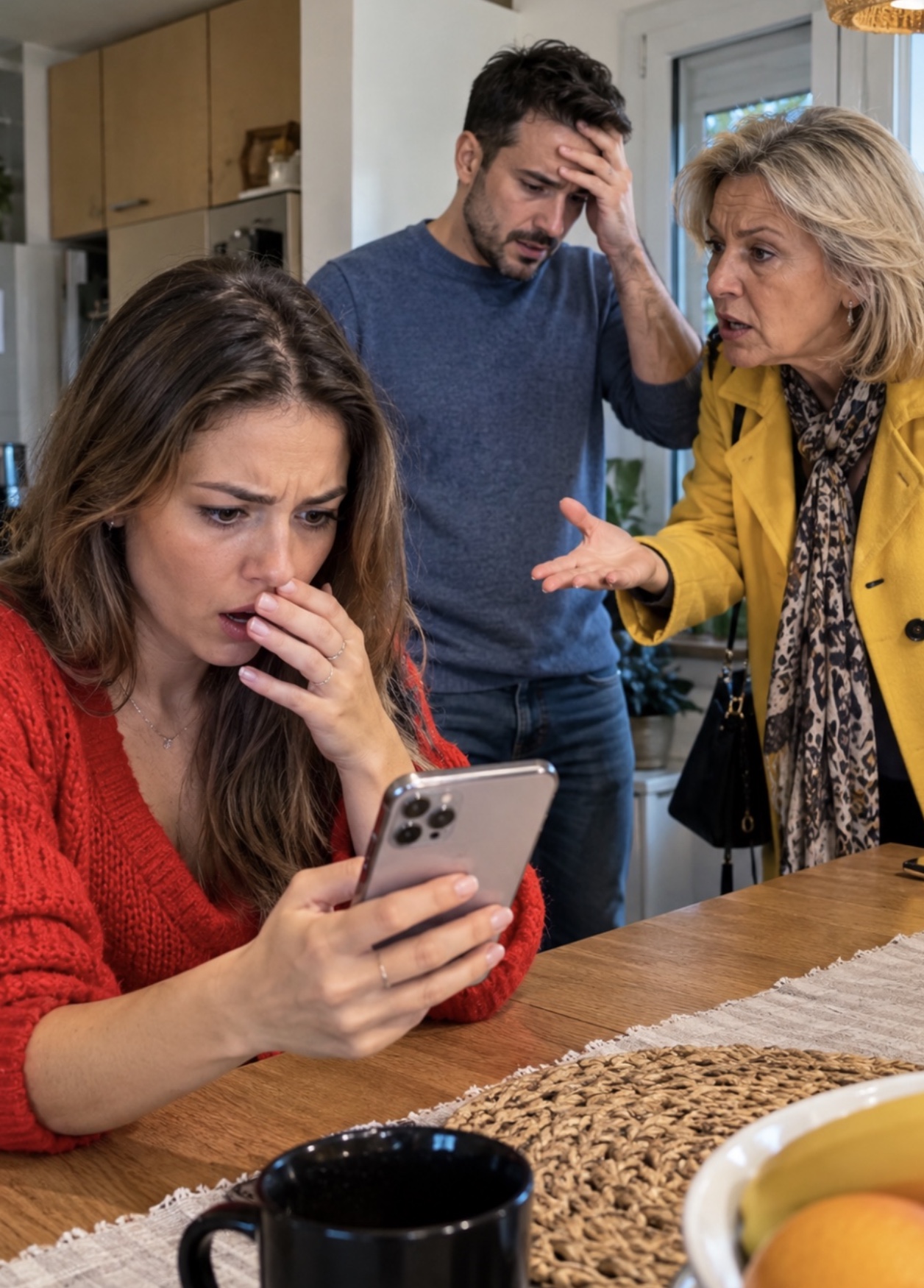
She was standing in the middle of our kitchen in Rijeka, still wearing her wet coat, raindrops clinging to her glasses, staring at me as though she had finally produced proof of my greatest shame.
“Your husband has been paying me because of you for eight years,” she repeated more slowly. “Every month. Without fail.”
My husband, Marko, who had been loading plates into the dishwasher, froze.
He didn’t say, “Mom, what are you talking about?”
He didn’t laugh.
He didn’t get angry.
He simply set the plate down on the counter and looked out the window.
That frightened me more than her words.
“How much?” I asked.
My mother-in-law, Gordana, folded her arms.
“Enough.”
“Gordana, I asked how much.”
“Three hundred euros a month. Sometimes more.”
I turned to Marko.
“Is that true?”
He still wouldn’t look at me.
“It’s not what it sounds like.”
That sentence never means anything good.
We had been married for nine years. We had a seven-year-old son, Luka, a mortgage, two cars—one of which always seemed to have some warning light glowing on the dashboard—and a perfectly ordinary life in which every major expense was planned in advance.
I worked as an administrator for a logistics company in Kukuljanovo. Marko was an electrician and, for the past several years, had worked for a company that maintained shopping centers throughout the Kvarner region and Istria.
We had never been rich.
But I had also never imagined that one of us was secretly spending nearly three hundred euros every month.
I unlocked my phone and opened our banking app.
“Show me.”
Marko finally looked up.
“Petra, not now.”
“Right now.”
Gordana gave me that brief, triumphant smile of hers.
“There. Now you’ll finally find out how much your stubbornness has cost him.”
I had no idea what she meant.
And that was exactly why I sat down at the table.
Marko didn’t.
He remained beside the sink, pale, as though calculating whether there was any possible way to leave the kitchen without answering me.
“Start talking,” I said.
It had begun eight years earlier, only a few months after our wedding.
Back then, we were renting an apartment in Turnić. Luka hadn’t been born yet. We were saving for a place of our own, and I recorded every kuna we spent in a small blue notebook.
I knew what we spent on utilities, how much went toward fuel, and exactly how much we could put aside every month.
But Marko’s salary didn’t always arrive in the same account back then.
He traveled for work and received allowances.
I never checked every euro he earned.
I trusted him.
According to Gordana, that was when Marko had started transferring money to her account.
“Why?” I asked.
She glanced briefly at her son.
“Because you refused to help his family when they needed it most.”
“What are you talking about?”
“The apartment in Crikvenica.”
Suddenly, I remembered.
Marko’s late grandfather had owned an old one-bedroom apartment not far from the bus station. After his death, it was inherited by Gordana and her younger brother, Damir.
The apartment was run-down but in a good location.
At the time, Gordana wanted to buy Damir’s half so the property would remain in the family.
She was short by around twenty thousand euros.
She asked Marko whether he could help.
At that point, we barely had six thousand euros in savings.
I said we couldn’t give away our savings if we were planning to buy our own home.
Marko agreed with me.
Or at least I thought he had.
“So that’s why you were paying your mother?” I asked him.
“Not exactly.”
“Is there anything in this story that is exactly what it seems?”
Gordana sat across from me.
“Your husband knew you were selfish.”
“Mom,” Marko warned.
“What? He’s kept quiet for eight years, and now I’m supposed to watch what I say?”
I opened the transaction history on our joint account.
There was nothing.
No regular payments to Gordana.
Not €300.
Not €200.
Nothing.
“Which account are you paying from?”
Marko said nothing.
That was when I realized for the first time that my husband apparently had a bank account I knew nothing about.
“Do you have another account?” I asked.
“Yes.”
My stomach tightened.
“Since when?”
“Always. I opened it when I was working for my first company.”
“And you never told me?”
“There was no reason to.”
“You’ve been sending money to your mother for eight years, and there was no reason to tell me?”
Gordana put her handbag on the table.
“Stop pretending you’re the victim. That money wasn’t for me.”
The kitchen fell silent.
“A minute ago, you said he was paying you because of me.”
“He is.”
“And now you’re saying the money wasn’t for you.”
Marko closed his eyes.
“Mom, enough.”
But Gordana was already too angry to stop.
She pulled a transparent folder from her handbag and placed it in front of me.
Inside were payment receipts, photocopied invoices, and several handwritten tables.
At the top of the first page was a name that meant nothing to me.
“St. Anne Senior Residence — Monthly Contribution.”
“Who’s in the care home?” I asked.
Gordana no longer looked pleased.
Marko sat down.
“My father.”
It took me a moment.
As far as I knew, Marko’s father was named Željko, and he had died when Marko was eleven.
I had seen his photograph.
It stood in Gordana’s living room.
A mustached man in a short-sleeved shirt, with a young Marko sitting on his shoulders.
“Your father is dead.”
Marko shook his head.
“Željko was my mother’s husband. But he wasn’t my biological father.”
Gordana turned toward the window.
Suddenly, she looked older.
Marko began speaking without drama, almost as though he were giving a formal statement.
His biological father was named Nikola Barišić.
Gordana had met him when she was very young.
Their relationship had been brief.
When she became pregnant, Nikola wanted nothing to do with the baby.
A few months later, she met Željko, who accepted Marko and raised him as his own son.
Nikola disappeared for years.
Then, when Marko was twenty-seven, he showed up outside Marko’s workplace.
He was ill.
He didn’t ask for money.
He only wanted to meet his son.
“Why did you never tell me?” I whispered.
“Because I promised Mom.”
I looked at Gordana.
“She forbade you?”
“I didn’t forbid him,” she said. “I asked him.”
“There’s a huge difference.”
“Not to me.”
Eventually, Nikola moved into a care home above Opatija. His pension was small and didn’t cover the full cost.
Marko began paying the difference.
At first, €180 a month.
Later, €250.
For the last two years, around €300.
“And what exactly does any of that have to do with me?” I asked.
Gordana looked directly into my eyes.
“If you hadn’t insisted back then that the two of you save every kuna for your apartment, Marko would have given me the money for Crikvenica. I would have sold my other property, cleared the debt, and I never would have had to borrow from Damir. Marko felt guilty. So afterward, every month, he put money wherever he thought he owed it.”
I stared at her.
“So for eight years, you’ve convinced yourself that your son helping his sick father was somehow my fault?”
“If you hadn’t interfered in family matters—”
“I’m his wife. Those are my family matters.”
Marko put his palm flat on the table.
“Both of you, stop.”
“No,” I said. “You don’t get to tell me to stop.”
I turned his phone toward me.
“Show me the account.”
After several seconds, he unlocked the banking app.
I went through the last few months.
The payments to the care home were there.
Gordana hadn’t lied about them.
But then I noticed something else.
Every three months, there was another payment.
€450.
Recipient: D. Kovačić.
“Who is this?”
Marko immediately reached for the phone.
Too late.
“Petra…”
“Who is D. Kovačić?”
Gordana went pale.
That was when I knew the story about Marko’s biological father wasn’t the main secret.
“Damir,” she said.
Her brother.
The same Damir whose half of the apartment she had supposedly tried to buy eight years earlier.
“Why is Marko sending him money?”
Nobody answered.
I picked up the folder and started going through the papers.
At the bottom was a contract.
Eight years old.
A private loan agreement.
Amount: €24,000.
The borrower wasn’t Gordana.
It was Marko.
I looked at the signature.
His.
“You borrowed twenty-four thousand euros?”
Marko looked sick.
“For our apartment.”
“We bought our apartment five years later.”
“I know.”
“Then where did the money go?”
Gordana suddenly stood up.
“This is pointless.”
“Sit down.”
For the first time since I had known her, she obeyed me without saying a word.
Marko then told me about a part of his life he had managed to hide for almost a decade.
A year after our wedding, he had been given an opportunity to invest in a small air-conditioning service company with a friend from high school.
He needed €24,000.
He was convinced the business would succeed.
He didn’t tell me because he knew I would object.
He borrowed the money from his uncle Damir.
The company collapsed in less than a year.
His business partner moved to Austria.
The debt remained.
Marko began repaying Damir.
At the same time, he was helping Nikola pay for the care home.
He funded both from the secret account where his travel allowances and the money he earned doing private weekend jobs were deposited.
“How much do you still owe?” I asked.
“Nothing.”
I didn’t believe him.
“Marko.”
“I paid off the last of it last month.”
Then Gordana did something completely unexpected.
She pulled an envelope from her handbag and threw it down in front of him.
“That’s why I came.”
Marko opened it.
Inside was a bank statement.
A transfer of €11,800.
In his name.
“What is this?”
Gordana sat down.
“Damir sold the apartment in Crikvenica.”
“What apartment?”
“Mine.”
Now both of us were staring at her.
“I haven’t told either of you the whole truth for years,” she said.
After her father died, Gordana had never bought Damir’s half of the apartment.
Quite the opposite.
She had sold her half to him.
The money she received—a little over €20,000—had been lent to Marko for his failed business.
But not directly.
It had gone through Damir.
“Why?”
Marko stood up.
“Mom, don’t.”
“It’s time.”
Gordana looked at me.
“Because Marko asked me to make sure you never found out that I had helped him.”
Everything suddenly made sense.
The private loan hadn’t really been Damir’s money.
It was hers.
Damir had simply signed the contract to hide the trail.
“So for eight years, he’s been paying your own money back through your brother?”
“Yes.”
“And today you came into my kitchen and told me he was ‘paying because of me’?”
Gordana lowered her eyes.
“I was angry.”
“At whom?”
“At him.”
That was not the answer I expected.
She explained that she had recently discovered that after Marko made the final repayment, he refused to accept money Damir wanted to return to him following the sale of the renovated apartment.
Property prices had risen sharply, and Damir had made a good profit.
He thought it was only fair that Marko receive part of it.
Marko refused.
So Damir transferred the money to Gordana instead.
And she had come to our house to give it to him.
Their argument had started before I walked into the kitchen.
“I told him he had spent eight years punishing everyone around him because of one stupid decision,” Gordana said. “Himself, me, you. Then he told me he had hidden everything because you would have left him if you knew how badly he’d screwed up.”
I looked at Marko.
“Did you say that?”
He nodded.
At that moment, I was no longer angry about the €300.
Or the €24,000.
I was angry about the eight years during which my husband had made every one of my decisions with me while keeping his biggest mistakes outside our marriage.
“I don’t know whether I would have left you then,” I said. “But I know that today I don’t trust the man who spent eight years refusing to give me the chance to decide for myself.”
Marko said nothing.
For the next two weeks, he slept in the living room.
I didn’t make a scene.
I didn’t run to my mother’s house.
I didn’t immediately mention divorce.
I asked for one thing.
Everything.
Every account.
Every debt.
Every contract.
Everything that existed.
One Saturday, we sat at the kitchen table for almost six hours.
We opened every banking app, every old PDF, every photograph of every contract.
And that was when the final twist came.
Marko didn’t discover it.
I did.
Among the documents from the care home, I found an invoice that had been paid three days earlier.
The recipient was no longer the care home.
It was a funeral home.
Nikola was dead.
He had died three weeks earlier.
Marko hadn’t told me that either.
“Why?”
He was silent for a long time.
Then he started crying.
Not loudly.
He simply sat at the table, stared at his hands, and said:
“I didn’t know whether I had the right to grieve for a man I spent almost my entire life calling ‘the other one.’”
For the first time in days, I sat down beside him.
I didn’t hug him.
But I didn’t get up either.
Gordana went to the funeral alone.
After that, she never again said that Marko was “paying because of me.”
We didn’t spend the €11,800 she had brought to our house.
Marko put it into a separate account in both our names.
We agreed that from then on, anything over €500 could never be hidden, borrowed, lent, or invested without the other person knowing about it.
It sounds like such a simple rule.
But it took us nine years of marriage to truly understand why it mattered.
A few months later, Gordana came to Luka’s birthday carrying a homemade walnut roll.
While I was cutting the cake, she walked over to me and spoke quietly.
“I shouldn’t have said what I said that day.”
“No, you shouldn’t have.”
“I wanted to hurt him.”
“But you hit me instead.”
She nodded.
“I know.”
It was the closest thing to an apology I had ever received from her.
Marko and I still aren’t exactly the same as we were before.
Maybe we never will be.
But there is one strange thing I understand now.
I used to think trust was a feeling.
Now I know it is actually a collection of very boring things: showing each other the bank statement, admitting when you’ve made a mistake, confessing a debt before it becomes a secret, and never deciding for another person what they “don’t need to know.”
Because the money Marko had hidden all those years wasn’t what nearly destroyed our marriage.
The silence would have.
If his mother hadn’t walked into my kitchen on that rainy afternoon and blurted out the ugliest possible version of the truth, I might have spent years more living beside a man I thought I knew completely.
When in reality, I didn’t even know which bank account he was using to pay for his own life.