



“Pack your things and get out of our family.”
Margaret Whitmore said it so calmly that for a second I thought I had misunderstood her.
There was no shouting. No slammed fist. No dramatic pointing toward the door.
She simply sat at the head of our dining table in her cream wool coat, handbag beside her chair, and looked at me as though she were dismissing a cleaner who had broken an expensive vase.
My husband, Daniel, stood by the window.
He didn’t defend me.
That was the part I remember most clearly.
Not Margaret’s words.
Not the cold November rain tapping against the glass.
Not even the fact that his younger sister, Sophie, was sitting three feet away pretending to study the pattern on her teacup.
Daniel just stood there with both hands in his pockets.
“Say something,” I told him.
His jaw tightened.
“Mum thinks it would be better if we had some space.”
I stared at him.
“Your mother thinks?”
Margaret gave a small sigh.
“Emily, please don’t make this uglier than it already is.”
I almost laughed.
We had been married for eleven years.
We had two children upstairs, eight-year-old Ben and five-year-old Lily, both supposedly asleep.
The house wasn’t Margaret’s.
It wasn’t even Daniel’s family home.
We had bought it together six years earlier, a red-brick semi in a quiet street outside York. I had spent months stripping wallpaper, repainting bedrooms and arguing with builders over a leaking conservatory roof.
And now my mother-in-law had arrived after dinner and told me to leave my own family.
“What exactly have I done?” I asked.
Nobody answered immediately.
That frightened me more than an accusation would have.
Then Margaret opened her handbag and took out a folded sheet of paper.
She slid it across the table.
It was a photocopy of our bank statement.
One transaction had been highlighted in yellow.
£9,800.
Transferred three weeks earlier from our joint savings account to an account in my name.
Daniel finally turned from the window.
“Why didn’t you tell me?”
I looked from him to the paper.
“I did.”
“No, you didn’t.”
“Yes, Daniel. I did. Twice.”
Margaret leaned back.
“Convenient.”
I felt heat rise into my face.
The money had gone toward a deposit for a small commercial unit in town.
For nearly four years, I had run a cake business from our kitchen. Wedding cakes, christening cakes, birthday orders, hundreds of buttercream flowers piped after the children were in bed.
By summer, I was turning down more orders than I accepted.
Daniel and I had discussed renting a proper workspace.
He had even viewed the unit with me.
But over the last three months he had become distracted, forgetful and strangely distant.
He said work was difficult.
I believed him.
Apparently I had been an idiot.
“You signed the paperwork with me,” I said.
Daniel rubbed his forehead.
“I knew you were looking. I didn’t know you were actually taking nearly ten grand.”
“You were sitting beside me when I made the transfer.”
Margaret’s expression sharpened.
“My son would remember losing that much money.”
“Losing?”
“It belongs to the family.”
“It belongs to Daniel and me.”
“There,” she said, looking at her son. “That attitude.”
I turned toward Sophie.
“You were there when we talked about the unit in August.”
Sophie swallowed.
“I remember you mentioning something.”
Margaret’s gaze snapped toward her.
“Sophie.”
Her daughter immediately went quiet.
That was when I understood this meeting hadn’t been called to discuss money.
The decision had already been made.
I was simply being informed.
Daniel walked to the table.
“Mum says you’ve been moving money for months.”
I stared at him.
“What?”
Margaret produced a second page.
Then a third.
Small transfers.
£220.
£175.
£310.
£400.
All going into my business account.
I knew exactly what they were.
Payments from customers that had accidentally landed in the joint account because I’d used the wrong bank details on several old invoices.
Margaret had arranged the pages in a neat pile as if preparing evidence for court.
“You went through our accounts?” I asked Daniel.
He looked uncomfortable.
“Mum was helping me understand what was happening.”
“You gave your mother access to our bank statements?”
“I showed her screenshots.”
“You showed her our private finances?”
“She’s my mother.”
“And I’m your wife.”
Nobody said anything.
I could hear the dishwasher humming in the kitchen.
Then Margaret said quietly, “Not for much longer, I imagine.”
That sentence changed something in me.
Until then I had been frightened.
Afterward, I became calm.
I folded the bank statements.
Placed them neatly together.
Then I asked Daniel one question.
“Are you asking me to leave?”
He looked at his mother.
That was his answer.
📖 What happened next began with one document nobody in that room knew existed — the story continues in the first comment 👇
I stood up.
“All right.”
Daniel blinked.
Margaret looked almost disappointed that I wasn’t crying.
I walked upstairs.
But I didn’t pack clothes.
I went into the box room where we kept old files, school certificates, mortgage papers and Christmas decorations.
On the top shelf was a grey plastic storage box.
Inside it was a blue folder I hadn’t opened for nearly five years.
I took it downstairs.
When I returned, Margaret was standing near the fireplace.
Daniel was whispering something to Sophie.
I sat down again.
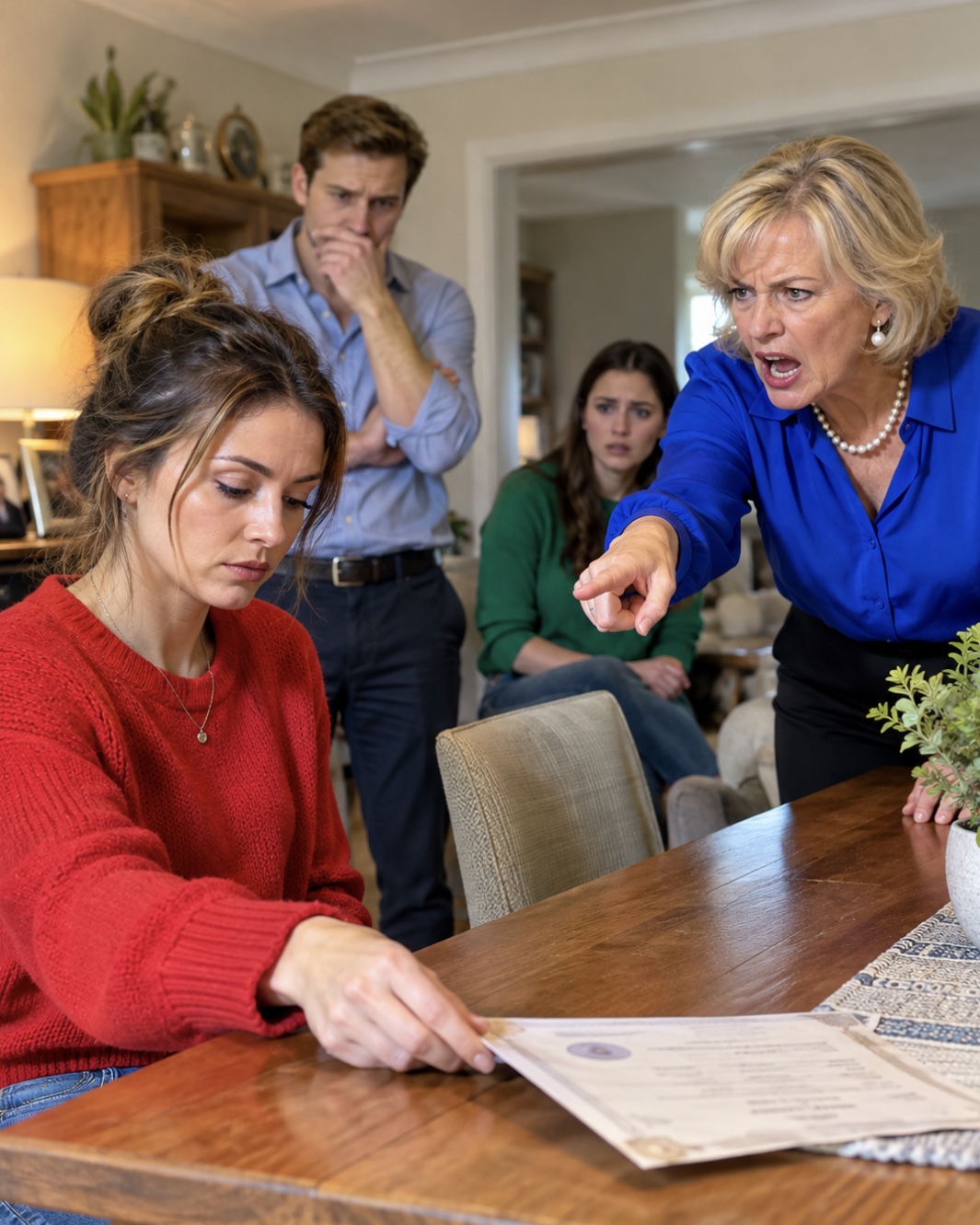
Then I placed one document in the middle of the table.
Margaret glanced at it.
Her expression didn’t change at first.
Then she noticed the name.
She stopped breathing.
Daniel leaned closer.
“What is that?”
“Read it.”
He picked it up.
It was an adoption certificate.
Dated 1999.
Twenty-seven years earlier.
The name on it was not mine.
It was Daniel’s.
His eyes moved across the page once.
Then again.
“I don’t understand.”
Margaret was suddenly very pale.
“Emily,” she said. “Where did you get this?”
I looked at her.
“You know where.”
Sophie stood.
“What does that mean?”
Margaret reached for the certificate.
Daniel pulled it back.
“Mum?”
She looked at me instead.
Her voice dropped.
“You had no right.”
“I found it five years ago.”
Daniel turned toward me so fast his chair knocked against the floor.
“Five years?”
“Yes.”
“And you never told me?”
“No.”
His face twisted with anger.
“Why?”
“Because your father asked me not to.”
That silenced everyone.
Daniel’s father, Peter, had died four years earlier after a short battle with pancreatic cancer.
He had been sixty-three.
Quiet, practical, gentle Peter, who fixed shelves before anyone asked and always brought my children chocolate buttons even when Margaret complained they were spoiled.
He had been the only person in Daniel’s family who never treated me like a temporary guest.
Five years earlier, while Peter was still healthy, he and Margaret had gone away to Cornwall for a week.
They asked me to find Peter’s old pension documents because their solicitor needed copies.
While searching through a filing cabinet in their study, I found the adoption certificate tucked behind an envelope containing Daniel’s childhood vaccination records.
I had stared at it for several minutes before Peter unexpectedly came home early.
He saw the paper in my hand.
He closed the study door.
Then he said, “Margaret must never know you’ve seen that.”
At first I thought Margaret didn’t know about the adoption.
The truth was stranger.
Daniel had been born to Margaret’s older sister, Caroline.
Caroline was twenty-two, unmarried and struggling with severe depression after Daniel’s father disappeared before he was born.
Margaret and Peter had been unable to have children.
When Daniel was seven months old, Caroline asked them to take care of him temporarily.
Temporary became permanent.
The adoption was finalised quietly the following year.
Caroline left Yorkshire shortly afterward.
According to Peter, Margaret decided Daniel would never be told.
“She loves him,” Peter had told me. “But she’s always been terrified that if he knew, he’d go looking for Caroline.”
“Where is she now?”
Peter had looked toward the window.
“Alive.”
That was all he would say.
I had hated keeping the secret.
But Peter was Daniel’s father in every meaningful sense, and he begged me not to destroy the family while he tried to persuade Margaret to tell the truth herself.
Then he became ill.
Everything else disappeared beneath hospital visits, scans and chemotherapy.
He died nine months later.
Afterward, I couldn’t bring myself to tell Daniel.
Especially because Margaret was grieving so badly.
So I placed a copy of the certificate in our box at home and waited.
I told myself there would be a right moment.
There never was.
Now Daniel lowered himself into a chair.
“My real mother is Aunt Caroline?”
Margaret flinched.
“Don’t call her that.”
Daniel looked at her.
“Is it true?”
“She gave you away.”
Sophie stared between them.
“But Aunt Caroline sends Christmas cards.”
“Yes,” Daniel whispered.
Every December, a card arrived from Brighton.
Usually with a lighthouse or winter beach on the front.
Love from Caroline.
Sometimes there was a cheque for the children.
Margaret always rolled her eyes and called Caroline unreliable.
I had never questioned why Caroline kept sending presents to Daniel’s children when they barely knew her.
Now it made terrible sense.
Daniel asked, “Does Caroline know where I am?”
Margaret said nothing.
“Mum?”
“She knows.”
“And she’s been allowed to contact me?”
“I didn’t stop her.”
“You told me she was just some distant aunt!”
“She is your biological mother. That doesn’t make her your mother.”
Daniel stood abruptly.
“Did Dad want me to know?”
Margaret’s mouth tightened.
Nobody needed to answer.
Daniel turned toward me.
“You said Dad asked you to keep it secret.”
“At first.”
“At first?”
I opened the blue folder again.
There was another envelope.
This one had Peter’s handwriting on it.
Daniel’s name.
Margaret looked genuinely frightened now.
“What is that?”
“A letter your father gave me three weeks before he died.”
Her hand moved toward it.
I pulled it away.
“He told me to give it to Daniel if you still hadn’t told him within a year.”
Daniel stared at me.
“You’ve had that for four years?”
“Yes.”
“Why didn’t you give it to me?”
That was the question I had been afraid of.
“Because your father also asked me to wait if your mother was emotionally unstable after his death. And she was. Then Sophie was going through her divorce. Then Lily was born. Then there was always another reason.”
Daniel looked devastated.
“You decided for me.”
“Yes.”
I didn’t defend myself.
“I did. And I was wrong.”
Margaret seized the opportunity.
“You see? She lies. She hides things. She moves money. She—”
Daniel turned on her.
“Stop.”
Margaret froze.
It may have been the first time in his life he had spoken to her that way.
He opened Peter’s letter.
I watched his eyes move slowly across the page.
Peter had explained everything.
Not only Daniel’s adoption.
Something else.
Something I had not known until reading the letter myself after Peter died.
Caroline had not abandoned Daniel.
Margaret had pressured her into signing the adoption papers.
Caroline had been recovering from a mental health crisis and living temporarily in supported accommodation.
Margaret offered stability.
A house.
Marriage.
Money.
Everything Caroline believed she couldn’t provide.
But according to Peter, within a year Caroline wanted Daniel back.
Legally, it was too late.
She begged Margaret to let her have contact.
Margaret refused.
For years, Peter secretly sent Caroline school photographs.
Later, when Daniel became an adult, Caroline could have contacted him directly.
She didn’t.
Peter wrote that she was afraid of destroying his life.
Daniel read the final paragraph twice.
Then he passed the letter to Sophie.
She began crying halfway through.
Margaret sat very still.
Finally she said, “Your father always made everything sound worse than it was.”
Daniel laughed once.
It was a horrible sound.
“You told me Caroline never wanted children.”
“She wasn’t capable of raising you.”
“That wasn’t your decision.”
“It absolutely was. You needed a home.”
“And after I turned eighteen?”
Margaret stood.
“I was your mother.”
“Then why were you so afraid I’d find out?”
She had no answer.
A long silence filled the room.
Then Sophie said, “Mum… is that why you hated Caroline coming to my wedding?”
Margaret looked away.
Sophie covered her mouth.
“Oh my God.”
Daniel sat down again.
For several minutes nobody spoke.
Then something unexpected happened.
Ben appeared halfway down the stairs.
“Dad?”
Daniel wiped his face quickly.
“Hey, mate. You should be asleep.”
“I heard Grandma shouting.”
Margaret looked offended.
“I wasn’t shouting.”
Ben ignored her.
“Is Mum leaving?”
Daniel looked at me.
Then at our son.
“No.”
Margaret stiffened.
Daniel stood.
“No. Mum isn’t leaving.”
He turned toward me.
His voice was quieter.
“I’m sorry.”
I nodded, but I wasn’t ready to forgive him.
Not yet.
Then he looked at Margaret.
“You need to go.”
Her eyes widened.
“Daniel.”
“Tonight.”
“You don’t mean that.”
“I do.”
“I raised you.”
“Yes.”
His voice cracked.
“And I’ll never pretend you didn’t. But you don’t get to walk into my house, accuse my wife of stealing and order her out because you’ve decided you’re in charge.”
“She hid this from you!”
“She did.”
He looked at me.
“And we’ll deal with that between us.”
Then he turned back to Margaret.
“But she didn’t spend twenty-seven years lying to me about who gave birth to me.”
Margaret’s face collapsed.
For one second she looked much older than seventy.
I almost felt sorry for her.
Almost.
She picked up her handbag.
At the door she turned.
“You’ll regret contacting Caroline.”
Daniel asked, “How do you know I’m going to?”
Margaret didn’t answer.
She left.
The next morning, Daniel phoned Caroline.
He put the call on speaker, then changed his mind before she answered and went into the garden alone.
He stayed outside for forty-three minutes.
When he came back, his eyes were swollen.
I didn’t ask what she had said.
He told me anyway.
Caroline had been waiting twenty-seven years for that call.
They met two weeks later at a café near Brighton station.
I didn’t go.
That needed to belong to them.
Daniel and I had harder conversations.
About the certificate.
About my decision to keep Peter’s letter.
About the money.
About how easily he had allowed Margaret to convince him that I was deceiving him.
For a while, I genuinely didn’t know whether our marriage would survive.
But something shifted when Daniel asked the bank for the full transaction history.
He discovered the screenshots Margaret had shown him were cropped.
She had removed references showing that several transfers were business payments.
She had also known about the commercial unit.
Daniel had mentioned it to her months earlier.
She hadn’t misunderstood.
She had built a case.
Why?
Because three days before that disastrous evening, Daniel had told her we might move to Leeds within a year if my business continued growing.
Margaret panicked.
She thought I was taking him away.
Just as Caroline might have, all those years ago.
The pattern was suddenly impossible to miss.
Control disguised as protection.
Fear disguised as loyalty.
Love measured by obedience.
Daniel eventually reconciled with Margaret, but not in the way she wanted.
There were rules.
No access to finances.
No unannounced visits.
No insulting me in front of the children.
No decisions made on Daniel’s behalf.
And Caroline was no longer a forbidden subject.
The first Christmas after they reconnected, two cards arrived.
One from Margaret.
One from Caroline.
For the first time, Daniel put both on the mantelpiece.
Margaret visited on Boxing Day.
She noticed Caroline’s card immediately.
She said nothing.
Neither did I.
Sometimes silence is defeat.
Sometimes it is acceptance.
And sometimes it means everyone in the room finally understands that the old rules no longer apply.
The commercial unit opened in March.
Daniel painted the walls on weekends.
Sophie designed my menus.
Caroline sent a small parcel containing an old silver cake server that had belonged to Daniel’s grandmother.
Margaret sent nothing.
But on opening day, just before noon, she appeared in the doorway.
She didn’t come in.
She simply stood outside for several seconds.
Then she said, “It looks nice.”
From Margaret, that was practically a speech.
I thanked her.
She nodded and walked away.
That night, Daniel and I locked the shop together.
On the drive home he said, “Do you ever think about what would’ve happened if Mum hadn’t told you to leave?”
I looked out at the wet streetlights reflecting on the road.
The truth was uncomfortable.
If Margaret hadn’t tried to push me out of the family, the certificate might still have been sitting inside that grey box.
Peter’s letter might still have been unopened.
Caroline might still have been sending Christmas cards to a son who didn’t know she was his mother.
And Daniel might still have believed that obedience was the same thing as peace.
“No,” I said. “I try not to.”
He smiled faintly.
Then he reached across the centre console and took my hand.
Twenty-seven years of silence had ended at our dining table.
Not because anyone was brave enough to tell the truth.
But because someone finally went too far trying to keep it buried.