



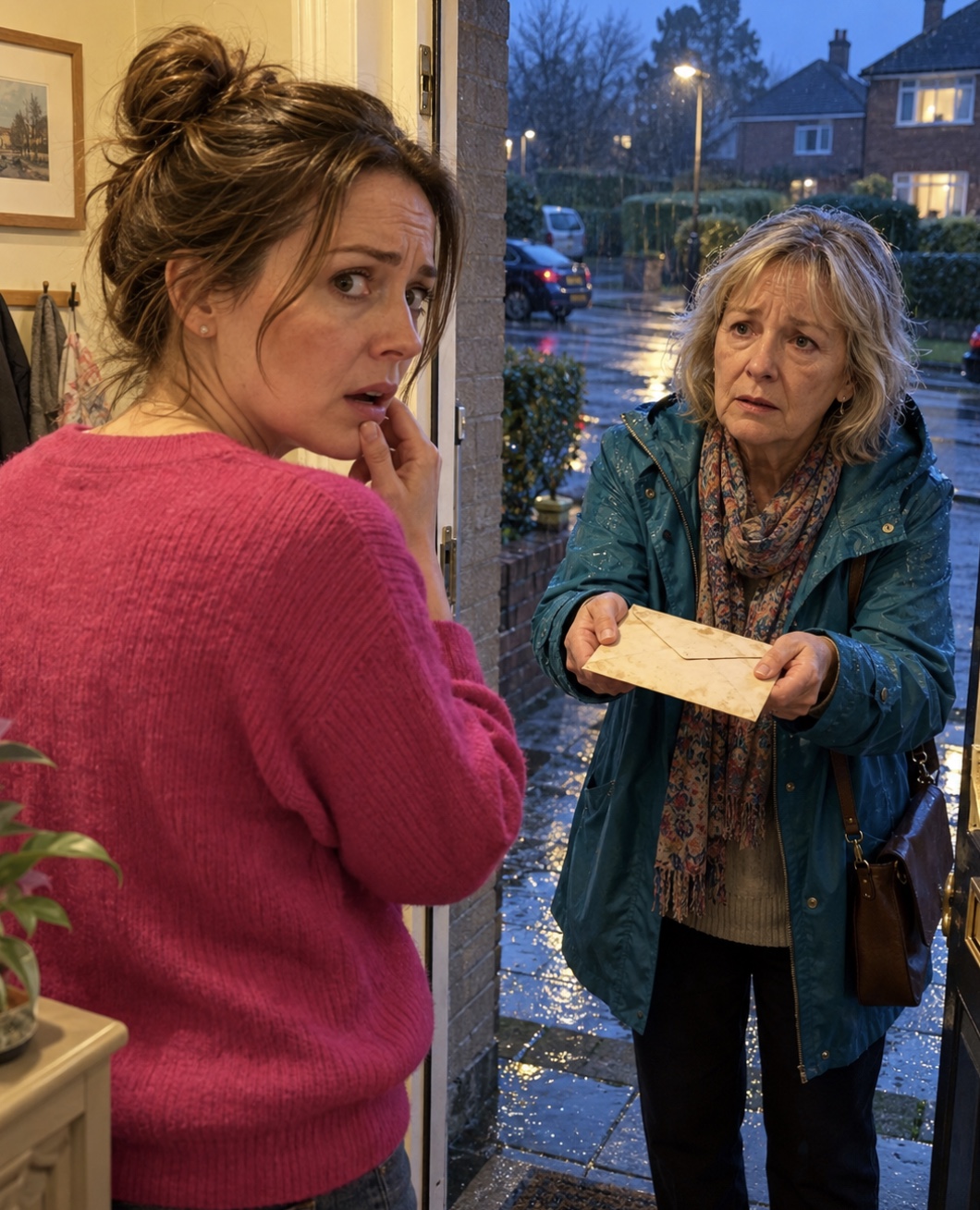
At 7:15 on a wet Thursday evening, our neighbour knocked on the door holding an old cream envelope in both hands as if it might break.
“Claire,” she said quietly, “I think this belongs with you now.”
I recognised the handwriting before I recognised my own name.
Margaret’s handwriting was impossible to mistake. Tall, narrow letters, every capital leaning slightly forward. She had written our Christmas cards the same way for fourteen years, even after she stopped putting kisses under my name.
The envelope had been sealed with brown tape along one edge.
On the front, in Margaret’s hand, were the words:
For Claire. Not before my seventieth birthday.
I looked at Diane.
“My mother-in-law gave you this?”
Diane nodded.
“When?”
“Last November.”
Margaret’s seventieth birthday was four days away.
She was alive, healthy enough to drive, still bossy enough to rearrange my kitchen whenever she visited, and currently staying with her sister in York.
I stared at the envelope.
“Why did she give it to you?”
Diane looked uncomfortable.
“She asked me to keep it somewhere your husband wouldn’t find it.”
That was the moment the rain outside seemed to get louder.
My husband, Simon, was upstairs on a work call.
I lowered my voice.
“She specifically said Simon shouldn’t find it?”
“Yes.”
“And I wasn’t supposed to get it until Sunday?”
Diane hesitated.
“That was the arrangement.”
“Then why are you giving it to me now?”
She glanced toward our staircase.
“Because yesterday Margaret rang me and told me to destroy it.”
I said nothing.
Diane swallowed.
“She sounded frightened.”
Margaret did not frighten easily.
This was a woman who once argued with an airport security officer for twenty minutes because he had called her handbag “oversized.” She had stood in our garden during a winter storm shouting instructions at a roofer because she thought he was fitting tiles incorrectly.
The idea of Margaret sounding frightened made my stomach tighten.
“What did you tell her?”
“That I’d already thrown it away.”
“Had you?”
“No.”
Diane pushed the envelope toward me.
“I don’t want to be in the middle of whatever this is.”
Neither did I.
But my name was on it.
I took the letter.
For nearly an hour, I didn’t open it.
I put it in the drawer beneath the tea towels and made dinner.
Simon came downstairs at eight, loosened his tie, and complained about a client in Birmingham.
Our daughter Sophie wandered in wearing one sock and asked if anyone had seen the other.
Everything looked normal.
That almost made it worse.
Simon poured himself a glass of wine.
“Mum called,” he said.
My hand stopped above the saucepan.
“When?”
“About half five.”
“What did she want?”
“She’s changed her mind about Sunday. Doesn’t want a big fuss for her birthday.”
Margaret had spent three months planning that birthday.
Private room at a country pub. Thirty-two guests. A pianist. A cake from a bakery in Harrogate because, according to Margaret, “supermarket icing tastes like wallpaper paste.”
“She cancelled it?”
“Not exactly. Just wants family now.”
Simon shrugged.
“She’s being weird.”
I forced myself to stir the sauce.
“Did she say why?”
“No. Probably fallen out with Aunt Janet again.”
After dinner, Simon took Sophie upstairs to help with her science homework.
I opened the drawer.
The envelope was still there.
I turned it over.
There was no return address.
I thought about calling Margaret.
I thought about waiting until Sunday.
Then I remembered Diane saying: She told me to destroy it.
If Margaret wanted the letter destroyed now, whatever she had written last November was something she no longer wanted me to know.
That was what made me slide my finger under the seal.
Inside were three folded sheets and a photocopy of an old bank statement.
The first line made me sit down.
Claire, if you are reading this, then either I finally found the courage to tell you the truth, or someone else found more courage than I did.
I read it twice.
Then the next line.
What happened when you and Simon nearly lost the house in 2018 was not what Simon told you.
My mouth went dry.
In 2018, Simon had lost his job.
Sophie was five.
Our mortgage payment had gone out two days before his company collapsed, and for four months we had lived with a calculator permanently open on the kitchen table.
Then Simon told me his mother had lent us £18,000.
I had hated accepting it.
Margaret had made sure I hated it.
For years afterward, every disagreement ended with some version of the same sentence.
“Some people forget who kept a roof over their heads.”
I kept reading.
I did not lend Simon £18,000.
I gave him £3,000.
The remaining £15,000 came from you.
I laughed once.
Not because anything was funny.
Because sometimes your body makes the wrong sound when it cannot process the right one.
The bank statement showed a savings account in my maiden name.
Claire Evans.
I hadn’t used that surname since marrying Simon.
The account number meant nothing to me.
The balance did.
£15,842.19.
There was a withdrawal dated 17 March 2018.
£15,000.
On the next page, Margaret had written:
You had forgotten this account existed. Your grandmother opened it for you when you were sixteen. Your father transferred birthday money and small amounts into it for years. Simon found the paperwork after your father died.
I stopped breathing properly.
My father had died in 2017.
Simon had helped clear his flat.
Boxes of documents had sat in our garage for months.
Margaret continued:
Simon asked me to help him move the money without telling you. He said you were panicking and would refuse to use it because you wanted the savings kept for Sophie. He told me it was temporary. He said he would repay you.
I looked toward the ceiling.
Above me, Sophie laughed at something Simon said.
My husband.
The man who had spent six years thanking his mother in front of me for money that had been mine.
📩 What happened next changed everything I thought I knew about my marriage — continue in the first comment. 👇
I nearly stopped reading.
Nearly.
But beneath Margaret’s neat handwriting, the letter changed tone.
At first I believed him. Then I allowed him to tell you the money was mine because I liked what it gave me.
Power.
There it was.
One word.
Power.
Margaret had underlined it.
Every time you disagreed with me, I reminded you of the “loan.” Every Christmas when you wanted to stay home, every summer when you chose your own plans, every time you questioned how much I interfered with Sophie, I used money that was never mine as a reason you owed me.
I am ashamed of that.
I sat perfectly still.
The anger came slowly.
Not like an explosion.
Like water rising in a locked room.
I remembered Christmas 2020, when Margaret had insisted we drive two hours through freezing rain because “after what this family has done for you, missing Christmas would be hurtful.”
I remembered when I wanted to take a part-time course in counselling and Margaret had said, “Perhaps focus on financial stability before reinventing yourself.”
I remembered apologising.
Again and again.
For being ungrateful.
For being difficult.
For forgetting what she had “done for us.”
The third page was worse.
Simon repaid the money into my account, not yours.
I stared at that sentence for almost a minute.
Margaret had attached another bank statement.
Her account.
Three transfers from Simon.
£5,000.
£5,000.
£5,000.
Between 2020 and 2022.
I had seen those payments.
Simon told me he was repaying his mother.
Technically, he had been.
But he had been repaying her for money she had never lent him.
Margaret wrote:
I kept it.
I told myself Simon owed me for putting me in that position. That is not true. I kept money that should have gone back to you.
Last November, when I wrote this, I had decided I would tell you on my seventieth birthday and give you the full amount plus interest. I wanted one day in my life when I stopped protecting my son from the consequences of what he had done.
I looked through the remaining papers.
There was another sheet.
A building society statement.
A balance of £19,460.
Margaret had opened an account six months earlier.
In the reference line, she had written: CLAIRE.
Then came the final paragraph.
If I lose my nerve, Diane has instructions to give you this anyway.
If I ask her to destroy it, that means I have lost my nerve.
Please don’t let my cowardice become another decision made for you.
I folded the letter slowly.
My hands were shaking.
Simon came downstairs ten minutes later.
He found me sitting at the kitchen table with the papers spread in front of me.
His face changed before he even reached the table.
Not confusion.
Recognition.
That hurt more than anything I had read.
He stopped walking.
“Where did you get that?”
I looked at him.
“That’s your first question?”
Simon closed his eyes.
“Oh, God.”
“How long were you planning to keep lying?”
“Claire—”
“How long?”
He pulled out a chair.
I pushed it back with my foot.
“Don’t sit down.”
He stayed standing.
For several seconds, neither of us spoke.
Then Simon said, “It wasn’t supposed to happen like this.”
I almost smiled.
“Which part?”
He rubbed both hands over his face.
“When Dad died, you were barely sleeping. You were dealing with Sophie, work, the funeral, everything. I found the old building society book in one of the boxes.”
“And instead of telling me?”
“We were about to miss the mortgage.”
“We were not about to miss it.”
“We were two months away.”
“That isn’t the same thing.”
“I panicked.”
“So you took my money.”
“I used it for us.”
“You took it without asking me.”
His voice rose.
“I was trying to keep the house.”
“And then you told me it came from your mother.”
He looked away.
That was when I realised there was something else.
“Why?”
Simon’s jaw tightened.
“Why involve Margaret?”
“She knew how to access the old account. She used to work at the building society. She helped with the forms.”
“That doesn’t answer me.”
He was silent.
I stood.
“Simon. Why did you let me believe your mother saved us?”
He looked genuinely ashamed.
“Because I knew you’d find out eventually that I’d used your account.”
“So?”
“And I thought if I replaced it first, maybe it wouldn’t matter.”
My voice went very quiet.
“But you didn’t replace it.”
“I did.”
“No. You gave the replacement money to Margaret.”
His eyes flicked toward the letter.
“So she told you everything.”
“Yes.”
He gave a short, bitter laugh.
“Of course she did.”
That angered me more than I expected.
“Don’t you dare make her the villain because she finally told me the truth.”
“You don’t understand what she did.”
“I understand exactly what she did.”
“No, you don’t.”
Simon walked toward the kitchen window, then turned.
“The first £15,000 I paid her wasn’t supposed to be repayment.”
I stared at him.
“What?”
“She blackmailed me.”
I thought I had misheard.
“She what?”
“She said if I didn’t give her the money, she’d tell you I took yours.”
The room went silent.
Simon spoke quickly now, as though the words had been waiting years to come out.
“The first time was in 2020. We’d just remortgaged at a better rate. She knew we had some extra cash. She said I had two choices: tell you everything or pay her £5,000.”
I couldn’t move.
“And you paid?”
“Yes.”
“Then again?”
“Yes.”
“And again?”
He nodded.
I looked at Margaret’s confession.
Power.
She had not exaggerated.
She had simply left out one of the ugliest parts.
“So both of you used my money to control each other.”
Simon shook his head.
“That’s not fair.”
I laughed.
“Not fair?”
“I made one terrible decision because I thought I was protecting us.”
“You stole from me.”
“I borrowed—”
“Stop calling it borrowing. Borrowing requires permission.”
He flinched.
Upstairs, a floorboard creaked.
We both lowered our voices.
I gathered the papers.
Simon reached for them.
I pulled them away.
“Don’t.”
“What are you going to do?”
“I don’t know yet.”
“Claire, please.”
“For six years I have felt indebted to your mother for money that belonged to me.”
“I know.”
“No, you don’t. You watched her humiliate me with it.”
“I tried to stop her.”
“You told me to let things go.”
He had no answer.
That night, Simon slept in the spare room.
I barely slept at all.
At 6:40 the next morning, my phone rang.
Margaret.
I watched it ring until it stopped.
Then a message appeared.
Diane gave it to you, didn’t she?
I replied with one word.
Yes.
Three dots appeared immediately.
Then disappeared.
Then returned.
Finally:
I’m coming home.
Margaret arrived that afternoon.
No lipstick. No jewellery. No perfectly pressed scarf.
For the first time since I had known her, she looked old.
Simon refused to come downstairs.
Margaret sat opposite me at the kitchen table.
Between us lay the letter.
“I’m sorry,” she said.
I didn’t respond.
She placed a folder beside it.
“That account has £19,612 in it now. I added this month’s interest. It’s yours.”
I didn’t touch the folder.
“Why did you call Diane yesterday?”
Margaret looked at her hands.
“Because Simon rang me.”
My stomach tightened.
“When?”
“Wednesday night.”
“What did he say?”
“He told me that if I planned to tell you on Sunday, he wouldn’t bring Sophie to my birthday.”
I stared at her.
“He used Sophie?”
Margaret nodded once.
“I wish I could tell you that shocked me.”
Something in her voice changed.
Not anger.
Grief.
“I realised what we had made normal.”
She looked upstairs.
“A family where everyone keeps secrets to control the next person.”
I said nothing.
Margaret continued.
“I asked Diane to destroy the letter because for about twelve hours I convinced myself silence was still easier.”
“And then?”
“She lied to me.”
A tiny smile appeared.
“Said she’d thrown it away.”
“So you thought it was gone.”
“Yes.”
“Were you relieved?”
Margaret’s eyes filled.
“Yes.”
That answer mattered more than an easy apology would have.
She didn’t pretend bravery.
She didn’t pretend goodness.
She simply admitted that, given one last chance, she had chosen cowardice again.
Until Diane had taken the choice away from her.
I asked, “Why write the letter at all?”
Margaret looked toward the back garden.
“Because my sister was diagnosed with breast cancer last autumn.”
I hadn’t known.
“She’s responding well,” Margaret said quickly. “This isn’t about her dying. It just made me start thinking about the stories families tell about themselves.”
She looked back at me.
“I have spent years telling myself I was the one who held everyone together.”
A tear slipped down one cheek.
“But sometimes holding people together is just another way of not letting them move.”
For the first time, I understood something about Margaret without forgiving it.
There was a difference.
Simon came downstairs eventually.
He stood in the doorway.
His mother did not look at him.
He said, “Mum, can we talk?”
Margaret replied, “No.”
Just that.
No shouting.
No dramatic confrontation.
“No.”
Simon looked at me.
“Claire?”
I stood.
“I want you to stay with your brother for a while.”
His face went pale.
“For how long?”
“I don’t know.”
“We can fix this.”
“Maybe.”
That was the truth.
Not yes.
Not no.
Maybe.
“But I need to work out whether I miss you,” I said, “or whether I just miss the version of you I thought I married.”
Simon left that evening with one suitcase.
Margaret’s birthday celebration was cancelled.
Four days later, on the Sunday she turned seventy, I drove to her house alone.
I almost didn’t go.
But there was one thing I needed to do.
Margaret opened the door wearing jeans and an old green jumper instead of the elegant navy dress she had bought for the party.
Her surprise was obvious.
“I wasn’t expecting you.”
“I know.”
I handed her a small gift bag.
Inside was a cheap notebook.
She looked confused.
“I don’t understand.”
I said, “No more letters hidden with neighbours.”
For a second, she stared at me.
Then she laughed.
A real laugh.
It turned into crying halfway through.
We sat in her kitchen drinking tea.
Nothing was magically repaired.
I did not call her Mum.
I did not tell her everything was forgiven.
She did not ask.
Before I left, she transferred £19,612 into an account in my name while I watched.
Not as a gift.
Not as repayment for kindness.
As money that should never have been hers.
Simon and I eventually started counselling.
Not because I had decided to stay.
Because after fourteen years together, I wanted one room where neither of us could rewrite what had happened.
Three months later, we were still living separately.
That surprised everyone except me.
The strangest change was with Margaret.
She stopped using money, age, family history, or sacrifice as arguments.
Sometimes she would begin a sentence with, “After everything I’ve—”
Then stop herself.
The first time she did it, we both noticed.
Neither of us said anything.
But we smiled.
Diane still lives next door.
A few weeks ago, she apologised again for giving me the envelope early.
I told her not to.
“Margaret made me promise to keep it until her seventieth,” she said.
“You broke your promise.”
“I know.”
I looked toward Margaret’s house across the road.
“Yes,” I said. “You did.”
Then I added:
“Thank God.”