



The first time one of Margaret’s neighbours called me, I assumed he had the wrong number.
“Is this Claire?” the man asked.
“Yes.”
“I’m sorry to bother you. I live underneath Margaret Bell, number twenty-six. There’s been another row.”
I stood in the kitchen with one hand wrapped around a mug of tea and looked through the rain-streaked window at our small back garden in Bristol.
“Another row?”
There was a pause.
“Someone was shouting. A woman. Then your mother-in-law started shouting back. It’s happened three times this week.”
I nearly laughed from confusion.
Margaret lived alone.
My husband, Daniel, was her only child. His father had died six years earlier, and Margaret had made a point of reminding everyone that she preferred her independence.
She was sixty-eight, stubborn, immaculate, and so protective of her privacy that she once refused to let a plumber use her bathroom because, as she put it, “Tradesmen don’t need to know which face cream I buy.”
There was no woman living with her.
At least, none that we knew about.
“Are you sure the shouting came from her flat?”
“Completely sure.”
“What were they arguing about?”
“I couldn’t make out everything.”
The man lowered his voice.
“But I heard someone say Daniel’s name.”
My fingers tightened around the mug.
“My husband?”
“Yes.”
That evening, when Daniel came home from work, I told him.
He was halfway through taking off his coat.
“Mum arguing with someone?”
“That’s what the neighbour said.”
“Probably the television.”
“He heard your name.”
Daniel stopped.
For less than a second.
Then he gave a small shrug.
“She watches those ridiculous daytime dramas. Half the men in them are probably called Daniel.”
It was exactly the kind of answer Daniel gave whenever his mother did something strange.
Margaret turning up without warning on Sunday morning?
“She was nearby.”
Margaret asking what we paid for our mortgage?
“She’s curious.”
Margaret keeping a key to our first flat after we’d asked for it back?
“She probably forgot.”
Daniel had spent thirty-nine years smoothing his mother’s sharp edges until he no longer seemed to notice them.
I did.
Two days later, another neighbour contacted me.
This time it was Mrs Jenkins from across the landing.
I knew her slightly. She was in her seventies, wore bright scarves, and always smelled faintly of lavender and cigarette smoke despite claiming she had quit in 1998.
“Claire, love,” she whispered, “I don’t like interfering.”
Anyone who begins a sentence that way is already deeply involved.
“But something isn’t right.”
“What happened?”
“There was banging last night. Not fighting, I don’t think. More like cupboards being slammed. Then Margaret shouted, ‘You don’t get to come back after all these years and make demands.’”
I sat down.
“Come back?”
“Yes.”
“And someone else was there?”
“I saw her.”
That made my stomach turn.
“What did she look like?”
“About our age. Maybe mid-sixties. Dark hair, though mostly grey now. Tall. Very thin.”
“Did she leave?”
“That’s the strange thing.”
Mrs Jenkins paused.
“I never saw her arrive.”
That night I asked Daniel whether he knew any woman fitting that description.
He was standing at the hob, stirring pasta sauce.
“No.”
“Think.”
“I am thinking.”
“Your mother said something about someone coming back after years.”
Daniel put the wooden spoon down.
“Claire, Mum has had friends since before I was born. She has cousins. Old colleagues. Church people.”
“Your mother hasn’t been to church in twenty years.”
“You know what I mean.”
I watched his face.
He wasn’t frightened.
Not exactly.
But he was irritated in a way that suggested I had moved too close to something he did not want touched.
“Why are you defending her before we even know what’s happening?”
“I’m not defending anyone.”
“You always say that immediately before defending her.”
Daniel rubbed both hands over his face.
“I’ll call her tomorrow.”
He did.
Margaret answered after six rings.
I could hear her through Daniel’s speakerphone because he had put it on the kitchen counter while making coffee.
“Mum, everything all right?”
“Of course.”
“The neighbours said there’s been shouting.”
Silence.
Then:
“Nosy people should learn to mind their business.”
“Who’s been visiting you?”
“No one you know.”
Daniel glanced at me.
“Mum, apparently my name came up.”
Another silence.
Longer this time.
Then Margaret said, very calmly:
“Daniel, do not come here.”
The line went dead.
He stared at the phone.
I said, “Still think it’s the television?”
Three days passed.
Margaret ignored Daniel’s calls.
Then she sent him a text:
I’m perfectly well. I need some quiet. Please respect that.
On Friday afternoon, while Daniel was at work, I received another call.
Mrs Jenkins.
This time she didn’t bother with politeness.
“Claire, you need to come.”
“What’s happened?”
“I heard glass break. Margaret’s crying.”
My stomach dropped.
“Have you called the police?”
“She told me through the door not to.”
“Is the other woman there?”
“Yes.”
I grabbed my coat.
Margaret lived fifteen minutes away if traffic was kind.
That afternoon it wasn’t.
By the time I reached her block, rain was coming sideways and my hands were shaking.
Mrs Jenkins had left her door open.
She stepped into the corridor as soon as she saw me.
“They’re quiet now.”
“That’s worse.”
“I thought so too.”
I knocked.
“Margaret?”
Nothing.
I knocked harder.
“It’s Claire.”
A chair scraped inside.
Then a woman said something too softly for me to understand.
Margaret answered her sharply.
I tried the handle.
Unlocked.
That was the first thing that frightened me.
Margaret locked her door even when taking rubbish to the bin.
I stepped inside.
“Margaret?”
Her hallway smelled of furniture polish and burnt toast.
A broken drinking glass lay near the kitchen threshold.
Then I heard Margaret say:
“You had no right to bring that here.”
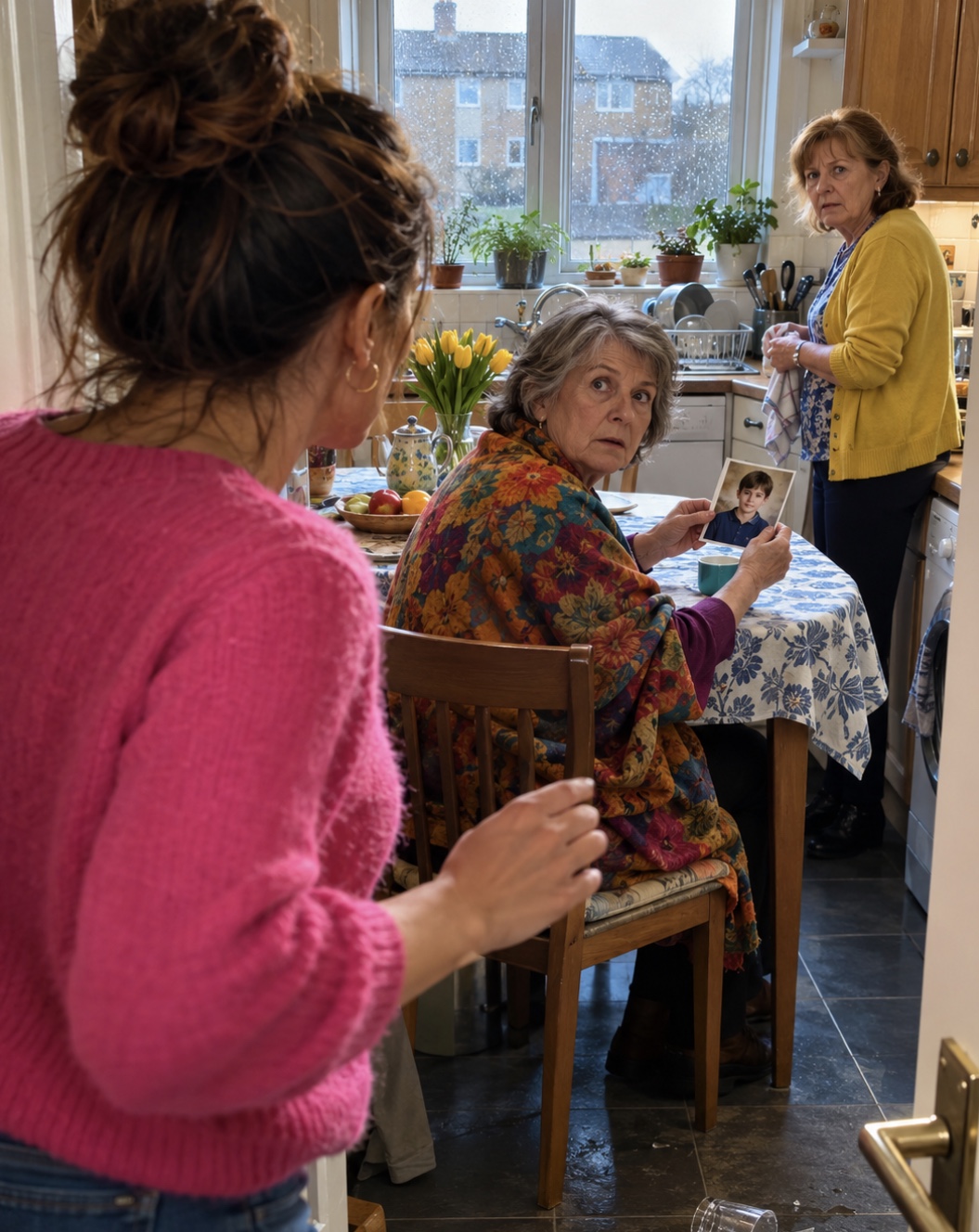
I walked into the kitchen.
Margaret was standing beside the sink, white-faced, one hand gripping the edge of the counter.
At the table sat a woman I had never seen before.
She was perhaps sixty-five, with short silver-streaked hair, a navy raincoat folded across the back of her chair, and a leather handbag by her feet.
In both hands, she was holding an old photograph.
A photograph of Daniel.
Not my grown husband.
Daniel as a child.
Maybe seven or eight.
School jumper. Missing front tooth. That serious little expression I had seen in Margaret’s photo albums.
The woman looked at me.
“Are you Claire?”
My mouth went dry.
“Yes.”
She stared at me for several seconds.
Then she looked down at Daniel’s picture and said:
“So he really did marry someone who asks questions.”
📖 What happened next was something no one in Daniel’s family had ever been prepared to explain — the rest is waiting in the first comment. 👇
Margaret snapped, “Enough.”
The woman didn’t even flinch.
I looked between them.
“Who are you?”
Margaret answered first.
“No one.”
The woman gave a tired laugh.
“That’s exactly what she’s been calling me for thirty-seven years.”
Margaret’s face changed.
I had seen her angry, offended, smug, wounded and occasionally theatrical.
I had never seen her afraid.
“Claire,” she said, “go home.”
“No.”
“This has nothing to do with you.”
“She’s holding a photograph of my husband.”
The woman placed the picture carefully on the table.
“My name is Rebecca Shaw.”
I waited.
The name meant nothing.
Apparently that showed on my face.
Rebecca nodded.
“Of course. She never told you.”
Margaret moved quickly across the kitchen and snatched up the photograph.
“I said enough.”
Rebecca stood.
They were almost the same height.
For the first time I noticed something peculiar.
Not resemblance.
Something subtler.
The way they held their shoulders.
The same habit of pressing their lips together before speaking.
The same green-grey eyes.
I looked at Margaret.
Then at Rebecca.
“Are you sisters?”
Rebecca looked at Margaret.
Margaret closed her eyes.
“Yes,” Rebecca said.
I almost laughed from relief.
A sister.
That was dramatic, certainly, but not terrifying.
Daniel had told me Margaret was an only child.
Maybe there had been a family falling-out.
People lied about relatives all the time.
Then Rebecca added:
“Twins.”
My relief disappeared.
Daniel had never mentioned an aunt.
Certainly not a twin aunt.
I turned to Margaret.
“Daniel thinks you’re an only child.”
“I practically was.”
Rebecca picked up her handbag.
“You erased me. There’s a difference.”
“What happened?”
Margaret pointed at the doorway.
“Claire, leave.”
“No.”
“Your marriage does not give you the right to interrogate me.”
“And being Daniel’s mother doesn’t give you the right to tell me something is none of my business when a stranger is sitting here with childhood photographs of him.”
Rebecca’s expression flickered.
Stranger.
The word seemed to hurt her.
That should have warned me.
Instead I asked the obvious question.
“Why do you have pictures of Daniel?”
Rebecca looked at Margaret again.
“Tell her.”
Margaret said nothing.
“Tell her yourself,” Rebecca whispered.
Margaret’s voice suddenly rose.
“You promised you wouldn’t involve him.”
“I promised when he was a child.”
“He’s still my son.”
Rebecca slammed one hand onto the table.
“And what exactly do you think he is to me?”
The silence afterwards was enormous.
I could hear the washing machine vibrating in someone else’s flat.
A bus braking on the street below.
Mrs Jenkins moving quietly outside the kitchen, pretending not to listen.
I stared at Rebecca.
Then Margaret.
“No.”
Margaret looked at me.
“Don’t.”
“Rebecca…”
My voice sounded strange.
“What is Daniel to you?”
Rebecca sat down slowly.
“I’m his mother.”
For several seconds, the sentence simply didn’t make sense.
I understood each word separately but not together.
Margaret said, “She is not.”
Rebecca’s head jerked up.
“I gave birth to him.”
“And I raised him.”
“That doesn’t change biology.”
“Biology?” Margaret spat. “You want to discuss biology now?”
I stepped backwards until my hip hit the worktop.
Daniel’s mother.
His actual mother.
“No,” I said.
Rebecca looked at me.
“He doesn’t know.”
“Obviously.”
My voice came out harsher than I intended.
“Why?”
Margaret folded her arms.
“Because there was nothing useful for him to know.”
Rebecca laughed bitterly.
“Useful.”
“Where were you?” I asked Rebecca.
“Canada.”
“For thirty-seven years?”
“Mostly.”
“And now you’ve just appeared?”
Rebecca nodded.
“That’s what Margaret wants you to believe.”
Margaret turned away.
Rebecca reached into her handbag.
Margaret immediately shouted, “Don’t.”
Rebecca ignored her.
She pulled out a bundle of envelopes tied together with an old elastic band.
Some were yellow with age.
All were addressed to Margaret.
“I wrote.”
She placed them on the table.
“Every year at first. Then every birthday. Then Christmas. Then whenever I thought I had enough courage to try again.”
I picked up the top envelope.
The handwriting had faded.
The postmark was Toronto.
Unopened.
I looked at Margaret.
“You kept them?”
“She sent them to my old address. They were forwarded.”
“But you never opened them?”
“No.”
Rebecca reached deeper into the bag.
“There are others she did open.”
She produced photocopies.
One letter began:
Please just send me one photograph. I won’t contact him. I swear. I only want to know if he’s happy.
Another:
Margaret, he’ll be eleven next month. I think about him every day.
Another:
You said when he became an adult it would be his decision. He is nineteen now.
I stopped reading.
My hands were shaking.
Margaret spoke behind me.
“You have no idea what she was like.”
“Then tell me.”
Rebecca sat motionless.
Margaret leaned against the counter.
For the first time in all the years I had known her, she looked old.
Not polished sixty-eight.
Actually old.
“We were nineteen.”
Her voice was quieter now.
“Rebecca got pregnant. The father was twenty-one and disappeared the moment he understood there would be a baby.”
Rebecca corrected her.
“He didn’t disappear.”
Margaret’s eyes flashed.
“He went to Manchester and stopped answering calls.”
“He sent money twice.”
“Wonderful man.”
Rebecca ignored the sarcasm.
“Our parents were furious. This was 1987. They weren’t monsters, but reputation mattered more than it should have.”
Margaret continued.
“Rebecca was depressed. Completely overwhelmed. She talked about giving the baby up.”
“I talked about adoption because I couldn’t see another way.”
“You said you didn’t want him.”
“I was nineteen!”
Their voices rose again.
Suddenly the complaints from the neighbours made sense.
These were not random quarrels.
They had been repeating the same argument for nearly four decades.
Margaret said, “You left the hospital without him.”
Rebecca went pale.
“You offered to take him temporarily.”
“You signed papers.”
“Temporary guardianship.”
“You went abroad.”
“For work. Because Dad said I couldn’t stay at home.”
“You stayed away.”
“Because every time I asked to come back, you told me Daniel was settled and I’d ruin his life!”
I looked at Margaret.
She did not deny it.
“Did Daniel believe you gave birth to him?” I asked.
Margaret nodded.
“Yes.”
“How?”
“We moved to Bath when he was a baby. No one there knew us well. People knew I had been away for several months.”
“You told people you were pregnant?”
“I never directly said it.”
Rebecca laughed.
“You wore maternity clothes.”
Margaret glared at her.
“I protected him.”
“You replaced me.”
“I became his mother.”
“You became his mother by making sure he could never choose whether he wanted me too.”
I left ten minutes later.
Not because the conversation was finished.
Because I couldn’t breathe.
I sat in my car with rain running down the windscreen and stared at Daniel’s name on my phone.
I wanted to call him immediately.
Instead I drove home.
When Daniel walked through the door just after six, he saw my face and stopped.
“What happened?”
I said, “Your mother has a twin sister.”
He stared at me.
“No, she doesn’t.”
“Her name is Rebecca.”
The colour drained from his face.
That surprised me.
“You know that name.”
Daniel put his keys on the hall table.
Very carefully.
“I’ve heard it.”
“Where?”
He didn’t answer.
“Daniel.”
“When Dad was dying.”
I felt another layer of the story shift beneath my feet.
“Your father knew?”
Daniel sat down on the bottom stair.
“He was on morphine. He kept saying things that didn’t make sense. Once he grabbed my wrist and said, ‘Rebecca should have been told.’ I asked Mum later. She said Rebecca was someone Dad knew years ago.”
I sat opposite him.
“Rebecca gave birth to you.”
He stared at me.
Nothing moved in his face.
Then he laughed.
One short, empty sound.
“No.”
“I saw letters.”
“No.”
“She says Margaret raised you after Rebecca left England.”
“No.”
“Daniel…”
He stood so fast that I flinched.
“No.”
Then he walked into the garden without a coat and stood in the rain.
I let him.
Ten minutes later he came back inside soaked through.
“Take me there.”
Margaret opened the door when we arrived.
When she saw Daniel, she looked at me with such fury that for a moment I genuinely thought she might slap me.
“You told him.”
“Yes.”
“You had no right.”
Daniel spoke from behind me.
“Apparently everyone had rights except me.”
Margaret froze.
Rebecca was still there.
When Daniel stepped into the kitchen, she stood.
Neither of them spoke.
I had expected tears.
Some dramatic recognition.
Instead Rebecca stared at him like someone looking at a house they once lived in, surprised by every alteration.
Daniel stared back.
Finally he said:
“You look like my grandmother.”
Rebecca’s mouth trembled.
“She was my mother too.”
Daniel sat.
For the next hour, they talked.
Dates.
Hospitals.
Addresses.
Questions about schools.
Questions about injuries.
Questions about why photographs existed.
Margaret answered some.
Rebecca answered others.
Then Daniel asked the question I think he had been avoiding from the moment we entered.
“Why now?”
Rebecca opened her handbag again.
This time she took out a hospital envelope.
My stomach clenched.
Margaret looked away.
Rebecca said, “I had heart surgery in February.”
Daniel’s face changed.
“I’m fine now. Mostly. But before the operation, I realised something. If I died, Margaret could continue telling herself she protected you, and you would never even know there was another version of your life.”
“So you came because you were ill?”
“I came because I was tired of asking permission to exist.”
Daniel looked at Margaret.
“You promised her she could contact me when I was eighteen?”
Margaret said nothing.
“Mum.”
“Yes.”
“And when I turned eighteen?”
“I thought there was no point disrupting you.”
“At twenty-five?”
“You were starting your career.”
“Thirty?”
“You were buying your flat.”
He laughed bitterly.
“Thirty-five?”
“You were getting married.”
I saw it then.
There had never been a right time.
Because Margaret had never intended there to be one.
Daniel stood.
“You weren’t protecting me from disruption.”
Margaret’s eyes filled with tears.
“You were mine.”
The words fell into the room like something heavy.
Daniel shook his head.
“I was a person.”
“I loved you.”
“I know.”
His voice cracked.
“That’s what makes this worse.”
Margaret started crying then.
Not elegantly.
Not quietly.
Rebecca turned towards the window.
I almost felt sorry for Margaret.
Almost.
Then Daniel noticed something on the kitchen counter.
A solicitor’s letter.
He picked it up.
Margaret moved quickly.
“Give me that.”
Daniel stepped away.
“What is this?”
Rebecca closed her eyes.
And suddenly I knew there was still something they had not told us.
Daniel read.
His eyebrows pulled together.
“This is about Granddad’s estate.”
Nobody spoke.
He kept reading.
Then he looked at Rebecca.
“You’re challenging Mum’s inheritance?”
Margaret seized the moment.
“You see? This is what this is really about.”
Rebecca turned around.
“No.”
“There it is,” Margaret said. “Money.”
Rebecca’s face hardened.
“You told him I was dead.”
Daniel slowly lowered the letter.
“What?”
Margaret went silent.
Rebecca pointed at the document.
“Our father left part of the family house to both daughters. When he died, Margaret submitted paperwork stating I was deceased overseas.”
I stared at Margaret.
Rebecca continued.
“She sold the property fourteen years ago.”
Daniel looked sick.
“How much?”
Margaret whispered, “That isn’t relevant.”
“How much?”
“About two hundred and forty thousand.”
“And Rebecca’s share?”
Silence.
Rebecca answered.
“She kept it.”
There was no screaming after that.
That was the strange part.
The neighbours had complained for weeks about shouting.
But the final argument happened almost in whispers.
Margaret had convinced herself for decades that every lie had a noble reason.
She kept Daniel because Rebecca was unstable.
She blocked the letters because Daniel was happy.
She hid Rebecca’s existence because telling the truth would hurt him.
She kept the inheritance because Rebecca had “abandoned the family.”
Each decision had become justification for the next.
By midnight, Daniel was exhausted.
Rebecca booked a room at a small hotel near Temple Meads rather than stay with Margaret.
Before she left, she handed Daniel the childhood photograph she had been holding when I first saw her.
On the back was written:
Daniel, age 8. School photograph. Thank you, M.
Daniel stared at the initial.
“Mum sent this?”
Rebecca nodded.
“Once.”
“When?”
“1995.”
Daniel looked at Margaret.
“You sent her a photograph.”
Margaret was crying again.
“I’m not made of stone.”
That sentence stayed with me.
Because it explained Margaret better than anything else.
She had never been entirely cruel.
That would have been simpler.
She had loved Daniel desperately.
She had also lied to him desperately.
Both things were true.
Six months later, Daniel still calls Margaret “Mum.”
Some people find that difficult to understand.
But thirty-nine years cannot be erased by a document, a DNA result or a confession in a kitchen.
Rebecca didn’t ask him to call her anything.
At first they met for coffee once a fortnight.
Then lunch.
Then she came to our house for Christmas.
Margaret refused to attend.
The following Easter, Daniel invited them both.
Margaret arrived first.
Rebecca came twenty minutes later carrying a lemon drizzle cake.
The room went silent.
Margaret looked at the cake.
Rebecca said, “Mum’s recipe.”
Margaret replied, “You always put too much lemon in it.”
Rebecca took off her coat.
“You always put too little.”
Daniel looked at me.
And for the first time since the truth came out, he smiled.
The inheritance dispute was settled privately. Margaret returned money to Rebecca, although neither woman has ever told us the exact amount.
They are not close.
Maybe they never will be.
Some wounds become scars before anyone admits they were injuries.
But occasionally they speak.
Mostly about ordinary things.
A cousin.
A recipe.
A television programme.
Whether the buses are worse than they were twenty years ago.
The neighbours stopped complaining about shouting.
Mrs Jenkins asked me once whether everything had “worked itself out.”
I told her that depended on what she meant by worked out.
Daniel now has two women in his life who can remember his first day of school.
One was there.
The other spent that same day thousands of miles away, wondering what colour jumper he had worn.
And every year on his birthday, Rebecca sends one old photograph from the box Margaret secretly mailed her over the years.
There were only twelve.
Twelve photographs across almost four decades.
On Daniel’s fortieth birthday, Rebecca handed him the last one.
It was a picture of him aged seventeen, standing beside Margaret in the garden, annoyed at whoever was holding the camera.
On the back, in Margaret’s handwriting, were five words:
He asks about you sometimes.
Daniel read it twice.
Then he quietly walked across the room and handed the photograph to Margaret.
She looked at what she had written nearly twenty-three years earlier.
Her face collapsed.
“You remembered her,” Daniel said.
Margaret nodded.
“Every day.”
“And you still said nothing.”
Another nod.
Daniel sat beside her.
He didn’t forgive her that afternoon.
Not completely.
Maybe he never will.
But he took her hand.
Across the room, Rebecca watched them without interrupting.
And that was when I finally understood what had really been happening in Margaret’s flat all those weeks.
The neighbours thought they were hearing two women fighting over the past.
They weren’t.
They were hearing two mothers arguing over who had loved the same boy more.
And neither of them had noticed that the boy had grown into a man who should have been allowed to decide for himself.