



The first time my mother-in-law called me a bad mother in front of other people, my six-year-old daughter was standing close enough to hear every word.
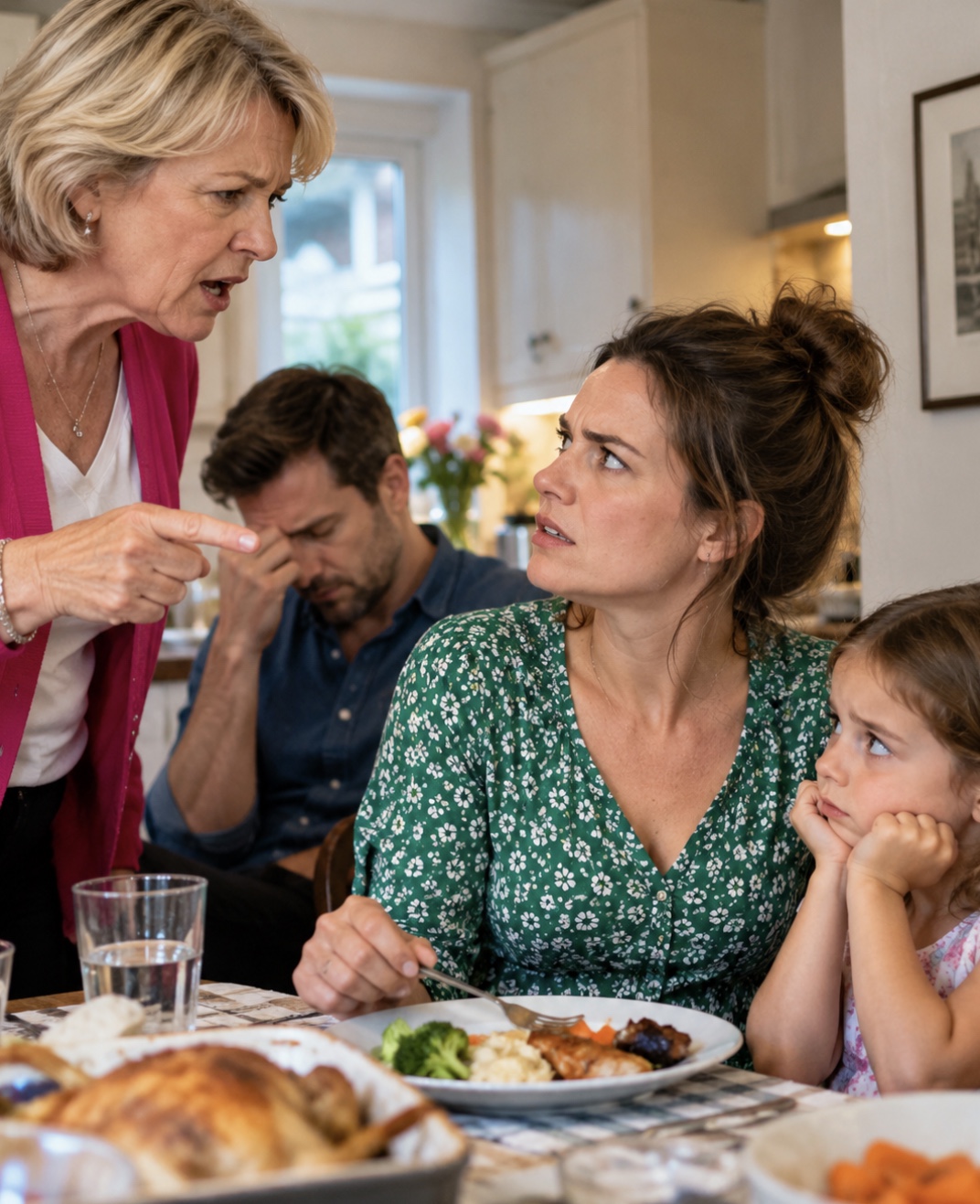
We were in the narrow kitchen of my sister-in-law’s terraced house in York, where twenty people had somehow been squeezed around folding chairs, a dining table and a breakfast bar for a Sunday roast. Rain ticked against the back windows. Someone had burned the Yorkshire puddings slightly, the children were arguing over a box of felt-tip pens, and my husband’s mother, Patricia, was holding my daughter’s half-finished plate like evidence in a criminal trial.
“She’s hardly touched the carrots,” Patricia said.
I kept cutting a slice of chicken for Rosie.
“She ate cucumber, peas and half a potato.”
“That isn’t the point.”
Rosie looked at me.
I knew that look. It meant: Is Grandma angry with me?
“Rosie,” I said quietly, “you can leave what you don’t want.”
Patricia set the plate down with a sharp clatter.
“What kind of mother says that? Honestly, Emma, I feel sorry for the child.”
The kitchen went silent in that peculiar British-family way where nobody actually stops moving, but suddenly every teaspoon becomes fascinating.
My husband, Daniel, stared into his gravy.
That was the moment something inside me finally shifted.
Not because Patricia had criticised me. She had been doing that for years.
Because Daniel had once again become invisible.
I looked across the table at him.
Then at Patricia.
“Well,” I said, “your child grew up, and he still hides from your advice.”
Daniel’s fork stopped halfway to his mouth.
My sister-in-law Clare whispered, “Oh God.”
Patricia’s face changed.
Not red. Patricia rarely went red.
She went pale.
“That,” she said, “was completely unnecessary.”
“So was what you said about me.”
“I’m concerned about my granddaughter.”
“And I’m concerned that she’s learning adults can humiliate her mother at lunch and call it concern.”
Daniel finally spoke.
“Can we not do this here?”
Patricia gave a short laugh.
“Of course. Daniel wants everyone to stop talking. There’s a surprise.”
He looked at her sharply.
And for one second, I saw something on his face I had never seen before.
Fear.
Not embarrassment.
Fear.
That night, on the drive back to Leeds, Rosie fell asleep in the back seat with her new colouring book against her chest.
For almost twenty minutes, Daniel said nothing.
The A64 stretched ahead in the rain.
Finally I said, “You know I wasn’t really talking about carrots.”
“I know.”
“Then why do you always disappear when she starts?”
He tightened both hands around the steering wheel.
“I don’t disappear.”
“You absolutely do.”
“She’s difficult.”
“So?”
“So arguing makes it worse.”
“For whom?”
He didn’t answer.
I turned toward the window.
For years I had accepted that explanation. Patricia was difficult. Patricia worried. Patricia was from a generation that spoke plainly. Patricia meant well. Patricia had raised three children. Patricia was lonely since her husband died.
There was always a reason Patricia was allowed to behave badly.
There was never a reason I was allowed to object.
We had been married nine years. Rosie was six. We lived in a semi-detached house on the edge of Leeds, paid our mortgage, worked full-time and had a perfectly ordinary life involving school WhatsApp groups, football boots left by radiators and arguments about whose turn it was to empty the dishwasher.
Patricia lived forty minutes away.
Somehow, she still managed to supervise us.
She commented on Rosie’s bedtime.
Her packed lunches.
How often we washed her hair.
Whether she needed a coat.
Whether she was too shy.
Whether she was too loud.
Whether ballet was expensive.
Whether swimming lessons were necessary.
Whether I worked too much.
Whether I should work more because “children need independent mothers.”
Whatever I did, Patricia already knew the opposite was better.
The strangest part was that she rarely criticised Daniel.
If Rosie forgot her PE kit, I was disorganised.
If Daniel forgot parents’ evening, he was busy.
If I ordered pizza on Friday, I was lazy.
If Daniel cooked frozen fish fingers, he was “giving Emma a well-earned rest.”
It would have been funny if it hadn’t been exhausting.
Two days after the Sunday roast, Patricia rang Daniel while we were clearing dinner.
I heard only his side.
“Yes.”
“No.”
“Mum.”
“I said no.”
A pause.
Then he walked into the utility room and shut the door.
That was unusual.
Daniel normally took calls wherever he happened to be.
Ten minutes later he came out.
“What did she want?”
“Nothing.”
“Daniel.”
“She thinks Rosie should stay with her next weekend.”
“Why?”
He put plates into the dishwasher without looking at me.
“Just to spend time together.”
Patricia had never requested an entire weekend alone with Rosie before.
“When did she suggest this?”
“Sunday.”
That was a lie.
I could tell immediately.
Daniel always rubbed the side of his thumb when he lied.
He was doing it now.
“Why are you lying?”
“I’m not.”
“You are.”
He shut the dishwasher harder than necessary.
“Can we not turn every conversation into an interrogation?”
I stared at him.
“Every conversation? You hid in the utility room to talk to your mother.”
“She winds you up.”
“So you protect me by lying?”
He sighed.
“It’s nothing.”
Then his phone lit up on the counter.
A message preview appeared.
From Patricia.
Have you told Emma about the appointment yet?
Daniel grabbed the phone.
Too late.
“What appointment?”
He closed his eyes.
And I understood instantly that the weekend with Rosie had never been the real issue.
📌 What Daniel had been hiding was about to change the entire argument — keep reading in the first comment. 👇
“What appointment?” I repeated.
Daniel sat down.
For once, he looked less like my husband than a schoolboy waiting outside a headteacher’s office.
“Mum booked Rosie to see someone.”
“Someone?”
“A private paediatric dietitian.”
I actually laughed because the alternative was shouting.
“She booked our healthy six-year-old child an appointment with a dietitian because she didn’t finish carrots?”
“It isn’t just the carrots.”
My stomach tightened.
“What has she been saying?”
Daniel said nothing.
“What has she been saying?”
“She thinks Rosie’s too thin.”
Rosie was not too thin. At her last NHS check, her height and weight were both comfortably within the normal range.
“She thinks Rosie’s tired.”
“She has school.”
“She thinks she’s pale.”
“She inherited your skin.”
“That isn’t funny.”
“I’m not laughing.”
I stood.
“You agreed to this?”
“No.”
“But you knew?”
“Since yesterday.”
“And instead of telling her no immediately, you hid the call from me.”
“I did tell her no.”
“After she already made the appointment.”
“I was trying to handle it.”
There it was.
Daniel’s favourite phrase.
Handle it.
It meant delaying conflict until everybody else became too exhausted to continue.
“You’re cancelling it.”
“I already said we’re not going.”
“That isn’t what I said. You are cancelling it. You are telling her she cannot arrange medical appointments for our child.”
He nodded.
But he did not move.
“Now.”
“Emma.”
“Now, Daniel.”
He picked up his phone.
I listened while he called Patricia.
“Mum, I need you to cancel Saturday.”
I could hear her voice faintly.
Daniel rubbed his forehead.
“No, Rosie is fine.”
Another burst of Patricia.
“No.”
Then he glanced at me.
“Yes, Emma knows.”
Patricia became louder.
Daniel stood and walked toward the hall.
I stepped in front of him.
“No more disappearing.”
He stayed.
Eventually he said, “Because we’re her parents, Mum.”
Silence.
Daniel’s face altered.
“What do you mean?”
More silence.
“Mum?”
Then he ended the call.
“What did she say?”
“Nothing.”
“Daniel.”
He looked at me.
“She said I’ve always been useless at noticing when a child needs help.”
It was such a peculiar sentence that my anger paused.
“What does that mean?”
“I don’t know.”
But again, he rubbed his thumb.
That evening, after Rosie was asleep, I asked him something I had never asked before.
“Why are you frightened of your mother?”
He looked genuinely offended.
“I’m not.”
“You are.”
“I’m forty.”
“Fear doesn’t check birthdays.”
He gave a humourless laugh.
“You sound like a therapist.”
“Fine. Then explain why a phone call from a retired receptionist makes you look terrified.”
For almost a minute, neither of us spoke.
Then Daniel said, “When I was fourteen, I stopped eating properly.”
I sat down.
“What?”
He stared at the floor.
“I was anxious all the time. School was awful. Dad had lost his job. Mum and Dad were fighting constantly.”
“You’ve never told me this.”
“It wasn’t a big thing.”
“Apparently it was.”
He shrugged.
“I lost weight.”
“What happened?”
“Mum noticed.”
“That sounds normal.”
“She noticed everything.”
The way he said it made me uneasy.
Daniel continued.
“She started weighing me every Sunday.”
I thought I had misheard.
“What?”
“In the bathroom.”
“Every week?”
He nodded.
“She kept a notebook.”
I said nothing.
“She counted what I ate. Packed extra food. Checked whether I finished it. She told my teachers to watch me at lunch.”
“Daniel…”
“She thought she was helping.”
“Were you diagnosed with an eating disorder?”
“No.”
“Did anyone tell her to do this?”
“No.”
“Did you see a doctor?”
“Eventually. The GP said stress, probably. I started eating normally again.”
“And the weighing?”
His mouth tightened.
“Continued for nearly two years.”
I suddenly understood dozens of things.
Daniel never owned bathroom scales.
He refused to discuss calories.
He hated people commenting on his plate.
Whenever Patricia asked whether Rosie had “eaten properly,” he changed the subject.
“Why didn’t you tell me?”
“Because it sounds ridiculous.”
“It doesn’t.”
“It does when you’re a grown man.”
“No.”
He looked at me, eyes unexpectedly wet.
“I learnt very early that the quickest way to stop Mum worrying was to tell her what she wanted to hear.”
There it was.
The secret was not a scandal, an affair, stolen money or a hidden second family.
It was something quieter.
Daniel had spent most of his life managing Patricia’s anxiety by surrendering small pieces of himself.
And now he was teaching our daughter to do the same.
The next morning, I told him exactly that.
He hated hearing it.
“So now everything’s my fault?”
“I didn’t say that.”
“You’re saying I’m damaging Rosie.”
“I’m saying silence teaches her something too.”
He went to work angry.
At three fifteen that afternoon, my phone rang while I was waiting outside school.
It was Patricia.
“Emma.”
“Patricia.”
“I think we need to clear the air.”
“That would be useful.”
She ignored the sarcasm.
“I have cancelled Saturday.”
“Thank you.”
“But I won’t apologise for caring.”
“I didn’t ask you to apologise for caring.”
“You’ve made Daniel feel ashamed of his childhood.”
That surprised me.
“He told you we spoke?”
“He doesn’t need to. I know my son.”
Apparently not as well as she imagined.
“You weighed him every week for two years.”
There was a long silence.
“He was dangerously thin.”
“Was he?”
“Yes.”
“According to whom?”
“According to me.”
That answer told me everything.
I looked across the playground. Rosie was coming toward me in her yellow raincoat, holding a paper crown.
“Patricia, I have to go.”
“You think you know better because you’ve been a mother for six years.”
“No. I think Daniel and I get to make decisions because we are Rosie’s parents.”
“You’re very defensive.”
“And you’re very used to people surrendering.”
She ended the call.
That Friday, Daniel came home carrying a cardboard storage box.
He placed it on the kitchen table.
“What’s that?”
“Something Clare found in Mum’s loft.”
Inside were school reports, old birthday cards, swimming certificates and photographs.
Then Daniel pulled out a small blue notebook.
On the front, in Patricia’s handwriting, were the words:
Daniel — Food & Weight.
He didn’t open it.
He didn’t have to.
“I asked Clare to look for it.”
“Why?”
“Because part of me thought maybe I remembered it wrong.”
He gave a sad smile.
“Mum always tells stories so confidently that eventually everyone else doubts their version.”
He handed me the notebook.
I didn’t read it.
“That’s yours.”
He nodded gratefully.
Then he put it back inside the box.
“What are you going to do?”
“I’m going to talk to her.”
The following Sunday, we invited Patricia for coffee.
Not lunch.
Not dinner.
No family audience.
Just the three of us while Rosie was at a friend’s birthday party.
Patricia arrived with supermarket flowers and a lemon drizzle cake as if diplomacy required baked goods.
She sat at our kitchen table.
Daniel placed the blue notebook between them.
For the first time since I had known her, Patricia had no immediate comment.
“Where did you get that?”
“Clare found it.”
“She had no right.”
“It’s about me.”
“I was looking after you.”
Daniel nodded slowly.
“I know you thought you were.”
Patricia’s chin lifted.
“You were skin and bone.”
“I was miserable.”
“We were all miserable.”
“You made food another thing to be scared of.”
Her expression hardened.
“That’s unfair.”
“Maybe. But it’s true.”
“I saved you from becoming seriously ill.”
“No doctor ever said that.”
“You don’t remember.”
“I remember more than you think.”
Patricia looked at me.
“This is you.”
Daniel’s voice changed.
“No.”
It was quiet, but firm.
“Mum. Don’t do that.”
She stared at him.
“This is me.”
Patricia folded her arms.
“Fine.”
Daniel took a breath.
“You don’t book appointments for Rosie. You don’t weigh her. You don’t comment on her body. You don’t ask what she weighs. You don’t tell her she has eaten too much or too little. You don’t criticise Emma’s parenting in front of her.”
Patricia gave a tight smile.
“And if I disagree?”
“Then disagree somewhere else.”
I nearly looked at him in surprise, but stopped myself.
This was his conversation.
Patricia’s eyes filled.
Not theatrically.
Actually filled.
“After everything I’ve done for you.”
Daniel looked devastated.
For one horrible second, I thought he would surrender again.
Then he said, “That sentence is exactly why I never tell you anything.”
Patricia blinked.
“What?”
“When I was twenty-two and hated my job, I told Dad first because I knew you’d tell me what to do.”
She looked wounded.
“When we were buying this house, I told you the survey was delayed because I didn’t want your opinion about the mortgage.”
She turned toward me.
Daniel continued.
“When Emma was pregnant, we told you three weeks later than everyone else.”
My head snapped toward him.
I hadn’t known that.
“We did?”
He gave me an apologetic glance.
“My idea.”
Patricia stared at him.
“Why?”
“Because I wanted three weeks when the pregnancy belonged to us.”
That finally broke something in her.
She looked down at her hands.
Not angry.
Deflated.
“I thought you told me first.”
“No.”
The silence that followed felt enormous.
Patricia eventually whispered, “Your father always said I worried too much.”
Daniel smiled sadly.
“Dad was right about quite a few things.”
She almost smiled back.
Almost.
Then she asked, “Do you really hide things from me?”
Daniel looked at the blue notebook.
“Yes.”
That answer seemed to hurt her more than anything I had said.
She left half an hour later.
She did not apologise to me.
She did not apologise to Daniel.
Not then.
For nearly three weeks, she barely contacted us.
I assumed this was punishment.
Then, one Tuesday afternoon, a card arrived addressed to Daniel.
Inside was no long explanation.
Only a few handwritten lines.
I spent your childhood trying to prevent every bad thing before it happened. I did not understand that sometimes I became the bad thing you had to prepare for. I am sorry. I am trying to learn the difference between helping and controlling.
Daniel read it twice.
Then he sat at the kitchen table and cried.
Quietly.
I put my hand on his shoulder.
A month later, Patricia came to Rosie’s school assembly.
Afterwards, we all went for lunch at a little café near Roundhay Park.
Rosie ordered tomato soup and half a cheese toastie.
She ate the toastie.
She left most of the soup.
I saw Patricia notice.
Her mouth opened automatically.
Then closed.
Rosie pushed the bowl away.
“I’m full.”
Patricia looked at me.
Then at Daniel.
Then she smiled at Rosie.
“All right, love. Do you want to go look at the ducks?”
That was it.
No miracle.
No dramatic reconciliation.
No promise that Patricia would never interfere again.
She still gave unnecessary advice about school shoes. She still believed children should wear vests from October to April. She still arrived with enough food to survive a minor national emergency.
But she stopped discussing Rosie’s body.
And Daniel stopped disappearing.
The strangest change came several months later.
Patricia was sitting in our garden while Rosie bounced on the trampoline.
She watched her for a while, then said, “I used to think being a good mother meant noticing everything.”
I waited.
She added, “Now I think perhaps it also means knowing what not to notice.”
I looked at her.
“That sounds harder.”
“It is.”
From the trampoline, Rosie shouted, “Grandma! Watch this!”
Patricia immediately stood.
“I’m watching!”
Rosie jumped, landed badly, laughed and tried again.
Patricia took one instinctive step forward.
Then stopped herself.
And for once, nobody had to tell her how to be a mother.