



The room went so quiet that I heard the little click of the kitchen clock changing from 4:17 to 4:18.
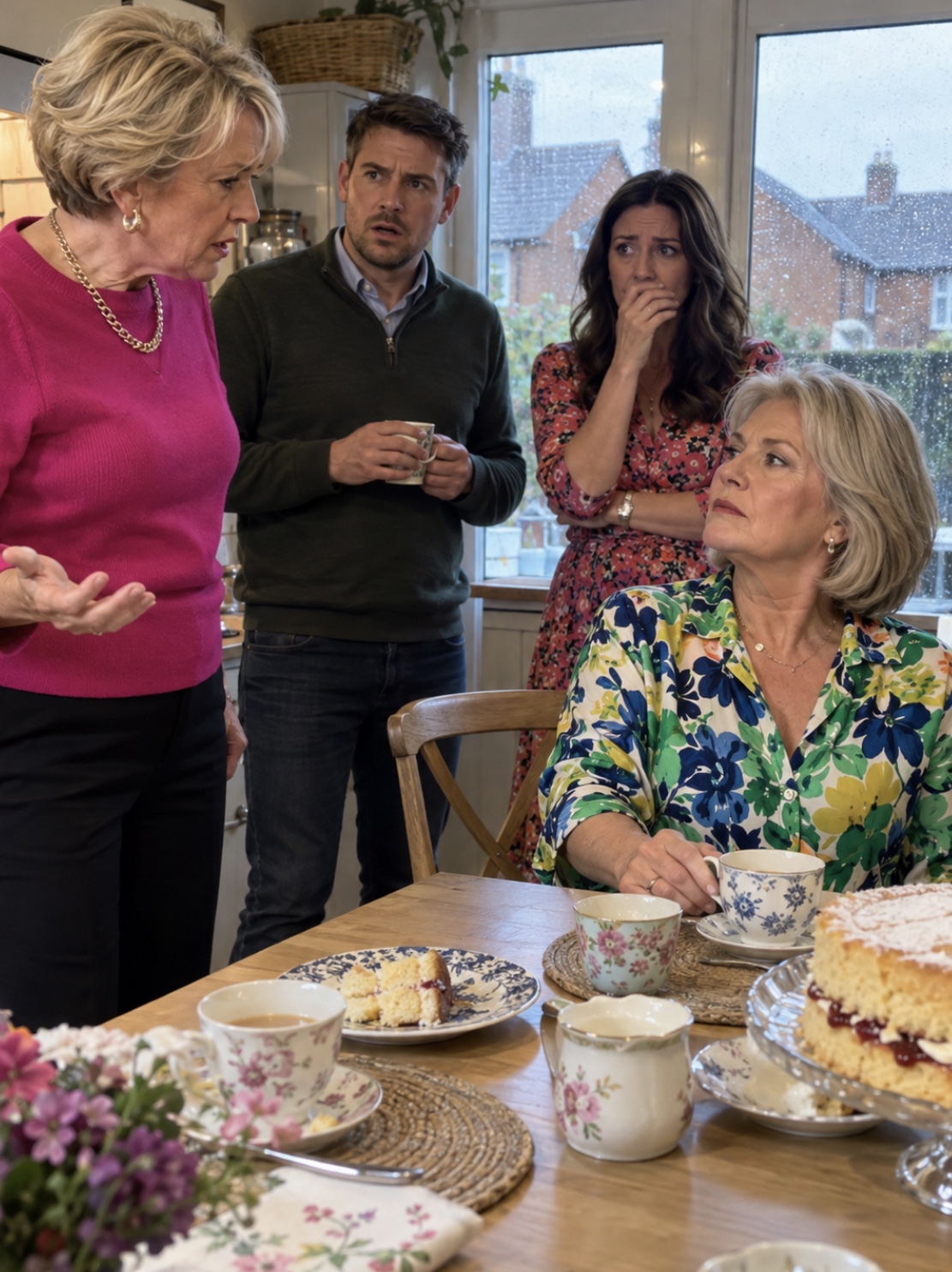
My mother-in-law, Margaret, was still standing beside the dining table with one hand pressed to the back of a chair. My mum, Susan, sat opposite her with the calm expression she used whenever someone had finally pushed her beyond politeness.
My husband, Ben, looked at me as if I had somehow arranged the whole thing.
I hadn’t.
If anything, I had spent the previous three years trying to prevent that exact moment.
It was a wet Saturday afternoon in Nottingham, the sort when everyone’s coats steam gently by the radiator and the windows turn grey before five. Ben and I had invited both our mothers for tea because our daughter, Ellie, had just started Reception and had been desperate to show them the cardboard crown she had made at school.
There was nothing dramatic planned. Sausage rolls from the bakery near Mapperley Top. A Victoria sponge. Tea. Ellie showing everyone her drawings.
Then Margaret had arrived forty minutes late carrying no umbrella, dripping rainwater over the hall floor and complaining that the parking on our street had become “ridiculous”.
Five minutes later she had criticised the cake.
Ten minutes after that she had asked my mother whether she still worked “at that little shop”.
Mum managed a local garden centre. She had done for sixteen years.
Then Margaret started on me.
It began, as it often did, with something so small that challenging it made you look oversensitive.
“You always cut cake too thick, Rachel.”
Then:
“Ellie’s fringe needs trimming.”
Then:
“Ben looks exhausted.”
And finally, when Mum gently said, “They both work full-time, Margaret. I think they’re doing rather well,” Margaret leaned back and smiled.
It was not a friendly smile.
“Oh, Susan, you’ve always been very good at defending Rachel.”
Mum blinked.
“She’s my daughter.”
“Yes. Exactly.”
I felt my stomach tighten.
Ben saw it too.
“Mum,” he said quietly.
But Margaret had already begun.
“I just think some people never teach their children how to take criticism. With a mother like that, no wonder you turned out the way you did.”
The words were directed at me, but she looked at Mum.
And Mum put her cup down.
“At least my daughter doesn’t have to apologise for me to the neighbours.”
Margaret’s face changed.
Not dramatically.
Just enough.
Ben immediately stood up.
“What does that mean?”
Mum looked at me.
That was when I realised she knew something I didn’t.
“Mum?”
She hesitated.
Margaret laughed too quickly.
“Oh, for heaven’s sake. Susan’s probably referring to some nonsense from years ago.”
“It wasn’t years ago,” Mum said.
“What wasn’t?” I asked.
Nobody answered.
Ellie appeared in the doorway holding her cardboard crown.
“Mummy, can Grandma Margaret see my picture?”
I stood up immediately.
“Of course. Come on, sweetheart. Let’s put it on the fridge.”
I took Ellie into the kitchen mostly because I needed ten seconds to think.
Behind me, I heard Ben say, “Mum, what happened with the neighbours?”
Margaret replied, “Nothing happened.”
Mum said, “That isn’t true.”
I fixed Ellie’s drawing to the fridge with a magnet shaped like a strawberry, kissed her head and asked whether she wanted to go upstairs and play with her Lego.
She looked between the adults.
“Are you cross?”
“No.”
It came out too quickly.
Children always know.
She went upstairs anyway.
When I returned, Margaret had put on her coat.
“This is absurd,” she said.
Ben blocked the hallway.
“Just tell us.”
“I have nothing to tell.”
Mum spoke from behind me.
“Then perhaps I should.”
Margaret turned.
For the first time since I had known her, she looked frightened.
Not embarrassed.
Frightened.
And that frightened me more than anything else.
Mum folded her hands on the table.
“Rachel, do you remember the older couple who used to live at number fourteen?”
I nodded.
“Mr and Mrs Patel?”
They had moved to Leicester the previous spring to be closer to their eldest daughter.
Mrs Patel had been kind to us when Ellie was born. She once left a casserole on our doorstep because she had seen me struggling with the pram in the rain.
“About six months before they moved,” Mum continued, “Mrs Patel rang me.”
“Why would she ring you?”
“Because she didn’t want to upset you.”
My throat went dry.
Mum and Mrs Patel had exchanged numbers at Ellie’s second birthday party. I had completely forgotten.
“What did Margaret do?”
Margaret reached for the door handle.
“I am leaving.”
Ben’s voice hardened.
“No, you’re not.”
She stared at him.
I had never heard him speak to her like that.
Mum took a breath.
“Mrs Patel said your mother-in-law had been telling people in the street that you and Ben were struggling financially.”
I almost laughed from confusion.
“What?”
“She said you were behind on the mortgage.”
“We’ve never missed a payment.”
“I know.”
Margaret rolled her eyes.
“Oh, honestly. It was a misunderstanding.”
Mum ignored her.
“She also told them Ben had lost his job.”
Ben’s jaw tightened.
“I’ve worked for the same engineering firm for nine years.”
“And,” Mum continued, “she told at least two neighbours that she was helping you financially every month.”
That one actually made me laugh.
Not because it was funny.
Because it was so completely backwards.
The previous winter, we had lent Margaret £1,600 when her boiler died.
She had paid back £400.
📚 Things had already gone too far to ignore — the rest of the story continues in the first comment. 👇
Ben looked at his mother.
“Why would you say that?”
Margaret gave a small shrug.
“I might have said I was helping now and again.”
“You weren’t.”
“I’m your mother. I’ve helped you all your life.”
“That isn’t what we’re talking about.”
Rain tapped against the front window.
Mum stood and began collecting cups, not because they needed collecting, but because that was what she did when she was angry.
I suddenly remembered something.
Two winters earlier, I had returned from work and found our neighbour Peter standing near his recycling bin.
He had asked, awkwardly, “Everything all right with you two?”
I had thought he meant generally.
“Yes, fine.”
He had nodded too intensely.
“Good. Good to hear.”
At the time, I assumed he was just being polite.
Now I understood.
“How many people?” I asked.
Margaret looked at the floor.
“Mum,” Ben said. “How many people did you tell?”
“Oh, I don’t know.”
“That means more than one.”
She snapped.
“I was worried about you!”
“No,” I said. “You were telling people things that weren’t true.”
She looked at me then.
“You’ve always been very sensitive about appearances.”
That sentence did something to me.
Not because it hurt.
Because it was familiar.
Margaret had a habit of causing a problem and then describing your reaction as a personality flaw.
If she criticised my parenting and I objected, I was defensive.
If she arrived without warning and I asked her to call first, I was controlling.
If she told strangers private information and I got upset, apparently I cared too much about appearances.
Mum returned from the kitchen.
“I didn’t tell Rachel because Mrs Patel asked me not to.”
I looked at her.
“Why?”
“She said Margaret had already confronted her once.”
Ben frowned.
“Confronted her how?”
Mum glanced at Margaret.
“Outside the chemist.”
Margaret laughed.
“That woman was forever exaggerating.”
“What happened?” I asked.
Mum sat down again.
“Mrs Patel asked why Margaret had told Peter that you couldn’t afford the house.”
I stared.
Our house was hardly a mansion. A three-bedroom 1930s semi with a narrow driveway and a kitchen we had saved five years to renovate.
Mum continued.
“Margaret became angry. Said Mrs Patel was interfering. Apparently there was shouting.”
“Shouting?” Ben asked.
“In the middle of Carlton Hill.”
Margaret pulled her coat tighter around herself.
“This is ridiculous.”
Mum’s voice stayed level.
“Then Margaret told Mrs Patel that Rachel had ‘married above herself’ and was constantly trying to prove something.”
I felt as if someone had opened a window behind me.
Cold moved across my shoulders.
Ben slowly turned toward his mother.
“You said that?”
Margaret said nothing.
That was answer enough.
I had heard variations of it before.
Not directly.
Little remarks.
Rachel’s family “weren’t used to certain things”.
Rachel “liked nice things”.
Rachel “had expensive taste”.
Which was interesting, considering I drove a six-year-old Ford Focus and bought most of Ellie’s clothes in supermarket sales.
Ben stepped away from the door.
“Go home.”
Margaret blinked.
“What?”
“Go home.”
“Benjamin—”
“No.”
She looked at me, expecting me to soften him.
For years, I would have.
That had been my role.
Translator. Peacekeeper. Excuse-maker.
She didn’t mean it like that.
That’s just how she is.
She worries.
She’s lonely.
She’s your mother.
But I stayed silent.
Margaret left without saying goodbye.
The front door shut hard enough to shake Ellie’s paper crown from the radiator.
For several minutes none of us spoke.
Then Ben asked Mum the question I was thinking.
“Why didn’t you tell us sooner?”
Mum looked uncomfortable.
“I nearly did.”
“When?”
“Last Christmas.”
I remembered last Christmas.
Margaret had spent most of Christmas lunch complaining that we had invited my parents for the whole day while she had to divide her time between us and Ben’s sister, Chloe.
“You should have told me.”
“I know.”
Mum rubbed her thumb along the edge of her cup.
“But Mrs Patel was embarrassed. And I thought if I told you, it would create a huge family row.”
“It has,” I said.
“Yes.”
Her expression softened.
“But perhaps it should have.”
That evening, after Mum left and Ellie was asleep, Ben and I sat in the kitchen with the remains of the cake between us.
Neither of us ate any.
Ben kept checking his phone.
“Has she messaged?”
“Eleven times.”
“Are you going to read them?”
“No.”
That was unusual.
Ben always read Margaret’s messages immediately.
He put the phone face-down.
Then he said, “There’s something else.”
I looked at him.
He rubbed both hands over his face.
“A few months ago Mum asked me how much we owed on the mortgage.”
I frowned.
“When?”
“February.”
“Why?”
“She said she was doing some retirement planning and wanted to understand where Chloe and I stood financially.”
“That doesn’t make sense.”
“I know.”
“How much did you tell her?”
“Nothing exact.”
I waited.
“Ben.”
“I said we had about twelve years left.”
I stared at him.
“Why didn’t you mention that?”
“Because it seemed boring.”
Under normal circumstances, it would have been.
Now it didn’t.
The next morning Margaret sent me a message.
Not Ben.
Me.
Rachel, I am very disappointed by yesterday. Your mother clearly enjoys stirring up trouble. I have always supported you and Benjamin and I won’t be made into some kind of villain because of gossip from an old neighbour.
I showed Ben.
He stared at the screen.
“She still hasn’t denied it.”
Exactly.
On Monday morning I was taking Ellie to school when Peter from number ten waved at me.
Usually, I would have smiled and continued walking.
Instead, I stopped.
“Peter, can I ask you something strange?”
He looked worried immediately.
That told me everything.
“Did Margaret ever talk to you about our mortgage?”
His face turned pink.
“Ah.”
“How much did she tell you?”
He put one hand in his coat pocket.
“I don’t want to get involved.”
“You already were.”
He winced.
“Fair point.”
Then he told me something Mum hadn’t known.
Margaret had not simply told neighbours we were struggling.
She had asked questions.
Had they noticed estate agents visiting?
Were we planning to sell?
Did anyone know whether houses in our street were going for more than £300,000?
At first Peter had thought she was just curious.
Then, one afternoon, she had asked whether he knew any local landlords who bought houses quickly.
My stomach dropped.
“When was this?”
“Last autumn.”
“Did she say why?”
He hesitated.
“She said you and Ben might need to downsize.”
I thanked him and walked Ellie to school feeling as though the pavement had tilted beneath me.
At home, I rang Ben.
He left work early.
By lunchtime we were going through old messages.
The strange thing was that nothing looked suspicious until we knew what we were searching for.
Margaret asking whether we had considered moving.
Margaret mentioning that bungalows near her were “much easier with children”.
Margaret sending Ben a Rightmove listing for a smaller house.
Margaret joking that our place was “too big for three people”.
Then Ben remembered something.
“My pension folder.”
“What?”
“Mum borrowed my printer last year.”
“So?”
“My pension statement was in the drawer under it.”
I stared at him.
“You think she went through your documents?”
“I don’t know.”
We both knew he did.
Three days later, Ben drove to Margaret’s flat.
I didn’t go.
He was there nearly two hours.
When he returned, he looked sick.
He placed a folded piece of paper on the kitchen counter.
“What is that?”
“A valuation.”
I unfolded it.
Our address was at the top.
An approximate market estimate.
£335,000–£350,000.
Prepared by a local estate agent.
I stared at the date.
Eight months earlier.
“How did she get this?”
“She requested an informal valuation online.”
“For our house?”
“Yes.”
“Why?”
Ben sat down.
The explanation was not what I expected.
Margaret had been trying to persuade Chloe to leave her husband.
Chloe’s marriage had been difficult for years. Constant arguments, debts, brief separations.
Margaret had decided that the solution was for Chloe to buy a flat near her.
But Chloe had almost no savings.
Margaret did.
Just not enough.
So she had developed a plan in her head.
Ben and I would sell our house.
We would buy somewhere cheaper.
And because our mortgage balance was relatively low, we would have enough equity left over to “help Chloe start again”.
I actually laughed.
“She planned to redistribute money from our house?”
Ben looked miserable.
“She says she never planned anything. She says she was only exploring options.”
“Options involving our property.”
“Yes.”
“Without us knowing.”
“Yes.”
I paced the kitchen.
“And the stories about us being broke?”
He looked at the floor.
“She said…”
“What?”
“She said she thought people would judge us less if we eventually downsized.”
For several seconds I couldn’t even speak.
Then I understood.
She had been building a story before anything had happened.
If we sold, the neighbourhood would already believe we had financial problems.
No one would question why.
And Margaret could present whatever came next as family sacrifice rather than interference.
That was the part that chilled me.
Not the money.
The preparation.
The quiet rearranging of other people’s understanding.
That evening Chloe rang me.
I expected anger.
Instead, she was crying.
“Rachel, I didn’t know.”
“I know.”
“She told me Ben had offered.”
My hand tightened around the phone.
“What?”
“She said he’d told her if I ever left Mark, you two would help with a deposit.”
Ben was standing beside me.
I put the phone on speaker.
He went pale.
“I never said that.”
“I know that now,” Chloe said. “But she made it sound completely settled.”
Silence.
Then Chloe added, “There’s something else.”
Of course there was.
“Mum gave me a folder in January. Property listings. Mortgage calculations. Stuff like that.”
Ben closed his eyes.
“One page had Rachel and Ben at the top.”
My skin prickled.
“What was on it?”
“Numbers. Your house value. What she thought you owed. And underneath… an amount.”
“How much?”
“£62,000.”
I sat down.
Margaret had calculated that if we sold and bought something cheaper, £62,000 might be available.
Not to us.
To Chloe.
The following Sunday, Margaret came to our house.
This time she rang first.
Ben had asked her to bring the folder.
She arrived holding it against her chest.
Mum was there too.
So was Chloe.
No one had planned a dramatic family confrontation. Ben had simply decided there would be no more private versions of events.
Margaret sat in the same chair she had occupied the previous Saturday.
She looked smaller.
Ben placed the folder on the table.
“I want to understand one thing.”
Margaret folded her arms.
“I have already apologised.”
“No. You said you were sorry everyone misunderstood.”
“That is an apology.”
“It isn’t.”
She looked at me.
“Rachel?”
I shook my head.
“Don’t ask me to rescue this conversation.”
Her face tightened.
Chloe opened the folder.
Inside were listings, handwritten calculations, mortgage estimates, and notes about schools and commuting times.
Then she pulled out the final sheet.
There it was.
Our names.
Our house.
Numbers.
At the bottom, written in Margaret’s handwriting:
Chloe deposit — approx. 60k possible if B & R sensible.
Mum read it twice.
Then she looked at Margaret.
“Do you understand why this is frightening?”
Margaret’s eyes filled with tears.
“I was trying to keep my children safe.”
Chloe spoke first.
“By taking from one of us to fix the other?”
“I wasn’t taking anything.”
“You decided what Ben should do with his home.”
“I only thought—”
“That’s the problem,” Ben said quietly. “You thought it was yours to decide.”
Margaret started crying then.
Real crying.
Not theatrical.
And for the first time, I saw something beneath the arrogance.
Fear.
She had watched Chloe’s marriage deteriorate and had become obsessed with solving it.
Then obsession had turned into entitlement.
She had convinced herself that because the goal was helping her daughter, every step toward it was justified.
The questions.
The lies.
The valuation.
The rumours.
“I didn’t know how else to help her,” she whispered.
Chloe reached across the table.
But not to comfort her.
She took the folder.
“You could have asked me what I wanted.”
Margaret stared at her.
Chloe continued.
“And you could have asked Ben.”
Mum stood.
She gathered the empty cups again.
Then Margaret looked at her.
“I suppose you’re pleased.”
Mum stopped.
“No.”
“You clearly dislike me.”
Mum considered this.
“I dislike what you did.”
Margaret gave a bitter laugh.
“There’s a difference?”
“Yes.”
Mum carried the cups to the kitchen, then turned back.
“People can survive being disliked, Margaret. It’s being controlled that ruins families.”
Nobody spoke after that.
Margaret left quietly.
For almost two months, we barely saw her.
Ben spoke to her by phone once a week. Chloe stopped discussing her marriage with her. We changed nothing about our house because there had never been anything to change.
Then, in early May, Mrs Patel came back to Nottingham for a hospital appointment and knocked on our door.
She brought a tin of homemade barfi.
She also apologised.
“I should have told you myself.”
I told her it wasn’t her responsibility.
She smiled.
“Your mother said the same thing.”
Before leaving, she hesitated.
“Margaret came to see us in Leicester.”
I stared.
“When?”
“Last month.”
My first thought was panic.
“What did she want?”
“To apologise.”
I waited for the catch.
There wasn’t one.
Mrs Patel said Margaret had sat in their front room, drunk tea and admitted that she had lied.
Not exaggerated.
Not misunderstood.
Lied.
She had also visited Peter and two other neighbours.
She told each of them the same thing.
Rachel and Ben were never in financial trouble. I said things that were not true because I was trying to justify something I had no right to plan.
When I told Ben that evening, he sat silently for a long time.
Then he said, “That must have been hard for her.”
“It should have been.”
He smiled slightly.
“Fair.”
Things did not return to normal after that.
They became something better.
Margaret stopped arriving without calling.
She stopped asking about money.
When Chloe finally separated from Mark later that year, Margaret did not organise her life.
She helped her find a solicitor.
That was all.
Chloe rented a small flat in West Bridgford with her own deposit and a loan from nobody.
One afternoon the following Christmas, both our mothers were in the kitchen making tea.
I heard Margaret say quietly, “Susan, about what I said last year…”
Mum interrupted.
“I remember.”
“I’m sorry.”
Mum handed her the milk.
“All right.”
“That’s it?”
“What were you expecting?”
“I don’t know.”
Mum smiled.
“Perhaps another argument.”
Margaret almost smiled back.
“Possibly.”
Then Mum said, “I meant what I said, you know.”
I froze in the hallway.
Margaret raised an eyebrow.
“Which part?”
“That Rachel shouldn’t have to apologise for her family.”
Margaret looked toward the living room where Ben was helping Ellie build a wooden train set.
“No,” she said quietly. “She shouldn’t.”
Then she added something I never expected.
“Neither should Ben.”
Mum nodded.
And that was the end of it.
Not forgiveness wrapped in a bow.
Not a miraculous friendship.
Just two women standing beside a kettle in a Nottingham kitchen, finally speaking without anyone else having to manage the truth between them.