



The first time my mother-in-law called me a freeloader, she was standing in my kitchen, eating a slice of the lemon drizzle cake I had baked that morning and complaining that I had bought the “wrong” kind of tea.
That should have told me everything.
Instead, I smiled, put the kettle back on, and said, “There’s Yorkshire Gold in the cupboard if you prefer.”
She didn’t even look embarrassed.
“Oh, I know,” Margaret said, opening the cupboard herself. “James always liked proper tea. Before all this fancy herbal nonsense.”
“All this fancy herbal nonsense” was one unopened box of peppermint tea my colleague had given me when I had a cold.
James caught my eye over his mother’s shoulder and gave me the tired little smile he used whenever she was being difficult.
Ignore it, the smile said.
For three years, I did.
We lived in a two-bedroom flat in Bristol, on the second floor of a converted Victorian house near Redland. It wasn’t enormous, but it had high ceilings, sash windows, creaky floorboards and a narrow balcony where I grew rosemary, basil and three stubborn tomato plants.
Margaret had never liked it.
Not because the flat was unpleasant.
Because she couldn’t understand why her son didn’t have more control over it.
Whenever she visited, she referred to it as “your place” when speaking to James and “the flat” when speaking to me.
At first, I thought I was imagining it.
Then came the comments.
“You’re lucky James is so easy-going.”
“It must be nice not having to worry about property.”
“James has always been generous.”
Once, while helping me clear the table after Sunday lunch, she asked casually, “And what exactly did you bring into the marriage?”
I laughed because I assumed it was a joke.
She didn’t.
“Emotionally?” I asked.
“Financially.”
I stared at her.
Margaret rinsed a plate as if she had asked whether I preferred still or sparkling water.
“I don’t think that’s any of your business.”
“Well.” She placed the plate in the rack. “Touchy.”
James told me later that she was “old-fashioned.”
I told him nosiness wasn’t a historical period.
He laughed.
Margaret didn’t.
The situation became worse after James’s younger sister, Sophie, split from her boyfriend and moved back into Margaret’s semi-detached house in Keynsham with her six-year-old son.
Suddenly, every conversation revolved around housing.
Mortgages.
Deposits.
Interest rates.
School catchment areas.
Sophie couldn’t afford to buy alone, which was understandable. Bristol prices were brutal, and she worked four days a week at a dental practice.
I felt sorry for her.
What I didn’t realise was that Margaret had already decided James was responsible for solving the problem.
One Sunday in October, she arrived carrying a Waitrose bag and a folder.
That folder should have frightened me more than it did.
She placed it on our dining table before taking off her coat.
“I’ve been thinking,” she said.
James groaned softly.
“Mum.”
“What? Someone has to think ahead.”
She took out property listings.
Two-bedroom houses in Longwell Green.
A small terrace in Fishponds.
A maisonette near Hanham.
All around £280,000 to £320,000.
“Sophie could manage the monthly payments,” Margaret explained, “if she had a larger deposit.”
James poured himself wine.
“How large?”
“About sixty thousand.”
He nearly choked.
“Mum, I don’t have sixty grand.”
Margaret gave me a quick look.
Not us.
Me.
Then she smiled.
“Well, obviously I’m not saying you should produce it tomorrow.”
“Good.”
“But there are assets.”
The room went quiet.
“What assets?” I asked.
Margaret tapped the folder.
“Property.”
I laughed once.
Not because it was funny.
Because my brain needed a second to catch up.
“You mean your house?”
“My house is my security.”
“Then whose property are you talking about?”
Margaret looked towards the window as though the answer were too obvious to deserve saying aloud.
Our flat.
James put his glass down.
“No.”
“I haven’t even finished.”
“You don’t need to.”
“It could be remortgaged.”
“No.”
“You haven’t looked at the figures.”
“It’s not happening.”
Margaret’s mouth tightened.
Then she turned to me.
“You could at least hear the idea.”
“Why me?”
“Well, because obviously any borrowing would affect both of you.”
That sentence stayed with me.
Obviously.
I didn’t correct her.
Not yet.
Instead, I asked, “And if we remortgaged our home to give Sophie sixty thousand pounds, how exactly would she repay us?”
Margaret’s expression changed.
“Oh, don’t make this transactional.”
“Borrowing against a property is literally a transaction.”
“Sophie is family.”
“So?”
“So family helps family.”
James rubbed his forehead.
“Mum, enough.”
Margaret gathered her papers with theatrical disappointment.
“I just hope neither of you ever needs anything.”
I almost said, “From whom?”
But I didn’t.
That evening, James apologised.
He admitted his mother had been pushing him about Sophie for weeks.
“What did you tell her?” I asked.
“That we couldn’t afford it.”
I looked at him.
“That isn’t the reason.”
“What?”
“The reason isn’t that we can’t afford it. The reason is that I’m not taking debt against my home to buy your sister one.”
He shifted uncomfortably.
“I know.”
“Do you?”
“Of course.”
I believed him.
That was my first mistake.
Three weeks later, I came home early from work because our office internet had gone down.
I’m a project manager for a small architectural consultancy near Temple Meads, and although I often worked from home, Wednesdays were usually office days.
That Wednesday, I unlocked the front door at half past two and heard voices in the sitting room.
One was Margaret’s.
The other belonged to a man I had never met.
I stopped in the hallway.
“…original fireplaces are always attractive,” he was saying.
Margaret replied, “And I imagine with the location—”
I walked into the room.
A man in a navy coat stood beside our fireplace holding a laser measuring device.
Margaret was near the window.
For perhaps three seconds, nobody spoke.
Then I said, “What exactly is happening?”
Margaret recovered first.
“Oh. You’re home.”
“Yes.”
The man looked uncomfortable.
“Mrs Carter?”
“No.”
He glanced at Margaret.
I folded my arms.
“Who are you?”
He gave me his name, Daniel Reeves, and said he was from a local valuation company.
My stomach turned cold.
“A valuation for what?”
Margaret stepped in quickly.
“It’s nothing official.”
Daniel looked from her to me.
“I was told the owners were considering refinancing.”
“The owners?”
I looked at Margaret.
She wouldn’t meet my eyes.
I asked Daniel to leave.
To his credit, he did immediately.
When the door closed behind him, I turned to Margaret.
“How did you get into my flat?”
She looked offended.
“James gave me a spare key years ago.”
“James didn’t own this flat years ago.”
There it was.
The first crack.
Small.
Almost invisible.
But enough.
Margaret’s face changed.
“What do you mean?”
I took a slow breath.
“You should go.”
“I am not leaving until you explain what you just said.”
“No. You are leaving because you brought a stranger into my home without permission.”
“Our home.”
“No.”
The word came out sharper than I expected.
Margaret stared at me.
Then she grabbed her handbag.
“This is exactly what I warned James about.”
“What?”
“You.”
📌 Want to know why that one word changed everything? Keep reading — the truth was far stranger than Margaret expected. 👇
She left.
I called James before she had reached the pavement.
He picked up after the fourth ring.
“Hey.”
“Did you give your mother permission to bring a valuer into the flat?”
Silence.
That silence told me more than any answer could.
“James.”
“She said she just wanted an idea of what it might be worth.”
I sat down.
“You knew.”
“I didn’t think she would actually arrange someone.”
“You gave her permission?”
“I said if she wanted to look into numbers, fine.”
“Numbers.”
“Emma, please.”
I closed my eyes.
“How did she get a key?”
Another pause.
“I gave her one when we went to Cornwall last year.”
“And you never asked for it back.”
“No.”
“Did you know she intended to use my flat as security for Sophie?”
“Our flat.”
“No, James.”
He went quiet.
I had waited nearly four years to say those words.
Not because I was hiding something sinister.
Not because I wanted power over my husband.
Because I had hoped it would never matter.
“It isn’t our flat.”
“What?”
“The flat belongs to me.”
He laughed.
Actually laughed.
A short, confused sound.
“What are you talking about?”
“I bought it before I met you.”
“No, you didn’t.”
“Yes.”
“You told me you were renting when we met.”
“I was renting out one room to Claire. You assumed I was renting the whole place. I corrected you later.”
“No, you didn’t.”
“I did. Twice.”
I remembered both conversations perfectly.
Once over dinner in Bath, when we had been dating for six months.
Once while completing paperwork before our wedding.
James had barely reacted either time.
Apparently, he had heard what he wanted to hear.
“Emma, I’ve been paying towards the mortgage for years.”
“No. You’ve been transferring money into our joint account for household expenses.”
“That includes the mortgage.”
“No. I paid off the mortgage eighteen months before we got married.”
Silence.
A deeper one this time.
“You’re saying this place is mortgage-free?”
“Yes.”
“And entirely yours?”
“Yes.”
He swore quietly.
Then, after a pause, said something that changed the shape of our marriage.
“Why didn’t you make that clearer?”
I almost laughed.
“Clearer to whom?”
“To me.”
“I told you.”
“You must have known I didn’t understand.”
“How exactly would I know that?”
“Because we always called it our home.”
“Our home, yes. That doesn’t automatically mean joint legal ownership.”
“That’s deceptive.”
I stood up.
“No. Deceptive is allowing your mother to arrange a financial valuation of property you apparently never bothered to check whether you owned.”
He hung up.
For the rest of the afternoon, I worked at the dining table without absorbing a single email.
At six twenty, James came home.
Margaret came with him.
Of course she did.
She walked through the door first.
Her face was flushed.
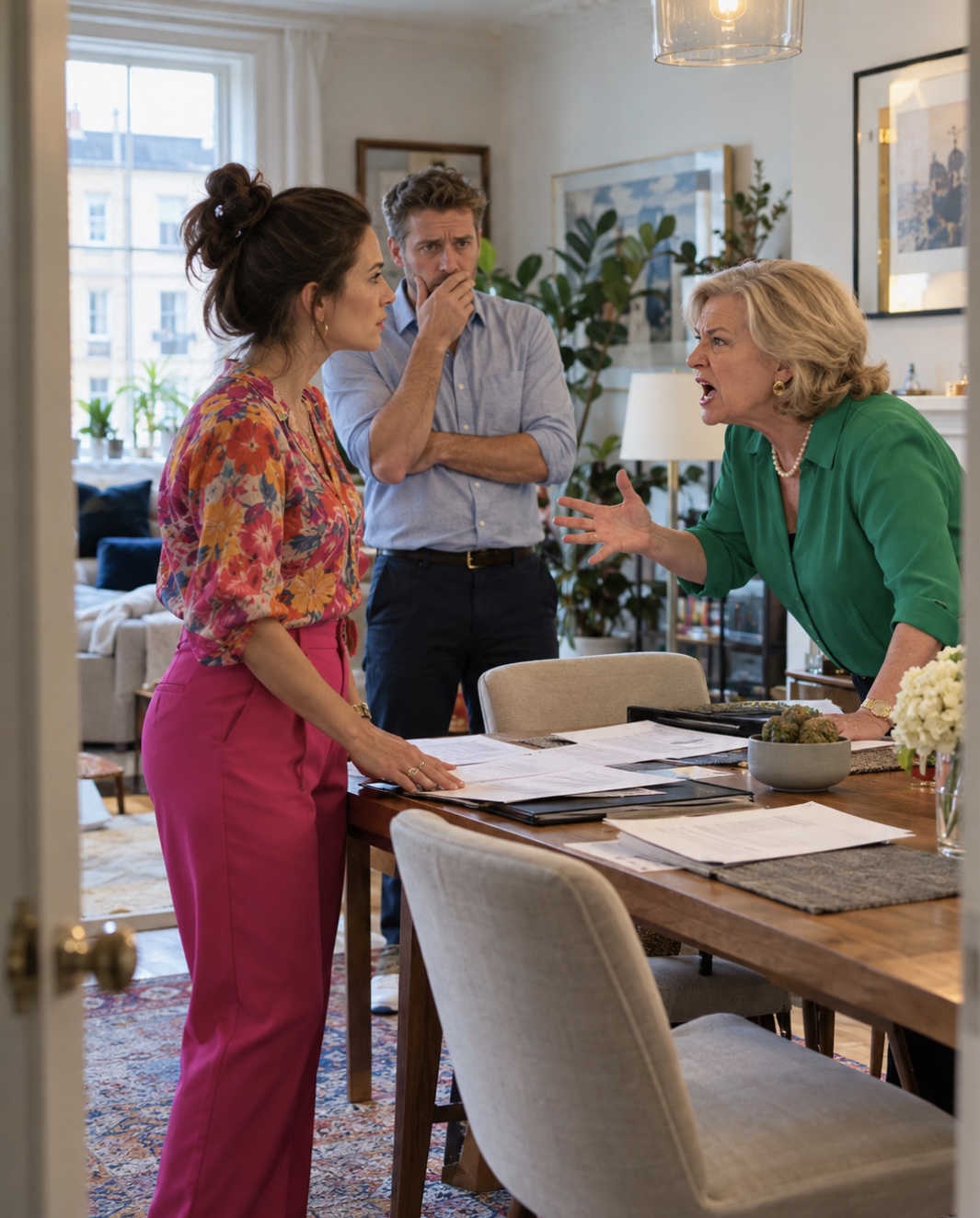
“Show me.”
I stared at her.
“Excuse me?”
“The documents.”
James shut the door behind them.
“Emma, Mum thinks there’s been some misunderstanding.”
“No misunderstanding.”
Margaret dropped her handbag onto a chair.
“You expect me to believe you secretly own a flat worth nearly half a million pounds?”
“It isn’t secret.”
“You married my son and didn’t put his name on it?”
I felt something inside me finally settle.
For years, Margaret had made comments because she believed I had entered her family with less than James.
Less money.
Less status.
Less entitlement.
Now, in less than one afternoon, she had discovered the opposite.
And somehow that offended her even more.
I walked into the small study and opened the locked drawer where I kept important paperwork.
Land Registry title.
Purchase completion documents.
Old mortgage discharge letter.
I returned to the dining table and placed them in front of her.
Margaret pulled the title register towards herself.
James stood behind her, reading over her shoulder.
His face went pale.
Owner: Emma Louise Bennett.
Purchase date: May 2015.
Three years before I met him.
Margaret read the page twice.
Then she looked up.
“So you’ve been sitting on this asset all these years.”
I blinked.
“Sitting on it?”
“While Sophie struggles.”
I almost admired the speed at which she rearranged reality.
James said, “Mum, stop.”
But she was gathering momentum now.
“You came into this family with nothing!”
She actually shouted it.
In my flat.
Standing over documents proving the opposite.
“You never contributed to the family. James supported you. We welcomed you. We treated you like one of us.”
I put both hands flat on the table.
Then I said, very calmly, “I came into this family with a home, savings and no debt.”
Margaret opened her mouth.
I slid the paperwork closer to her.
“And you, I see, arrived with your mouth already open.”
James made a strange choking sound.
Margaret went rigid.
“You insolent—”
“No. You came here because you believed you had discovered money you could allocate. You entered my home without permission, brought a valuer here and started making plans involving property that belongs to me.”
“For Sophie!”
“That doesn’t change anything.”
“She has a child.”
“Yes.”
“And you have no children.”
There it was.
Even James flinched.
Margaret realised too late how cruel it sounded.
She knew we had been trying.
She knew about the miscarriage I’d had the previous winter.
The room changed instantly.
James stepped forward.
“Mum.”
But I raised my hand.
“No. Let her finish.”
Margaret’s face lost some of its colour.
“I didn’t mean—”
“Yes, you did.”
“I meant your circumstances are different.”
“My circumstances are none of your business.”
James told her she should leave.
This time, she did.
After the door closed, he sat at the table.
“I’m sorry.”
I remained standing.
“For which part?”
“All of it.”
“That’s too vague.”
He looked exhausted.
“I should never have let her get involved.”
“You didn’t let her get involved. You involved her.”
He looked down.
That difference mattered.
For the first time, James told me the whole story.
Margaret had been pressuring him for nearly two months.
Not only about Sophie.
About money generally.
She believed James was “behind” compared with his cousins.
One cousin had bought a detached house.
Another owned two rental properties.
Margaret was embarrassed that her forty-year-old son was, as she saw it, “still paying for someone else’s flat.”
James had never corrected her.
Because he hadn’t understood the ownership arrangement himself.
And because, he admitted, he had enjoyed letting her believe he owned more than he did.
That confession hurt almost more than the valuation.
“You let her think you owned my property?”
“I never said that.”
“You never corrected her.”
“No.”
“Why?”
He stared at the floor.
“Pride.”
At least that answer was real.
We barely spoke for two days.
Then, on Friday evening, Sophie rang me.
I expected anger.
Instead, she said, “I’m so sorry.”
I sat on the edge of the bed.
“For what?”
“Mum.”
“She told you?”
“She told everyone.”
Of course she had.
According to Margaret, I had humiliated her, hidden assets from James and refused to help a struggling single mother.
Sophie sounded mortified.
“I never asked James for money.”
I frowned.
“What?”
“I didn’t ask him.”
I felt cold again.
“Mum told me she was going to lend me some savings.”
“How much?”
“Twenty thousand. Maybe twenty-five.”
Not sixty.
Never sixty.
Sophie continued.
“I told her I wasn’t even sure I wanted to buy yet. My landlord offered me another two-year tenancy, and Oliver’s settled at school.”
“Then where did sixty thousand come from?”
“I have no idea.”
After we hung up, I called James into the bedroom.
He listened while I explained.
His expression shifted from confusion to alarm.
That weekend, he went to see Margaret alone.
He returned three hours later carrying the folder she had brought to our flat.
Inside were property listings, mortgage calculations and handwritten notes.
And one printout that explained everything.
It was not for Sophie.
It was a brochure for a new-build retirement apartment outside Bath.
Price: £365,000.
Margaret’s house had been valued at around £310,000.
She had been planning to sell it, buy the apartment and use money supposedly “raised for Sophie” to cover the difference and moving costs.
Sophie’s name was the emotional lever.
Our flat was the imagined funding source.
James looked sick.
“She said she thought it would all work out eventually.”
I stared at him.
“What does that even mean?”
“She thought we could release equity, Sophie could get something, and Mum could downsize.”
“With our debt.”
“Yes.”
“And she never intended to repay us?”
He shook his head.
“She kept calling it family money.”
I laughed bitterly.
“Interesting how family money always belongs to someone else first.”
Margaret didn’t speak to me for six weeks.
Christmas came close enough that James asked whether we should invite her.
I said yes.
Not because I had forgiven her.
Because I wanted to know whether she could behave differently.
She arrived at noon carrying a poinsettia and a bottle of prosecco.
For once, she didn’t rearrange anything in my kitchen.
She didn’t comment on the food.
She didn’t ask about money.
After lunch, while James and Sophie took Oliver to the park, Margaret stayed behind.
She stood by the window for a while.
Then said, “I was jealous of you.”
I hadn’t expected that.
“Why?”
She gave a small, embarrassed shrug.
“You had security at your age that I never had.”
Margaret had divorced James’s father in her early forties.
For years, she had raised two children while working as a school administrator.
Her house had been bought after the divorce with a mortgage she struggled to maintain.
“I suppose,” she said, “I had built a story in my head where James rescued you.”
I almost smiled.
“And when you discovered he hadn’t?”
“I felt foolish.”
“So you blamed me.”
“Yes.”
It was the first clean apology she had ever given me.
No excuses.
No “if you were offended.”
No “we both said things.”
Just yes.
She reached into her handbag.
For one terrifying second I thought she had brought another property brochure.
Instead, she put a key on the table.
The spare key to our flat.
“I should have returned this before you had to ask.”
I picked it up.
“Thank you.”
She hesitated.
Then said, “For what it’s worth, I’ve decided not to move.”
“What changed?”
“Sophie told me that if I used her as an excuse for another financial scheme, she’d put me in a retirement home herself.”
I laughed.
Margaret laughed too.
It didn’t repair everything.
Real life rarely repairs itself that neatly.
James and I started seeing a couples counsellor in January.
Not because of the property itself, but because of everything underneath it: assumptions, pride, boundaries and how often silence had been mistaken for agreement.
We also had a solicitor draw up a clear declaration concerning household contributions and future finances.
Nobody found it romantic.
That was fine.
Romance is useful.
Clarity is better.
Six months later, Sophie renewed her tenancy and started saving independently for a deposit.
Margaret apologised to her too.
And one Saturday morning in early summer, while we were drinking coffee on the balcony, James looked at the tomato plants and said, “Do you know what’s strange?”
“What?”
“I spent years thinking Mum was protecting me from people taking advantage of me.”
I waited.
He smiled without humour.
“She nearly convinced me to take advantage of you.”
That sentence stayed with me.
Because in the end, the apartment documents were never really the most important thing on that table.
They didn’t prove that I was richer than Margaret thought.
They didn’t prove that I had “won.”
They proved how dangerous assumptions become when nobody challenges them.
Margaret had assumed I arrived empty-handed.
James had assumed shared life meant shared ownership.
And I had assumed that keeping the peace was the same as having boundaries.
None of us had been entirely right.
The flat is still mine.
Our home is still ours.
And Margaret now rings the doorbell every single time she visits.
Even when she knows perfectly well we’re expecting her.