



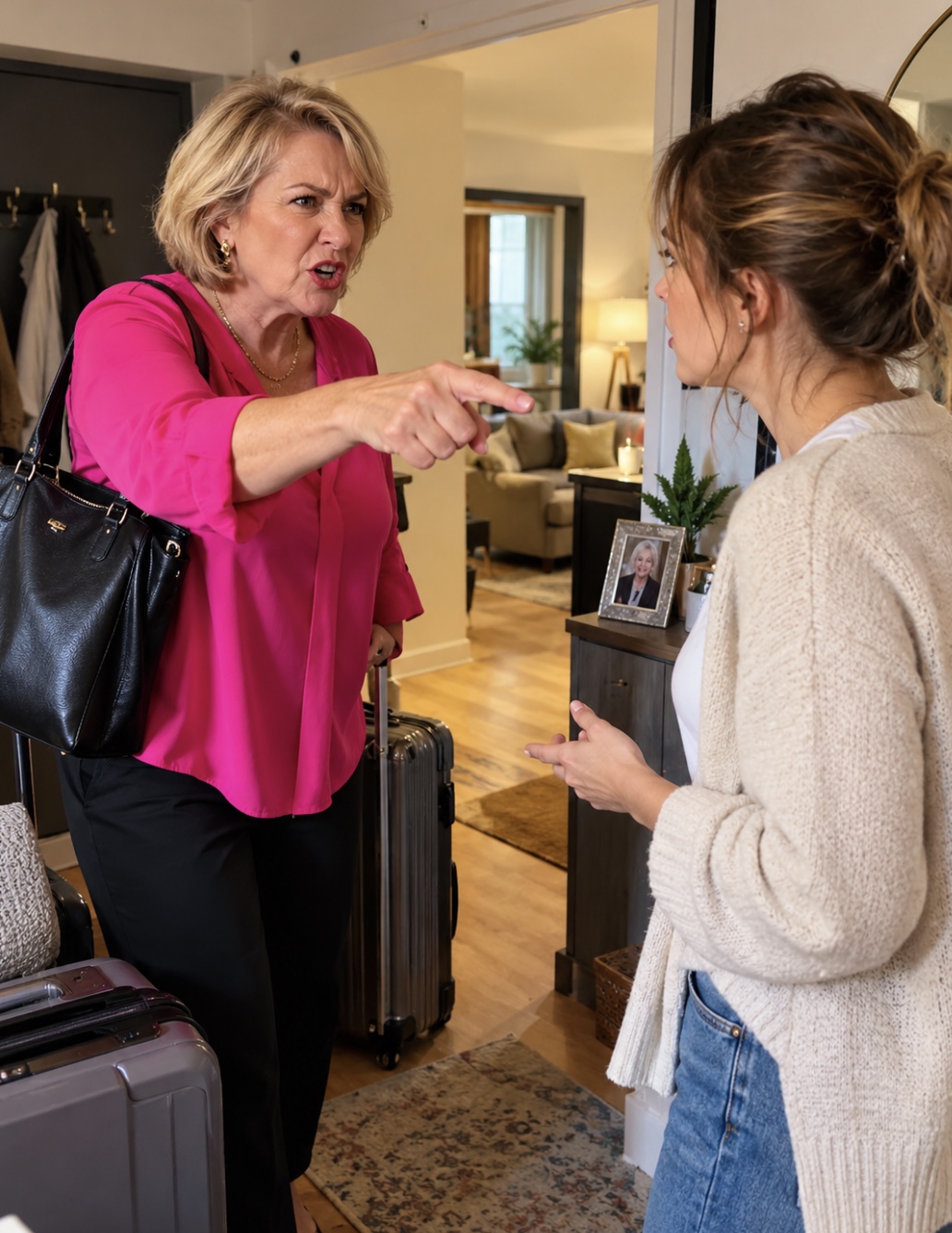
The first thing my mother-in-law did after letting herself into my apartment was move the photograph of my mother.
Not throw it away. Not break it.
She simply picked up the silver frame from the bookshelf, carried it into the hallway, and placed it face down on the little bench beside the shoe rack.
“That looks better,” she said.
I was standing in the kitchen with a tea towel in my hand, staring at her.
“Put it back, Diane.”
She didn’t even turn around.
Instead, she opened the coat closet and began shifting my jackets from one side to the other as though she were checking into a hotel.
“You have too much stuff,” she said. “No wonder Daniel can never find anything.”
That was when I realized she hadn’t come for coffee.
My name is Rachel Bennett. I was thirty-six, worked as a physiotherapist at a private rehabilitation clinic in Bristol, and had been married to Diane’s son, Daniel, for seven years.
The apartment she was rearranging had been mine for almost eleven.
I bought it at thirty, before Daniel and I had even met.
It was a two-bedroom flat in a converted Victorian building in Redland, with tall sash windows, slightly uneven floorboards, a narrow balcony overlooking a row of gardens, and one persistent patch of damp beside the kitchen window that no contractor had ever completely defeated.
It wasn’t enormous.
But it was mine.
Daniel moved in two years after we started dating. We married three years later.
We had always treated the flat as our home, even though the legal ownership had never changed.
That distinction had never seemed important.
Until Diane arrived that Thursday afternoon with two suitcases.
I looked at them.
Then at her.
“What are those?”
She gave me the kind of smile people use when they believe the conversation has already been decided.
“My boiler’s gone.”
“For how long?”
“The engineer says possibly a week.”
“And?”
“And Daniel told me I could stay here.”
I folded the tea towel slowly.
“When did Daniel tell you that?”
“This morning.”
That was interesting, because Daniel had left for Manchester before seven and had texted me from the train at 8:12 saying, Mum’s in one of her moods. Don’t answer if she rings.
Apparently, at some point between warning me not to answer her calls and arriving in Manchester, he had also invited her to live with us.
“Did he actually say you could stay here?” I asked.
Diane sighed dramatically.
“Rachel, I’m not standing on the pavement discussing semantics. I’m already here.”
She wheeled the larger suitcase toward the spare bedroom.
I stepped in front of the doorway.
“No.”
She stopped.
For the first time, her expression changed.
Not much.
Just enough.
“What do you mean, no?”
“I mean you can’t move in because Daniel hasn’t asked me and neither have you.”
“It’s for a few days.”
“Then you should have called.”
“You never answer properly when I call.”
“I answer when I’m free.”
“You answer when it suits you.”
“Yes,” I said. “That is generally how phones work.”
Her mouth tightened.
Diane had never liked me, although for years she had disguised it as concern.
Concern that I worked too much.
Concern that Daniel cooked dinner “too often.”
Concern that we still had no children.
Concern that my surname remained Bennett after the wedding.
Concern that the apartment was “a little feminine.”
Concern that Daniel contributed toward bills in a property he did not technically own.
That last one had become her favourite subject.
At Christmas, she had asked across the dinner table whether Daniel was “building equity in anything at all.”
In March, she had suggested I add him to the deeds “for security.”
In May, she had sent him the phone number of a solicitor without telling me.
Daniel had always rolled his eyes.
“Leave it,” he would say. “She likes interfering.”
So I left it.
That was my mistake.
Diane pushed one suitcase against the wall.
“I’m not asking permission to stay with my own son.”
“You’re not staying with your son. You’re staying in my flat.”
She laughed.
Actually laughed.
Then she looked straight at me and said, very calmly:
“You really do have an inflated idea of your importance here.”
I felt something cold move through my chest.
“What exactly is that supposed to mean?”
She stepped closer.
“This is Daniel’s home.”
“It’s our home.”
“No. It’s his home. You just happened to buy it first.”
I stared at her.
Diane’s eyes were bright now, almost excited.
As though she had been waiting years to say what came next.
“You’re nobody here, Rachel.”
The room went completely still.
Even the traffic outside seemed to disappear for a second.
Then my phone buzzed on the kitchen counter.
I glanced at it.
A message.
Not from Daniel.
From Martin Shaw.
I read it once.
Then again.
Diane noticed.
“Who is it?”
I locked the screen.
“No one.”
That made her smile.
“Exactly.”
📚 What happened next changed the whole conversation — keep reading in the first comment 👇
I picked up my mother’s photograph from the hallway bench, wiped an invisible mark from the glass, and put it back exactly where it had been.
Diane watched me.
“I wouldn’t get too comfortable,” she said.
I turned.
“What does that mean?”
She opened her handbag and removed a folded piece of paper.
For one ridiculous moment, I thought it might be something from the boiler engineer.
Instead, she placed it on the dining table and slid it toward me.
It was a photocopy of a letter.
A property valuation.
My property valuation.
The address was mine.
The estimate was dated twelve days earlier.
I looked up.
“Where did you get this?”
“Daniel.”
My stomach dropped.
The valuation put the flat at £465,000.
I had paid £278,000 for it years before.
There was about £96,000 left on the mortgage.
I looked again at the letter.
The company name was familiar.
I had seen it on a card in our kitchen two weeks earlier.
Daniel had told me someone in the building was thinking of selling.
“Why does Daniel have a valuation of my flat?”
Diane sat down.
That frightened me more than if she had shouted.
“Because he’s finally being practical.”
“About what?”
“About your future.”
“My future?”
“Both of yours.”
I said nothing.
Diane leaned back in the chair.
“The flat has increased enormously in value. You don’t need two bedrooms. You’ve said yourself you might want somewhere bigger one day.”
“What does that have to do with you arriving with suitcases?”
She smiled.
“Everything, really.”
Then she told me.
Or at least, she told me the version she believed.
Daniel, she said, had been discussing selling the flat.
Selling my flat.
He wanted to use part of the equity as a deposit on a house in Clifton.
A family home.
Something “proper.”
And because Diane’s own house in Keynsham needed substantial repairs, Daniel had apparently suggested that after the sale, she might temporarily move into the new place.
“Temporarily,” I repeated.
“For six months. Perhaps less.”
“Daniel told you this?”
“Yes.”
“When?”
“We’ve been discussing it for weeks.”
My face must have changed, because she suddenly looked triumphant.
“You didn’t know.”
“No.”
“Well. Perhaps Daniel understood you’d make everything difficult.”
I walked toward the window.
Below us, a woman in running clothes was trying to persuade a spaniel to move away from a hedge.
Normal life.
Completely normal.
Behind me, Diane continued speaking.
She talked about estate agents, market timing, interest rates, the possibility of renovating before listing.
I barely heard her.
Because the message on my phone had not come from some random person.
Martin Shaw was Daniel’s godfather.
He was also a retired solicitor.
And three days earlier, he had called me unexpectedly.
“Rachel,” he had said, “I need to ask you a slightly strange question. Have you signed anything recently relating to the flat?”
“No.”
“Has Daniel asked you to?”
“No.”
There had been a pause.
Then Martin had said, “Right. I think we should speak in person.”
I had assumed Daniel was considering refinancing.
Maybe surprising me with some financial plan.
Maybe nothing serious.
Martin had asked to come by Thursday afternoon.
I had completely forgotten until his message arrived.
Outside now. Shall I come up?
I typed:
Please do.
Diane was still talking.
“Once the property is sold, of course you’ll have to be sensible about how the money is divided.”
I turned around.
“Divided?”
“Well, Daniel has lived here for years.”
“And?”
“And contributed.”
“To bills.”
“And improvements.”
“He paid half for the dishwasher.”
Diane rolled her eyes.
“Don’t be childish.”
I laughed then.
I couldn’t help it.
“Diane, are you actually sitting in my apartment telling me how the proceeds from selling it should be divided?”
“I’m saying marriage is a partnership.”
“Except when you call me nobody.”
“That’s not what I meant.”
“It’s exactly what you meant.”
The intercom buzzed.
Diane looked toward the hallway.
“Who’s that?”
I pressed the button.
“Come up.”
A minute later, there was a knock.
I opened the door.
The expression on Diane’s face changed so quickly it was almost impressive.
“Martin?”
He stepped inside carrying a leather document folder.
He was sixty-eight, tall, silver-haired, still wearing the dark blue suit he seemed to wear every day of his life.
“Hello, Diane.”
She stood up.
“What are you doing here?”
Martin looked at me.
“You said I could come over.”
Then he noticed the suitcases.
His eyebrows rose.
“Oh.”
Diane recovered quickly.
“My boiler is broken.”
“I see.”
She looked at his folder.
“What’s that?”
Martin did not answer immediately.
Instead, he removed his glasses, polished them with a handkerchief and said, “Rachel, is Daniel here?”
“No.”
“Good.”
Diane folded her arms.
“Why good?”
Martin looked at her.
“Because what I’m going to explain will be simpler without him interrupting.”
That wiped the smile from her face.
We sat around the dining table.
Martin opened the folder.
Inside were photocopies of emails.
Not many.
Five or six.
He pushed the first toward me.
The sender was Daniel.
The recipient was Martin.
Subject: Property question.
The email was three weeks old.
Daniel had asked whether a spouse could establish a financial interest in a property owned before marriage if they had contributed to household expenses.
My throat tightened.
The second email asked whether evidence of renovations would matter.
The third asked about selling a property if one spouse refused.
The fourth was different.
That one made Martin contact me.
Daniel had written:
Hypothetically, if Rachel transferred a percentage to me, could we then remortgage based on combined ownership?
I looked up.
Diane was pale.
“He was only asking questions,” she said quickly.
Martin ignored her.
The last page was not an email.
It was a draft document.
A declaration of trust.
My name appeared at the top.
So did Daniel’s.
The percentages were blank.
But underneath was a note in Daniel’s handwriting.
50/50 ideal.
My fingers went cold.
“He asked you to prepare this?”
“No,” Martin said. “He drafted it using an online template and sent it to me asking if it was valid.”
“Why?”
Martin hesitated.
“Because he said he wanted to persuade you to sign it.”
Diane stood up.
“This is absurd. Married couples arrange property all the time.”
Martin looked at her.
“Yes. With informed consent.”
“He wasn’t stealing anything.”
“I didn’t say he was.”
“You’re making it sound sinister.”
“I’m showing Rachel documents concerning her property that she did not know existed.”
Diane’s face reddened.
Then she made her second mistake.
She said, “Well, you already knew about the house.”
Martin looked at her.
“What house?”
Silence.
A tiny silence.
But enough.
Diane realized it instantly.
I leaned forward.
“What house?”
She picked up her handbag.
“This conversation is becoming ridiculous.”
“Sit down.”
It was the first time I had ever spoken to her in that tone.
She froze.
Martin turned toward me.
“I don’t know what she means.”
But I did.
Or at least I suddenly knew where to look.
I took my phone and called Daniel.
He answered on the fourth ring.
“Hey. Everything okay?”
“Do you have an offer accepted on a house?”
Silence.
Behind him, I could hear station announcements.
“Rachel—”
“Answer me.”
Another pause.
“Yes.”
I closed my eyes.
“How much?”
“Six hundred and twenty thousand.”
Martin quietly leaned back in his chair.
Diane stared at the floor.
“When?”
“Last week.”
“Deposit?”
“Rachel, we need to talk about this properly.”
“Deposit, Daniel.”
“About one hundred and fifty.”
I almost laughed.
We did not have £150,000 sitting around.
But my flat did.
Or rather, it would if sold.
“You made an offer on a house using money you expected from selling a property you don’t own.”
“It wasn’t like that.”
“How was it?”
“We’ve talked about moving.”
“We talked about moving someday.”
“And this place is too small if we want children.”
“That does not mean you get to sell it behind my back.”
“I wasn’t selling anything behind your back.”
“Your mother has the valuation.”
Silence.
Then:
“Mum’s there?”
Diane whispered, “Don’t drag me into this.”
I stared at her.
“You arrived with suitcases.”
Daniel exhaled sharply.
“Rachel, I made a mess of this.”
That was the first truthful thing anyone had said in ten minutes.
Martin left shortly after.
Before he did, he told me something important: Daniel had no automatic right to sell the flat simply because we were married, and nothing could happen without proper legal process and my involvement.
Diane stood beside her suitcase as though suddenly unsure whether she was staying.
I walked to the door and opened it.
She stared at me.
“You’re throwing me out?”
“Yes.”
“My boiler genuinely is broken.”
“I’ll pay for a hotel tonight if necessary.”
Her expression hardened again.
“This is Daniel’s home too.”
“Yes.”
“And you think you can just humiliate his mother?”
“No. I think you humiliated yourself.”
She grabbed the suitcase handle.
Then stopped.
“You’ll regret making him choose.”
That sentence changed something in me.
Because until then, I had been angry at Diane.
Suddenly I understood that this wasn’t really about her.
It was about Daniel.
He had spent years letting his mother say the cruel part out loud while he stayed safely quiet.
He came home just after nine.
Diane had gone.
I was sitting at the dining table with the valuation, the emails and the draft declaration spread in front of me.
Daniel took one look and sat down.
“I can explain.”
“Please do.”
And he did.
Not beautifully.
Not convincingly.
But eventually, honestly.
He had become obsessed with buying the house after viewing it online.
A four-bedroom semi-detached place with a garden.
He had imagined children, barbecues, a study, Christmases.
He knew I would probably like it.
But he also knew I was cautious with money.
So instead of showing it to me, he booked a viewing.
Then another.
Then asked what the seller wanted.
Then told the agent we were “getting our current property valued.”
Then made an offer.
Each small lie made the next one easier.
“And your mother?”
He rubbed his face.
“Mum knew from the beginning.”
“Of course she did.”
“She encouraged me.”
“That doesn’t excuse you.”
“I know.”
“And the declaration of trust?”
He looked sick.
“I thought if I showed you the house first, then explained we’d need to restructure the ownership, you might agree.”
“Might agree?”
“Yes.”
“And if I didn’t?”
He looked at the papers.
“I don’t know.”
That answer hurt more than I expected.
Not because he had planned to steal from me.
He hadn’t.
Because he had planned an entire future based on the assumption that I would eventually surrender.
I said, “Your mother told me I’m nobody here.”
His eyes closed.
“I’m sorry.”
“You weren’t here.”
“I know.”
“She said it because you made her believe it.”
That landed.
He didn’t defend himself.
We slept in separate rooms that night.
For the next month, we barely spoke about anything except practical matters.
Daniel withdrew the offer on the house.
He emailed the estate agent himself and copied me.
He apologised to Martin.
Then he did something I did not expect.
He asked Diane to return the spare key.
She refused at first.
So Daniel drove to Keynsham and collected it personally.
After that, he started therapy.
Not couples therapy.
His own.
He told me later that the hardest thing the therapist asked was simple:
“Why did your mother know your financial plans before your wife did?”
He didn’t have an answer.
Neither did I.
We eventually did go to couples counselling.
I did not add Daniel to the deeds.
We did not buy the house in Clifton.
And Diane did not stay in my flat again.
Her boiler was repaired two days later.
For nearly six months, I barely saw her.
Then one rainy Sunday afternoon, she came to the door holding the silver picture frame she had moved that first day.
I hadn’t even realised the glass had developed a crack.
She had replaced it.
“I thought this belonged here,” she said.
I looked at her.
She looked older somehow.
Smaller.
“I said something unforgivable,” she continued.
“Yes.”
“I was angry.”
“I know.”
“That isn’t an excuse.”
“No.”
She hesitated.
Then said, “Daniel told me something.”
I waited.
“He said if I ever forced him to choose between respecting his marriage and keeping me happy, I shouldn’t assume I’d like his decision.”
For the first time, Diane did not sound offended.
She sounded sad.
I took the frame from her.
“Would you like tea?”
She nodded.
I let her inside.
Not because everything was forgiven.
Not because trust had magically returned.
But because she had finally knocked.
And sometimes the difference between being nobody in your own home and truly belonging there is as simple as deciding who gets to walk through the door.