



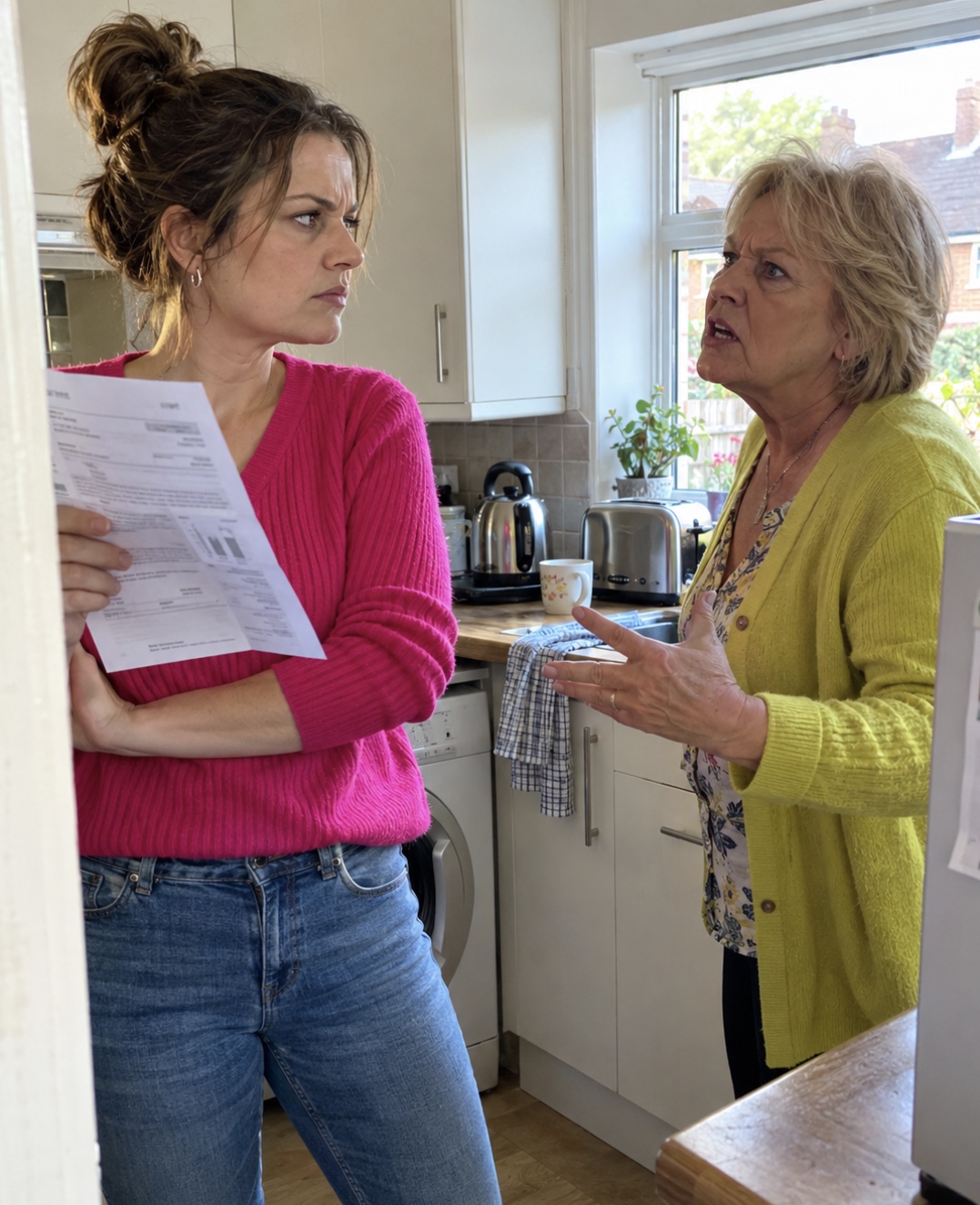
The first time Margaret told me I was “nobody” in her house, I was standing barefoot in the kitchen at six-thirty in the morning, holding an electricity bill for £412.
She was wearing a silk dressing gown, stirring instant coffee in a mug that said World’s Best Mum, while the central heating hummed loudly enough to remind me exactly who had paid for it the month before.
“You don’t get to make decisions here, Rachel,” she snapped. “This is my home.”
I looked at the bill in my hand, then at her.
“Right,” I said. “Then why am I paying to run it?”
Her teaspoon stopped against the side of the mug.
For three seconds neither of us spoke.
Then Margaret smiled.
Not warmly.
It was the small, satisfied smile she used whenever she believed she had information I didn’t.
“You really want to have that conversation?”
That was the moment I realised our arrangement was not what I thought it was.
My husband, Daniel, and I had moved into Margaret’s semi-detached house outside York eight months earlier.
It had never been part of our plan.
We had been renting a two-bedroom flat near Fulford. It was small but comfortable, and more importantly, it was ours. Then Daniel lost his job when the logistics company he worked for cut half its regional staff.
Two weeks later, Margaret fell on the back step and broke her wrist.
Nothing dramatic, but she made it sound as though she had narrowly survived an avalanche.
“You can stay here for a few months,” she told Daniel. “Save money. Help me while my hand heals. It makes sense.”
At first, it did.
Margaret’s house had three bedrooms, a garden, and no mortgage. She had lived there since Daniel was a teenager.
The deal was simple.
We would give her £500 a month toward household expenses.
I would continue working remotely for an insurance company.
Daniel would look for another job.
And once he was back on his feet, we would find another flat.
Except “a few months” quietly turned into eight.
And the £500 quietly turned into much more.
It began with groceries.
Margaret liked specific brands.
Not supermarket own-brand tea. Yorkshire Tea.
Not cheap butter. Lurpak.
She complained if I bought frozen vegetables.
She wanted fresh salmon on Fridays and proper Sunday roasts, even if only three of us were eating.
Then came the broadband.
“The old package is useless for your work,” she said.
She was right.
I upgraded it.
Then the boiler needed servicing.
Then the washing machine broke.
Then the council tax direct debit bounced because Margaret said she had “mixed up accounts”.
Then her car insurance renewal arrived in the same week as Daniel’s unemployment payment was delayed.
Each thing sounded temporary.
Each payment had an explanation.
And because Daniel was already embarrassed about not working, I rarely pushed.
By month six, I was paying nearly £1,400 a month into the house.
Not rent.
Bills.
Food.
Repairs.
Petrol sometimes.
Even Margaret’s mobile phone bill had somehow ended up linked to my bank account after she asked me to “sort the app out”.
The strange thing was that Margaret still acted as if I were a guest who had overstayed her welcome.
She complained if I left my laptop on the dining table.
She moved my shoes from the hallway.
She told me I used too much washing powder.
If I cooked, she hovered behind me.
If I ordered takeaway, she said I was wasting money.
And whenever I objected, she used the same sentence.
“My house, my rules.”
Daniel always tried to smooth it over.
“Mum’s been on her own for years.”
“She’s set in her ways.”
“Don’t take it personally.”
I didn’t.
Not at first.
Then one Tuesday evening I came downstairs and found Margaret sitting at the dining table with a man I had never met.
He had a navy folder open in front of him.
There were photographs of the kitchen on the table.
“What’s going on?” I asked.
Margaret closed the folder immediately.
“Nothing.”
The man stood.
“Mrs Carter?”
He looked at me.
“No,” Margaret said quickly. “This is my daughter-in-law.”
He gave me an awkward smile.
“I’m from Benson & Hart.”
Estate agents.
I looked at Margaret.
“Why is an estate agent here?”
She folded her arms.
“I was curious what the house might be worth.”
Daniel came through the front door twenty minutes later.
I told him what had happened.
He went pale.
“Mum, are you selling?”
“No.”
“Then why did you get it valued?”
Margaret stared at him.
“Because I own it.”
That answer should have bothered me more than it did.
But at the time I thought she was simply asserting control.
A week later, the electricity bill arrived.
£412.
More than double the previous winter bill.
I checked the meter.
Then I checked the account.
Margaret had increased the heating schedule.
Twenty-three degrees from six in the morning until midnight.
Every day.
When I asked her about it, she shrugged.
“I’m cold.”
“I understand, but four hundred pounds is a lot.”
“You earn good money.”
“That doesn’t mean—”
That was when she interrupted me.
“You’re in my house, Rachel. You’re nobody here. You came because my son needed help, so don’t start acting like you own the place.”
I stared at her.
“Then why am I paying the bills?”
Her expression changed.
Not embarrassment.
Not guilt.
Something closer to amusement.
“You really want to have that conversation?”
I should have walked away.
Instead, I said, “Yes.”
Margaret put down her coffee.
“Fine. Ask your husband.”
And then she left the kitchen.
Daniel was upstairs.
I found him sitting on the edge of our bed, tying his trainers.
“What did your mother mean?”
He didn’t look up.
“About what?”
“She told me to ask you why I’m paying for this house.”
His hands stopped.
That was enough.
“Daniel.”
He sighed.
“Rachel, please don’t start first thing in the morning.”
“What am I starting?”
“Nothing.”
“You know something.”
“I said nothing.”
“You’re terrible at lying.”
He stood.
“I’ve got an interview.”
“You’ve had an interview every time your mother says something strange.”
“That’s not fair.”
“What isn’t fair is paying your mother’s expenses for eight months and being told I’m nobody.”
He rubbed both hands over his face.
“Can we talk tonight?”
“No.”
“Rachel.”
“No. Tell me now.”
He looked toward the bedroom door.
Then lowered his voice.
“Mum’s struggling.”
“With what?”
“Money.”
I laughed once.
“She owns this house outright.”
“That doesn’t mean she has cash.”
“She has a pension.”
“Not much.”
“So where does her money go?”
Daniel didn’t answer.
That silence became the first crack.
➡️ What Daniel finally admitted changed everything — continue in the first comment.
“Where does her money go?” I repeated.
Daniel sat back down.
“There was an investment.”
“What investment?”
“Mum put money into something with Uncle Peter.”
I knew Peter only vaguely. Margaret’s younger brother. Divorced twice, always talking about business opportunities.
“What kind of investment?”
“A holiday-let project.”
“In Spain?”
“No. Scarborough.”
I blinked.
“Scarborough?”
“They bought a flat near the seafront. Peter said they could renovate it and let it short-term.”
“How much did she put in?”
Daniel stared at the carpet.
“Most of her savings.”
“How much?”
“About forty-five thousand.”
I felt my stomach tighten.
“And?”
“And Peter took out finance in both their names.”
“What do you mean, both?”
“Mum signed.”
“How much?”
“Another seventy.”
I sat beside him.
“Seventy thousand pounds?”
He nodded.
“And the project failed?”
“The contractor disappeared halfway through. Then there were planning issues. The flat’s been empty.”
I stared at him.
“So your mother has debt.”
“Yes.”
“How much?”
“I don’t know exactly.”
“You do know.”
He looked at me.
“About £61,000 left.”
I stood again.
“And instead of telling me, you let me pay for this entire house.”
“It wasn’t like that.”
“It was exactly like that.”
“I was going to pay you back once I got work.”
“You don’t even know when that will be.”
“I know.”
“And the estate agent?”
He looked miserable.
“Mum’s thinking of selling.”
I felt something cold settle in my chest.
“So we’ve been paying to keep up a house she intends to sell?”
“She hasn’t decided.”
I laughed.
“Daniel, she had an estate agent here.”
“She’s desperate.”
“So am I!”
He stood quickly.
“I know.”
“No, you don’t. Because every time I asked why the bills kept increasing, you told me not to stress your mother.”
“I was trying to protect her.”
“From me?”
“From feeling ashamed.”
“And what exactly were you protecting me from?”
That stopped him.
There was no good answer.
I went downstairs.
Margaret was watching breakfast television.
I stood between her and the screen.
“How much do you owe?”
She didn’t even pretend not to understand.
“Daniel told you.”
“Yes.”
She turned the television down.
“I didn’t ask you to pay everything.”
“You asked every week.”
“I asked for help.”
“You asked me to cover council tax, food, heating, repairs and half a dozen other things because you didn’t want to tell me you were paying off debt.”
Margaret’s mouth tightened.
“This is a family matter.”
“I’m married to your son.”
“That doesn’t mean you need to know everything.”
“Apparently it means I need to fund everything.”
She stood.
“I will repay you.”
“With what?”
Her face changed.
“The house.”
“What about it?”
“I’m selling.”
The way she said it was so calm that I thought I’d misheard.
“When?”
“As soon as possible.”
“And where are you going?”
“I’ll find somewhere smaller.”
“What about us?”
Margaret gave a tiny shrug.
“You’re adults.”
I stared at her.
“You invited us here.”
“I helped you when Daniel lost his job.”
“You also used my salary to keep yourself afloat.”
“That is an ugly way to describe family helping family.”
“No. It’s an accurate way.”
She raised her voice.
“You lived here without rent!”
“I paid more than rent!”
“Not market rent.”
I nearly laughed.
“You want market rent? Fine. Then let’s calculate it. One bedroom in a shared three-bedroom house outside York. Then subtract the boiler repair, washing machine, groceries, broadband, council tax, your mobile bill, and the £1,800 I paid when your roof leaked.”
Margaret went quiet.
I continued.
“You don’t get to call me a guest when you need money and a stranger when I ask questions.”
Her cheeks flushed.
“This is still my home.”
“Yes,” I said. “And your debt.”
For the first time, she had nothing to say.
That evening, I opened a spreadsheet.
Every transfer.
Every card payment.
Every direct debit.
Every receipt I could find.
I went back eight months.
The total shocked even me.
£10,860.
That was beyond the original £500-a-month agreement.
I sent the spreadsheet to Daniel.
He came downstairs half an hour later.
“I didn’t realise it was that much.”
“That’s the problem. You didn’t want to realise.”
“I’ll fix it.”
“How?”
“I’ll talk to Mum.”
“No.”
He looked confused.
“No?”
“We’re moving.”
His face fell.
“Rachel—”
“I mean it.”
“Where?”
“I spoke to Hannah at work. Her sister’s flat in Bishopthorpe is empty until February. She’ll rent it to us for three months.”
“You arranged that already?”
“Yes.”
“When?”
“This afternoon.”
Daniel stared at me as though I had betrayed him.
For one bitter second, that almost made me laugh.
“You made a decision without me.”
“Yes.”
“That’s not how marriage works.”
I looked directly at him.
“No, Daniel. Marriage is apparently when one person secretly lets the other finance his mother’s debt.”
He sat down.
“I’m sorry.”
“I know.”
“I was ashamed.”
“That explains lying. It doesn’t excuse it.”
He nodded.
Then something unexpected happened.
Daniel said, “You should go.”
I frowned.
“What?”
“You should take the flat.”
“What about you?”
“I need to stay here for a while.”
I felt exhausted suddenly.
“Why?”
“Because Mum won’t manage the sale on her own.”
There it was.
His choice.
I had been waiting eight months for him to make one.
I just hadn’t expected it to be that.
“Okay,” I said.
His head lifted.
“Okay?”
“Yes.”
I packed over the next two days.
Margaret barely spoke to me.
On Friday morning, while I carried boxes to my car, she stood in the doorway.
“You’re being dramatic.”
I kept walking.
“You’ll regret making Daniel choose.”
I stopped.
“I didn’t make him choose.”
She looked uncertain.
“That’s the difference.”
I moved into the flat alone.
For two weeks, Daniel and I barely spoke except by text.
Then, on a rainy Thursday evening, he appeared at my door carrying a holdall.
“I was wrong,” he said.
I didn’t answer immediately.
He held out an envelope.
“What’s that?”
“Open it.”
Inside was a bank statement.
A transfer.
£5,000.
From Margaret.
I looked up.
“She sold something?”
“The house hasn’t sold yet.”
“Then where did she get this?”
Daniel looked tired.
“She had another account.”
I felt anger rise again.
“What account?”
“A savings account.”
“How much?”
“Nearly £28,000.”
I stared at him.
“No.”
“Yes.”
“Then why was I paying her bills?”
“She said that money was untouchable.”
“For what?”
He hesitated.
“For me.”
I almost couldn’t process the sentence.
“What do you mean, for you?”
“She’d been saving it for years. She wanted to give me a deposit for a house one day.”
I sat down slowly.
“So she let me spend nearly eleven thousand pounds supporting her because she didn’t want to use twenty-eight thousand pounds she had saved for you?”
Daniel nodded.
“And you knew?”
“No. I swear.”
For once, I believed him.
“Why did she tell you now?”
“Because I told her I was leaving.”
I looked up.
“You’re leaving the house?”
“Yes.”
“What about helping her?”
“She can hire a solicitor and an estate agent like everyone else.”
Despite everything, I smiled.
Daniel didn’t.
“There’s more.”
Of course there was.
“What?”
“She doesn’t actually have to sell.”
I stared at him.
“She contacted the lender. Peter finally sold his share of another property. He can cover most of what they owe.”
“So all of this—”
“She panicked.”
“Panicked?”
“She thought if she used her savings, I’d lose my future deposit.”
I laughed, but there was no humour in it.
“She protected your imaginary future house by making your actual wife pay for her current one.”
“Yes.”
The absurdity of it filled the room.
For a long time neither of us spoke.
Then Daniel said something I didn’t expect.
“I told her to keep the deposit.”
I looked at him.
“What?”
“The £28,000. I told her I don’t want it.”
“Daniel—”
“I don’t.”
“That’s still a lot of money.”
“I know.”
He sat opposite me.
“But I finally understood why she kept saying it was her house.”
I waited.
“Because the house was the only thing she felt powerful about. Dad handled everything when he was alive. Bills. Banking. Insurance. Repairs. After he died, she was terrified of admitting she didn’t understand any of it. Then Peter talked her into that investment, and she made a mess of it.”
“That explains her fear.”
“I know.”
“It doesn’t justify how she treated me.”
“I know that too.”
He rubbed his hands together.
“She called you nobody because if she admitted you were carrying the household, she’d have to admit she wasn’t in control.”
That sentence stayed with me.
Not because it made me forgive Margaret.
But because it finally made sense.
Three months later, Daniel and I rented a small terraced house in York.
Together.
He had found a new job by then.
Not as well paid as his old one, but stable.
We split bills according to income and kept separate personal accounts.
No secrets.
No vague “family arrangements”.
Margaret kept her house.
Peter sold his investment property and cleared most of their shared loan.
Margaret used some of her savings for the rest.
She never mentioned the £28,000 deposit again.
But she did repay me.
Not all at once.
Five hundred pounds every month.
The first transfer arrived with no message.
The second said simply:
For household expenses owed.
The third came after Christmas.
That one had a note attached.
I behaved badly. I am sorry.
It wasn’t a dramatic apology.
Margaret wasn’t a dramatic-apology person.
I accepted it anyway.
The following spring, she invited us for Sunday lunch.
When I arrived, she was in the kitchen fighting with a new smart meter display.
“It says I spent four pounds yesterday,” she complained.
“You had the heating on all day.”
“It was freezing.”
“It was fourteen degrees.”
“That is freezing.”
Daniel laughed from the hallway.
Margaret rolled her eyes.
Then she looked at me.
“Would you show me how to read this thing properly?”
It was the first time she had ever asked instead of demanded.
So I showed her.
Later, while we were eating roast chicken, she looked around the table and said, almost casually, “It’s nice having you both here.”
I raised an eyebrow.
“In your house?”
She caught the joke immediately.
For a second, I wondered if she might be offended.
Instead, Margaret smiled.
“Yes,” she said. “In my house.”
Then she pointed her fork at me.
“But don’t get too comfortable.”
I laughed.
“Don’t worry. I’m not paying the gas bill.”
Daniel nearly choked on his Yorkshire pudding.
And even Margaret laughed.
That was when I understood something I wish I had learned much earlier.
The biggest problem had never been whose name was on the deeds.
It was that everyone had been pretending money was not power.
Margaret used ownership to control the house.
Daniel used silence to avoid conflict.
And I used money to keep the peace.
The arrangement only changed when I stopped paying for a place where I was expected to have responsibilities without having a voice.
Margaret had been right about one thing.
It was her house.
But once I stopped confusing helping someone with surrendering my boundaries, she never called me “nobody” again.