



“Here, you’re nobody, Claire. Absolutely nobody.”
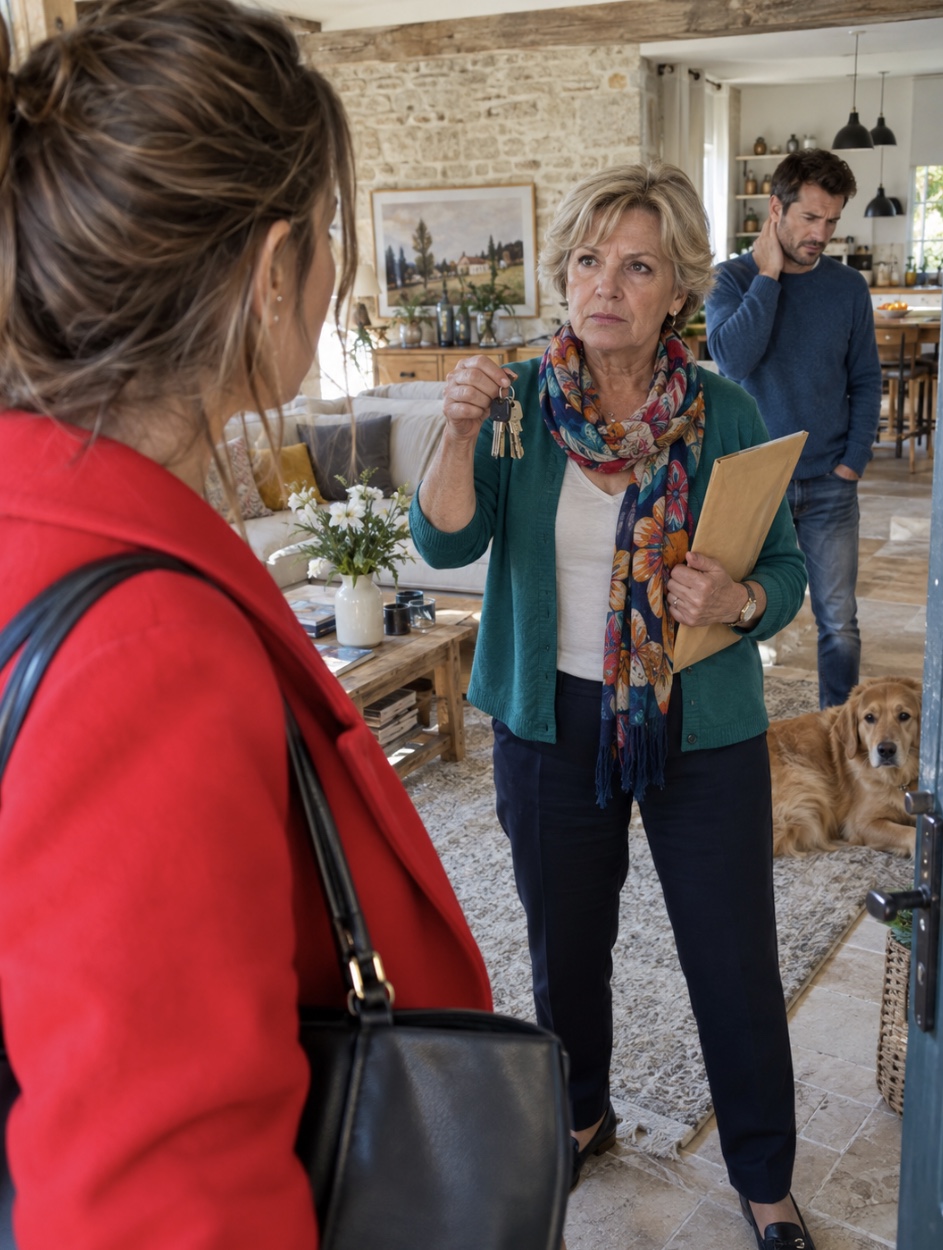
My mother-in-law said it in the middle of my living room, standing in front of my bookcase with my set of keys in one hand and a brown envelope in the other.
At first, I thought I had misheard her.
Behind her, my husband, Thomas, was staring at the floorboards with the expression of a man who would have preferred to disappear between two planks.
It was just after seven on a Tuesday evening in November. I had just returned from Lyon after a full day of training. I still had my coat on and my laptop bag hanging from my shoulder.
And yet, in my own home, someone had already decided that I had no say.
“Excuse me?” I asked.
Monique lifted her chin.
“You heard me perfectly well. This house belonged to our family long before you came along. You’re not going to start giving orders as though this place were yours.”
I looked around the room.
The green sofa I had chosen.
The curtains my mother and I had sewn together.
The oak dining table Thomas and I had bought after saving for eight months.
The wall by the entrance that I had painted myself during lockdown.
Then I looked back at her.
“Then why did you come into my home without being invited?”
Thomas closed his eyes.
Monique smiled.
A small, tight smile.
The kind she always wore when she thought she knew something I didn’t.
“That,” she said, “is exactly what we need to discuss. What you keep calling ‘your home.’”
That was when I realized this visit wasn’t spontaneous.
In the eleven years I had been with Thomas, Monique had always had a strange relationship with this house.
Not with us.
With the house.
She lived forty minutes away, near Bourg-en-Bresse, in a modern detached home she had bought with her second husband after her divorce.
But whenever she visited us, she spoke about our house as though it were another member of her family.
“That fireplace has always drawn a little too strongly.”
“The lilac at the bottom of the garden was already there when Thomas was a boy.”
“Your father-in-law laid those tiles himself.”
At first, I had found it touching.
The house stood in a village in the Ain department, a few miles from Pérouges. It was an old stone building with blue-grey shutters, a narrow garden and a huge attic that still smelled of dry timber.
Thomas had lived there until he was eight.
After his parents divorced, his father, Alain, stayed there alone.
When Alain died of a heart attack, six years before Thomas and I married, Thomas inherited the house.
At least, that was what I had always understood.
When Thomas and I got married, the house had been practically uninhabitable for nearly three years.
The roof leaked.
The boiler was dead.
The electrical system belonged to another era.
The bathroom had a salmon-pink sink and a bathtub surrounded by brown tiles.
For four years, we renovated the house room by room.
Much of it was paid for with our savings.
The rest came from a renovation loan in both our names.
I had even sold the small studio apartment my grandmother had left me in Villeurbanne to pay for the roof and insulation.
Monique knew all of that perfectly well.
And yet she always found a way to call it “Thomas’s house.”
Never “your house.”
That evening, she went a step further.
“Thomas,” I said calmly, “why does your mother have our keys?”
He cleared his throat.
“I gave her a spare set in the summer, when we went to Brittany.”
“We went to Brittany four months ago.”
“I forgot to get them back.”
Monique sighed.
“We’re not going to create a drama over a key.”
“It isn’t the key that worries me. It’s the fact that you came inside without telling us.”
She placed the brown envelope on the table.
“I needed to check a few things.”
“What things?”
She didn’t answer immediately.
Instead, she took off her coat as though she intended to stay.
Then she walked into the kitchen and opened one of the cupboards.
I followed her.
“Monique.”
“What?”
“What exactly did you come here to check?”
She turned around.
“The house.”
“I gathered that.”
“More specifically, what you’ve done to it.”
Thomas joined us.
“Mum, stop.”
“Why? She wants an explanation. I’m giving her one.”
She pointed toward the ceiling.
“The glass partition in the hallway. The wall you opened between the kitchen and the living room. The shower upstairs. The new windows.”
I blinked.
“All of that was done years ago.”
“Without my permission.”
I laughed.
I genuinely couldn’t help it.
“Your permission?”
Monique didn’t laugh.
“Yes.”
Thomas put one hand on the table.
“Mum, I’ve already explained this.”
“You explained your version.”
Then she tapped the envelope.
“I have the documents.”
The silence in the room changed.
I remember that moment very clearly.
A second earlier, I had mostly been angry.
After those words, I began to feel afraid.
“What documents?” I asked.
Monique opened the envelope.
She pulled out several yellowed photocopies.
A notarized deed.
Plans of the property.
An old property tax statement.
And a document bearing the name of Thomas’s father.
Alain Delorme.
Monique placed her finger on one line.
“The house didn’t belong only to Alain.”
Thomas looked away.
My stomach tightened.
“Thomas?”
He said nothing.
Monique looked almost pleased.
“We bought this house together in 1989.”
“You got divorced.”
“Yes.”
“And?”
“When we divorced, the final division of this property was never completed.”
I turned toward Thomas.
“Did you know this?”
He took a long breath.
“Not exactly.”
“What does ‘not exactly’ mean?”
“Dad always told me the house belonged to him. After he died, the notary told me it formed part of his estate.”
Monique gave a dry laugh.
“Because your father left out a few details.”
“What details?” I asked.
She pushed one of the photocopies toward me.
I wasn’t a lawyer, but I understood enough to see that the situation was more complicated than I had been told.
The house had been purchased by Alain and Monique while they were married.
When they divorced, an agreement had granted Alain the use of the house.
But the document didn’t look like a sale.
Or a transfer.
“You’re saying you still own part of this house?”
“Exactly.”
Thomas immediately shook his head.
“It isn’t that simple.”
“Oh, really?” Monique replied. “Because the notary I saw last week seems to think otherwise.”
So that was why she was here.
Not to inspect the glass partition.
Not to criticize our windows.
She was preparing something.
“Why now?” I asked.
She slowly put the documents back together.
“Because I want what belongs to me.”
“After more than thirty years?”
“Time doesn’t change ownership.”
Thomas rubbed both hands over his face.
“Mum, you signed an agreement with Dad.”
“A private agreement.”
“You gave him the house.”
“I gave him the use of the house while you and your sister were children.”
I frowned.
“His sister?”
Thomas had an older sister, Émilie, who lived near Montpellier. She rarely came to the region and had never shown the slightest interest in the house.
Monique turned toward me.
“That’s the real problem. Thomas has behaved as though he were an only child.”
“What does Émilie have to do with this?”
“She has rights too.”
Thomas slammed his palm against the table.
“No.”
It was the first time he had raised his voice.
Monique flinched.
“Don’t speak to me like that.”
“You walk into our home without warning, go through the house, talk to Claire as if she’s an intruder, and now you’re dragging Émilie into this?”
“I’m not dragging anyone into anything. Émilie already knows.”
Thomas froze.
“Since when?”
“For two weeks.”
I sat down.
Suddenly, several details from the previous months made sense.
Émilie had called Thomas twice after months of silence.
She had asked about the renovations.
About property prices in the area.
About the land behind our fence.
She had even asked whether we intended to sell “one day.”
Thomas had found it strange.
So had I.
Now I understood.
“You want to sell?” I asked.
Monique didn’t answer.
Thomas turned toward her.
“Mum.”
“It’s only one possibility.”
“You want to sell our house?”
“Your house?” she repeated with a smile. “That’s exactly the question.”
Something inside me cracked.
Not because of the money.
Because of the years.
The Saturdays spent covered in dust.
The evenings comparing quotes from contractors.
The holidays we cancelled because the roof structure needed repairing.
The studio I had sold.
All the times Monique had watched the renovations progress without saying a word.
“You knew we were putting all our savings into this place,” I said.
“I never asked you to do so much work.”
“No. But you also never told us that you still considered this house yours.”
She shrugged.
“It wasn’t my responsibility to explain your legal situation to you.”
Thomas stared at her.
“If you knew there was a problem, why didn’t you say anything when Dad died?”
Monique pressed her lips together.
“Because at the time, I didn’t want anything.”
“And now?”
She looked away.
Thomas understood before I did.
“Émilie needs money.”
Monique said nothing.
So that was it.
Émilie had been going through a divorce for several months. She wanted to buy out her husband’s share of their apartment in Montpellier.
She was short a significant amount of money.
“How much?” Thomas asked.
“That isn’t the point.”
“How much does she need?”
“Eighty thousand euros.”
Thomas gave a humorless laugh.
“And you want to take it from here.”
“I want my share.”
“So you can give it to Émilie.”
“She’s going through a difficult time.”
I looked at Thomas.
He had gone pale.
Then I remembered something.
A detail I had almost completely forgotten.
Three years after our wedding, when I sold my studio apartment, our notary had insisted that the money be clearly documented.
He had explained that because the studio had come to me through inheritance, we needed proof of the origin of the money I was investing in the renovations.
At the time, it had seemed like pointless paperwork.
I had kept everything.
“Wait here,” I said.
Monique smiled.
“Where exactly do you think I’m going?”
I went upstairs to our home office.
At the back of a cupboard was a grey box containing our important documents.
I found the paperwork from the sale.
Then the renovation invoices.
The bank statements.
And, most importantly, a document I hadn’t looked at in years.
I went back downstairs.
Thomas and his mother were arguing quietly.
I sat down opposite them.
“You may have rights to this house,” I told Monique. “I don’t know. That will be for the professionals to determine.”
She folded her arms.
“Finally, something sensible.”
“But there’s something else.”
I placed the document in front of her.
Her smile disappeared.
When Alain’s estate had been settled, the notary had prepared a detailed inventory.
And in that inventory was a debt.
Fifty-two thousand euros.
Owed to Thomas.
“What is this?” Monique asked.
Thomas picked up the document.
Then his expression changed.
“I remember this.”
I didn’t.
Not properly.
Thomas explained.
Several years before his death, his father had borrowed money from both of his children.
Émilie and Thomas had each received money from a life insurance policy their grandfather had taken out for them.
Alain, who had been experiencing financial difficulties at the time, borrowed the money.
Émilie had been repaid almost in full.
Thomas had not.
The debt had therefore been formally recorded in Alain’s estate.
“So?” Monique asked.
Thomas continued reading.
Then he looked up.
“The debt was offset against my share of the estate.”
“Yes, and?”
“And that’s why the notary assigned the house to me.”
Monique went still.
I handed her the next page.
It was a supplementary deed.
Signed two years after Alain’s death.
A document Thomas had signed at the notary’s office without really understanding its significance, believing it was simply part of finalizing the estate.
It referred to the division of several assets.
And, most importantly, to a settlement payment corresponding to Monique’s remaining share of the former marital property.
Paid.
In full.
By Alain.
Seventeen years earlier.
By bank transfer.
Monique read the line twice.
“That’s impossible.”
Thomas leaned closer.
“You received this money.”
“I don’t remember.”
“Forty-six thousand euros.”
“That was almost twenty years ago!”
“So you were paid for your share of the house.”
Monique shook her head.
“I never signed that.”
I showed her the final page.
Her signature was at the bottom.
Beside Alain’s.
The entire room fell silent.
I expected her to explode.
To accuse the notary.
To accuse Alain.
To find some new reason why none of it counted.
Instead, she did something much stranger.
She sat down.
And whispered:
“I thought that money came from the sale of the garage.”
Thomas stared at her.
“What garage?”
Then Monique told us a story Thomas had never heard.
After their divorce, Alain had co-owned a small commercial property with his brother.
When he transferred the forty-six thousand euros to Monique, he had simply told her:
“Here’s what I owe you.”
She had assumed the money came from the sale of that property.
She had never asked any further questions.
“So you genuinely forgot that you had already been compensated for the house?” I asked.
Monique flushed.
“I didn’t say that.”
Thomas gave a bitter laugh.
“Yes. That’s exactly what you just said.”
But it still wasn’t over.
The following Thursday, we had an appointment with our notary.
Monique came with hers.
Émilie joined by video call.
For almost an hour, they went through the deeds, dates and bank transfers.
The conclusion was clear.
Monique had not owned any part of the house for nearly twenty years.
The property had been transferred to Alain when their matrimonial assets were finally divided.
After his death, it had passed to Thomas through the estate.
Monique could not sell it.
Neither could Émilie.
I thought that would be the end of it.
I was wrong.
As we left the notary’s office, Émilie called Thomas directly.
He put her on speaker.
“Mum told me she still owned half the house,” she said.
Monique went pale.
“Émilie…”
“She even told me Claire had taken advantage of the fact that Thomas didn’t understand paperwork and had put her name on everything.”
I said nothing.
Thomas did.
“Claire’s name isn’t even on the property deed.”
Silence on the phone.
“What?”
“The house is in my name. Claire has never tried to take ownership of it.”
I knew that was true.
And perhaps that was what hurt most.
I had invested a large part of my inheritance in a house that legally belonged to my husband.
I had trusted him.
Monique had turned that trust into an accusation.
Émilie sighed.
“Mum told me something completely different.”
In the end, the real argument that day wasn’t between my mother-in-law and me.
It was between her and her two children.
Thomas asked her to return our keys.
Émilie told her to stop using her financial problems to turn members of the family against one another.
Monique cried.
Then she became angry.
Then she tried to claim that she had only wanted to “protect her children.”
Thomas replied with something I will never forget.
“You don’t protect your children by inventing rights you no longer have and humiliating their spouse in their own home.”
Three months later, Thomas and I changed the legal arrangements concerning the house.
On our notary’s advice, we drew up an agreement that formally recognized the money I had invested in the renovations and my contribution to the loan.
Thomas wanted to go further.
He transferred a share of the property to me.
When I asked him why he was doing it now, he said:
“Because for years, I thought it was perfectly normal for you to invest in this place as though it were your home while allowing the paperwork to tell a different story. I never want anyone to be able to use that against you again.”
Monique didn’t come back for almost four months.
Then, one Sunday in March, she sent me a message.
Not Thomas.
Me.
“Could I come over for coffee?”
I stared at the screen for a long time.
Then I replied:
“Yes. Around three.”
At 2:58, the doorbell rang.
When I opened the door, Monique was standing outside holding a cake she had bought from the bakery.
She didn’t come in.
She waited.
That small detail almost affected me more than her apology.
“May I?” she asked.
I stepped aside.
“Yes.”
She took two steps into the hallway, then stopped in front of the wall I had painted years earlier.
“I said something horrible the last time I was here.”
I said nothing.
She lowered her eyes.
“When I told you that you were nobody here.”
“I remember.”
“So do I.”
Then she looked around.
“For a long time, I kept thinking of this house as the place where I raised my children. I confused my memories with rights.”
That sentence surprised me.
Because it was simple.
And, for once, honest.
Monique placed the cake on the table.
“I don’t know whether you’ll forgive me.”
“That isn’t something I can decide in five minutes.”
“I understand.”
Then she smiled hesitantly.
“But today, at least, I know one thing.”
“What?”
She pointed toward the front door behind her.
“That I ring the bell before I come in.”
I smiled despite myself.
And that day, for the first time in eleven years, Monique didn’t call it “Thomas’s house.”
As she was leaving, she simply said:
“You two have really made something beautiful here.”
It wasn’t much.
But sometimes, in a family, a single word is enough to show that something has finally changed.
She had said “you two.”
Not “him.”