



The first time my mother-in-law accused our neighbor of having an affair, she did it loudly enough for half the street to hear.
“Every evening, seven-thirty sharp,” Margaret said, standing at our front window with the curtain pinched between two fingers. “Same woman. Same red coat. Same little handbag. And she stays for almost an hour.”
I was chopping onions in the kitchen.
“Margaret, please stop spying on Peter.”
“I am not spying.”
“You’re standing behind my curtain.”
“I’m observing.”
My husband, Daniel, looked up from his laptop at the dining table and gave me the expression he always used when his mother had crossed the line but he was hoping I would deal with it.
We lived in a quiet residential street outside Bristol, in one of those rows of semi-detached houses where everyone knew which bins belonged to whom and where parking six inches too far over somebody’s drive could create tension for months.
Peter Walsh lived next door.
He was sixty-one, recently retired from the council, divorced for years and generally private. He watered his front garden early in the morning, washed his silver estate car every second Saturday, and occasionally took parcels in for us.
There was nothing remotely scandalous about him.
Until Margaret came to stay.
She was supposed to stay with us for ten days while builders replaced the bathroom in her flat in Bath. By the third evening, she had apparently adopted our street as a personal investigation.
The woman Margaret had noticed looked to be in her forties. Dark hair, red wool coat, low black shoes. She arrived on foot, usually at around half past seven, rang Peter’s bell, and disappeared inside.
At eight-fifteen or eight-thirty, she would leave again.
That was it.
No embraces on the doorstep. No secrecy. No dramatic cars waiting with engines running.
Just a visitor.
But Margaret had decided the matter was suspicious.
“He never mentioned having a girlfriend,” she said.
“Why would he tell us?” I asked.
“Because neighbors talk.”
“Normal neighbors don’t report their dating lives to each other.”
Margaret gave me a look.
“You’re very trusting, Lucy.”
“I’m very uninterested.”
Daniel snorted into his tea.
Margaret turned toward him.
“You think it’s funny now. Wait until it turns out there’s a married woman sneaking into that house every night.”
Daniel sighed.
“Mum, she could be a cleaner.”
“At eight at night?”
“A relative.”
“Every day?”
“A carer.”
“She doesn’t carry a medical bag.”
I stared at her.
“You do realize carers are allowed to carry handbags?”
Margaret ignored me.
The next evening, she was waiting at the window again.
The woman arrived at 7:34.
Margaret checked the clock.
“She’s late.”
I nearly dropped my fork.
“Late for what?”
Her answer was whispered.
“For whatever she’s doing.”
I should have laughed.
Instead, something about the intensity in Margaret’s face made me uneasy.
Not because I believed her theory.
Because I realized she wasn’t merely gossiping.
She was watching for a reason.
Two nights later, the situation became embarrassing.
I had just come home from work when I saw Margaret standing outside our house in slippers and a cardigan, arms folded, staring toward Peter’s front door.
The woman in the red coat was walking up the path.
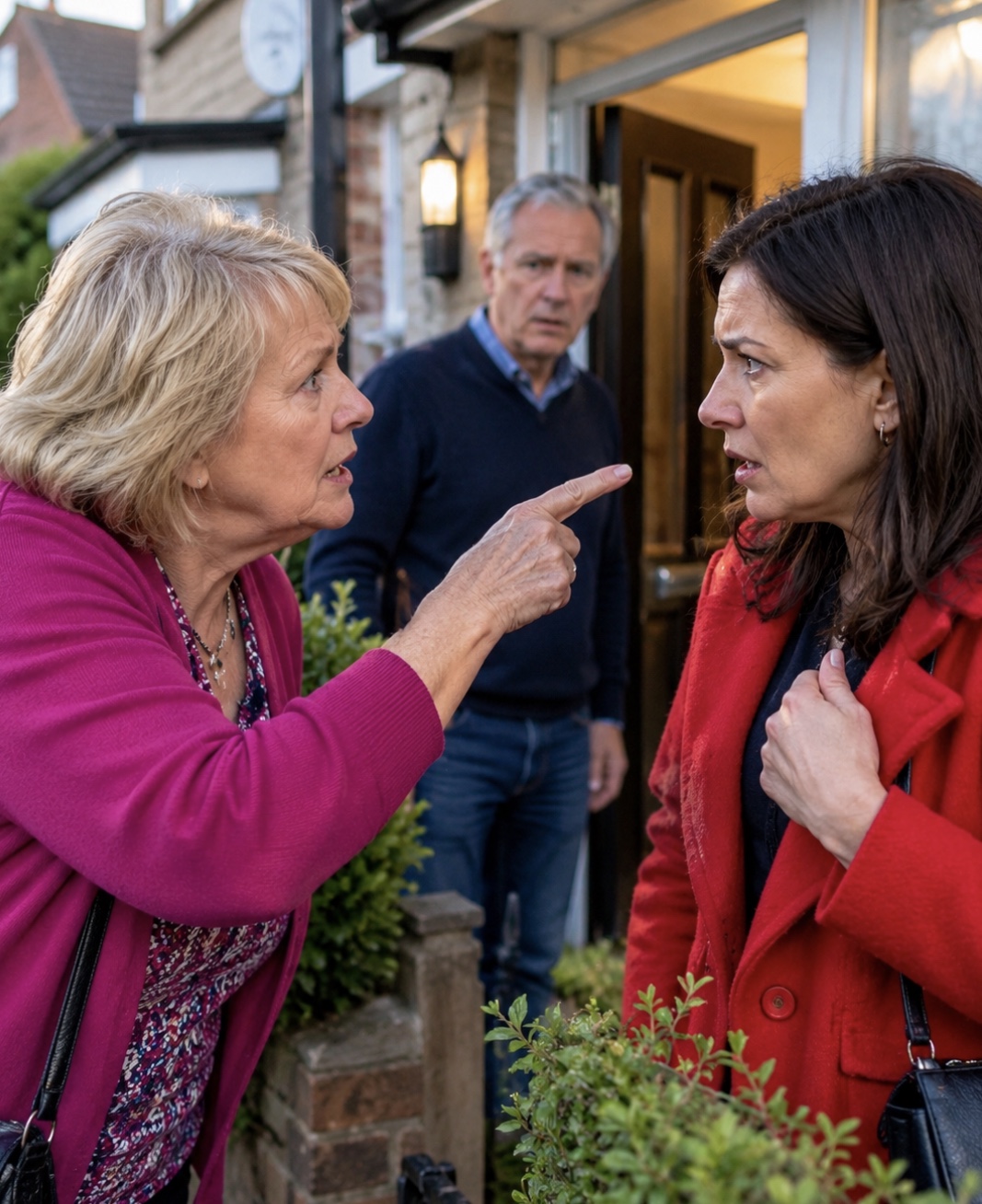
Margaret called out.
“Excuse me!”
The woman stopped.
I froze beside my car.
Margaret walked toward the low hedge separating our properties.
“Do you visit here every evening?”
The woman stared at her.
“Sorry?”
“You come to this house every evening.”
Her voice changed.
“Who are you?”
“I live next door.”
“You don’t.”
“I’m staying next door.”
“Margaret,” I called sharply.
She ignored me.
“I just think people ought to be careful,” she continued. “This is a quiet street.”
The woman’s expression hardened.
“With what, exactly?”
Margaret glanced at Peter’s house.
“I’m sure you know.”
The front door opened.
Peter appeared.
He looked from the woman to Margaret and then to me.
“What’s going on?”
“Nothing,” I said immediately.
Margaret spoke over me.
“I was simply asking your visitor a question.”
Peter’s face changed.
He was usually mild, almost shy.
Now his voice was cold.
“My visitors are none of your business.”
Margaret stiffened.
“I’m only looking out for people.”
“No. You’re standing outside my house interrogating someone.”
The woman stepped closer to Peter.
“Should I come back later?”
“No,” he said. “Come in.”
Then he looked directly at Margaret.
“And please don’t speak to her again.”
The door closed.
For a few seconds, nobody moved.
Then Margaret said, “That was defensive.”
I could hardly believe what I was hearing.
“That was humiliating.”
“For whom?”
“For us!”
I took her arm and guided her toward our house.
She pulled away.
“You’re making a mistake, Lucy.”
“What mistake?”
She stopped on the pavement.
For the first time since she had arrived, she didn’t look nosy or triumphant.
She looked frightened.
But the expression vanished almost instantly.
“You’ll see,” she said.
📌 The real reason Margaret was watching our neighbor had nothing to do with an affair — and what happened next changed everything.
That night, Daniel and I argued in the kitchen.
Not loudly.
We didn’t want Margaret to hear us from upstairs.
“You have to talk to her,” I whispered.
“I have.”
“No, Daniel. You’ve asked her to stop. That’s different.”
He rubbed his forehead.
“She gets fixated on things.”
“Has she done this before?”
He hesitated.
That hesitation annoyed me more than an answer would have.
“Daniel.”
“When Dad was alive, sometimes she got suspicious about people.”
“What people?”
“Neighbors. People from his work. Once she became convinced a woman at their local pharmacy was deliberately giving Dad the wrong prescriptions.”
I stopped wiping the counter.
“Was she?”
“No.”
“And what happened?”
“Dad changed pharmacies.”
I stared at him.
“You never thought to mention this before she started questioning strangers in our street?”
He lowered his voice.
“It hasn’t happened for years.”
The next morning, I went to Peter’s house to apologize.
He opened the door wearing a navy jumper and looked exhausted.
“I’m sorry about Margaret,” I said. “She’s Daniel’s mum. She’s staying temporarily.”
Peter nodded.
“I know.”
“She was completely out of order.”
“Yes.”
I appreciated the honesty.
“I’ve spoken to her.”
He looked past me toward our house.
“Keep her away from Helen.”
So the woman had a name.
“Helen?”
His expression closed immediately.
“My visitor.”
I didn’t ask more.
“Of course.”
As I turned to leave, something inside the hallway caught my eye.
A folding wheelchair.
Peter noticed me looking.
“It’s not mine,” he said quickly.
I nodded and walked home.
That evening, Helen arrived at 7:31.
Margaret was not at the window.
I found her in the spare bedroom sitting on the edge of the bed.
“You all right?”
“Fine.”
She didn’t look fine.
Her phone lay in her hands.
On the screen was an old photograph.
I only saw it for a second before she locked the phone.
A man standing beside a lake.
Something about him looked familiar.
Later that night I woke at 1:40 to use the bathroom.
Margaret’s bedroom door was open.
She wasn’t inside.
I found her downstairs.
The hallway light was off, but streetlamps threw a pale glow through the glass panels beside the front door.
She was standing there in her dressing gown.
Looking at Peter’s house.
“Margaret?”
She jumped.
“What are you doing?”
“Nothing.”
“At nearly two in the morning?”
She took a long breath.
Then she said something that made the entire situation stranger.
“I saw that woman ten years ago.”
I stared at her.
“What?”
“Helen.”
“You know her?”
“I’ve seen her.”
“Where?”
Margaret shook her head.
“I’m not sure.”
That made no sense.
“You’ve been acting like a private detective for a week because somebody looks familiar?”
“She doesn’t just look familiar.”
“What does that mean?”
Margaret walked into the kitchen and switched on the light.
She looked suddenly older.
“I think she knew your father-in-law.”
Daniel’s father, Michael, had died three years earlier after a heart attack.
He and Margaret had been married for thirty-eight years.
I sat down.
“Why?”
Margaret unlocked her phone again.
She showed me the photograph.
Michael was standing beside a lake, probably somewhere in Wales. He looked younger, perhaps fifty.
There were several people behind him.
And on the far left was a woman with dark hair.
Red jacket.
Even younger, I recognized her.
Helen.
“Where was this taken?”
“Brecon Beacons. Michael used to go walking with a group.”
“When?”
“About eleven years ago.”
“That doesn’t mean anything.”
“I know.”
But she clearly didn’t.
The next day, everything exploded.
Margaret was coming back from the corner shop when she saw Helen leaving Peter’s house.
Instead of walking away, she crossed the road.
I saw it from my office window.
By the time I got outside, Margaret had grabbed Helen’s sleeve.
“Tell me where you knew Michael Bennett from.”
Helen pulled her arm free.
“What?”
“Michael Bennett.”
Her face went pale.
That was the moment I knew Margaret had not imagined the connection.
Peter opened his front door.
Margaret pointed at Helen.
“You knew my husband.”
Helen said nothing.
“Answer me.”
Peter walked toward them.
“Margaret, go home.”
“How do you know my name?”
The street seemed to go silent.
Even I felt my stomach tighten.
Peter realized his mistake immediately.
Margaret stepped closer.
“How do you know who I am?”
Helen whispered, “Peter.”
He closed his eyes.
Margaret looked from one to the other.
“What is this?”
No one answered.
She began shouting.
“What did Michael do? Was he seeing you? Were you meeting him?”
Helen’s eyes filled with tears.
“Please stop.”
“You came to my husband’s walking group. I have photographs.”
“That’s enough,” Peter said.
“No, it isn’t!”
Margaret’s voice cracked.
“My husband is dead. I deserve to know.”
Helen looked at Peter.
Then she looked directly at Margaret.
“Your husband wasn’t having an affair with me.”
Margaret’s whole body seemed to sag.
But Helen wasn’t finished.
“He saved my brother’s life.”
None of us spoke.
Helen reached into her bag and pulled out a small envelope.
Inside was a photograph.
She handed it to Margaret.
It showed Michael beside a younger man in a hospital bed.
Helen explained.
Eleven years earlier, during a group walk near Pen y Fan, her younger brother, Simon, had collapsed.
He had an undiagnosed heart condition.
Michael had been the first person to realize something was seriously wrong.
While others panicked, he called emergency services, started CPR when Simon stopped breathing and kept going until paramedics arrived.
Simon survived.
Margaret stared at the photograph.
“I never knew.”
“Michael didn’t want attention,” Helen said softly. “He came to the hospital once. Then again a few months later. After that, he and Simon stayed in touch.”
Margaret’s face tightened.
“Why didn’t he tell me?”
Helen hesitated.
Peter answered.
“Because Simon asked him not to tell anyone about his condition at first. He was ashamed. He thought it would affect his job.”
Margaret looked confused.
“What does this have to do with Peter?”
Helen glanced toward the house.
“Simon was Peter’s son.”
I felt the pieces move into place.
Peter’s divorced wife had raised Simon elsewhere. I vaguely remembered hearing he had an adult son, but I had never met him.
Then Helen said, “Simon died in February.”
Margaret covered her mouth.
“His heart?”
“No. Cancer.”
Helen explained that Simon had been diagnosed the previous year.
Before he died, he had asked Helen to find Michael Bennett.
He wanted to thank the man who had given him eleven extra years of life.
Helen found out through old walking-club contacts that Michael had already died.
Then she contacted Peter.
The evening visits had nothing to do with romance.
Helen had been helping Peter sort through Simon’s belongings.
Letters.
Photographs.
Voice recordings.
And one unfinished letter addressed to Michael.
Margaret’s hands began to shake.
Helen opened her handbag again.
“I was going to post this to you.”
She handed Margaret a folded sheet of paper.
Michael’s name was written across the top.
Margaret read silently.
Then she sat down on Peter’s garden wall.
Nobody interrupted her.
Finally she passed the page to Daniel, who had come outside after hearing voices.
Simon had written that there were moments in his eleven borrowed years that Michael would never know about.
His wedding.
His daughter’s birth.
His first marathon after doctors cleared him to run.
His father’s sixtieth birthday.
Ordinary Sundays.
Christmas mornings.
Arguments.
Apologies.
Everything.
At the bottom, Simon had written:
You once told me that saving someone’s life isn’t about the dramatic moment. It’s about all the boring days they get afterward.
Margaret began crying.
Not loudly.
Not theatrically.
The kind of crying that seems to empty a person from the inside.
“I thought he was hiding something from me,” she said.
Helen sat beside her.
“He was.”
Margaret looked at her.
Helen smiled sadly.
“But not what you thought.”
We all stood there for several minutes while cars passed at the end of the street and someone’s dog barked two gardens away.
Eventually Peter spoke.
“Simon kept something else.”
He disappeared into the house.
When he returned, he was carrying a small cardboard box.
Inside were old photographs, postcards and letters.
Michael had written to Simon perhaps twice a year.
Nothing dramatic.
Advice about work.
A joke about bad knees.
Congratulations on the marathon.
A note after Simon’s daughter was born.
Margaret read each one.
“I recognize this paper,” she whispered. “He used to sit at the dining table writing Christmas cards.”
Then she laughed through her tears.
“I used to complain he took too long.”
Helen smiled.
“He probably wrote to Simon at the same time.”
Margaret looked embarrassed.
“I owe you an apology.”
“A fairly large one.”
To my surprise, Margaret laughed.
“Yes. A fairly large one.”
Over the next few days, the atmosphere changed completely.
Helen continued visiting Peter in the evenings.
Margaret stopped watching from our window.
On the final night before she returned to Bath, she made a lemon drizzle cake and carried half of it next door.
I went with her.
Peter opened the door.
Margaret held out the cake.
“I thought I’d try behaving like a normal neighbor.”
Peter looked at it.
“That would be a promising development.”
Helen laughed from the hallway.
Margaret smiled.
Then she turned serious.
“I’m sorry.”
Peter nodded.
“So am I.”
“For what?”
“For knowing who you were and not explaining sooner.”
Margaret shook her head.
“You didn’t owe me an explanation. I owed you privacy.”
That was probably the most self-aware thing I had ever heard her say.
Before we left, Helen gave Margaret one last photograph.
It had been taken nine years earlier at Simon’s daughter’s christening.
Michael stood in the background holding a champagne glass.
He was laughing at something outside the frame.
Margaret stared at it for a long time.
“I’ve never seen this picture.”
“Simon kept it because Michael said something to him that day,” Helen explained.
“What?”
“He said, ‘This is why you keep going.’”
Margaret pressed the photograph to her chest.
Back at our house, she placed it carefully inside her suitcase.
I expected her to say something sentimental.
Instead she looked at me and sighed.
“I suppose I made a complete fool of myself.”
I smiled.
“A fairly large one.”
She narrowed her eyes.
“You’re enjoying this.”
“A little.”
The following morning, Daniel drove her back to Bath.
Before getting into the car, Margaret looked toward Peter’s house.
The curtain moved slightly.
She didn’t stare.
She simply waved.
Someone inside waved back.
And for the first time all week, Margaret walked away without trying to find out who it was.