



The first thing my mother-in-law did after her husband’s funeral was not cry, not thank the neighbours for coming, and not ask whether anyone wanted another cup of tea.
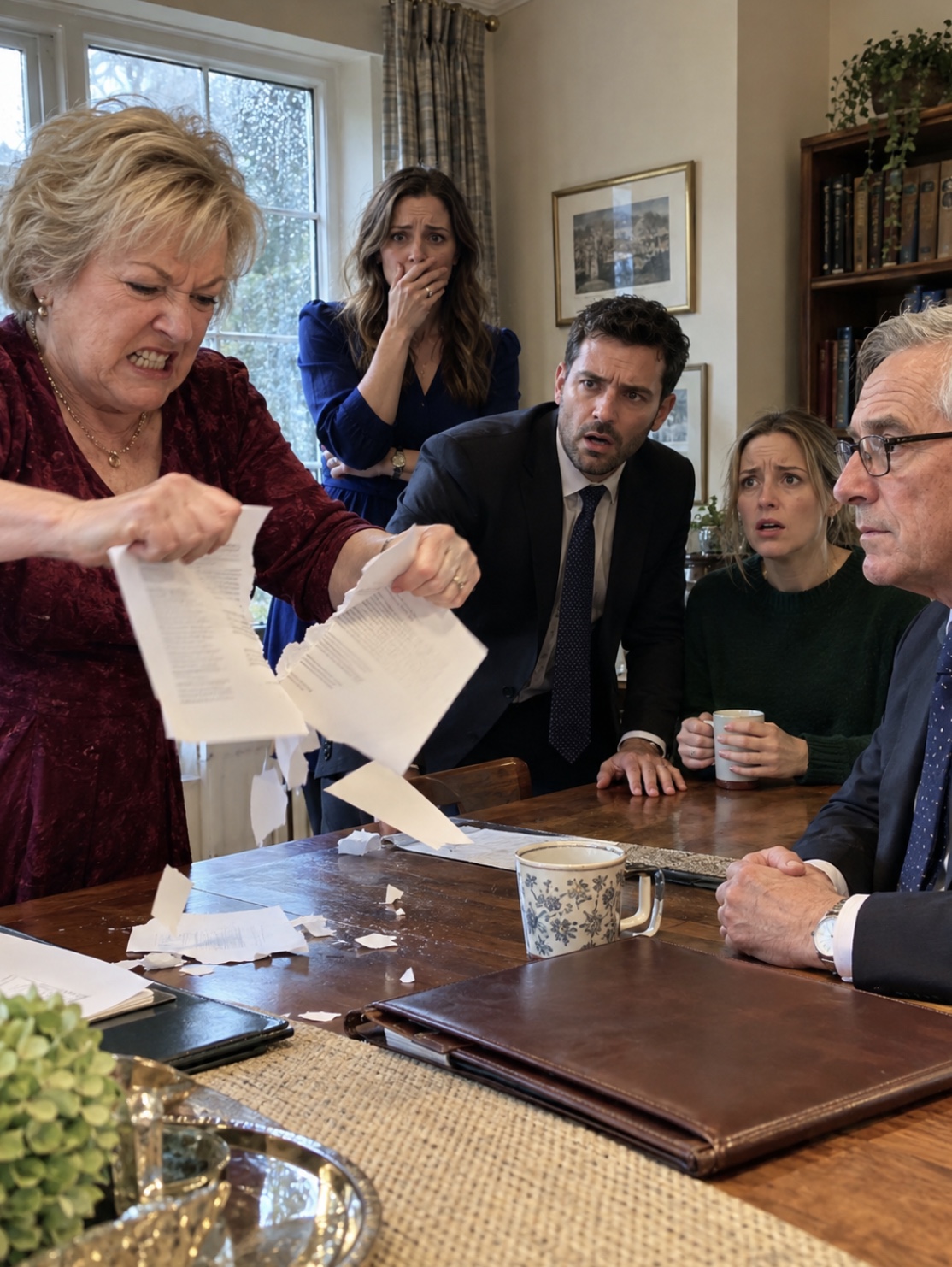
She reached across the solicitor’s dining-room table, snatched the will from beneath his hand, and tore it straight down the middle.
The sound of paper ripping was shockingly loud.
Everyone froze.
My husband, Daniel, was still wearing the same black tie he had worn at the crematorium in Surrey two hours earlier. His younger sister, Chloe, sat beside him with both hands around a mug she hadn’t touched. I was near the window, watching rain crawl down the glass.
Margaret, my mother-in-law, tore the document again.
And again.
Four pieces became eight.
She dropped them onto the table.
“There,” she said, breathing hard. “That nonsense is finished.”
Mr Whitmore, the solicitor, looked down at the scraps.
Then he calmly removed his glasses.
“That was a copy, Mrs Carter.”
Margaret’s face changed.
Not much.
But enough.
“Excuse me?”
“The original is held securely at my office.”
For several seconds, nobody spoke.
Then Margaret laughed.
It wasn’t a natural laugh. It was too sharp and too quick.
“Oh, for heaven’s sake. I thought you’d brought the real thing.”
Mr Whitmore folded his glasses and placed them beside his leather folder.
“No solicitor brings an original will to an informal family reading.”
“This isn’t America,” Chloe muttered.
Margaret turned toward her.
“What did you say?”
“Nothing.”
But the silence had already shifted.
Until that moment, everyone had treated Margaret like a grieving widow who was understandably tense after losing her husband of thirty-eight years.
After that moment, I started wondering what exactly she had been so desperate to destroy.
My father-in-law, Peter Carter, had died eleven days earlier after a short illness.
He was sixty-eight.
For most of the twenty years I had known him, Peter had been one of those quiet English men who always seemed to be repairing something. A fence panel. A dripping tap. A lawnmower. Once, during Christmas dinner, he disappeared for twenty minutes because he noticed the shed door wasn’t closing properly.
He had worked as a building surveyor before retiring.
He wasn’t rich.
At least, none of us thought he was.
He and Margaret lived in a detached 1970s house outside Guildford. They owned it outright, but the place was hardly a mansion. Three bedrooms, one small conservatory, a narrow garden, and a kitchen Peter had been saying he would replace “next spring” for about six years.
Daniel and I lived forty minutes away in Woking with our eight-year-old daughter, Lucy.
Chloe lived in Brighton.
Peter had always been careful with money. He bought used cars, repaired old appliances, and complained if anyone left the heating on with a window open.
So when Mr Whitmore told us the estate had “several components requiring explanation”, I assumed he meant the house, some savings, and perhaps Peter’s pension arrangements.
Margaret apparently assumed the same.
She sat back down.
“Fine,” she said. “Read whatever version you like.”
Mr Whitmore didn’t read it word for word.
Instead, he explained the structure.
Peter had left Margaret the right to remain in the marital home for the rest of her life.
Margaret nodded immediately.
“Obviously.”
But she did not own the property outright.
On Margaret’s death—or if she permanently moved out—the house would pass equally to Daniel and Chloe.
Margaret stopped nodding.
“What?”
Daniel frowned.
“I thought the house was joint.”
“It was originally,” Mr Whitmore said. “The ownership structure was changed twelve years ago.”
Margaret stared at him.
“Without my knowledge?”
Mr Whitmore didn’t answer immediately.
“That question may be more complicated than it sounds.”
I saw Daniel glance at me.
Margaret’s voice rose.
“No. It is not complicated. I am his wife.”
Mr Whitmore continued.
Peter had also left £42,000 in cash savings. Fifteen thousand to Chloe. Fifteen thousand to Daniel.
Five thousand to Lucy.
Two thousand each to two local charities.
And the remaining three thousand to cover some estate expenses.
Margaret went very still.
“And me?”
“You have the lifetime right to the house. There is also a monthly payment provision from a small investment account.”
“How much?”
“Eight hundred pounds per month.”
Margaret stared at him as if he had insulted her.
“Eight hundred?”
“It is in addition to your existing pension income.”
She stood up.
“I don’t need to listen to this.”
“Margaret,” Daniel said quietly.
“No. Your father has humiliated me in front of my own children.”
Chloe finally put down her mug.
“Mum, you just tore up his will.”
Margaret swung toward her.
“Because I knew this would happen.”
That sentence landed differently from everything else.
Daniel leaned forward.
“What do you mean, you knew?”
Margaret blinked.
“I mean I knew he’d been listening to ridiculous people.”
“What people?”
“Oh, don’t start.”
Mr Whitmore closed his folder.
“There is another matter.”
Margaret’s face tightened again.
“What now?”
“It concerns a property in Portsmouth.”
I looked at Daniel.
He looked genuinely confused.
“Dad owned a property in Portsmouth?”
Mr Whitmore looked directly at Margaret.
“Yes.”
And suddenly, for the first time that afternoon, she stopped pretending she was surprised.
📩 The will was only the beginning — the next revelation changes everything in the first comment. 👇
Daniel noticed it too.
“Mum?”
Margaret looked toward the rain-streaked window.
Mr Whitmore continued carefully.
“It’s a two-bedroom flat in Southsea, purchased in 2009.”
Daniel shook his head.
“Dad never mentioned a flat.”
Chloe looked at Margaret.
“You knew.”
Margaret pressed her lips together.
Mr Whitmore said, “The property is currently worth approximately £285,000.”
I actually thought I had misheard him.
Daniel gave a short laugh of disbelief.
“Two hundred and eighty-five thousand?”
“Thereabouts.”
“And who gets that?”
Nobody moved.
Mr Whitmore turned one page in his notes.
“The flat has been left to Mrs Emily Foster.”
I had never heard the name.
Neither had Chloe.
Daniel’s face went blank.
Margaret closed her eyes.
That was when I knew.
Whatever this was, she had known about it for a long time.
Daniel asked first.
“Who is Emily Foster?”
Mr Whitmore hesitated.
Then he said, “Peter requested that I give you this letter.”
He removed a sealed envelope.
Margaret reached for it.
Mr Whitmore moved it out of her reach.
“It is addressed to Daniel and Chloe.”
Margaret’s voice became icy.
“I am their mother.”
“They are both adults.”
Daniel took the envelope.
He didn’t open it immediately.
He looked at Margaret.
“Who is Emily?”
Margaret picked up her handbag.
“I’m going home.”
Chloe stood.
“No, you’re not.”
“Don’t speak to me like that.”
“You knew Dad owned a flat worth nearly three hundred grand, and now some woman we’ve never heard of gets it.”
Margaret grabbed her coat.
“That is between your father and me.”
Daniel’s voice changed.
It became quieter.
“Is she his daughter?”
Margaret stopped.
I remember the exact sound the radiator made behind me—a small metallic click.
Nobody breathed.
Daniel asked again.
“Is Emily Dad’s daughter?”
Margaret slowly turned around.
“No.”
Too fast.
Too firm.
Mr Whitmore looked down at the table.
Daniel saw it.
“Is she?”
Mr Whitmore replied, “The letter explains Peter’s wishes more appropriately than I can.”
Daniel opened the envelope.
There were three sheets.
His hands shook slightly as he read.
Chloe moved beside him, reading over his shoulder.
I didn’t.
It wasn’t my letter.
I watched their faces instead.
Confusion first.
Then shock.
Then something worse.
Daniel lowered the pages.
“She’s not his daughter.”
Margaret said nothing.
Chloe looked at her mother.
“She’s yours.”
I felt my stomach drop.
Margaret sat down again.
The colour had drained from her face.
Daniel looked at the letter.
Then back at his mother.
“You had a daughter before you met Dad?”
Margaret whispered, “I was nineteen.”
Nobody spoke.
“She was adopted,” Margaret said. “That was what people did then.”
“You told Dad?”
“Of course I told him.”
Chloe’s voice cracked.
“And he found her?”
Margaret looked at her.
“No.”
“But he owned a flat that he’s leaving to her.”
“He contacted her.”
“When?”
“I don’t know.”
Mr Whitmore intervened.
“Peter first contacted Emily approximately six years ago.”
Margaret looked furious.
“You had no right to say that.”
“I am carrying out your husband’s instructions.”
Daniel rubbed a hand over his face.
“Dad found Mum’s daughter?”
“Yes.”
“And bought her a flat?”
“No,” Mr Whitmore said. “The flat was already his.”
That was the next surprise.
Peter had bought the property during the financial crash.
Not secretly from family money, as Margaret immediately implied.
He had inherited £90,000 from an unmarried uncle in 2008.
He bought the flat cheaply the following year, rented it out, and kept the rental income in a separate account.
Margaret knew the flat existed.
But she believed it had been sold years earlier.
“Why would Dad lie about selling it?” Daniel asked.
Mr Whitmore looked uncomfortable.
“He did not explain that in the will.”
The letter did.
Peter had written that after finding Emily, he had discovered something Margaret had never told him.
Emily’s adoption had not been entirely voluntary.
According to Peter’s letter, Margaret’s parents had arranged everything while she was still in hospital after giving birth. She had been told it would be best if she never tried to contact the baby.
Decades later, Peter had encouraged her to search.
Margaret refused.
Not because she didn’t care.
Because she was terrified.
Peter searched alone.
He found Emily living near Portsmouth with her husband and teenage son.
He contacted her carefully.
At first, she wanted nothing.
Then, gradually, they began meeting.
Not as father and daughter.
Peter was clear about that.
He introduced himself as Margaret’s husband.
For years, he acted as a bridge between two people who were both too frightened to cross the distance themselves.
Daniel looked up from the letter.
“You met her?”
Margaret’s eyes filled.
It was the first genuine emotion I had seen from her all day.
“Once.”
Chloe whispered, “When?”
“Three years ago.”
“What happened?”
Margaret shook her head.
“She looked like my mother.”
No one said anything.
“She walked into the café,” Margaret continued, “and I couldn’t breathe. She had Mum’s mouth. The same way of holding her handbag. Ridiculous things.”
“What happened?” Daniel asked again.
“She asked me why I never looked for her.”
“And?”
“I told her I had another family.”
Chloe recoiled.
“Mum.”
“I didn’t mean it like that.”
“How else could you mean it?”
Margaret pressed both hands against her face.
“I panicked.”
She admitted that she left the café after twenty minutes.
Emily never contacted her again.
Peter continued seeing Emily occasionally.
Margaret knew.
They argued about it for years.
Then came the part Peter had hidden.
He didn’t keep the flat because of Emily.
He kept it because of Margaret.
The rental income had been quietly used to cover several debts she had never told the children about.
Catalogue accounts.
Credit cards.
A personal loan.
Then another loan.
The amounts were not enormous individually, but together they had reached nearly £60,000 over the years.
Peter cleared them.
Twice.
Daniel stared at his mother.
“You had sixty grand of debt?”
Margaret snapped, “Not all at once.”
“That’s your defence?”
“I paid for this family too.”
“Nobody said you didn’t.”
“You children have no idea what life costs.”
Chloe shook her head.
“This isn’t about groceries, Mum.”
Margaret suddenly stood again.
“You’re enjoying this.”
Chloe looked stunned.
“What?”
“You always liked seeing me embarrassed.”
“That’s insane.”
Mr Whitmore raised his hand.
“There is more.”
I don’t think any of us wanted more.
But Peter had apparently spent years preparing for precisely that day.
The Southsea flat was going to Emily, but not simply because she was Margaret’s biological daughter.
Peter’s letter explained that Emily had repeatedly refused money from him.
She did not know he planned to leave her the property.
She had once told him that she wanted nothing from Margaret except one honest conversation.
Peter had written:
If Emily accepts the flat, good. If she sells it, good. If she refuses it, also good. I am not purchasing forgiveness for Margaret. That cannot be bought.
Margaret started crying silently.
Daniel continued reading.
Then he stopped.
“What?”
Chloe leaned closer.
“What does it say?”
Daniel looked at his mother.
“Dad knew you tried to sell the flat.”
Margaret froze.
That was the real secret.
Two years before Peter died, Margaret had found old paperwork and realised he still owned the Southsea property.
She contacted an estate agent.
She told them Peter was ill and that she had authority to act for him.
She did not.
The agent eventually contacted Peter directly because Margaret could not provide the necessary documents.
Peter found out.
They had a huge argument.
Margaret insisted she was trying to release money for “their retirement”.
Peter believed she intended to help Chloe buy a house without telling Daniel.
Chloe’s face went scarlet.
“Me?”
Margaret didn’t answer.
“Mum?”
“I was going to help you.”
“With Dad’s property?”
“You were renting that awful flat.”
“I never asked you for £200,000!”
“It wasn’t going to be that much.”
Daniel stood.
For the first time all afternoon, he looked angry rather than shocked.
“So that’s why you tore the will.”
Margaret wiped her face.
“No.”
“You thought Dad had written about the flat.”
“I was upset.”
“You knew exactly what you were destroying.”
She turned to me unexpectedly.
“Sarah, tell him. You’ve been married. You know what it’s like when money gets mixed between two people.”
I shook my head.
“Don’t bring me into this.”
Her expression hardened.
Of all the things she had heard that day, somehow that offended her most.
Mr Whitmore then told us Peter had changed his will eight months before his death.
Not because he had recently discovered the attempted sale.
He had known about it for two years.
The change happened after something else.
Emily had written him a letter.
In it, she said she had decided she was willing to meet Margaret again, but only if Margaret approached her herself.
Peter had kept the letter.
He gave Margaret a copy.
Margaret claimed she never received it.
Peter believed she had thrown it away.
After his death, Mr Whitmore found the original among Peter’s documents.
Margaret stared at him.
Then she whispered, “That’s not true.”
Mr Whitmore opened another envelope.
“This was found in Peter’s desk.”
Inside was the letter.
Unopened.
It was addressed to Margaret.
But across the front, in Peter’s handwriting, were five words:
She says she is ready.
Margaret sank into her chair.
For a while, nobody spoke.
Then Chloe asked, “Why didn’t you open it?”
Margaret cried harder.
“I thought it was another lecture from your father.”
“You knew who it was from?”
“I guessed.”
“And you still didn’t open it?”
Margaret looked at both her children.
“I was ashamed.”
That answer finally sounded true.
Not greedy.
Not defensive.
Not dramatic.
Just ashamed.
The strange thing is that after everything—the debts, the attempted sale, the torn will—that was the moment the anger in the room softened.
Not disappeared.
But changed.
Daniel sat back down.
“You could have told us.”
“I didn’t know how.”
“Dad did.”
“Yes.”
“And you hated him for it.”
Margaret looked toward the scraps of paper still scattered across the table.
“Yes,” she whispered.
The funeral reception had ended hours earlier by the time we left.
Outside, the rain had stopped.
Margaret went home alone.
For two weeks, none of us heard from her except for short messages about paperwork.
Then one Sunday morning, Daniel’s phone rang.
It was Chloe.
“Mum’s gone to Portsmouth.”
We drove there too.
Not because Margaret asked us.
Because Chloe didn’t trust her not to lose her nerve.
We found her outside a red-brick terrace near the seafront, sitting in her car with both hands on the steering wheel.
She had been there forty minutes.
Daniel tapped on the passenger window.
Margaret nearly jumped.
He opened the door.
“You going in?”
“I don’t know.”
Chloe stood beside me.
“You came all this way.”
Margaret looked toward the house.
“What if she doesn’t want to see me?”
Daniel answered quietly.
“Then at least this time she gets to make the choice.”
Margaret sat there another minute.
Then she got out.
She walked to the front door alone.
A woman opened it.
She was in her late forties.
Dark coat. Short brown hair.
From where we stood, I could not hear the first words.
But I saw Margaret cover her mouth.
The woman didn’t hug her.
Not immediately.
They stood facing each other for several seconds.
Then the woman stepped aside.
Margaret entered.
The door closed.
We waited in a café near the promenade for almost two hours.
When Margaret finally called, she asked us to go home without her.
“Are you all right?” Daniel asked.
There was a long pause.
“Yes.”
Then, unexpectedly, she laughed through tears.
“She made me tea.”
That was all.
Emily accepted the flat six months later.
She did not move into it.
She kept the existing tenant and used part of the rent to establish a small annual bursary through a local charity supporting young mothers who had been estranged from their families.
Margaret never asked her to do that.
In fact, when she found out, she cried.
She also never received ownership of the family home.
Peter’s will remained exactly as written.
For the first time in years, Margaret began living within her own income.
She sold her newer car, cancelled three credit cards, and started bringing a notebook when she went shopping.
She still complained about prices.
She still interfered.
She still once told me I was “wasting electricity” by running the dishwasher when it was only three-quarters full.
People do not become entirely different just because one terrible afternoon exposes everything they wanted hidden.
But something did change.
On the first anniversary of Peter’s death, we all met at Margaret’s house.
Emily came too.
So did her husband and son.
There were awkward silences.
There were also jokes.
At one point, Margaret disappeared into the kitchen and returned carrying an old biscuit tin.
Inside were eight small pieces of paper.
The copy of the will.
She had collected them from Mr Whitmore’s table that day.
She had kept every piece.
Daniel looked at them.
“Why?”
Margaret sat down.
“I thought about taping it back together.”
Chloe laughed.
“You realise we can print another copy?”
“I know that now.”
Emily smiled.
Margaret looked at her.
Then she said something I will never forget.
“I spent most of my life believing that if I destroyed the evidence of a mistake, the mistake might disappear too.”
She looked at the torn paper.
“It turns out paper is the easiest thing to replace.”
Nobody answered.
There was nothing to add.
Peter’s original will remained locked in a solicitor’s archive.
The copy stayed in Margaret’s biscuit tin.
And sometimes I think that was exactly where it belonged—not as proof of who inherited what, but as a reminder of the day a woman tried to tear up the past and discovered that the one thing she had actually been given was another chance.