



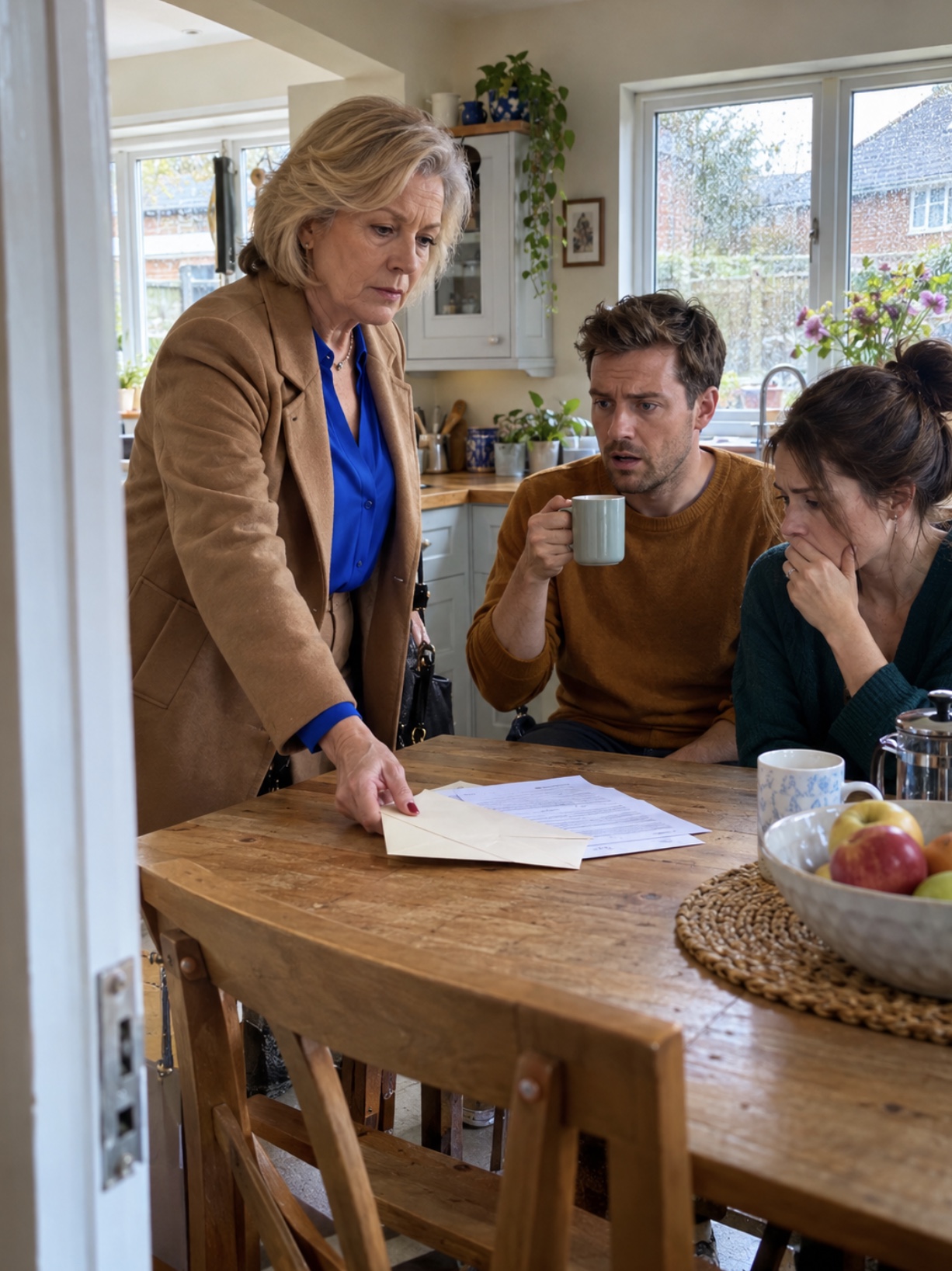
Three days after my father-in-law’s funeral, my mother-in-law placed a cream-coloured envelope on our kitchen table and said, very calmly, “There’s no point arguing about the house anymore. Peter left everything to me.”
My husband, Daniel, stopped halfway through making tea.
I stared at her.
Margaret didn’t look like a woman delivering bad news. She looked relieved.
Outside, rain tapped against the windows of our semi-detached house in Leeds. The kettle clicked off, but Daniel didn’t move. His hand remained wrapped around the mug he had been holding.
“What do you mean, everything?” he asked.
Margaret slid two sheets of paper from the envelope.
“The house in Harrogate. The savings. The investment account. His car. Everything in his name.”
Daniel’s face went pale.
My father-in-law, Peter, had died suddenly from a stroke at sixty-eight. Until then, everyone believed he had been in excellent health. He still went walking in the Yorkshire Dales twice a week, repaired things that didn’t need repairing, and complained about supermarket tomatoes as if poor produce were a personal insult.
More importantly, Peter had always been very open with Daniel about money.
Not exact numbers. But enough.
The Harrogate house had been bought before Peter and Margaret married. Peter had inherited part of the deposit from his own father. For years, he had told Daniel that one day the property would probably be sold and divided fairly.
Not necessarily equally.
Fairly.
Peter had a daughter from his first marriage, Rachel, who lived in York. Daniel was Margaret’s only child.
“Both of you will be fine,” Peter had said more than once at Christmas. “Your mother will be looked after first. After that, what’s left is for you and Rachel.”
Margaret now tapped the document.
“He changed his mind.”
Daniel finally sat down.
“When?”
“Last year.”
“Why didn’t he tell me?”
“Because it was private.”
I looked at the pages. I’m not a solicitor, but even to me the document seemed strangely plain. Peter’s full name was typed at the top. There were paragraphs about property and personal possessions. Two signatures sat at the bottom beside names I didn’t recognise.
Margaret noticed me reading.
“You don’t need to inspect it like a detective, Claire.”
“I’m just looking.”
“Well, don’t. The solicitor will deal with it.”
Daniel looked up sharply.
“Which solicitor?”
She hesitated.
“Not Peter’s usual one.”
That was the first moment I felt something shift.
Peter had used the same small Harrogate law firm for nearly twenty years. They had handled the purchase of a rental flat he later sold, a boundary dispute with a neighbour, and the administration of his sister’s estate.
“Why not?” Daniel asked.
Margaret folded her arms.
“He wanted privacy.”
“From his solicitor?”
“From everyone.”
The conversation ended badly.
Daniel refused to accept anything until the will had been reviewed. Margaret accused him of being greedy before Peter was even “cold in the ground”. Daniel shouted that he wasn’t asking for money, only an explanation.
Then Margaret said something that made the entire room go quiet.
“Your father knew exactly what kind of son you were.”
Daniel looked as though she had slapped him.
She gathered the documents, pushed back her chair, and left.
That evening, he barely spoke.
At eleven, I found him sitting on the landing floor outside our spare room with an old cardboard box beside him.
“What are you doing?”
“Dad gave me these last Christmas.”
Inside were photographs, receipts, insurance papers, an old Ordnance Survey map, and several folders.
Daniel pulled out one blue file.
“Look.”
It contained copies of letters from Peter’s usual solicitor.
The most recent was dated just seven months earlier.
Daniel read it twice.
Then handed it to me.
It referred to “your existing will dated 14 May 2018” and a discussion about whether Peter wanted to update a charitable donation and clarify a clause concerning the Harrogate property.
The letter ended:
“If you decide to make amendments, please contact us and we will prepare a revised draft.”
Daniel looked at me.
“Dad’s supposed new will is dated before this letter.”
I felt a chill.
“When exactly?”
He opened the photograph he had taken of Margaret’s document.
The date at the top was 3 February.
The solicitor’s letter was from September.
Daniel whispered, “Why would Dad’s own solicitor talk about his 2018 will as the existing will seven months after Mum says he signed a new one?”
The next morning, he rang Rachel.
At first she thought he was calling about funeral flowers.
When he explained, she went silent.
Then she said, “He told me something in August.”
“What?”
“That he’d never sign anything without Graham.”
Graham Collins was Peter’s solicitor.
Rachel continued, “Dad and I were talking about Mum’s sister after that inheritance row. He said people do stupid things when property is involved. Then he laughed and said, ‘That’s why Graham has everything locked down.’”
Daniel rubbed his forehead.
“Did he ever tell you he was changing his will?”
“No.”
“Did he say Mum would get everything?”
“No. The opposite, really.”
Then Rachel added, “Dan, don’t confront her again. Get the document checked.”
So we did.
Three days later, Daniel, Rachel, Margaret and I sat in a meeting room at Peter’s old law firm.
Graham Collins was in his early sixties, softly spoken and almost irritatingly calm. His office smelled faintly of coffee and old paper.
Margaret placed the will in front of him.
“I’d like probate dealt with quickly,” she said.
Graham adjusted his glasses.
He read the first page.
Then the second.
He turned back to the first.
His expression barely changed.
But I noticed his finger stop beneath the date.
“Mrs Whitmore,” he said, “may I ask you one question?”
Margaret leaned back.
“Of course.”
Graham looked directly at her.
“Where was Peter on the third of February last year?”
Margaret’s face emptied.
Daniel turned towards her.
Rachel frowned.
“What does that matter?” Margaret asked.
Graham did not answer immediately.
Instead, he opened a file on his desk.
“That date matters a great deal.”
📖 The document looked convincing — until one tiny detail sent the whole family searching for answers. The continuation is in the first comment 👇
Margaret’s voice hardened.
“He was at home.”
Graham slowly shook his head.
“No, he wasn’t.”
Daniel leaned forward.
“How do you know?”
“Because I was with him.”
The silence that followed felt almost physical.
Graham pulled out a diary entry and a copy of an attendance note.
“Peter was in my office that morning from ten fifteen until shortly after midday.”
Margaret stared at him.
Graham continued.
“He came here because he wanted advice about a neighbour’s proposed extension. We also discussed his will.”
Rachel whispered, “On the same day?”
“Yes.”
“And?”
“He did not sign a new will.”
Margaret’s hand moved towards her handbag.
Graham placed one palm over the document.
“I’ll need to retain this for the moment.”
“You absolutely will not.”
“I strongly advise you not to remove it.”
Her chair scraped backwards.
“This is ridiculous.”
Daniel looked at her.
“Mum, where did you get it?”
“Your father gave it to me.”
“When?”
“A few weeks before he died.”
“Then why is it dated last year?”
“He kept it.”
Graham looked at the witness names.
“Do you know these people?”
Margaret glanced down.
“One was someone Peter knew.”
“One?”
“I don’t remember.”
Rachel stood.
“You brought us a will supposedly signed by Dad on a day when his solicitor can prove he was sitting in this office discussing a different will.”
Margaret snapped, “Stop being dramatic.”
But Graham was still reading.
He picked up the second page and studied Peter’s signature.
Then he opened another folder containing original documents.
“Daniel,” he said, “I’m not a handwriting expert, so I’m not making any conclusions from appearance alone. But there is another problem.”
“What?”
“The address.”
The new will listed Peter’s address as 46 Moorland Crescent.
“That was his house,” Margaret said.
“Yes,” Graham replied. “But the postcode printed here is not the postcode for Moorland Crescent.”
Margaret said nothing.
“It’s the postcode of a property in Knaresborough.”
I felt Daniel’s hand tighten around mine.
“Whose property?”
Graham turned his computer screen slightly and typed.
Then he paused.
“I believe we should proceed carefully.”
Rachel had already taken out her phone.
Within thirty seconds she had found it.
The postcode belonged to a small development of flats near the railway station.
Margaret abruptly stood.
“I’m leaving.”
Daniel blocked neither the door nor her path.
He simply asked, “Who lives there?”
She pushed past him without answering.
By evening, Rachel had found the answer.
One of the flats belonged to a woman named Susan Hale.
None of us recognised the name.
Daniel searched social media. Nothing useful.
Rachel found a company listing showing Susan as the former director of a small bookkeeping business.
Then I remembered something.
At Peter’s funeral, a woman had stood at the back of the church alone. Late fifties, maybe early sixties. Grey coat, dark green scarf. She didn’t join us afterwards.
Peter had many friends, so I hadn’t thought much about her.
But now I asked Rachel, “Was there a woman at the funeral you didn’t know?”
Rachel looked at me.
“The one by the side entrance?”
“Yes.”
Her expression changed.
“I noticed Mum watching her.”
The following morning, Daniel received a message.
Not from Margaret.
From an unknown number.
It read:
Daniel, my name is Susan Hale. I believe we need to speak about the document your mother has shown you. Your father asked me to contact you if anything happened to him unexpectedly.
Daniel called immediately.
Susan agreed to meet that afternoon in a café near York station.
She arrived carrying a battered leather folder.
The moment she sat down, Daniel asked, “Did you witness my father’s will?”
Susan looked genuinely shocked.
“No.”
“Your postcode is on it.”
She closed her eyes.
“I thought she might do something like this.”
“Who?”
“Margaret.”
Daniel’s jaw tightened.
Susan took a moment before continuing.
She had worked for Peter more than fifteen years earlier when he owned a small building supplies business. She handled his accounts. They had remained friends afterwards, mostly because Susan helped him organise paperwork after his first wife died.
She was not Peter’s lover.
That was the first thing she made clear.
“The reason your father trusted me,” she said, “was that I knew what happened when he married your mother.”
Daniel frowned.
“What happened?”
Susan opened the folder.
Inside were bank statements, photocopies and handwritten notes.
“When Peter married Margaret, he was already financially comfortable. She wasn’t. There was nothing wrong with that. They agreed the Harrogate house would remain his, but she would have the right to live there if he died first.”
Daniel nodded.
“That sounds like Dad.”
“The problem started about four years ago.”
Susan placed a statement on the table.
Several large transfers had been highlighted.
£9,000.
£12,500.
£7,200.
All from Peter’s savings.
All transferred to an account in Margaret’s name.
“Did Dad know?”
“At first, yes.”
“What do you mean, at first?”
Susan explained that Margaret had asked Peter for money to help her younger brother, Colin, whose catering business had failed.
Peter agreed to lend £9,000.
Then another transfer appeared.
Then another.
Peter became suspicious.
By the time he checked carefully, more than £40,000 had moved from accounts he believed were untouched.
Daniel looked stunned.
“Why didn’t he go to the police?”
“Because he loved her. And because some of the transfers had been made from a joint access arrangement he had authorised years earlier. Legally, it was complicated. Emotionally, worse.”
“Did he confront her?”
“Yes.”
“When?”
“Last winter.”
That explained the timing.
Susan continued.
Peter had begun reorganising everything. He moved part of his investments. He met Graham to review the will. He wanted Margaret protected, but not given unrestricted control.
Then Susan took out a sealed copy of another document.
Not a will.
A letter.
It was addressed to Daniel and Rachel.
Peter had written it by hand six months before he died.
Daniel read silently.
Halfway through, he covered his mouth.
Peter explained that he did not want his children blaming Margaret for every disagreement after his death. He admitted their marriage had become difficult, especially around money.
But one sentence changed everything:
“If your mother produces any document suggesting I have left the Harrogate house solely to her, speak to Graham before doing anything.”
Daniel read it again.
Rachel, who had joined us by video call, whispered, “He knew.”
Susan nodded.
“He was afraid Margaret would pressure him into signing something. He told me she had brought home a document prepared by someone she knew through Colin.”
“Did he sign it?”
“No. He tore it up.”
The forged will appeared to be a recreated version of that document.
But there was still a question.
Who had made it?
The witness names eventually answered that.
One belonged to a man called Martin Hale.
Susan’s ex-husband.
The other was his former business partner.
Susan looked horrified when Graham later contacted her.
Martin had died eighteen months earlier.
The second witness had moved to Spain.
More importantly, neither man had known Peter.
When Daniel confronted Margaret again, he did it at her house with Graham present.
She denied forging anything.
Then she changed her story.
Peter had signed it, she insisted, but perhaps the date was wrong.
Then she said Peter might have signed a blank page.
Then she blamed Colin.
“Your uncle found someone who helped with legal paperwork,” she said. “I didn’t create it.”
Daniel stared at her.
“Did Dad sign that will?”
Margaret started crying.
Not loudly.
Almost angrily.
“I spent twenty-seven years with that man.”
“That wasn’t my question.”
“I cooked for him. I looked after him when his knee was bad. I went to every miserable work dinner. I sat beside your grandmother when she was dying. And now Rachel walks in and gets half a house because she shares his blood?”
Rachel went pale.
Daniel said quietly, “Dad was my blood too.”
“You have your own home.”
“So does that make forgery acceptable?”
“I didn’t forge his signature.”
“Then who did?”
Margaret said nothing.
That silence gave us the real answer.
She may not have physically written the signature. But she knew the document was false.
And the final truth was even uglier.
Colin had paid a man he knew to reproduce Peter’s signature from an old Christmas card and prepare the document. Margaret provided copies of Peter’s papers, including Susan’s old business address by mistake. She thought the postcode belonged to one of Peter’s former contacts and never checked.
The false will had been prepared months earlier.
Margaret had hidden it.
She apparently intended to use it only if Peter died before completing his new arrangements.
No one expected that to happen so soon.
When Peter suffered the stroke, Margaret found herself holding exactly what she had once considered merely a “backup plan”.
She used it.
The police became involved after Graham reported the suspected forged document. The probate application was stopped.
But there was one final surprise none of us expected.
Peter’s valid will from 2018 did not divide the house equally between Daniel and Rachel.
Nor did it leave everything to Margaret.
Margaret had the right to remain in the Harrogate property for the rest of her life, provided she paid ordinary household expenses and maintained the property. After her death or voluntary move, the house would be sold.
Forty percent would go to Rachel.
Forty percent to Daniel.
The remaining twenty percent would go to a local hospice that had cared for Peter’s first wife.
His savings were different.
Margaret received £30,000 outright.
Rachel received £20,000.
Daniel received £20,000.
The rest went to the same hospice.
When Graham finished reading, nobody spoke.
Then Margaret laughed once.
A small, exhausted sound.
“He left me the right to live there anyway?”
“Yes,” Graham said.
“For life?”
“Yes.”
She looked down at her hands.
“So I could have stayed.”
Daniel’s expression didn’t change.
“You could have stayed without doing any of this.”
That was the part that destroyed her.
Not the police investigation.
Not Colin refusing to take responsibility.
Not the possibility of losing people’s trust.
It was realising that Peter had already protected her.
He had given her exactly the security she claimed she was afraid of losing.
She had tried to steal more and nearly destroyed the thing she already had.
In the end, Margaret chose to leave the Harrogate house.
She said she couldn’t bear living there anymore.
It was sold the following spring.
Daniel donated an extra portion of his inheritance to the hospice.
Rachel did the same.
Margaret moved into a small rented bungalow outside Ripon. Daniel still speaks to her, but not often. Their conversations are polite, short and strangely formal.
A year after Peter’s death, Daniel and I went walking near Malham, one of his father’s favourite places.
At the top of the path, Daniel stopped and pulled a folded piece of paper from his coat.
It was a photocopy of Peter’s letter.
He had carried it for months.
“I kept thinking the worst part was Mum lying,” he said.
I asked, “What was?”
He looked towards the valley.
“That Dad knew she might.”
Then he folded the letter carefully and put it away.
We stood there for a while in the cold Yorkshire wind.
And for the first time since the funeral, Daniel talked about his father without mentioning the will, the house, the police or the money.
He told me about being eight years old and getting lost with Peter on a walking trail because neither of them wanted to admit they’d read the map wrong.
By the time he finished the story, he was laughing.
And somehow, that felt like the first thing Peter had truly left him that no forged document could ever take away.