



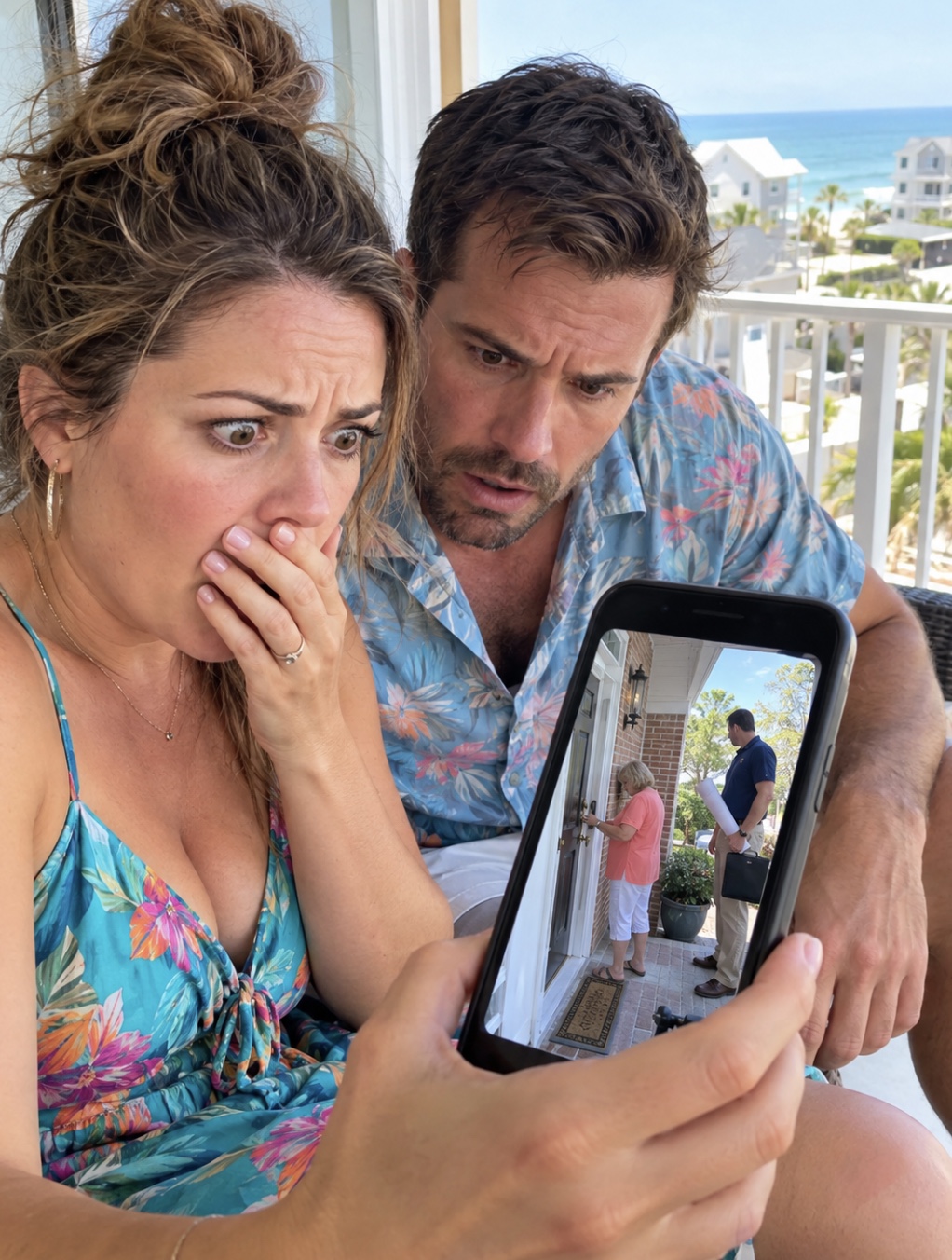
The first thing I saw on my phone was my mother-in-law standing on our front porch with a man I had never seen before.
The second thing I saw was the key in her hand.
I was sitting barefoot on the balcony of a rental condo in Charleston, South Carolina, with a paper cup of coffee cooling beside me and the Atlantic visible between two rows of pastel houses. My husband, Ben, was still asleep inside.
It was 8:14 on Tuesday morning, the second day of the anniversary trip his mother had given us.
The notification from our doorbell camera said simply:
“Person detected at Front Door.”
I almost ignored it.
Then I opened the live view.
“Ben.”
He didn’t answer.
“Ben.”
Something in my voice must have reached him because he appeared in the doorway a few seconds later, hair flattened on one side, squinting against the sunlight.
“What happened?”
I turned the phone toward him.
On the screen, his mother, Diane, stood on the porch of our house in Columbus, Ohio, wearing white capri pants and a coral blouse. Beside her was a tall man in khakis carrying a black leather folder.
Diane looked straight into the camera.
Then she stepped closer to the door.
Ben frowned.
“What is she doing there?”
“That was going to be my question.”
The man said something we couldn’t hear clearly.
Diane answered, “Yes, this is the one.”
Then she unlocked our front door.
Ben stopped breathing for half a second.
I watched his face change.
Three months earlier, we had taken Diane’s spare key away.
Not dramatically. Not after some giant family explosion. We had simply changed the locks after she let herself in one Saturday morning while we were still in bed because she wanted to “drop off muffins.”
When Ben asked her to return the old key, she had looked hurt.
“I’m your mother, not a burglar.”
Ben had replied, “Then knock like everyone else.”
We believed that had ended it.
Apparently not.
I tapped the speaker button.
“Diane?”
On the video, she froze.
The man beside her turned toward the camera.
“Diane,” I repeated, louder. “Why are you at our house?”
For several seconds, no one moved.
Then Diane smiled.
Not a guilty smile.
A prepared one.
“Oh! Claire. Good morning.”
Ben leaned toward the phone.
“Mom?”
Her smile vanished.
“Ben? You’re awake already?”
“It’s eight in the morning.”
“I thought you two would be out sightseeing.”
My stomach tightened.
That sentence bothered me more than the key.
Not “I didn’t know you were watching.”
Not “I can explain.”
I thought you’d be out.
Ben must have heard it too.
“Who is that man?”
The stranger raised one hand awkwardly.
“Hi. I’m Greg.”
“That answers absolutely nothing,” I said.
Diane gave a small laugh.
“Claire, please don’t make this uncomfortable.”
“You unlocked our house.”
“I need ten minutes.”
“For what?”
She glanced at Greg.
That tiny movement told me she didn’t want to answer in front of him.
Ben said, “Mom, step back outside and lock the door.”
“Benjamin.”
“Now.”
His tone was so sharp that even I turned toward him.
Diane stared at the camera.
Then, with visible annoyance, she backed out. Greg followed. She shut the door and locked it.
Ben immediately opened our smart-lock app.
The log showed the door had been unlocked with a physical key.
Not an old electronic code.
A physical key.
He looked at me.
“You changed the deadbolt, right?”
“I watched the locksmith install it.”
“Then how does she have a key?”
That question followed us for the rest of the morning.
Diane ignored three calls from Ben.
Then she texted:
“Please enjoy your trip. You’re turning something harmless into a crisis.”
Ben called again.
No answer.
I opened the camera history.
At 7:51, Diane’s car had pulled up.
At 7:57, Greg arrived separately.
At 8:13, they walked to our door.
Then I noticed something else.
Diane hadn’t come empty-handed.
Before approaching the porch, she had taken a rolled-up tube from her trunk and handed it to Greg.
“Go back,” I said.
“To what?”
“Her car.”
We replayed the video.
Ben zoomed in.
The tube was white, about three feet long.
Greg had tucked it under one arm.
Ben stared at it.
“What is that?”
“I don’t know.”
But I had a guess.
I work in commercial interior design. Architects bring rolled drawings into meetings all the time.
Plans.
Floor plans.
Measurements.
Renovation sketches.
Except we weren’t renovating anything.
Our house was a 1950s brick ranch we had bought four years earlier after almost a year of searching. It wasn’t huge: three bedrooms, two bathrooms, a narrow kitchen, and a finished basement where Ben had his home office.
We had spent weekends refinishing the oak floors ourselves.
I had painted the kitchen cabinets twice because the first green looked like toothpaste.
Ben had planted a maple in the backyard the spring after we moved in and still checked it after every bad storm.
The house wasn’t an investment project.
It was ours.
And his mother had just arrived with a stranger carrying what looked suspiciously like architectural plans.
📌 What they were planning inside our house was far stranger than I imagined — keep reading below.
Diane finally called at 10:36.
Ben put her on speaker.
“Before you start,” she said, “Greg is a contractor.”
I closed my eyes.
Of course he was.
Ben asked, “Why did you bring a contractor to our house?”
“I wanted an estimate.”
“For what?”
A pause.
“The downstairs.”
Ben looked at me.
“Our basement?”
“It’s wasted space.”
“It’s my office.”
“There’s plenty of room down there.”
“For what, Mom?”
Another pause.
Then Diane sighed as though we were the ones making this difficult.
“For a small apartment.”
I actually laughed.
Not because it was funny.
Because the alternative was screaming.
Ben said, “Whose apartment?”
“You don’t have to react like that.”
“Whose apartment?”
“Mine.”
The room went completely silent.
Outside, somewhere below our balcony, a delivery truck beeped while reversing.
Ben sat down.
“What?”
Diane rushed into the explanation now, words spilling out faster.
“It wouldn’t be permanent. Maybe a year or two. I’ve been thinking about selling my condo while the market is still decent. The association fees keep going up, and it makes no sense for me to keep paying almost five hundred dollars a month when you have all that space.”
I stared at Ben.
Diane had a two-bedroom condo twelve minutes from us.
She was sixty-three, healthy, employed three days a week at a dental office, and perfectly capable of living independently.
Ben said, “You planned to move into our basement?”
“I planned to discuss it.”
“You brought a contractor into my house while I was in South Carolina.”
“To get numbers first. There’s no point starting a conversation without knowing whether it’s practical.”
I said, “How did you get a key?”
Silence.
“Diane?”
“Well…”
Ben leaned forward.
“How did you get the key?”
“You gave one to Mark.”
My stomach dropped.
Mark was Ben’s younger brother.
We had given him an emergency key because he lived nearby and sometimes checked our cat when we traveled.
Ben said, very quietly, “Mark gave you our key?”
“He didn’t give it to me.”
“Then what?”
“I borrowed it.”
“How?”
“He left it on his kitchen counter.”
I stared at the phone.
Ben rubbed one hand over his face.
“You took our house key from Mark without telling him.”
“I made a copy. Don’t be dramatic.”
That was the moment everything changed.
Until then, I had still been trying to fit her behavior into a category I understood: intrusive mother-in-law, poor boundaries, entitlement.
But secretly copying our emergency key was different.
She had planned around our refusal.
I asked, “Whose idea was the anniversary trip?”
Diane didn’t answer.
Ben looked at me.
I continued.
“You’ve never given us a trip before. Last year you gave us a restaurant gift card. This year you suddenly paid for flights and a condo for seven nights.”
“It was a gift.”
“Was it?”
“What are you suggesting?”
“I’m asking whether you sent us away because you wanted access to the house.”
“That is ridiculous.”
But her voice changed.
Ben heard it too.
“Mom.”
Diane exhaled.
“The timing was convenient.”
I felt cold despite the Carolina heat.
Ben stood.
“You planned this.”
“No. I offered you a vacation. You accepted it. While you were gone, I thought I could get a professional opinion without everyone becoming emotional.”
“Everyone?” I repeated. “You mean us. The people who own the house.”
Diane snapped, “I helped you buy that house.”
There it was.
A sentence I had heard in smaller forms for four years.
I bought you that refrigerator.
I paid for the movers.
I covered your inspection.
The truth was that when we bought the house, Diane had given Ben $8,000 from money his grandmother had left him years earlier but kept in an account in Diane’s name while he was in college.
We had always considered it Ben’s inheritance.
Diane increasingly referred to it as her contribution.
Ben’s face hardened.
“You transferred Grandma’s money to me.”
“I managed that money for fifteen years.”
“That doesn’t make it yours.”
“I’m not saying it does.”
“You just said you helped buy the house.”
“Because I did!”
“No. Claire and I put down forty-seven thousand dollars. You transferred me money Grandma left me.”
There was a long pause.
Then Diane said, much more quietly, “You wouldn’t have gotten that house without me.”
Ben hung up.
For the next hour, he barely spoke.
Then he called Mark.
His brother answered on the second ring.
“You guys having fun?”
“Did Mom copy our house key?”
“What?”
Ben explained.
Mark cursed.
He said Diane had come by for lunch six weeks earlier. The key had been sitting in a ceramic bowl near the door because Mark had used it the previous weekend to water our plants.
“I didn’t give it to her. I swear.”
“I believe you.”
“Jesus. Is she at your house?”
“She was.”
Mark went quiet.
Then he said, “Ben, there’s something else.”
I looked at my husband.
Ben switched the phone to speaker.
“What?”
“Mom asked me two months ago if your neighborhood allows accessory dwelling units.”
My skin prickled.
“What did you say?”
“I thought she was asking because one of her friends wanted to build one. I told her I had no idea.”
“Anything else?”
Another pause.
“She asked whether Claire’s company had ever done basement conversions.”
I felt anger rise slowly through my chest.
Diane hadn’t just had an impulsive thought.
She had researched this.
After the call, Ben opened his laptop.
“Let’s go home.”
Our return flight wasn’t until Sunday.
It was Tuesday.
I should have wanted to leave immediately.
Instead, I said, “No.”
He looked at me.
“If we fly home now, she’ll turn this into a story about how we ruined our anniversary because she got an estimate.”
“She already ruined it.”
“Only if we let her.”
He stared at me for a moment.
Then he closed the laptop.
That evening we ate shrimp and grits at a crowded restaurant near King Street. We walked afterward through humid streets while church bells rang somewhere in the distance.
Neither of us talked much about Diane.
For a few hours, we tried to reclaim the vacation.
But at 11:18 that night, the doorbell camera sent another notification.
This time it was Mark.
He waved at the camera and held up a new lockset.
Ben laughed for the first time all day.
Mark had driven over, replaced the deadbolt himself, and left the only two new keys inside a lockbox whose code he texted directly to us.
“Mom called me screaming,” his message said twenty minutes later. “So I guess the old key doesn’t work anymore.”
I slept better.
On Thursday, something unexpected happened.
Diane sent a photograph.
Not of the house.
Of a real-estate listing.
Her condo.
It had been listed that morning.
Ben immediately called her.
“You listed your condo?”
“I told you I planned to sell.”
“Where are you planning to live?”
“I’ll figure something out.”
“You thought you were moving into our house.”
“I said I’ll figure something out.”
Then she added, “Apparently I misunderstood how much family means to you.”
Ben didn’t take the bait.
“What does Greg’s estimate say?”
She went silent.
“You got the estimate, didn’t you?”
“He sent preliminary numbers.”
“How much?”
“Why does it matter now?”
“Send it.”
She refused.
So Ben called Greg.
We found his company online. Small remodeling business. Good reviews. Licensed and insured.
Greg sounded mortified when Ben explained what had happened.
“I honestly thought your mother owned the property,” he said.
“What?”
“That’s what I was told.”
I sat upright.
Ben said, “She told you she owned our house?”
“She said it was a family property and she wanted to convert the basement before moving in.”
Greg paused.
“I’m sorry. I should have verified ownership before even coming out.”
“Did she give you drawings?”
“Rough measurements from an old appraisal.”
My pulse quickened.
“What old appraisal?” I asked.
Greg heard me through the speaker.
“She had a report with floor dimensions.”
Ben and I looked at each other.
We knew exactly what appraisal he meant.
Three years earlier, we had refinanced the mortgage when rates were lower.
The appraisal had been emailed only to Ben and me.
A printed copy was stored in our filing cabinet.
In the basement.
The cabinet was locked.
When we got home Sunday night, Ben went downstairs before we had even unpacked.
The filing cabinet showed no damage.
He unlocked it.
The appraisal folder was still there.
So were our tax documents, insurance policies, and closing paperwork.
But behind the appraisal was a yellow sticky note I had never seen before.
Ben pulled it out.
In Diane’s handwriting were six words:
“Side entrance possible from laundry room.”
Neither of us spoke.
I sat on the basement stairs.
“Ben.”
“I know.”
“She was down here before.”
“I know.”
We checked the camera history as far back as our subscription allowed.
Thirty days.
Nothing.
Then Ben remembered something.
Five weeks earlier, I had been in Cleveland for work. He had gone fishing with Mark for most of a Saturday.
Diane had texted him that afternoon asking whether we wanted her to drop off soup because she had made too much.
Ben had told her to leave it on the porch.
When he returned, the soup was on the porch.
At the time, he thought nothing of it.
Now we knew she already had the copied key.
We couldn’t prove she had entered that day.
But the handwritten note in a locked cabinet told us enough.
That evening, Diane came over.
We didn’t invite her inside.
The three of us sat on the back patio because I didn’t want the conversation happening in the basement she had apparently redesigned in her imagination.
Ben placed the sticky note on the table.
Diane looked at it.
Her expression collapsed.
Not dramatically.
She simply stopped pretending.
“I went downstairs once.”
“When?” Ben asked.
“A few weeks ago.”
“You entered our house without permission?”
“You weren’t home.”
“That is exactly why it was without permission.”
She looked toward me.
“I wasn’t snooping through your personal things.”
“You opened a locked filing cabinet.”
“The little key was taped underneath the drawer.”
I almost admired the absurdity of the defense.
Ben asked the question I had been waiting for.
“Why were you so sure you were moving here?”
Diane folded her hands.
For the first time since Charleston, she didn’t sound angry.
She sounded scared.
“Because I’m in trouble.”
Ben’s expression changed.
“What kind of trouble?”
Diane looked down at the patio table.
Her condo association had approved a major special assessment six months earlier.
The building needed roof work, balcony repairs, and replacement plumbing in several units.
Her share was nearly $31,000.
She had known for months.
She hadn’t told us.
She had also borrowed against a home-equity line several years earlier to help Mark after his divorce and later used more of it to cover credit-card balances.
Between the loan, the special assessment, and rising monthly fees, selling the condo would leave her with far less cash than we assumed.
Possibly less than $20,000 after everything was paid.
“I panicked,” she said.
Ben stared at her.
“So you decided to secretly move into our house?”
“I thought if I could show you how reasonable it was—”
“By sending us out of state?”
Her eyes filled.
“I knew Claire would say no before hearing the idea.”
I answered calmly.
“You were right.”
She flinched.
“But not because I hate you, Diane. Because you copied our key, entered our home, opened private files, hired a contractor, and made plans for property that doesn’t belong to you.”
“I was desperate.”
“Desperate people can still ask.”
That silenced her.
Then Ben asked, “Does Mark know you used the home-equity money to help him?”
Diane looked away.
That was our final surprise.
Mark had never asked her for that money.
After his divorce, Diane had paid off $14,000 of his car loan without telling him where the money came from. She told him it was from savings.
When Ben called him later, Mark went completely quiet.
Then he said, “She told me Dad had left extra money.”
Their father had died six years earlier.
Diane had been rearranging family finances in secret ever since, fixing problems before anyone asked her to, then carrying the consequences alone until she couldn’t anymore.
For years, she had confused helping with deciding.
And when her own crisis came, she assumed we would accept the same arrangement she had imposed on everyone else.
We didn’t.
But we also didn’t abandon her.
The condo sold seven weeks later.
After paying the line of credit, the special assessment, fees, and closing costs, Diane had $23,600 left.
Not enough to comfortably buy somewhere else.
Enough to start over.
Mark insisted on repaying the money she had secretly spent on his car. He couldn’t return it all at once, but he refinanced and gave her $9,000 immediately.
Ben and I helped her find a modest one-bedroom apartment about twenty minutes away.
Not our basement.
Her own place.
She resisted at first.
Then she signed the lease.
A month after she moved, she invited us over for dinner.
There were moving boxes stacked beside the wall and a folding table in place of a dining set.
She had made pot roast, Ben’s favorite.
Halfway through dinner, Diane disappeared into the bedroom.
She returned with a small envelope.
Inside was a brass key.
Our old copied key.
“I know it doesn’t work anymore,” she said.
Ben looked at it.
“So why give it back?”
“Because I should have given it back before I ever used it.”
He closed his hand around the key.
Diane looked at me.
“I thought having a key meant I still had a place in my son’s life.”
I didn’t answer immediately.
Then I said, “You never needed a key for that.”
Her eyes filled again.
This time she nodded instead of arguing.
On our next anniversary, Diane gave us a card.
Inside was a fifty-dollar restaurant gift certificate.
At the bottom she had written:
“No trips this year. I’ve learned my lesson.”
Ben laughed so hard he had to sit down.
We used the gift certificate the following Friday.
Before leaving home, I checked that the doors were locked.
Then, out of habit, I opened the camera app.
The porch was empty.
No contractors.
No surprise visitors.
No one holding a copied key.
Just the maple tree Ben had planted four years earlier, its branches moving softly in the evening wind.
For the first time in months, our house felt quiet again.
And fully ours.