



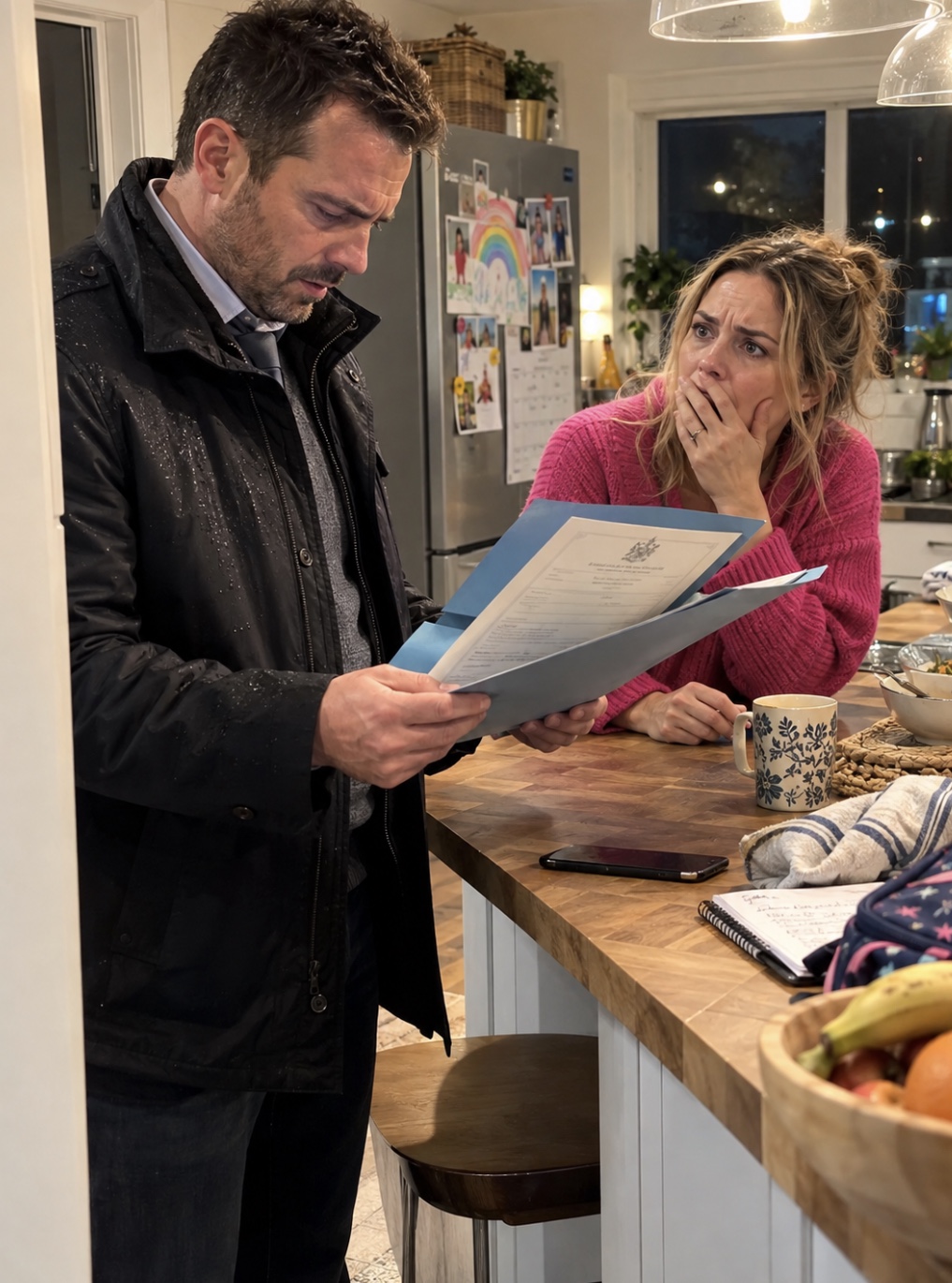
At 7:18 on a rainy Thursday evening, my husband walked into our kitchen carrying a pale blue document folder like it contained something explosive.
He didn’t take off his coat.
He didn’t kiss me hello.
He just stood beside the breakfast bar, rain still shining on his shoulders, and said, “Claire, I need you to sit down.”
Our eight-year-old daughter, Poppy, was upstairs doing spelling homework. The washing machine was running. A supermarket lasagne was cooling on the counter. Everything in our house looked painfully ordinary.
Then Tom opened the folder.
Inside was a birth certificate.
Not his.
Not mine.
Not Poppy’s.
The name printed across the top was Elliot James Mercer, born in Nottingham twenty-nine years earlier.
I looked at Tom.
“Who is Elliot Mercer?”
He rubbed both hands over his face.
“I don’t know.”
That answer frightened me more than almost anything else he could have said.
Two hours earlier, his mother, Margaret, had phoned while we were clearing dinner plates.
“Tom, could you come round?”
Nothing unusual there. Margaret lived twenty minutes away in a neat semi-detached house in West Bridgford and had a talent for turning minor household problems into family emergencies.
A stiff window latch became, “I’m worried someone could get in.”
A blinking router light became, “I think the internet company has cut me off.”
So when Tom asked what was wrong, I expected a dripping tap or a boiler complaint.
Instead, Margaret said, “I need to speak to you privately.”
Tom glanced at me.
“Privately?”
“Yes.”
There was a pause.
“And come alone, please.”
I had laughed.
Not because it was funny, exactly, but because Margaret had been strange with me for years in small, deniable ways. She never insulted me directly. She preferred comments polished enough to pass as concern.
“You work such long hours, Claire. I don’t know how Poppy copes.”
“You’re very independent, aren’t you? Tom always liked feeling needed.”
“Another takeaway? Goodness, you young people are relaxed about these things.”
We weren’t enemies. We simply weren’t close.
Still, asking Tom to come without me was unusual even for Margaret.
He left at half past five.
By six-thirty, I had messaged him once.
Everything okay?
No reply.
At seven, I rang.
Straight to voicemail.
Then, at 7:18, he appeared with Elliot Mercer’s birth certificate.
“What did your mum say?” I asked.
Tom pulled out a chair but didn’t sit.
“She said Dad had lied to her.”
Tom’s father, Peter, had died four years earlier after a short illness. He had been sixty-seven, quiet, decent, fond of golf and terrible jokes. He was also the sort of man who labelled plugs before storing Christmas decorations.
The idea that Peter had some huge secret felt ridiculous.
“What kind of lie?”
Tom slid the certificate towards me.
On it, Elliot’s mother was listed as Sarah Louise Mercer.
The father’s name was blank.
I looked up.
Tom said, “Mum thinks Dad was Elliot’s father.”
I stared at him.
“Thinks?”
“She found this in his papers.”
“When?”
Tom finally sat.
“Apparently last week.”
Apparently.
The word immediately bothered me.
Margaret was the sort of woman who kept every important document in clearly marked plastic wallets. She had reorganised Peter’s paperwork within three months of his death. She knew where the pension statements were, which solicitor held the will, even which drawer contained the original guarantee for a fridge bought in 2011.
“You’re telling me she only found this now?”
“That’s what she says.”
I studied the certificate.
It wasn’t a photocopy. It was an official certified copy issued only five months earlier.
My stomach tightened.
“Tom.”
“What?”
“This wasn’t in your dad’s old papers.”
He looked at me.
I pointed to the issue date.
For several seconds, he didn’t speak.
Then he whispered, “I didn’t notice that.”
The certified copy had been ordered in April.
Peter had been dead for four years.
I asked the obvious question.
“Why would your mother order the birth certificate of a twenty-nine-year-old man she supposedly knows nothing about?”
Tom picked it up again.
His face changed.
That was the moment our quiet Thursday stopped being about a dead father’s possible affair and became something else entirely.
Tom rang Margaret immediately.
She didn’t answer.
He tried again.
Nothing.
At 7:41, she sent one message.
Please don’t discuss this with Claire yet. I need time to explain properly.
Tom showed me the screen.
We both read it twice.
Then I said, “Well, that’s unfortunate.”
He gave a short, humourless laugh.
“What?”
“You’ve already discussed it with Claire.”
That should have broken the tension.
It didn’t.
Because beneath Margaret’s message sat something I hadn’t expected to see.
A second notification.
An email alert.
From a solicitor.
Tom tapped it.
The subject line read:
Regarding the estate of the late Peter Holloway and Mr Elliot Mercer.
I felt every hair on my arms rise.
Tom opened the email.
The solicitor, Helen Draper, was asking Tom to confirm whether he would attend a meeting the following Tuesday “in connection with recently disclosed family information and its possible implications for the administration of the estate.”
Tom read the sentence aloud.
Then again.
“What implications?”
I had no answer.
But I knew one thing.
Whatever Margaret had been trying to control, it had already escaped her control.
📚 The reason behind that birth certificate was stranger than either of us imagined — keep reading below.
The next morning, Tom took the day off work.
He barely slept. At three in the morning, I found him downstairs searching Elliot Mercer online.
There were dozens.
At six-fifteen, he found the right one.
Or at least we thought he had.
Elliot Mercer, aged twenty-nine, worked as a physiotherapist at a sports rehabilitation clinic near Beeston. There was a staff photo.
Tom stared at it for so long that I eventually closed the laptop.
“What are you looking for?”
“A resemblance.”
“And?”
“I don’t know.”
The man in the photo had dark hair, a narrow face and grey-blue eyes.
Peter had had grey-blue eyes.
So did half the country.
At nine-thirty, Margaret finally called.
Tom put her on speaker without telling her.
“Darling,” she began, “I’m sorry about last night.”
“Why did you order Elliot Mercer’s birth certificate?”
Silence.
“Tom—”
“Just answer me.”
Another pause.
“Because I needed to confirm something.”
“What?”
“I’d rather explain in person.”
“I’m coming over.”
“No.”
He looked at me.
“What do you mean, no?”
“I have an appointment this morning.”
“With the solicitor?”
The silence after that was so complete we could hear the clock above the cooker.
Margaret lowered her voice.
“How do you know about Helen?”
“She emailed me.”
“Oh.”
That single syllable carried more panic than her entire previous conversation.
Tom asked, “Is Elliot my brother?”
Margaret did not answer.
“Mum?”
“I don’t know.”
“Then what do you know?”
She exhaled sharply.
“Your father knew Sarah Mercer.”
“How?”
“They worked together years ago.”
That was plausible. Peter had managed procurement for a medical supplies company before retiring. He had travelled around the Midlands constantly in the nineties.
“Were they having an affair?”
“I believe so.”
“You believe so now?”
“I had suspicions then.”
“And you stayed with him?”
“It was complicated.”
Tom stood and began pacing.
“What does Elliot have to do with Dad’s estate?”
Margaret’s voice hardened.
“That is exactly why I asked you not to involve Claire until I had facts.”
I almost laughed at the absurdity of it.
I leaned towards the phone.
“Good morning, Margaret.”
There was a terrible pause.
Then she said, “Claire.”
Tom shut his eyes.
I said, “I’m afraid the facts have already involved me.”
Margaret hung up.
That afternoon, Tom phoned Helen Draper directly.
The solicitor was careful.
She said she could not discuss everything without Margaret present because Margaret had approached the firm first. But Tom was an executor of Peter’s estate alongside his mother, so Helen confirmed one important detail.
A man named Elliot Mercer had contacted Margaret in February.
Not the other way around.
He claimed Peter Holloway had made regular payments to his mother for nearly twenty years.
He also claimed Peter had promised him something before his death.
“What?” Tom asked.
Helen hesitated.
“A sum of money.”
“How much?”
“I think we should discuss that in the meeting.”
Tom insisted.
Eventually, she said, “Forty thousand pounds.”
I actually put down my mug.
Peter’s estate had not been enormous. After the mortgage was cleared, Margaret inherited the house, savings and most personal assets. Tom received £35,000 under the will.
Forty thousand pounds was not spare change.
“Did Dad leave this Elliot forty thousand?”
“Not in the will.”
“Then why are we discussing the estate?”
“Because Mr Mercer has produced correspondence.”
“What correspondence?”
“Letters.”
Tom turned pale.
“From Dad?”
“Yes.”
The meeting was brought forward to Monday.
Margaret arrived twenty minutes early.
Tom and I arrived together.
She looked at me in the reception area and immediately said, “I thought this was family.”
Tom answered before I could.
“Claire is my family.”
Margaret’s mouth tightened.
The meeting room overlooked a car park wet from autumn rain. Helen Draper sat opposite us with three folders.
Then a fourth person entered.
Elliot Mercer.
Seeing him in real life was different from seeing a clinic website photograph.
He was tall, nervous and visibly uncomfortable. He wore navy trousers and a grey jumper and looked like a man who would rather have been anywhere else.
He didn’t look much like Peter.
He did, however, look startlingly like Margaret.
Same pale eyes.
Same sharp chin.
Same small line between the eyebrows when tense.
I noticed it immediately.
So did Tom.
Margaret went completely still.
Elliot sat down.
“Thank you for coming.”
Tom didn’t respond.
Helen began with legal explanations, but nobody was listening.
Finally Tom interrupted.
“Did my father have an affair with your mother?”
Elliot looked at Margaret first.
Then at Tom.
“I don’t think Peter was my father.”
Tom stared.
“What?”
“My mum never said he was.”
Margaret suddenly snapped, “Then why did you send me the letters?”
“Because he told me to.”
The room shifted.
Helen asked Elliot to explain from the beginning.
His mother, Sarah, had died the previous Christmas.
While clearing her bungalow, Elliot found a locked metal cash box containing letters, bank statements and a note with Peter Holloway’s name and Margaret’s address.
There were payments from Peter to Sarah going back to 2001.
Usually £120 or £150 a month.
Sometimes more.
The final transfer had been made six weeks before Peter died.
“What were the payments for?” Tom asked.
Elliot swallowed.
“I thought child support.”
Margaret flinched.
“But then,” Elliot continued, “I found the letters.”
Helen passed copies around.
The first was dated 1997.
Peter’s handwriting.
I recognised it from birthday cards.
The letter began:
Sarah,
I know Margaret has made her decision, but I cannot pretend the baby doesn’t exist.
Tom read the line three times.
Margaret’s hands began trembling.
He looked at her.
“What decision?”
She stared at the table.
Elliot continued quietly.
“My mum wasn’t Peter’s lover.”
No one moved.
“She was Margaret’s younger sister.”
Tom’s expression emptied.
Margaret whispered, “Half-sister.”
It turned out Margaret’s father had left her mother when Margaret was fourteen and later had another daughter with someone else.
Sarah.
Margaret rarely spoke about her father and had always told Tom she had no siblings.
That had been the first lie.
The second was larger.
When Margaret was thirty-six, Sarah was nineteen and pregnant.
The baby’s father disappeared before the birth.
Sarah was frightened, broke and temporarily living in a hostel.
Peter wanted to help.
Margaret refused.
“She was trouble,” Margaret said sharply.
Elliot looked at her.
“She was nineteen.”
“You don’t understand.”
“I understand she was my mother.”
Margaret’s face flushed.
“She had taken money before. Lied before. Turned up whenever she needed something. My father always chose her.”
There it was.
Not scandal.
Old jealousy hardened over decades.
Peter secretly began helping Sarah anyway.
At first, with nappies and rent.
Later, school shoes, electricity bills, university textbooks.
When Elliot was seventeen, Peter met him for the first time.
Not as a father.
As an uncle.
Elliot said Peter never asked him to call him Uncle Peter because Margaret still knew nothing.
“He said he’d tell her eventually.”
Margaret laughed bitterly.
“He never did.”
Tom opened another letter.
This one was from 2018.
If anything happens to me before I sort this properly, I want Elliot to have the money I promised. Margaret will fight it. Tom won’t, if he knows the truth.
Tom stopped reading.
I watched his face.
Peter had trusted his son’s character more than his own courage.
That hurt Tom deeply.
But there was still one question.
“Why forty thousand?”
Elliot looked embarrassed.
“My mum was going to lose her house.”
Sarah had developed severe rheumatoid arthritis and had reduced her working hours. Peter had helped her restructure some debt. He had apparently told Elliot that if Sarah’s situation worsened, he would give them £40,000 from an investment bond due to mature in 2021.
Peter died in 2020.
The bond became part of the estate.
Margaret inherited it.
Tom looked at his mother.
“Did you know?”
Margaret said nothing.
Helen Draper opened the final folder.
“That is where the situation becomes more complicated.”
After Elliot contacted her, Margaret had searched Peter’s archived documents.
She found the investment statements.
And one handwritten instruction.
The instruction was not legally binding like a will.
But it was clear.
Peter wanted £40,000 paid to Sarah or, if Sarah had died, to Elliot.
Tom asked, “So why did Mum bring me the birth certificate and say Dad might be Elliot’s father?”
Nobody answered.
Then Elliot did.
“Because she wanted you angry at Peter.”
Margaret snapped, “That’s ridiculous.”
Elliot turned towards her.
“You thought if Tom believed his father had cheated, he’d dismiss everything else as part of an affair.”
Her face changed.
Tom stared at her.
The entire scheme became obvious.
Margaret had ordered Elliot’s birth certificate because the blank space under “father” gave her a useful story.
She had called Tom over alone.
Shown him the certificate.
Suggested Peter had fathered a secret child.
If that version took hold first, Peter’s financial support could look like hidden child maintenance, not years of secret help to Margaret’s abandoned half-sister.
And Peter’s promise of forty thousand could be interpreted as guilt rather than an instruction Margaret had deliberately ignored.
Tom looked sick.
“You lied about Dad to stop me asking why he helped your sister.”
Margaret’s eyes filled with tears.
“He lied to me for twenty-three years.”
“Yes,” Tom said. “Because you forced him to choose.”
“You don’t know what she was like.”
“Neither do you. You hadn’t spoken to her since I was fourteen.”
Margaret stood.
Helen asked her to sit.
She didn’t.
Then Elliot said something that changed the entire temperature of the room.
“I didn’t come for the money.”
Margaret froze.
He reached into his bag and placed another envelope on the table.
“My mum’s mortgage was paid off eighteen months before she died.”
Helen frowned.
“But the claim—”
“I never made a legal claim.”
He looked at Margaret.
“I asked if Peter had left instructions because Mum wanted something returned.”
Inside the envelope was a bank statement.
A savings account.
£41,870.
Sarah had saved much of Peter’s monthly support in later years after her finances improved.
Alongside it was a handwritten note.
Elliot allowed Tom to read it.
Peter helped me when your aunt would not. I survived because someone in that family chose kindness over pride. If Peter dies before me, this money should go back to Tom or to Tom’s child. He should know his father was a better man than Margaret allowed him to be.
Nobody spoke.
Margaret sat down slowly.
Tom looked at Elliot.
“You were trying to give money back?”
“Some of it. Mum wanted your daughter to have it for university one day.”
That was the first time Poppy’s name entered the room.
I felt tears sting my eyes.
Tom shook his head.
“No.”
Elliot looked confused.
“No?”
“We’re not taking your mum’s savings.”
“She wanted—”
“I know. But Dad gave that money because she needed it. It was hers.”
Tom turned towards Helen.
“What about the forty thousand Dad promised?”
Helen explained that because Peter’s instruction was not formally incorporated into the will, forcing payment through the estate would be difficult and potentially expensive.
Tom didn’t hesitate.
“I’ll pay half.”
Margaret stared at him.
“What?”
“I received thirty-five thousand from Dad. I still have most of it. I’ll give Elliot twenty.”
“Tom—”
“And you received everything else.”
Margaret’s voice shook.
“You expect me to hand over twenty thousand pounds to a stranger?”
Elliot quietly said, “I don’t want your money.”
Tom looked at him.
“It isn’t hers.”
That ended the argument.
Not legally.
Morally.
And somehow everyone in that room understood the distinction.
Three weeks later, Margaret transferred £20,000.
Tom transferred another £20,000.
Elliot protested twice, then accepted on one condition: ten thousand would go into an education account for Poppy, matching part of what his mother had intended.
Tom agreed.
Margaret did not speak to us for nearly three months.
When Christmas came, she sent Poppy a card and a cheque but did not visit.
Tom found that harder than he admitted.
He had lost the uncomplicated version of both his parents at once.
His father had been kinder than he knew, but also dishonest.
His mother had been hurt, but had turned that hurt into cruelty and then tried to rewrite the truth.
There were no heroes left.
Only people.
In February, Elliot invited us to his house for Sunday lunch.
He had a wife named Hannah and a toddler called Sam who threw peas under the table and became obsessed with Poppy within twenty minutes.
After pudding, Elliot brought out an old photograph.
It showed Peter standing beside Sarah outside a small brick bungalow. Sarah was laughing at something outside the frame.
Peter looked older than I remembered him.
Tired.
But happy.
On the back, in his handwriting, were six words:
Family is what you refuse to abandon.
Tom read it, turned away and cried.
Not loudly.
Just enough.
Later that evening, when we got home, Poppy asked why she had never met Elliot before.
Tom thought for a moment.
“Because the adults made things complicated.”
She considered this.
Then asked, “Is he my cousin?”
“Technically, yes.”
“And Sam?”
“Your second cousin, I think.”
Poppy nodded.
“Good. He likes dinosaurs.”
For her, the entire impossible family history was settled in six seconds.
I wish adults could do the same.
Margaret eventually came back into our lives, slowly and with rules.
No rewriting what happened.
No blaming Sarah in front of us.
No pretending Peter was Elliot’s father.
And no private “family meetings” designed to exclude me.
The first time she came for coffee, she stood awkwardly in our kitchen and looked at Tom for a long time.
“I was afraid you’d think less of me.”
Tom answered quietly.
“I do.”
She flinched.
Then he added, “But that doesn’t mean I stopped loving you.”
Margaret began crying.
It was the first truly honest conversation I had ever seen them have.
Sometimes I still think about that rainy Thursday, about Tom standing in our kitchen with a stranger’s birth certificate and believing it was proof of his father’s betrayal.
It wasn’t.
It was proof of his mother’s fear.
And behind that fear was a family member who had been erased so thoroughly that even her existence had become a secret.
The strangest part is that Elliot’s birth certificate now sits in our own document drawer.
Not because anyone needs it.
But because Tom kept the copy Margaret gave him.
On the back, months later, he wrote one sentence.
I saw it accidentally while looking for our home insurance paperwork.
This is where the lie started to end.