



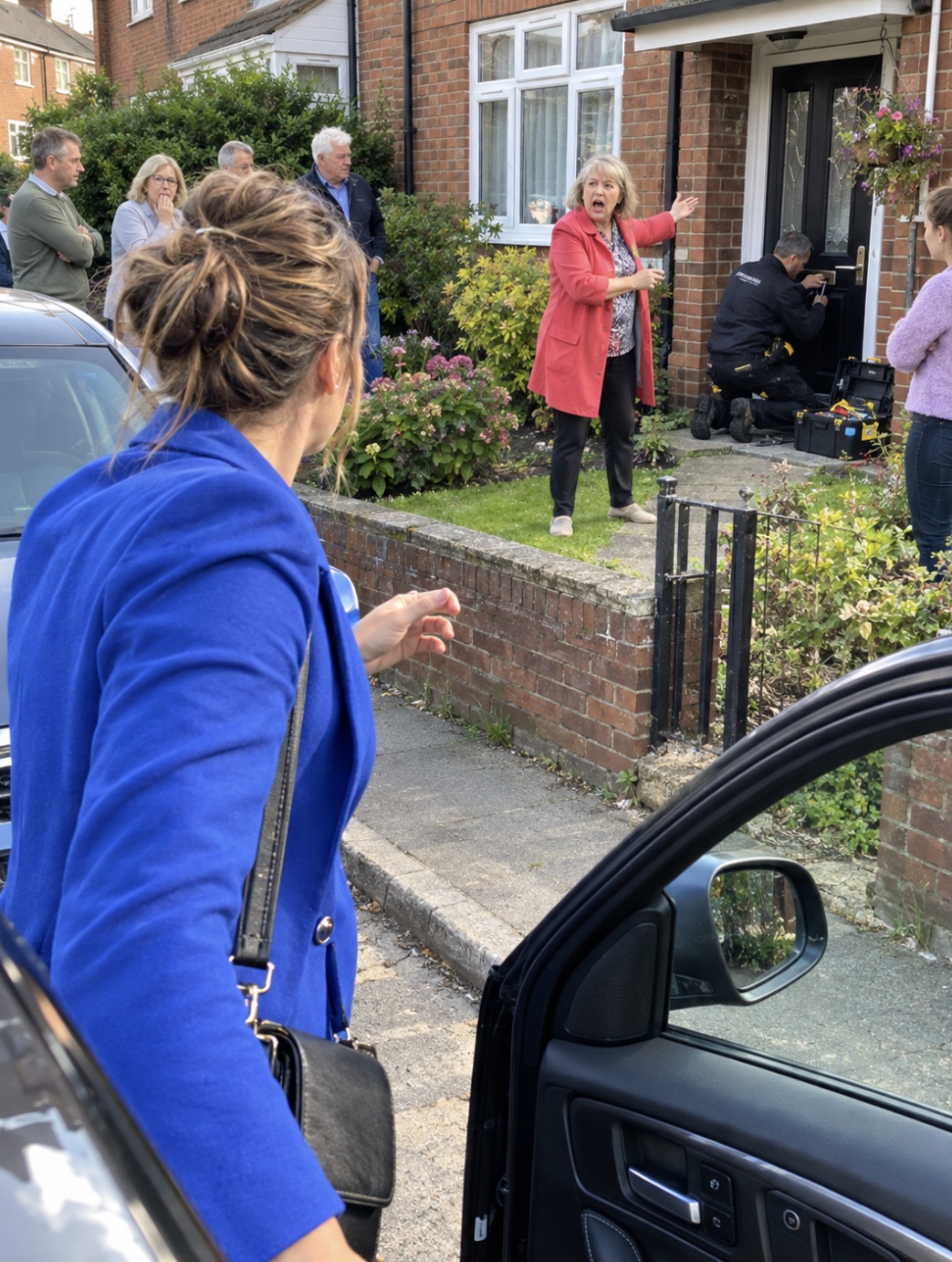
The first thing I saw when I turned into our street was my mother-in-law standing in the middle of our front garden with six neighbors gathered around her.
The second thing I saw was the locksmith.
He was kneeling beside our front door with his toolbox open.
“Don’t touch that lock!” I shouted before I had even switched off the engine.
Everyone turned.
My mother-in-law, Margaret, didn’t look embarrassed. She looked relieved, as if I had finally arrived for a meeting she had organized.
“There she is,” she announced loudly. “Now perhaps she’ll explain herself.”
I stayed behind the steering wheel for a second, staring at her.
My husband, Tom, and I lived in a red-brick semi-detached house in a quiet street outside York. It was the kind of place where people noticed if you put your recycling bin out on the wrong morning. Our neighbors knew one another’s dogs, watched one another’s parcels and complained politely about parking.
Public scenes did not happen here.
Certainly not scenes involving locksmiths.
I got out of the car.
“What are you doing?”
Margaret folded her arms.
“Protecting my son’s property.”
I actually laughed because the alternative was shouting.
“My property?”
“Our family’s property.”
Mrs Patel from number 18 suddenly became very interested in the hydrangeas.
Mr Collins from across the road stared at his shoes.
The locksmith stood up slowly.
“Maybe I should—”
“Yes,” I said. “You should.”
Margaret snapped, “No, you shouldn’t. I called you.”
“And I own the house.”
That made everyone look at me.
Margaret gave a sharp smile.
“That’s exactly what she keeps saying.”
I felt the beginning of a headache behind my eyes.
Tom was in Manchester for two days attending a training course. Margaret knew that. She had also known I would be at work until five.
Which meant this wasn’t spontaneous.
She had planned it.
“What happened?” I asked.
Margaret pointed dramatically at the front door.
“She changed the locks.”
“Yes.”
“Without telling me.”
“I didn’t realize homeowners had to notify their mothers-in-law.”
A couple of neighbors shifted awkwardly.
Margaret’s face hardened.
“I had a key for seventeen years.”
“No. You had an old key that happened to work until yesterday.”
“It was given to me.”
“By the previous owner.”
That silenced her for perhaps two seconds.
Our house had originally belonged to Tom’s grandfather, George. After George died, the house passed to Tom’s father, Peter. Peter eventually sold it to me and Tom twelve years later, using a solicitor and an ordinary mortgage like any other sale.
Margaret had never accepted the emotional difference between “family house” and “house legally owned by someone else.”
For years she had treated our place as if she were still entitled to walk in.
At first it had been harmless.
She watered the plants when we were away.
She dropped off parcels.
Once she let in a plumber.
But gradually she stopped knocking.
Then she began rearranging things.
A casserole dish moved from one cupboard to another.
My cleaning products disappeared from under the sink because she said they were “too chemical.”
Last Christmas I came home and found that she had removed a framed photograph of my parents from the hall table and replaced it with a photograph of Tom aged eleven.
When I moved it back, she called me territorial.
Three days ago, I came home early because I had forgotten a folder for work and found Margaret upstairs.
In our bedroom.
She was standing in front of my open wardrobe.
When I asked what she was doing, she said she was looking for spare pillowcases.
We kept spare pillowcases in the airing cupboard downstairs.
That evening I told Tom I wanted the locks changed.
For once, he didn’t argue.
“I’ll tell Mum,” he said.
Apparently, he hadn’t.
Now Margaret had brought an audience.
“You’re making this sound ridiculous,” she said.
“It is ridiculous.”
“You don’t understand what that house means to this family.”
“I understand perfectly.”
“No, you don’t. You married into it.”
That sentence landed differently.
There was a pause around us.
Even Margaret seemed to realize she had gone slightly too far, but instead of stopping, she raised her voice.
“My husband grew up here. Tom spent half his childhood here. George wanted this house kept in the family.”
I stared at her.
“Then why did Peter sell it?”
Margaret’s mouth tightened.
“That’s private.”
“No, Margaret. You’re discussing my house in front of half the street. Let’s not suddenly become private.”
The elderly woman from number 11, Mrs Evelyn Harper, stood at the edge of the group.
She was eighty-two, tiny, always dressed neatly, even when taking out the rubbish. She had lived on our street longer than almost anyone.
She said nothing.
But she was watching Margaret.
Very carefully.
Margaret turned to the neighbors.
“Tom’s grandfather would turn in his grave if he knew she’d locked his own family out.”
“Margaret,” I said, “go home.”
“No.”
“Please.”
“No. Not until everyone understands what’s happening.”
“What exactly do you want them to understand?”
“That you’re trying to separate Tom from his family.”
There it was.
Not the key.
Not the lock.
Me.
I heard Mrs Patel quietly say, “Oh dear.”
I crossed my arms.
“This has nothing to do with Tom being separated from anyone. This is about you entering our house whenever you feel like it.”
“I came in when necessary.”
“You went through my wardrobe.”
“I was looking for linen.”
“In my jewelry drawer?”
Her face changed.
Only slightly.
But I noticed.
“What jewelry drawer?”
The question came too quickly.
I hadn’t mentioned the jewelry drawer before.
The neighbors noticed too.
Mr Collins looked up.
I felt a cold sensation move through my stomach.
When I had found Margaret in our bedroom, the top drawer of my dressing table had been slightly open.
At the time, I assumed I had left it that way.
Inside were several pieces I rarely wore, including my grandmother’s gold locket.
That night I checked the drawer and everything seemed present.
But now I suddenly wasn’t sure.
“What were you looking for in there?” I asked.
Margaret shook her head.
“I wasn’t.”
“You just knew which drawer I meant.”
“I guessed.”
“Which drawer?”
She stared at me.
I took out my phone.
“I’m calling Tom.”
Margaret stepped toward me.
“Don’t you dare drag him into this while he’s working.”
I almost smiled.
“You brought six neighbors and a locksmith to my garden, but I’m dragging Tom into it?”
That was when Evelyn Harper finally spoke.
“Margaret.”
Her voice wasn’t loud.
But everyone stopped talking.
Margaret turned.
Evelyn was holding the handle of her walking stick with both hands.
“I think you should leave the girl alone.”
Margaret gave a short laugh.
“Evelyn, with respect, this has nothing to do with you.”
Evelyn nodded.
“It didn’t.”
Then she looked directly at me.
“But I think it does now.”
Something in her tone made my skin prickle.
Margaret went pale.
Not angry pale.
Afraid pale.
“Evelyn,” she said quietly, “don’t.”
And that was the moment I knew the argument about the lock had uncovered something much older.
📩 What happened next had been hidden on our street for seventeen years — the rest is in the first comment. 👇
Evelyn turned toward her house.
Margaret caught her arm.
“You’re confused.”
Evelyn pulled away.
“I’m old, Margaret. I’m not confused.”
The street had gone completely silent.
Even the locksmith had stopped packing his tools.
Evelyn crossed slowly to number 11 and disappeared inside.
Margaret watched her front door.
I had never seen my mother-in-law look so nervous.
“What is she getting?” I asked.
“Nothing.”
“What does she know?”
“Nothing.”
“Margaret.”
She rounded on me.
“This is your fault. All of this. If you hadn’t changed that stupid lock—”
“What does Evelyn know?”
Before she could answer, Evelyn returned.
In one hand she held her walking stick.
In the other, a faded brown envelope.
It was thick, creased and sealed with yellowing tape.
She walked directly to me.
“I’ve had this since 2009.”
Margaret whispered, “Please.”
Evelyn ignored her.
“George gave it to me.”
Tom’s grandfather.
I stared at the envelope.
“Why would George give you something?”
“Because he didn’t trust anyone in his own house to keep it.”
Margaret stepped forward.
“That is absolutely not true.”
Evelyn looked at her.
“You were standing in my kitchen when he said it.”
Margaret stopped.
My hands suddenly felt cold.
Evelyn held the envelope out.
“It has your husband’s name on it.”
Written on the front in faded blue ink were two words:
For Thomas.
Not Margaret.
Not Peter.
Thomas.
My husband.
I didn’t take it.
“This belongs to Tom.”
“Yes.”
“Then why give it to me?”
“Because I tried once before.”
Margaret closed her eyes.
Evelyn continued.
“George asked me to give it to Tom after his eighteenth birthday if George wasn’t alive. But that year Tom went away to university. Then Peter told me the family had dealt with everything.”
She looked at Margaret.
“I believed him.”
“What changed?” I asked.
Evelyn glanced toward our house.
“A few years later, I saw Peter outside. He asked whether George had ever left anything with me.”
Margaret interrupted.
“This is nonsense.”
Evelyn raised one finger.
“No. You’ve talked enough.”
I almost felt sorry for Margaret then.
Almost.
Evelyn turned back to me.
“Peter looked frightened when he asked. So I lied. I said no.”
My pulse quickened.
“Why?”
“Because George had told me something else.”
She paused.
“He said if anyone came looking for the envelope before Tom did, I must keep it hidden.”
The neighbors were no longer pretending not to listen.
Margaret looked around and realized how many people were watching.
“This is private family business.”
Mrs Patel surprised everyone by saying, “You made it public family business.”
Mr Collins coughed into his hand to hide a smile.
Margaret glared at him.
Evelyn pressed the envelope into my hand.
“Call Tom.”
This time Margaret didn’t try to stop me.
Tom answered on the fourth ring.
“Hey, everything okay?”
“No.”
I looked at Margaret.
“Your mother is in our front garden.”
Silence.
Then: “What?”
“With a locksmith and half the street.”
“Oh God.”
“And Evelyn Harper has just given me an envelope from your grandfather. It’s addressed to you.”
A longer silence.
“Evelyn?”
“Yes.”
“My grandfather?”
“Yes.”
“I’m coming home.”
“Tom, you’re two hours away.”
“I’m coming home.”
He arrived shortly after eight.
By then the neighbors had gone inside, the locksmith had left and Margaret was sitting rigidly in our kitchen.
Evelyn had come in too.
The envelope remained unopened on the table.
Tom dropped his overnight bag by the door.
“What is going on?”
Margaret stood.
“Before you read anything, you need to understand that your grandfather was ill.”
Evelyn snapped, “He had arthritis, Margaret, not dementia.”
Tom looked between them.
“Mum?”
She sat down again.
Tom picked up the envelope.
His hands trembled slightly as he peeled back the old tape.
Inside were four folded sheets of paper and a smaller white envelope.
The first page was handwritten.
Tom recognized the writing immediately.
He began reading silently.
His face changed halfway down.
“What?” I asked.
He handed me the letter.
George had written it seventeen years earlier.
Most of it was personal. He wrote about Tom as a child, about teaching him to repair bicycle chains and grow runner beans.
Then came the part that mattered.
George had wanted the house sold after his death.
Not kept in the family.
Sold.
He believed Peter and Margaret were already under severe financial pressure and feared they would use the house as security for Peter’s struggling business.
George’s instructions had been clear: the property was to be sold, and £40,000 from the proceeds was to be placed into an account for Tom, available when he turned twenty-five.
Tom looked up.
“I never received £40,000.”
Margaret said nothing.
There was a second letter.
This one was from a solicitor.
It confirmed that George had discussed those wishes, although the final legal arrangements had apparently been changed shortly before his death.
Then Tom opened the smaller envelope.
Inside was a photocopy of an old bank transfer.
£40,000.
From an account in George’s name.
To a joint account belonging to Peter and Margaret.
Dated three weeks before George died.
Tom sat back.
“What is this?”
Margaret looked at Evelyn.
“You should never have kept that.”
“That’s not an answer,” Tom said.
Margaret’s eyes filled.
“Your father’s business was collapsing.”
Tom’s expression froze.
“He needed money.”
“You took Grandad’s money?”
“It wasn’t like that.”
“It looks exactly like that.”
“He gave it to us.”
Evelyn shook her head.
“No, Margaret.”
“You weren’t there.”
“Yes, I was.”
Margaret stared at her.
Evelyn’s voice became softer.
“George found out afterward. That’s why he made copies.”
I looked at the transfer again.
“You mean the money was moved without his permission?”
Margaret’s face collapsed.
For the first time that day, she stopped fighting.
She covered her mouth.
Peter had managed George’s banking for nearly a year because George had difficulty getting out of the house.
Peter had moved the money.
Margaret had known.
The business survived another eleven months before failing anyway.
George discovered the transfer but was already very unwell. He confronted them, threatened legal action, then died before anything was resolved.
Peter later inherited the house because of changes made to George’s will during the final months of his life.
Years later, when Peter needed money again, he sold the house to us.
For twelve years, Margaret had acted as though the house still morally belonged to her family.
But the truth was the opposite.
She had spent seventeen years guarding a story in which George supposedly wanted the house preserved for them because the real story was much uglier.
Tom didn’t speak for a long time.
Finally he asked, “Did Dad know Evelyn had this?”
“I don’t know,” Margaret whispered.
“Did you?”
She nodded.
That shocked me almost more than the transfer.
“You knew she had evidence?”
“She told me after George died. She said she would keep it for Tom.”
“And you never told me?” Tom asked.
“I was protecting your father.”
“From me?”
“From shame.”
Tom laughed once, without humor.
“You let me grow up thinking Grandad didn’t leave me anything.”
“He left you memories.”
“That’s not the point.”
Margaret began crying.
I had seen her cry before, but usually tears were part of an argument, something that arrived at exactly the moment she was losing control.
This was different.
She looked smaller.
Older.
“He was your father,” she said. “He made one terrible mistake.”
Tom stared at the papers.
“And you spent seventeen years helping him hide it.”
No one spoke.
Eventually Evelyn stood.
“I think I should go.”
Tom walked around the table and hugged her.
It surprised all of us, including Evelyn.
“Thank you,” he said.
She patted his back.
“I should have done it sooner.”
When she left, Margaret stayed seated.
Then Tom asked the question I hadn’t expected.
“Why did you bring a locksmith here today?”
She looked confused.
“What?”
“You knew Evelyn lived across the road. You knew she had that envelope. You still came here and made a scene in front of everyone. Why?”
Margaret looked at me.
Then at the floor.
And suddenly I understood.
“You thought Evelyn wouldn’t say anything,” I said.
Margaret said nothing.
“But when I changed the locks, you panicked.”
Tom turned to me.
“Why?”
I thought about the jewelry drawer.
Then I went upstairs.
The locket was still there.
My grandmother’s earrings were there.
A bracelet.
Two rings.
Nothing missing.
But at the back of the drawer sat a small brass key I had never used.
It belonged to an old writing desk downstairs.
George’s writing desk.
Peter had left it in the house when we bought the property.
I opened the desk.
Most drawers contained old receipts, spare batteries and stationery.
One lower drawer was locked.
The brass key opened it.
Inside was a thin green folder.
Tom stood beside me.
On the front, in George’s handwriting, were the words:
Peter — Loan.
Inside were copies of handwritten loan agreements.
Not just the £40,000.
There were three earlier loans.
£8,000.
£6,500.
£12,000.
All signed by Peter.
All unpaid.
Margaret had not gone into my bedroom for pillowcases.
She had been searching for the key.
“You knew this was here,” Tom said when we came downstairs.
Margaret didn’t deny it.
“Your father thought George had kept copies somewhere.”
“So you’ve been coming into our house looking for them?”
“Not constantly.”
I almost laughed at the absurdity of her answer.
Tom closed his eyes.
“How long?”
She didn’t answer.
“How long, Mum?”
“Years.”
The word barely came out.
That was the real reason she had been so furious about the lock.
Not because she had lost sentimental access to the family home.
She had lost access to something she had been secretly searching for.
The next week, Tom met with a solicitor.
Legally, much of what had happened was too old and complicated to resolve simply. Peter had died four years earlier. George had died seventeen years earlier. Documents were incomplete. Some transactions were clear; others weren’t.
But Tom didn’t care about recovering money as much as I expected.
He wanted the truth recorded.
He scanned every paper.
He stored copies with the solicitor.
And then he gave the original envelope back to Evelyn.
She refused at first.
“It belongs to you.”
“No,” Tom said. “You kept it safe for seventeen years. I think you should keep it until I’m ready to look at it again.”
Two months later, Margaret came to our house.
She knocked.
That mattered.
I opened the door.
She stood on the step holding no bags, no spare key, no excuse.
“I wanted to apologize.”
I waited.
She looked toward Evelyn’s house across the road.
“Not for getting caught.”
That surprised me.
“For believing that protecting Peter meant I had to keep lying for him.”
I said nothing.
“And for treating this house as though it belonged to my memories more than it belonged to your life.”
That was probably the first completely honest thing she had ever said to me.
I stepped aside.
“Would you like tea?”
She nodded.
She didn’t walk past me automatically.
She waited until I invited her in.
We never became close after that.
Real life doesn’t always end with people suddenly understanding one another perfectly.
But Margaret stopped arriving unannounced.
She stopped commenting on our furniture.
She stopped calling the house “George’s place.”
And every time she visited, she knocked.
As for Evelyn, she became unexpectedly famous on our street.
Mrs Patel started bringing her homemade samosas on Fridays. Mr Collins began taking her bins out on rainy mornings. Tom repaired the loose gate at number 11 and refused payment.
One evening that autumn, I found Evelyn outside trimming dead roses.
“I still don’t understand why you waited so long,” I told her.
She considered that.
“Because secrets get heavier when you carry them.”
She clipped another rose.
“And after seventeen years, I was tired.”
I looked across the road at our house.
The new lock shone faintly under the porch light.
For weeks I had thought changing it had caused the biggest argument our street had seen in years.
In the end, the lock hadn’t caused anything.
It had simply closed one door.
And forced a seventeen-year-old secret to finally come through another.