



The first time I realised my mother-in-law was frightened of a dead man was twenty minutes after we buried him.
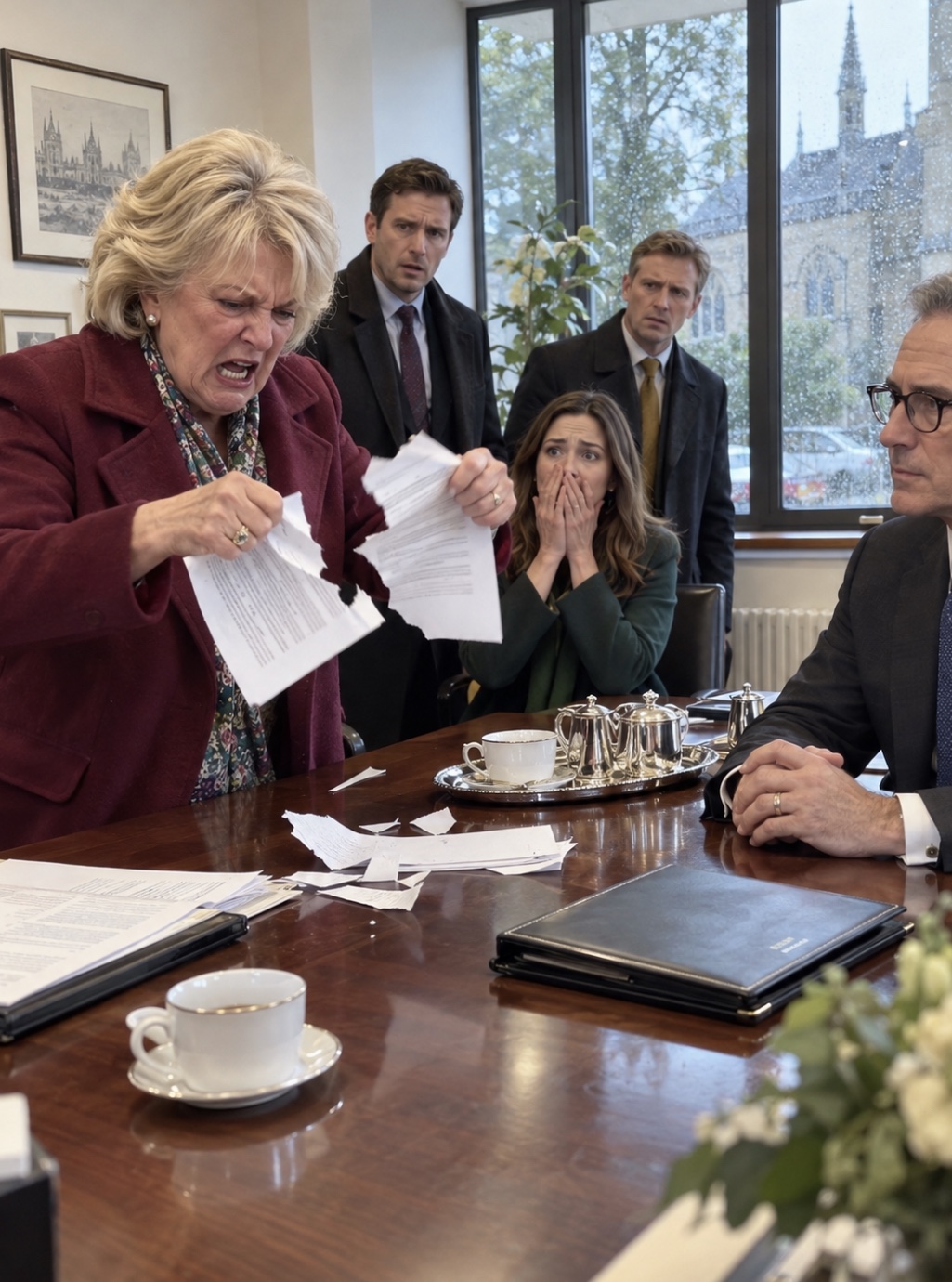
We were still wearing our funeral clothes. Rain tapped against the sash windows of the solicitor’s office in York, my black tights were damp around the ankles, and nobody had touched the tea that the receptionist had brought in on a silver tray.
Across the table, Margaret Hale sat rigidly beside her eldest son, Simon.
My husband, Daniel, was next to me.
At the head of the table sat Mr Patel, the solicitor who had handled my father-in-law’s affairs for nearly twenty years.
He had just placed three stapled sheets on the polished oak table when Margaret reached across, snatched them from under his hand and tore them straight down the middle.
Once.
Twice.
Then into smaller pieces.
Nobody spoke.
She dropped the scraps beside the sugar bowl.
“There,” she said, breathing hard. “We are not doing this today.”
Mr Patel looked at the paper, then at Margaret.
His expression barely changed.
“That was a copy, Mrs Hale.”
Daniel’s hand tightened around mine.
Margaret went white.
Until that moment, I had thought the family argument was going to be about money.
I was wrong.
It was about something George Hale had spent thirty-four years hiding.
I had married Daniel eight years earlier.
The Hale family lived just outside York, in a stone house in a village where everyone knew who had bought a new car, whose daughter had dropped out of university and who had put their house on the market before the estate agent’s board had even gone up.
George and Margaret had lived in Hawthorn House since the late 1980s.
It wasn’t a stately home. It was a large, slightly draughty Georgian place with uneven floors, an Aga that heated the kitchen too well in August and barely enough in January, and an apple tree in the back garden that George refused to cut down even after one branch smashed the greenhouse roof.
George had been the easiest member of the family to like.
He was quiet, funny in a dry way and almost impossible to impress.
When Daniel first brought me home, Margaret asked what my parents did, where I had gone to school and whether I planned to “keep working once children arrived.”
George looked at me over his glasses and said, “Ignore the interview. We don’t actually issue membership cards.”
I liked him immediately.
Margaret never quite forgave me for it.
Daniel and I never had children.
For years, Margaret managed to turn that fact into a subject that somehow appeared at Christmas lunch, birthdays, Sunday roasts and even Simon’s fortieth.
George was the one who would change the subject.
“Pass the potatoes, Margaret.”
Or, “Daniel, have you fixed that gutter?”
Anything to rescue me.
Simon, Daniel’s older brother, had two children and had always been treated as the sensible son.
He lived fifteen minutes away, worked in commercial property and visited Hawthorn House several times a week.
Daniel was different.
He restored old furniture for a living, hated spreadsheets and could go three weeks without remembering to return a family WhatsApp message.
That difference mattered more to Margaret than she ever admitted.
When George was diagnosed with pancreatic cancer, everything changed very quickly.
He lasted eleven months.
During that time Margaret became his full-time organiser. She controlled hospital appointments, medication, visitors and meals. She even kept a notebook beside his chair with the times he had taken morphine.
At first, it seemed practical.
Then George began asking to speak to Daniel alone.
Not Simon.
Daniel.
The first time was in February.
Daniel came home late that night and stood in our kitchen without taking off his coat.
“What happened?” I asked.
“Dad asked me something strange.”
“What?”
“He asked whether I remembered staying with Aunt Ruth when I was little.”
I knew Ruth was Margaret’s younger sister. She had died before I met Daniel.
“What did you say?”
“I told him barely. I was four or five.”
“And?”
Daniel frowned.
“He asked whether Mum had ever told me why.”
She hadn’t.
Two weeks later George asked me to visit him without Daniel.
I almost refused because it felt secretive.
But when I arrived, Margaret was at Waitrose and George was alone in the sitting room with a blanket over his knees.
He looked thinner than he had three days earlier.
“You’re good for Daniel,” he said.
I laughed awkwardly. “That sounds ominous.”
“It isn’t meant to.”
Then he handed me a small brass key.
It had a red plastic tag with the number 214 written on it.
“What is this?”
“Keep it.”
“For what?”
“You’ll know when you need it.”
I stared at him.
“George, if this is about the will—”
“It isn’t about money.”
That was the last thing he said about it.
I put the key in the zipped pocket of my handbag and told no one.
Three months later, he died at St Leonard’s Hospice just before six in the morning.
Margaret was beside him.
Daniel and I arrived twenty minutes too late.
The funeral was held the following Thursday.
George had chosen the hymns himself and left strict instructions that nobody was to describe him as “brave.”
The church was packed.
Afterwards, we went back to Hawthorn House for sandwiches, sausage rolls, tea and whisky.
Margaret moved through the rooms like a hostess at somebody else’s event.
At half past three, Mr Patel quietly asked the immediate family to meet him at his office later that afternoon.
Margaret’s reaction was immediate.
“Today?”
“George requested it.”
“It can wait.”
“I’m afraid he was quite specific.”
That was why, less than two hours later, we were sitting around the solicitor’s table watching Margaret tear up what she believed was George’s last will and testament.
Mr Patel calmly opened a leather folder.
“The executed original is held securely elsewhere,” he said.
Simon stared at his mother.
“Mum, what the hell was that?”
Margaret pushed back her chair.
“I’ve just buried my husband.”
“So have we buried our father,” Daniel said quietly.
She looked at him.
For some reason, that seemed to make her angrier.
Mr Patel continued.
“George made a new will fourteen months ago.”
Margaret turned sharply.
“Fourteen months?”
“Yes.”
“He wasn’t well fourteen months ago.”
“He had full testamentary capacity. I also arranged an independent assessment because George specifically anticipated that his decisions might later be challenged.”
Simon swore under his breath.
I felt Daniel’s thumb moving nervously against my hand.
Mr Patel read the first ordinary provisions.
Some savings to Margaret.
Small legacies to the grandchildren.
A donation to the hospice.
George’s vintage Jaguar to Simon, which made Simon blink in surprise.
His workshop tools and woodworking collection to Daniel.
Then came Hawthorn House.
Mr Patel paused.
“The property does not pass to Mrs Hale.”
Margaret stood up.
“What?”
“The house is owned solely in George’s name.”
“I know whose name is on the Land Registry. I have lived there for thirty-seven years.”
Mr Patel nodded.
“You have a lifetime right of occupation, subject to certain conditions.”
“A what?”
“You may remain in the house for the rest of your life, provided it remains your principal residence and you do not attempt to sell, mortgage or transfer any interest in the property.”
“And after that?”
Mr Patel looked towards Daniel.
“Ownership passes to Daniel Hale.”
Simon’s face changed.
Margaret’s did not.
She simply stared at Daniel.
Then she said something that made no sense to me at the time.
“Of course it does.”
Not angrily.
Not sarcastically.
Almost like she had been expecting it.
📜 What George had hidden for decades was about to change far more than an inheritance — the rest is waiting in the first comment. 👇
Daniel leaned forward.
“What does that mean?”
Margaret picked up her handbag.
“It means your father always had his favourites.”
“No,” Simon said. “You said, ‘Of course it does.’ Why?”
She ignored him.
Mr Patel closed the will.
“There is also a letter of wishes. However, George instructed me not to release it unless a particular condition occurred.”
“What condition?” I asked.
Mr Patel looked at Margaret.
“If Mrs Hale contested the will, attempted to dispose of Hawthorn House, or removed certain documents from the property after George’s death.”
The room went completely still.
Simon slowly turned towards his mother.
“Mum?”
Her mouth tightened.
“This is disgusting.”
“What documents?” Daniel asked.
Mr Patel didn’t answer immediately.
Instead he took out an envelope.
“George asked me to tell you that there is a safe-deposit box at York Private Bank.”
I felt cold.
Without thinking, I reached inside my handbag.
The brass key was still there.
Mr Patel noticed.
So did Margaret.
Her eyes fixed on my hand.
“You,” she whispered.
Daniel looked at me.
“What?”
I placed the key on the table.
“Your dad gave me this in March.”
Margaret’s chair scraped violently against the floor.
“What did he tell you?”
“Nothing.”
“You expect me to believe that?”
“He said I’d know when I needed it.”
Margaret grabbed her coat.
“I’m leaving.”
Mr Patel spoke before she reached the door.
“Mrs Hale, you should know the bank requires two authorisations. The key is only one.”
She stopped.
“The second is a sealed instruction held by me.”
For the first time that afternoon, I saw genuine fear on her face.
Not anger.
Fear.
We went to the bank the next morning.
Margaret refused to come.
Simon did.
The safe-deposit box was disappointingly ordinary: grey metal, about the size of a shoe box.
Inside were no stacks of cash, no jewellery and no hidden property deeds.
There were photographs.
Letters.
A birth certificate.
And a thin brown envelope with Daniel’s name on it.
Daniel sat down before opening it.
The birth certificate was the first clue.
It belonged to a baby boy named Daniel James Reeves.
Same date of birth as my husband.
Same hospital.
Mother: Ruth Reeves.
Father: blank.
Daniel stared at it for so long I could hear the bank’s ventilation system humming above us.
“Ruth?”
Simon whispered, “Aunt Ruth?”
Mr Patel said nothing.
Daniel opened the envelope.
Inside was a six-page handwritten letter from George.
My dear Daniel,
If you are reading this, then I have failed to find the courage to tell you while I was alive.
Daniel stopped reading.
“I can’t.”
I put my hand on his shoulder.
“You don’t have to do it here.”
“Yes,” he said. “I do.”
He continued.
Ruth had been nineteen when she became pregnant.
She was unmarried.
The father was a married man who disappeared as soon as he learned about the pregnancy.
Margaret had already suffered three miscarriages.
According to George’s letter, the sisters made a decision that seemed, in 1978, like a solution to everybody’s problems.
Ruth would give birth.
Margaret and George would raise the baby.
No adoption was formally completed.
The family simply told neighbours that Margaret had spent several months staying with relatives because of complications late in pregnancy.
They returned home with Daniel.
Ruth remained in his life as “Aunt Ruth.”
Then, when Daniel was five, Ruth changed her mind.
She wanted her son back.
That explained the memory George had asked Daniel about.
For nearly two months, Daniel had lived with Ruth while solicitors became involved.
George’s letter said Ruth had eventually agreed to let him return to Margaret and George after Margaret threatened to tell Ruth’s new fiancé that Daniel existed.
Ruth married anyway.
She never had another child.
She died of an aneurysm at forty-six.
Daniel lowered the pages.
“My whole childhood was a lie.”
Simon looked devastated.
“I didn’t know.”
“I know.”
But George’s letter wasn’t finished.
There was another secret.
Hawthorn House had never really belonged to George.
Not originally.
The deposit had come from Ruth.
In 1988, she had inherited money from an aunt and quietly given George £38,000 — a significant sum at the time — to help buy the house.
She had attached one condition.
Eventually, the house was to belong to Daniel.
Not because she wanted to take him from Margaret.
Because, as she wrote in a separate letter found inside the box, “If I cannot be his mother openly, I would like at least one thing I leave behind to find its way to him.”
George had kept the promise privately.
Margaret knew.
That was why she had said, “Of course it does.”
But there was still the question of why she had torn up the will.
The answer arrived three days later.
Simon called Daniel just after nine in the evening.
“You need to come to Mum’s.”
We found Margaret in George’s study.
Two drawers had been emptied onto the floor.
The filing cabinet was open.
On the desk lay a bundle of bank statements.
Simon stood by the window.
“Mum’s been transferring money.”
Margaret snapped, “It was my husband’s money.”
“How much?” Daniel asked.
Simon answered.
“Just over eighty-six thousand pounds in eighteen months.”
I stared at him.
“To where?”
“Mostly to me.”
Daniel looked at his brother.
Simon held up both hands.
“I didn’t know where it came from. She said Dad wanted to help with the business.”
Simon’s property company had struggled badly after an investment in serviced offices went wrong.
Margaret had been moving money from George’s savings to keep Simon’s company afloat.
At first, George had agreed to £20,000.
Then Margaret had continued without telling him.
When he discovered it, he changed his will.
Not to punish Simon.
To protect what remained.
That was also why the lifetime right to Hawthorn House contained restrictions.
George had feared Margaret might attempt to raise money against the property after his death to rescue Simon’s company again.
“You thought Dad was going to expose you,” Daniel said.
Margaret sat down heavily.
“I thought he had.”
“So you tore up the will?”
“I panicked.”
“You knew it wouldn’t matter.”
“I wasn’t thinking.”
Simon rubbed both hands over his face.
“You forged Dad’s signature on one transfer.”
Margaret didn’t answer.
That silence was enough.
Mr Patel later explained that the estate could demand repayment and that the forged authorisation created far more serious problems.
Daniel, however, surprised everyone.
He didn’t call the police.
Neither did Simon.
Instead, Simon sold a buy-to-let flat he owned in Leeds and repaid most of the missing money himself.
Margaret sold some investments to cover the rest.
It took nearly five months.
During that time, Daniel barely spoke to her.
The strangest part was Hawthorn House.
Margaret had every legal right to stay there.
But in February she announced that she was moving to a small bungalow near Harrogate.
“I don’t want to live in a house where every room belongs to ghosts,” she told Daniel.
He didn’t argue.
Once she moved out permanently, one of the conditions in George’s will was triggered.
The house passed to Daniel earlier than expected.
Everyone assumed we would move in.
We didn’t.
Daniel couldn’t imagine sleeping in the bedroom where George had hidden documents from Margaret or eating breakfast in the kitchen where Ruth had once sat pretending to be his aunt.
We sold the house that summer.
But Daniel kept the apple tree.
Not literally, of course.
Before completion, he took six cuttings and gave them to a local nursery.
Only two survived.
One is now growing behind our house.
The other is in a garden in Scarborough.
That one belongs to a woman named Catherine.
We found her because of another document in the safe-deposit box.
Ruth had had a daughter eight years after Daniel.
She had never told the Hale family.
Catherine grew up knowing that her mother had once given away a baby boy, but she had never known his name.
When Daniel first phoned her, he stood in our kitchen for ten minutes before pressing call.
I stayed in the next room.
Afterwards, I found him sitting at the table crying.
“She sounds like me,” he said.
They met two weeks later in a café near the railway station.
What was supposed to be one coffee lasted nearly five hours.
There was no dramatic instant bond.
No film-like reunion.
Just two middle-aged strangers comparing photographs, discovering they both hated olives, both rubbed their left eyebrow when nervous and both had the same habit of keeping old birthday cards for years.
Daniel still calls Margaret Mum.
That surprised me.
Their relationship is different now, but it didn’t disappear.
Some things are too complicated for clean endings.
Simon rebuilt his business on a smaller scale.
He and Daniel speak more than they did before George died.
And every October, on George’s birthday, Daniel takes a bottle of whisky into the garden, pours himself one glass and leaves another beside the young apple tree.
Last year, I asked him whether he was still angry that George had waited until death to tell him the truth.
Daniel thought about it for a long time.
“Yes,” he said finally. “But I understand him better now.”
Then he looked towards the tree.
“Dad spent his whole life trying to keep a family together with secrets. In the end, the secrets nearly destroyed it.”
The solicitor still has the original will.
The torn copy stayed in Mr Patel’s office bin.
Margaret never asked for it back.
But I kept one thing from that afternoon.
A small piece of paper had stuck to the sleeve of my black coat when we left the office.
I noticed it on the train home.
There were only seven printed words on it, part of the clause concerning Hawthorn House:
For the absolute benefit of my son.
For months, Daniel kept it in his wallet.
Not because of the house.
Because after discovering that the woman who raised him had lied about giving birth to him, that his biological mother had loved him from a distance and that his father had spent decades carrying a promise between them, those seven words answered the only question he was frightened to ask.
George might not have been his biological father.
But he had never considered Daniel anything other than his son.