



My mother-in-law placed the envelope in the middle of our kitchen table as if she were presenting evidence in court.
“I had a DNA test done without your permission,” she said, almost proudly.
For several seconds, nobody moved.
My husband, Oliver, was still standing by the kettle, one hand wrapped around a mug he had forgotten to fill. I was sitting opposite his mother, Margaret, with our eight-month-old daughter, Rosie, asleep upstairs.
Outside, a wet November evening pressed against the windows of our terraced house in York. Cars hissed along the rain-darkened street. Somewhere next door, a washing machine thudded through its spin cycle.
Inside our kitchen, the room had become completely silent.
“You did what?” I finally asked.
Margaret folded her hands neatly over her handbag.
“I did what needed to be done.”
Oliver stared at her.
“Mum.”
“You can look at me like that if you want,” she replied, “but I was thinking about you.”
That sentence nearly made me laugh.
Margaret had been “thinking about Oliver” ever since I met him seven years earlier.
She thought about him when we chose our wedding venue.
She thought about him when we bought our house.
She thought about him when I refused to name our daughter Elizabeth after Margaret’s mother.
She had also been thinking about him three weeks earlier when she leaned over Rosie’s pram at Sunday lunch and announced that our baby had “absolutely nothing of the Harrison family in her face.”
Rosie had my dark brown eyes and Oliver’s fair hair.
Apparently that was suspicious.
At first, I assumed Margaret’s comments were just another irritating phase.
Then she started asking questions.
Was Oliver definitely registered as Rosie’s father?
Had the hospital ever mixed up babies?
Had I ever considered one of those ancestry tests?
I told Oliver she was being ridiculous.
He agreed.
Or at least I thought he did.
Then Margaret pushed the envelope towards him.
“Well?” she said.
Oliver didn’t touch it.
“What exactly did you test?”
She sighed impatiently.
“Rosie.”
My stomach turned.
“How?”
Margaret hesitated.
That hesitation frightened me more than the answer.
“How did you get a sample from my baby?”
“She was at my house.”
“Once.”
“Yes.”
“For two hours.”
Margaret straightened.
“I used one of her little teething spoons after she’d had yoghurt.”
I stood up so quickly that the chair legs scraped across the tiles.
“You sent my daughter’s DNA to a company without asking either of us?”
“Oh, don’t dramatise it, Emily.”
“Don’t dramatise it?”
“It was saliva.”
“That isn’t the point.”
Oliver finally put his mug down.
“Mum, which company?”
Margaret pulled a folded leaflet from her handbag.
“It’s all legitimate.”
“That wasn’t what I asked.”
He took the envelope.
The logo belonged to a private laboratory based in Manchester.
I recognised the kind of service immediately. They advertised discreet relationship testing online: paternity, siblingship, grandparent testing, ancestry comparisons.
Oliver opened the envelope slowly.
Margaret watched his face with the unmistakable anticipation of someone expecting to be proved right.
I could hardly breathe.
Not because I had anything to fear.
Rosie was Oliver’s daughter.
There had never been anyone else.
But the sheer violation of what Margaret had done made my hands shake.
Oliver read the first page.
Then the second.
His eyebrows pulled together.
Margaret leaned forward.
“Well?”
He didn’t answer.
She smiled faintly.
“I knew there was something unusual.”
Oliver looked up.
“What exactly did you ask them to compare?”
“Rosie’s sample with mine.”
“A grandparent test?”
“Yes.”
“And?”
Margaret glanced at me.
“The probability of biological grandparentage was extremely low.”
She said it gently, almost sympathetically, which somehow made it worse.
I stared at Oliver.
He kept reading.
“Oliver,” I said, “you know what this means. It means her sample was bad, or the test was rubbish, or—”
“I know.”
Margaret interrupted.
“Or Rosie isn’t genetically connected to our family.”
Oliver looked at her.
“That isn’t the only explanation.”
Margaret’s expression hardened.
“It’s the obvious one.”
I crossed my arms.
“Say it properly, Margaret.”
She frowned.
“Excuse me?”
“If you came here to accuse me of cheating on your son, at least have the courage to use the words.”
She looked offended.
“I never said that.”
“You didn’t have to.”
Oliver turned another page.
Then he stopped.
His face changed.
Not dramatically.
Just enough that I noticed.
He read one line again.
Then another.
“Mum,” he said.
Margaret sat straighter.
“Yes?”
He tapped the paper.
“Why is there another name here?”
She blinked.
“What?”
“This name.”
He turned the page towards her.
Margaret looked down.
The colour seemed to drain from her face.
For the first time since arriving, she had nothing to say.
I leaned across the table.
Under a heading marked REFERENCE SAMPLE DETAILS was a name I had never seen before.
Not Margaret Harrison.
Not Oliver Harrison.
A woman named:
Judith Anne Palmer.
I looked at Oliver.
“Who’s Judith Palmer?”
He shook his head.
“I don’t know.”
Margaret reached for the paperwork.
Oliver pulled it away.
“Mum?”
“There must be some administrative error.”
“You filled in the forms.”
“The laboratory must have mixed something up.”
Oliver pointed at a handwritten reference number.
“This is your handwriting.”
Margaret’s mouth opened.
Then closed.
The radiator clicked behind us.
Rain tapped against the window.
Oliver’s voice became quieter.
“Mum, who is Judith?”
Margaret stood.
“This has become completely confused.”
“No,” he said. “Sit down.”
I had never heard him speak to her like that.
Neither had she.
Her eyes flashed.
“Oliver.”
“Sit down.”
She slowly lowered herself back into the chair.
📩 What happened next changed the meaning of that DNA test completely — keep reading in the first comment. 👇
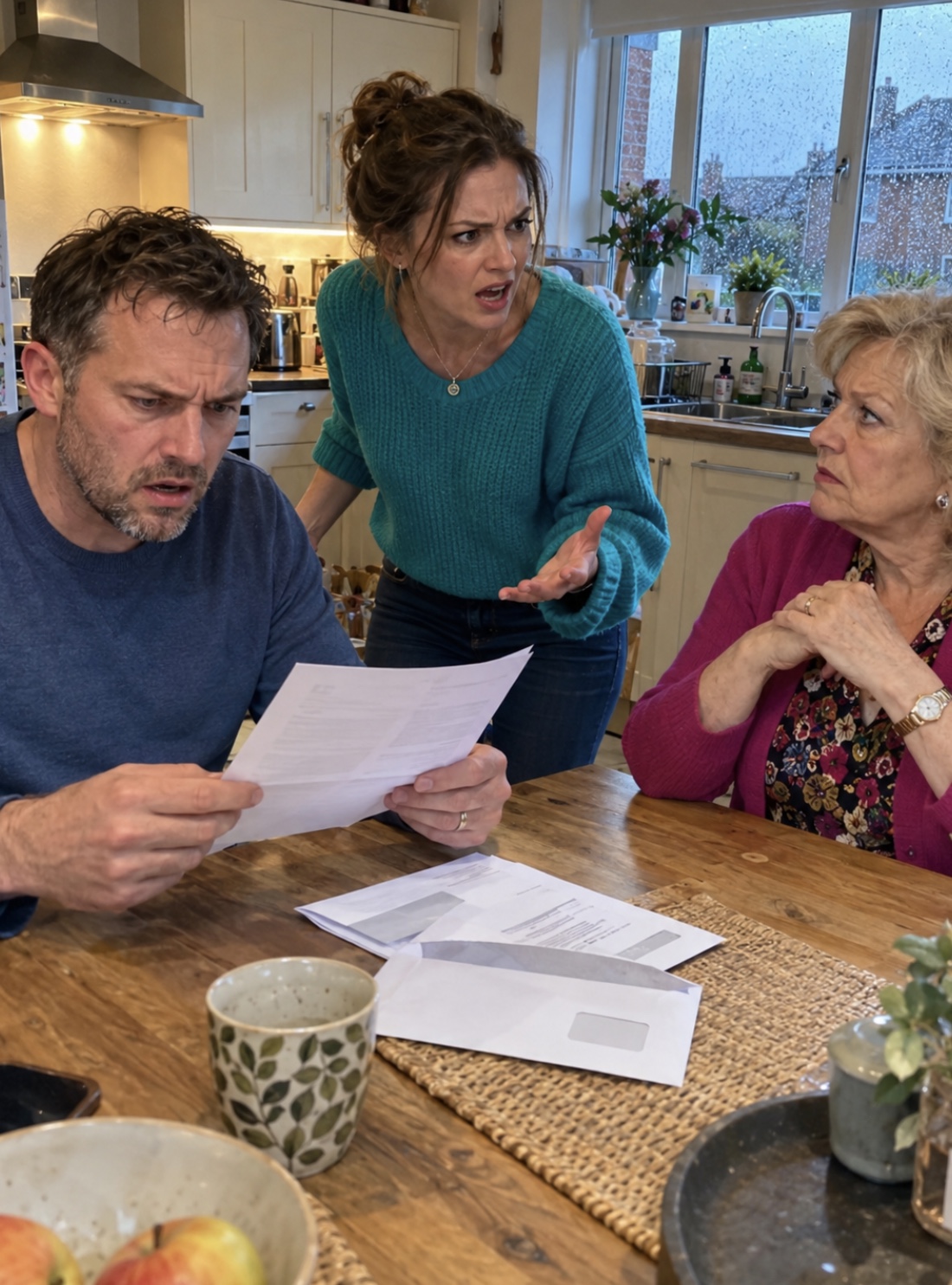
Oliver placed all four pages in a row across the table.
I came around and stood beside him.
The report wasn’t simply a grandparent test.
There were two reference samples.
One had Margaret’s name.
The second was listed under Judith Anne Palmer.
And underneath, in smaller print, was a note:
Additional adult reference sample supplied by client for kinship clarification.
Oliver looked at his mother again.
“You sent somebody else’s DNA too?”
Margaret rubbed her thumb against the clasp of her handbag.
“It was only to make the result clearer.”
“Whose DNA?”
She stared at the table.
“Mum.”
Finally, she whispered, “My sister’s.”
Oliver frowned.
“You don’t have a sister.”
Margaret looked up sharply.
I felt a chill run across my shoulders.
Oliver had grown up as an only child of an only child.
At least, that was what I had always understood.
Margaret’s parents had died before I met Oliver.
There were no aunts.
No uncles.
No cousins on her side.
Just Margaret.
“You told me Gran and Grandad only had you,” Oliver said.
“That was what you needed to know.”
Oliver gave a short, disbelieving laugh.
“What does that mean?”
Margaret closed her eyes for a second.
Then she reached for her handbag.
“I should go.”
Oliver stepped between her and the door.
“No.”
“Move.”
“Not until you tell me who Judith is.”
“You are being extremely disrespectful.”
“And you secretly collected DNA from my daughter.”
That stopped her.
She looked towards the ceiling, as though remembering Rosie was sleeping upstairs.
Then she sat again.
For several moments, nobody spoke.
Margaret finally said, “Judith is older than me.”
“How much older?”
“Four years.”
“Where is she?”
Margaret swallowed.
“Leeds.”
Oliver stared at her.
“Leeds?”
Less than thirty miles away.
Margaret nodded.
“Why have I never heard of her?”
“She and I have not had a relationship for a very long time.”
“What does that have to do with pretending she doesn’t exist?”
“It was complicated.”
Oliver pushed the laboratory report towards her.
“What does she have to do with Rosie?”
Margaret pressed her lips together.
At that moment, a thought occurred to me.
“How did you get Judith’s DNA?”
Margaret looked at me.
She didn’t answer.
“Did Judith know about this test?”
Margaret’s silence gave us the answer.
I stared at her.
“You took DNA from two people without permission?”
“I had something of hers.”
“Something?”
“A hairbrush.”
Oliver stared at his mother as if he were seeing a stranger.
“You went to her house?”
“No.”
“Then where did you get her hairbrush?”
Margaret’s eyes filled suddenly.
Not enough to cry.
Just enough to change the room.
“It belonged to our mother.”
Oliver looked confused.
“That doesn’t make sense.”
Margaret shook her head.
“You don’t understand.”
“Then explain it.”
She sat very still.
Finally, she said, “Judith contacted me in August.”
Oliver’s expression changed.
“August?”
“Yes.”
That was two weeks after Rosie was born.
Margaret continued.
“She saw a photo of Rosie online.”
“Whose photo?”
“Yours. On Facebook.”
Oliver rarely posted anything publicly, but after Rosie was born, he had uploaded one photograph. The three of us outside York Hospital, exhausted and smiling.
“What did she want?” he asked.
“She said Rosie looked like our mother.”
Margaret’s voice had lost all its confidence now.
“She sent me a message after nearly thirty years of silence.”
“Why had you stopped speaking?”
Margaret looked down.
“Because of you.”
Oliver went completely still.
I reached for his hand.
He didn’t seem to notice.
“Because of me?”
Margaret’s eyes moved towards him.
“When you were born, there were… arguments.”
“What arguments?”
She hesitated again.
Oliver pulled out the chair opposite her and sat.
“Mum, I’m forty years old. Stop protecting me from whatever this is.”
Margaret gave a strange little nod.
Then she said the words so quietly that I nearly missed them.
“Judith believed you should have been told who your mother was.”
Oliver’s hand slipped from mine.
Nobody moved.
He stared at Margaret.
“What?”
Margaret’s breathing became uneven.
“You heard me.”
“I heard the words. They don’t make sense.”
I sat beside him.
Margaret’s face seemed suddenly older.
“You were born in February 1986.”
“I know.”
“I was twenty-four.”
“I know that too.”
“No,” she said. “You know what I told you.”
Oliver’s jaw tightened.
Margaret looked towards the window.
“When I was twenty-four, I was engaged to your father. We had already booked the church. We had a deposit on a flat in Harrogate.”
Oliver didn’t interrupt.
“Judith was twenty-eight. She was separated from her husband and living back with our parents.”
Margaret paused.
“She became pregnant.”
Oliver’s face emptied.
I could hear the clock above the cooker ticking.
Margaret continued.
“The father was married.”
Oliver whispered, “And?”
“She wanted to keep the baby.”
Margaret’s voice cracked.
“Our father was furious. This was the eighties. He cared about what people thought more than anything.”
Oliver leaned forward.
“What happened?”
Margaret looked directly at him.
“You happened.”
For a moment, I genuinely didn’t understand.
Then Oliver did.
He pushed his chair backwards.
“No.”
“Oliver—”
“No.”
Margaret started crying.
Not loudly.
Not dramatically.
Just tears running down her cheeks.
“Judith gave birth to you.”
Oliver walked out of the kitchen.
I followed him into the narrow hallway.
He stood by the front door, staring at nothing.
“Oliver.”
He lifted one hand.
“Just… give me a second.”
Behind us, Margaret remained at the table.
After perhaps a minute, Oliver turned around and went back in.
His face looked grey.
“You are saying Judith is my biological mother?”
Margaret nodded.
“And you?”
“I raised you.”
“That wasn’t my question.”
Margaret flinched.
“No.”
Oliver sat down again.
I had never seen him look so calm while being so completely destroyed.
“Does Dad know?”
“Yes.”
That surprised me.
“Dad knew?”
“From the beginning.”
“And Judith just gave me to you?”
Margaret wiped her cheeks.
“It wasn’t as simple as that.”
“Make it simple.”
Margaret took a shaky breath.
Judith had developed severe complications after Oliver’s birth and remained in hospital for several weeks.
During that period, Margaret and her fiancé, Peter, helped care for the baby.
Judith was overwhelmed, financially unstable and still caught in a bitter separation.
Their parents began suggesting that Margaret and Peter could provide Oliver with a more stable home.
“At first it was supposed to be temporary,” Margaret said.
Oliver laughed once.
There was no humour in it.
“Temporary for forty years?”
Margaret’s eyes dropped.
“Judith changed her mind later.”
“What does that mean?”
“She wanted you back.”
Oliver stared at her.
“When?”
“When you were nearly one.”
“And?”
“Our parents convinced her not to disrupt your life.”
“Convinced her?”
Margaret said nothing.
Oliver’s voice sharpened.
“What did they do?”
Margaret looked ashamed.
“They offered to help her financially if she signed the papers.”
I felt sick.
Oliver stood again.
“You bought me?”
“No!”
“That’s what you just described.”
“No, Oliver. We loved you.”
“Did she?”
Margaret covered her mouth.
“Yes.”
That one word seemed to hurt him more than everything else.
He turned away.
A long silence followed.
Then I looked at the DNA report again.
Something still bothered me.
“If Judith is Oliver’s biological mother,” I said slowly, “then why did you send her DNA with Rosie’s?”
Margaret froze.
Oliver turned.
That was when I understood.
The test hadn’t begun because Margaret suspected me.
Not really.
Rosie had simply reopened something Margaret had spent decades trying to bury.
Margaret stared at her hands.
“Judith said Rosie looked like Mum. Then she said something else.”
“What?” Oliver asked.
“She said, ‘You know she’s my granddaughter too.’”
Oliver closed his eyes.
Margaret continued.
“I told her she had no right to say that.”
“She does,” he replied.
Margaret flinched.
“I know.”
The words were barely audible.
“So you tested Rosie against Judith?”
“Yes.”
“And yourself?”
“Yes.”
“Why?”
Margaret’s voice shook.
“Because some foolish part of me thought maybe Judith had been wrong all these years. Maybe there had been some mistake. Maybe our parents had lied to both of us.”
Oliver shook his head.
“But the test showed Judith is related to Rosie.”
Margaret nodded.
“The probability of a biological grandparent relationship between Judith and Rosie was over ninety-nine percent.”
Oliver looked back at the papers.
That explained why the first page had appeared strange.
Margaret’s own grandparent probability was low because she wasn’t Rosie’s grandmother.
Biologically, she was Rosie’s great-aunt.
The paperwork hadn’t exposed my supposed affair.
It had exposed Margaret’s forty-year-old lie.
Oliver sank back into the chair.
“Does Judith know the result?”
“No.”
“Does she know you tested Rosie?”
“No.”
He looked at me.
Then back at Margaret.
“Give me her number.”
Margaret’s face tightened.
“Oliver, please think about this first.”
“I have had forty years to think about it without knowing what I was supposed to be thinking about.”
“She has a different life now.”
“So do I.”
“She has children.”
Oliver stared at her.
That was another blow.
“I have siblings?”
“Half-siblings.”
“How many?”
“Two.”
“Names?”
Margaret started crying again.
“Oliver…”
“Names.”
“Claire and Matthew.”
He repeated them quietly, as if memorising them.
“Do they know?”
“I don’t know.”
“You do know.”
Margaret looked away.
“They know Judith had a baby when she was young.”
“But they don’t know it’s me.”
“I don’t think so.”
Oliver held out his hand.
“Phone.”
Margaret didn’t move.
He held his hand there.
Eventually, she unlocked her mobile and placed it in his palm.
Judith’s number was saved under her full name.
Oliver copied it into his own phone.
Then he stared at it for nearly a minute.
He didn’t call.
Not that night.
Instead, he asked Margaret to leave.
She looked devastated.
Before going, she stopped at the hallway.
“I know you think everything I did was selfish.”
Oliver said nothing.
“But when they put you in my arms, I loved you. Whatever else happened, that part was real.”
Oliver’s expression barely changed.
“I’m sure it was.”
Margaret took a breath.
“But love doesn’t give you the right to rewrite somebody else’s life.”
She nodded.
Then she left.
For the next three days, Oliver barely spoke.
He went to work.
He came home.
He fed Rosie her mashed banana and made ridiculous noises until she laughed.
Then, after she went to sleep, he sat in the kitchen reading the DNA report again.
On Thursday evening, he called Judith.
I offered to leave the room.
He asked me to stay.
The phone rang four times.
A woman answered.
“Hello?”
Oliver’s face changed immediately.
Later he told me that he couldn’t explain why.
He simply recognised something in her voice.
Not the sound exactly.
The rhythm.
The way she said hello.
“Is this Judith Palmer?”
“Yes.”
“My name is Oliver Harrison.”
Silence.
Long enough that I could hear my own heartbeat.
Then the woman inhaled sharply.
“Oh.”
Oliver swallowed.
“I think you know who I am.”
“Yes.”
Her voice broke.
“Yes, I do.”
They spoke for nearly two hours.
Judith did not blame Margaret entirely.
That surprised both of us.
She blamed their parents.
She blamed herself.
She blamed the fear and shame of a different time.
She told Oliver that she had tried twice to contact him directly when he was younger.
The first time, he was seventeen.
She wrote a letter.
Margaret intercepted it.
The second time, when Oliver was twenty-five, she found him on Facebook.
Margaret contacted her first and begged her not to “destroy his family.”
So Judith stayed away.
Until Rosie was born.
“I saw her face,” Judith said over the phone, “and I thought, I’ve already missed one whole lifetime. I can’t pretend I don’t care about the next generation too.”
A week later, we met her.
Not at Margaret’s house.
Not at ours.
At a quiet café near the river in Leeds.
Judith arrived early.
She was seventy years old, with silver hair cut to her chin and the same peculiar habit Oliver had of rubbing the side of his thumb when nervous.
He noticed it immediately.
So did I.
She brought no photographs.
No dramatic letters.
No demands.
Just a small knitted cardigan.
“I made this for Rosie,” she said. “But if that’s too much, I understand.”
Oliver held it for a long time.
Then he said, “It isn’t too much.”
There was one final surprise.
Judith had not given Margaret the hairbrush Margaret claimed to have used.
When Oliver mentioned it, Judith looked confused.
“My mother’s hairbrush?”
“Yes.”
Judith shook her head.
“Margaret doesn’t have it.”
“How do you know?”
“Because I do.”
That meant Margaret had lied again.
When Oliver confronted her later, she admitted the truth.
She had met Judith secretly three weeks before the test.
Margaret had invited her for coffee, pretending she wanted reconciliation.
While Judith was in the ladies’ room, Margaret took her used teaspoon and wrapped it in a tissue.
That was the DNA sample.
The lie about the hairbrush had simply been an attempt to make what she had done sound less calculated.
That revelation was the final boundary Oliver needed.
For the next four months, he did not see Margaret.
He didn’t punish her.
He didn’t shout.
He simply told her that until she understood the difference between loving someone and controlling their life, he needed distance.
In spring, Margaret began counselling.
Slowly, carefully, Oliver allowed her back into our lives.
Not as before.
There were rules now.
No entering our house without invitation.
No decisions involving Rosie.
No family secrets disguised as protection.
And absolutely no DNA tests.
Judith became part of our lives too, although nobody tried to force a title onto her.
Rosie eventually started calling her Jude.
Margaret remained Grandma.
Biology turned out to be both enormously important and strangely insufficient.
One rainy afternoon the following November, almost exactly a year after the envelope appeared on our kitchen table, I found Oliver sitting on the floor with Rosie.
She was playing with the knitted cardigan Judith had made, now far too small for her.
Margaret was due to visit later.
Judith was coming for Christmas.
Two branches of a family that had spent forty years pretending the other did not exist were slowly learning how to occupy the same room.
Oliver looked up at me.
“You know what’s strange?”
“What?”
“If Mum hadn’t done something so completely unforgivable, I might never have learned the truth.”
I sat beside him.
“Does that make you grateful she did it?”
He thought about that.
Then he shook his head.
“No.”
He picked Rosie up and kissed her hair.
“But it taught me something.”
“What?”
He smiled sadly.
“You can love someone very deeply and still have to tell them they were wrong.”
Then Rosie grabbed his glasses, Margaret rang the doorbell, and somewhere on the kitchen counter the old DNA report remained folded inside a drawer.
We never threw it away.
Not because we needed proof of who belonged to whom.
But because that piece of paper had finally ended a family tradition that had lasted far too long:
deciding that secrets were kinder than the truth.