



The first thing I noticed was that Carol wasn’t reading the document.
She was photographing it.
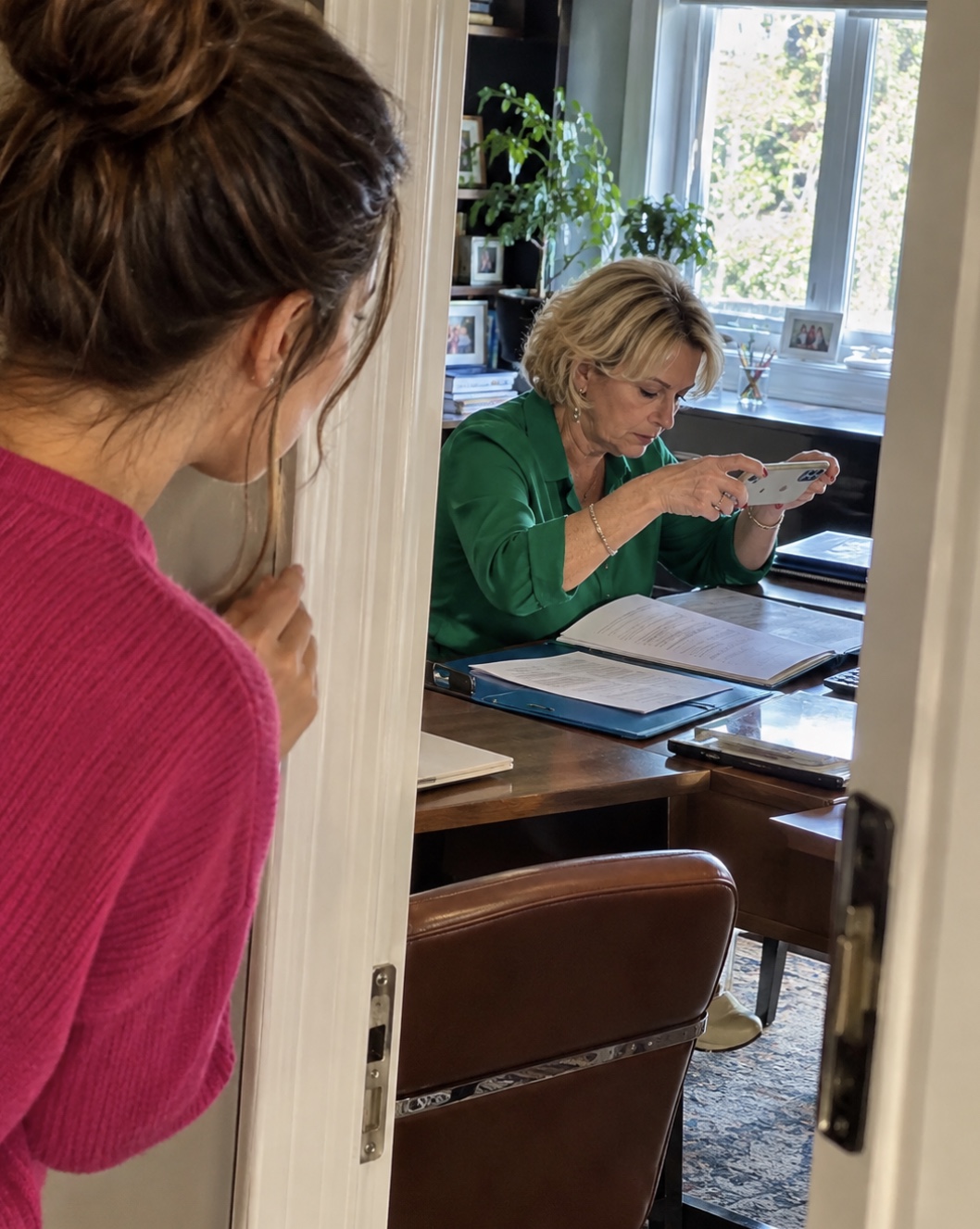
I stopped halfway down the hallway, still holding two mugs of tea, and watched through the narrow gap in the office door as my mother-in-law flattened one of Ben’s bank statements against the desk with her left hand and held her phone above it with her right.
Click.
She turned the page.
Click.
Then she opened the blue folder beside it.
That was the moment my stomach tightened.
The blue folder contained paperwork from our mortgage broker, copies of our passports, a recent valuation of our house and documents relating to the small architecture consultancy Ben and I had started three years earlier.
Carol had absolutely no reason to be looking at any of it.
She certainly had no reason to photograph it.
For perhaps five seconds I simply stood there.
Then she shifted in the chair.
I stepped backwards before she could see me.
I carried the tea into the kitchen, put both mugs down and turned on the tap so she would hear water running.
A minute later Carol appeared.
“There you are,” she said brightly.
She was sixty-two, perfectly made-up even on a wet Thursday afternoon in York, wearing a coral raincoat and cream trainers that looked as though they had never met actual rain.
“I wondered where you’d disappeared to.”
“Just making tea.”
“Oh, lovely.”
She placed her phone face-down on the kitchen island.
I looked at it.
She noticed.
“What?”
“Nothing.”
Ben was upstairs on a work call, which was why Carol had come over in the first place. She had said she wanted to drop off a casserole dish and see us before she drove to Harrogate for the weekend.
She stayed another forty minutes.
She talked about her neighbour’s extension, the price of parking in town and whether Ben should finally replace his old car.
I barely heard any of it.
Every few minutes I thought about the photographs sitting on her phone.
When Ben came downstairs, Carol kissed his cheek, collected her handbag and announced that she had to beat the traffic on the A59.
At the front door she squeezed my arm.
“You look tired, Naomi.”
“Do I?”
“You work too much.”
Then she smiled.
It was such an ordinary smile that I nearly questioned what I had seen.
Nearly.
When her car disappeared around the corner, I closed the door.
Ben was already walking back towards the stairs.
“Your mum was in the office.”
He stopped.
“So?”
“She was photographing our documents.”
That brought him back down two steps.
“What documents?”
“The mortgage papers. Bank statements. Maybe company paperwork.”
His expression changed, but not in the way I expected.
Not shock.
Recognition.
“Are you sure?”
I stared at him.
“Yes, Ben. I know what taking a photograph looks like.”
He rubbed the back of his neck.
“She’s probably just being nosy.”
“People are nosy about salaries. They don’t photograph passport copies.”
“I’ll ask her.”
“No.”
He looked at me.
That answer surprised both of us.
“What do you mean, no?”
“If you ask her now, she’ll deny it. Or say she accidentally opened the folder. Or tell you I’m overreacting.”
“She wouldn’t—”
I raised an eyebrow.
He stopped.
Carol had once spent Christmas lunch explaining to twelve people that I had “probably misunderstood” a conversation in which she had very clearly told me women became less ambitious after having children.
She was an expert in making something obvious sound debatable.
Ben lowered his voice.
“So what do you want to do?”
“I want to know why.”
That evening I checked every document in the office.
Nothing appeared to be missing.
The cabinet was locked, but the folders that had been left on the desk were exactly where I remembered them.
Ben suggested changing the code on the office door.
I said we would.
But not yet.
The following afternoon Carol rang.
“I left my reading glasses at yours.”
She had not.
I knew that because they were visible in a photograph she had posted that morning in the family WhatsApp group, beside a cappuccino in Harrogate.
Still, I said, “Come by tomorrow.”
After the call ended, I opened a new folder on my laptop.
I did not create anything illegal or damaging.
I created something believable.
A fictional letter from a financial adviser about restructuring our company shares.
A draft schedule showing that Ben and I were considering transferring a portion of the business into a new holding company called Alderwick Consulting.
And one document titled:
PRIVATE — PROPOSED DIRECTOR CHANGES.
None of it was real.
But buried halfway down the second page was a newly created email address that existed nowhere else.
I printed everything, placed it inside a dark green folder and left it on the office desk.
On top I wrote, in pen:
BEN — PLEASE DON’T LEAVE THIS OUT. CONFIDENTIAL.
Ben looked at it that night.
“This feels slightly mad.”
“It probably is.”
“What if Mum doesn’t touch it?”
“Then I’ll be delighted.”
“And if she does?”
“Then maybe we finally stop guessing.”
📩 What happened after that folder was opened changed the whole meaning of Carol’s visits — the continuation is in the first comment. 👇
Carol arrived at eleven the next morning.
She did not mention the glasses.
Instead, she brought a lemon drizzle cake from a bakery near Bootham Bar and complained that our road was impossible to park on.
Ben deliberately went into the garden to deal with a loose fence panel.
I stayed in the kitchen.
Carol lasted fourteen minutes.
“I need the loo,” she said.
The downstairs toilet was three metres from where she was standing.
The office was upstairs.
I smiled.
“Of course.”
Her footsteps went up.
I counted slowly to twenty.
Then I heard the office door.
Three minutes later she returned.
“Found them!”
She held up a pair of reading glasses.
Not hers.
Mine.
They had been in the kitchen drawer.
For a second, neither of us spoke.
Then I smiled.
“Brilliant.”
Her expression flickered.
Only for an instant.
She left at noon.
At 7:18 the following morning, the new email address received a message.
No subject line.
The sender was someone called Martin Vale.
The message contained only nine words.
Could you send the incorporation date and current shareholder split?
I read it twice.
Then I searched the name.
Martin Vale was an accountant in Sheffield.
More specifically, he was listed as finance director of a company called Vale & Mercer Property Solutions.
The second director was Richard Mercer.
I knew that name.
Ben didn’t.
When I showed him my laptop, he frowned.
“Who’s Richard Mercer?”
“My mum’s ex-husband.”
Ben stared at me.
Not my father.
My mother had been married briefly in her twenties, years before she met Dad.
Richard Mercer had barely existed in our family history. I knew he had worked in property. I knew the marriage had lasted less than two years. I knew Mum had never wanted to talk about him.
That was it.
“What the hell does my mother have to do with your mother’s ex-husband?” Ben asked.
“I have no idea.”
We did not call Carol.
Instead I rang my mum.
She answered from a supermarket in Selby.
“Can I call you later? I’m trying to find that coffee your dad likes.”
“Mum, do you know a man called Martin Vale?”
Silence.
The background noise continued—trolleys, a child crying, an announcement about checkout number six.
“Mum?”
“Where did you hear that name?”
I sat down.
Ben pulled out the chair opposite me.
“So you do know him.”
“I know of him.”
“How?”
Another pause.
“Through Richard.”
My mouth went dry.
“What’s going on?”
“Naomi, where did you get that name?”
“From an email connected to Carol.”
This time the silence lasted so long I thought the call had dropped.
Then Mum said, very quietly, “Don’t tell her we’ve spoken.”
I looked at Ben.
“Why?”
“Because I need to find something.”
“What?”
“Your grandfather’s old files.”
“Mum—”
“I’ll call you this afternoon.”
She hung up.
Ben and I sat in the kitchen without speaking.
At two thirty, Mum arrived at our house carrying an old supermarket bag filled with papers.
Dad came with her.
That frightened me more than anything else.
My parents had the kind of marriage where Dad considered opening a letter addressed to Mum a major invasion of privacy. If he was carrying someone else’s documents into my kitchen, something serious had happened.
Mum put the bag on the table.
“Richard Mercer tried to buy your grandfather’s engineering workshop in 1998,” she said.
I blinked.
“What?”
My maternal grandfather, Frank, had owned a small precision engineering business outside Leeds. He sold it years before I went to university.
Mum continued.
“Richard knew the land was going to become much more valuable if the local development plan went through. He tried to persuade Dad to sell cheaply before the planning information became public.”
“Did Grandad sell?”
“No. Not to him.”
“Then what does this have to do with Carol?”
Dad took a photocopy from the bag.
It was an old company registration.
One shareholder’s name had been highlighted.
Caroline Mercer.
I stared at it.
“That’s not Carol’s surname.”
“Not now,” Mum said.
Ben went completely still.
His mother’s maiden name was Caroline Webb.
At least, that was what Ben had always believed.
Mum looked at him carefully.
“Your mother was married to Richard’s brother, Stephen Mercer, for four years.”
Ben actually laughed.
A short, disbelieving sound.
“No, she wasn’t.”
My father slid another document across the table.
A marriage certificate.
Caroline Anne Webb and Stephen James Mercer.
Ben sat back.
“My dad married Mum in 1991.”
“Yes,” Mum said.
“There’s nothing strange about her being married before.”
“No,” Mum replied. “There isn’t.”
But the way she said it told us that wasn’t the problem.
The problem was what happened afterwards.
Richard and Stephen Mercer had operated several small property companies together.
One collapsed.
Another was dissolved.
A third bought commercial buildings through complicated arrangements involving relatives as temporary shareholders.
Carol had been a shareholder in at least one of them.
“She told me she worked in a travel agency,” Ben said.
“She may have,” Mum replied. “That doesn’t mean this didn’t happen too.”
I looked at the green folder still sitting on our office desk upstairs.
“But why is she photographing our documents now?”
My dad answered.
“Because Richard Mercer has started buying small professional firms.”
Ben looked at him sharply.
“What do you mean?”
Dad had spent the morning checking Companies House.
Over the previous four years, businesses linked to Richard Mercer had bought stakes in six small firms—two surveying practices, a building consultancy, a planning business and two architecture companies.
Our consultancy fit the pattern almost perfectly.
We were profitable but small.
Ben and I each owned fifty percent.
And lately we had been discussing hiring three people and moving into a proper office.
“What exactly could he do with photographs?” I asked.
“Not much legally,” Dad said. “But he could learn your turnover, borrowing, ownership structure, clients, liabilities. Enough to understand whether you’re worth approaching.”
Ben pushed back his chair.
“So Mum is spying on us for him?”
Nobody answered.
He rang her.
I tried to stop him.
Too late.
Carol answered immediately.
“Hello, darling.”
“Who is Richard Mercer?”
Silence.
Ben’s knuckles went white around the phone.
“Mum?”
“Where did you hear that name?”
Exactly the same question my mother had asked.
Only Carol sounded afraid.
“Why are you sending photographs of our documents to his accountant?”
She inhaled sharply.
“Ben, listen to me.”
“You were in our office.”
“It isn’t what Naomi thinks.”
“Don’t bring Naomi into this.”
“I was trying to help you.”
I almost laughed.
Ben didn’t.
“How?”
Carol began crying.
Not loudly.
That made it worse.
She admitted that Richard had contacted her six months earlier.
He knew about our company.
He had seen Ben’s name online and realised whose son he was.
At first, according to Carol, he had simply asked how Ben was doing.
Then he asked questions about our business.
Revenue.
Staff.
Whether we owned our office.
Whether we had outside investors.
Carol answered some of them.
Then Richard told her he might be interested in investing.
“I thought it could make you secure,” she said.
“You thought secretly giving him our financial information would make us secure?”
“He said he needed to know whether the company was healthy before he approached you.”
“Then he could have approached me.”
“He thought you’d say no if you knew it came through me.”
Ben closed his eyes.
That sentence told us everything.
But there was still one thing that didn’t make sense.
“Why the passports?” I asked loudly enough for Carol to hear.
She stopped crying.
“What passports?”
“You photographed copies of our passports.”
Nothing.
Ben looked at me.
“Mum?”
“I didn’t send those to Richard.”
“Who did you send them to?”
“I didn’t send them.”
“You photographed them.”
Another pause.
Then Carol said, “Because I needed Naomi’s date of birth.”
I felt something cold move through me.
“For what?”
Nobody spoke.
Finally Carol whispered, “For the trust.”
My parents exchanged looks.
“What trust?” Ben asked.
Carol asked to come over.
I said no.
Ben said yes.
For once, I did not argue.
She arrived forty minutes later.
No makeup.
No coral coat.
No confident smile.
She carried a brown envelope.
Inside were documents relating to a discretionary family trust established by Stephen Mercer—Carol’s first husband—before his death in 2009.
Ben was named as a potential beneficiary.
He had never known.
Stephen Mercer was Ben’s biological father.
That was the secret Carol had been protecting for thirty-five years.
The man Ben had called Dad his entire life, David, had adopted him when Ben was three.
David knew.
Carol knew.
Almost nobody else did.
Stephen Mercer had never wanted contact after the divorce.
But before his death, he had placed part of his estate into a trust that could eventually pass to Ben or Ben’s family.
Richard had become one of the trustees.
That was why he had contacted Carol.
Not primarily to buy our business.
He wanted information to confirm whether Ben qualified under the trust conditions before another trustee retired.
And Carol, terrified that telling Ben the truth would destroy the family story she had maintained for decades, decided she could quietly gather everything herself.
“So the company documents?” Ben asked.
Carol wiped her face.
“Richard asked about your financial position because the trust contains shares in commercial property companies. He said if you were interested, he could arrange for you to become involved.”
“That’s not the same as needing my bank statements.”
“I know.”
“Or Naomi’s passport.”
“I know.”
“Or photographing confidential paperwork in my house.”
“I know.”
Her voice had become tiny.
Ben stood at the kitchen window.
Rain tapped softly against the glass.
I had expected rage.
Instead, he looked exhausted.
“Does Dad know Richard contacted you?”
Carol shook her head.
That hurt him more than anything else.
Because David was not dead.
He was seventy-one and lived twelve minutes away.
Ben called him.
David arrived that evening.
He did not deny anything.
He sat beside Ben at our kitchen table and said, “I hoped your mum would tell you before I had to.”
“You knew she was taking documents?”
“No.”
“You knew about the trust?”
“Yes.”
“Why didn’t you tell me?”
“Because it was her history to explain.”
Ben looked at both of them.
“No. It was my history too.”
Carol started crying again.
This time Ben did not comfort her.
There was no dramatic shouting match.
No one stormed out.
That almost made it more painful.
We spent three hours reconstructing thirty-five years of decisions made by adults who had convinced themselves that silence was kindness.
Stephen had left when Ben was a baby.
David met Carol when Ben was two.
He became the father who attended football matches, stayed up through asthma attacks, taught Ben to drive and lent us the deposit for our first rented flat after university.
Nothing about the truth changed that.
But it changed Ben’s understanding of his own life.
And Carol had been so frightened of that change that she had invaded ours.
The following Monday, we met a solicitor in Leeds.
Not Richard’s accountant.
Ours.
We confirmed that the trust existed.
We confirmed Ben’s position.
And we instructed the solicitor to communicate directly with the trustees.
Carol was removed from the process entirely.
As for our company, Richard Mercer received one brief letter stating that no financial information had been provided with our permission and that all photographs or copies of our private documents should be deleted.
He replied through his solicitor within three days.
He claimed he had received only limited company information and one photograph showing a draft shareholding document.
The green folder.
Our fake folder.
That told me something important.
Carol had lied even after confessing.
She had not merely photographed documents “for the trust.”
She had sent our business information to Richard because she believed she could negotiate something beneficial for Ben behind our backs.
Maybe she genuinely thought she was helping.
That did not make it acceptable.
We changed the locks.
We installed a lock on the office.
Carol no longer had a spare key.
For two months, Ben saw her only in cafés or at his parents’ house.
Then, one Sunday in November, she came to ours for lunch.
By invitation.
She stood outside until I opened the door.
That detail mattered.
After dessert, she placed her phone on the table.
“I owe you an apology, Naomi.”
I waited.
She looked embarrassed.
Not defensive.
“I kept telling myself I was protecting Ben. But really, I was protecting the version of myself that I wanted him to believe in.”
Ben looked at her.
Carol continued.
“I didn’t want him to know I’d made mistakes before David. I didn’t want him to know his biological father walked away. And when Richard contacted me, I thought I could turn something ugly into something useful before Ben ever had to know.”
She looked at me.
“So I crossed a line.”
“No,” I said quietly.
“You crossed several.”
She nodded.
“Yes.”
That was the first apology she had ever given me without adding the word “but.”
Ben has since met Richard once.
Only once.
He came home afterwards and said he did not want another father.
He already had one.
The trust turned out to be worth considerably less than Carol had imagined, mostly because several of its property investments had performed poorly.
That almost made me laugh.
All those secrets, all those photographs, all that manipulation—and there was no hidden fortune waiting at the end.
Ben eventually accepted a modest distribution from it.
He used part of the money to take David to Scotland for a week of golf.
Carol hated golf.
She helped pack their bags anyway.
The strangest thing is that the green folder still sits in my office cupboard.
Every document inside it is fictional.
The company name doesn’t exist.
The director changes never happened.
But whenever I see it, I remember how close we came to solving the wrong mystery.
I thought I was trying to discover who Carol was sending our documents to.
I did discover that.
But the name in that email was only the first layer.
What I really discovered was that families can spend decades protecting secrets long after the original reason for keeping them has disappeared.
And sometimes the person who says, “I was only trying to help,” is telling the truth.
That doesn’t mean you have to give them the key again.