



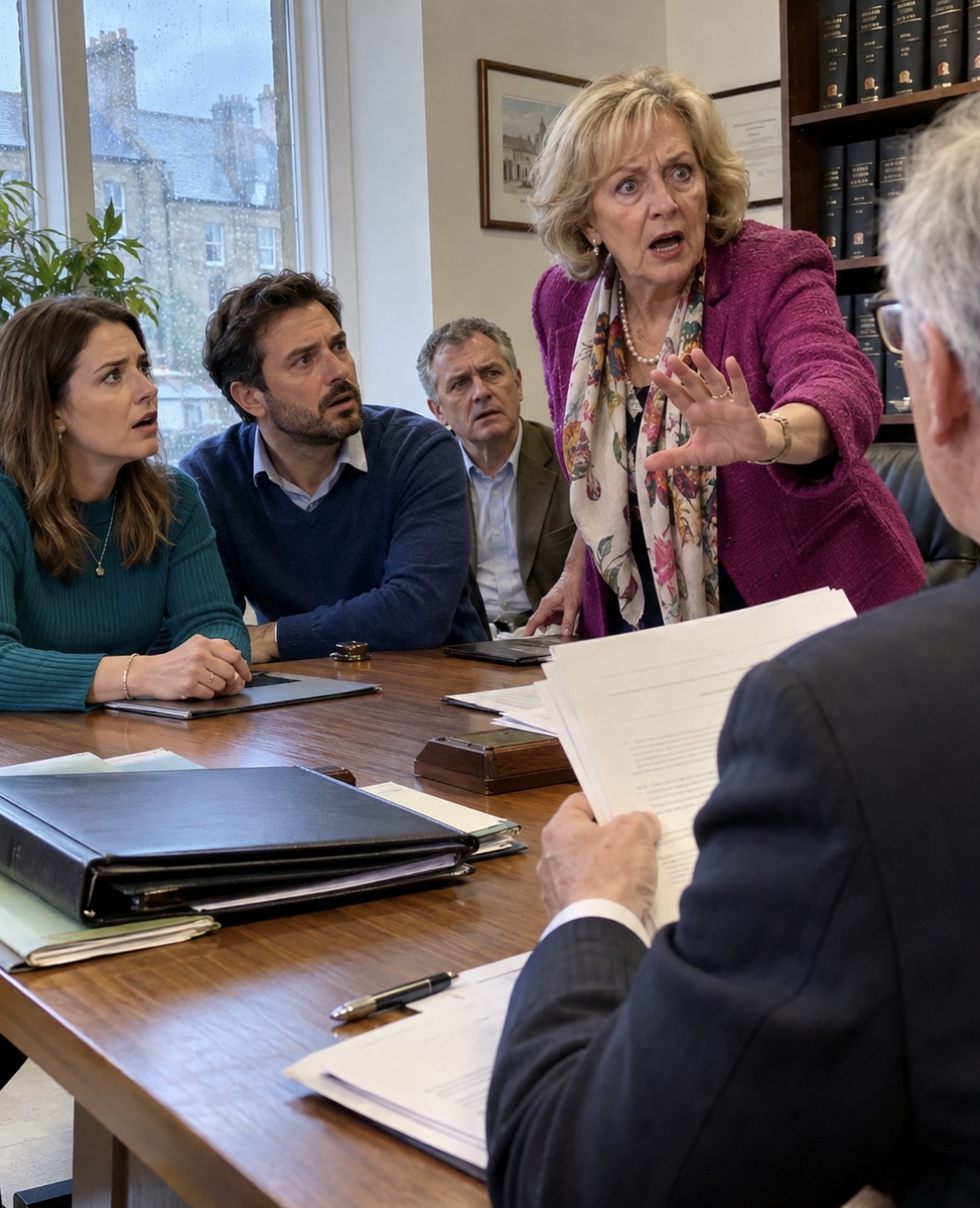
The solicitor had just turned the final sheet when my mother-in-law shot out of her chair so violently that her handbag fell to the carpet.
“Don’t read the last page!”
For a second, nobody moved.
The old clock in the corner of the office ticked twice.
Then Mr. Howard, the probate solicitor, slowly lowered the paper.
My husband Daniel stared at his mother.
I stared at her too.
But it was Mr. Howard who asked the question that changed the entire afternoon.
“Mrs. Whitmore,” he said calmly, “how do you know there is anything important on the last page?”
My mother-in-law’s face went white.
Until that moment, she had spent nearly an hour insisting she had never seen her late sister’s will.
We were sitting in a narrow conference room above a solicitor’s office in Winchester, Hampshire. Outside, a fine October rain was running down the sash windows, and somebody downstairs kept opening the front door, letting in the sound of traffic from the High Street.
My husband’s aunt, Margaret Whitmore, had died six weeks earlier at seventy-four.
She had never married and had no children.
For most of Daniel’s life, Margaret had been the eccentric aunt who arrived at Christmas with expensive cheese, books nobody had asked for and opinions everybody pretended not to hear.
But to me she had been different.
When Daniel and I moved back to Hampshire after his redundancy, Margaret had been the only person in the family who didn’t ask how much money we had left.
She simply said, “I’ve got a spare room if you need breathing space.”
We didn’t move in, but I never forgot it.
Neither did I forget what happened two years later, when Margaret broke her wrist and my mother-in-law, Patricia, suddenly became very involved in her life.
Patricia started doing her shopping.
Then her banking.
Then her appointments.
Soon she was answering Margaret’s telephone.
Whenever Daniel suggested visiting, Patricia always seemed to have a reason why it wasn’t convenient.
“She’s tired.”
“She’s got the district nurse coming.”
“She doesn’t want company.”
Once, Margaret rang me directly.
Her voice sounded smaller than usual.
“Claire, do you still have that lemon drizzle recipe?”
I laughed because Margaret hated baking.
Then she said quietly, “Good. I just wanted to make sure this number still worked.”
Before I could ask what she meant, I heard Patricia’s voice in the background.
The call ended.
I told Daniel something felt wrong.
He dismissed it at first.
“Mum fusses. You know what she’s like.”
I did know.
Patricia had opinions about everything from our mortgage to how often our daughter should see her cousins.
But fussing was one thing.
Control was another.
Three months before Margaret died, Daniel finally drove over without warning.
He found his aunt perfectly lucid, sitting in her conservatory with a cup of tea and the Saturday paper.
Patricia was nowhere there.
Margaret seemed genuinely pleased to see him.
Later, Daniel told me she had said something strange as he was leaving.
“Tell Claire she was right to keep copies.”
“Copies of what?” I asked.
Daniel shrugged.
He hadn’t asked.
That sentence came back to me in the solicitor’s office.
Mr. Howard adjusted his glasses.
“Perhaps we should take five minutes.”
“No,” Patricia said too quickly. “There’s no need.”
Her younger brother, Stephen, frowned.
“What exactly is on the last page?”
Patricia gripped the edge of the table.
“I don’t know.”
“But you just told him not to read it,” Daniel said.
“I meant—I assumed there might be something upsetting.”
Mr. Howard looked at her for a long moment.
Then he placed the document flat on the table.
“This will was executed on the twenty-third of May,” he said. “Mrs. Whitmore attended this office in person. Two members of staff witnessed her signature. She was assessed as having full testamentary capacity.”
Patricia sat down again.
“Yes, yes, we know.”
Mr. Howard’s expression changed slightly.
“Do we?”
Nobody answered.
The reading had been awkward from the start.
Margaret had left modest gifts to neighbours, a former colleague, her church flower fund and the Winchester hospice.
Stephen received twenty thousand pounds.
Daniel received Margaret’s small collection of first-edition books and thirty thousand pounds.
Our daughter, Sophie, received an education trust of fifteen thousand.
Patricia had received Margaret’s jewellery.
That was the moment Patricia had smiled for the first time.
Margaret owned several pieces inherited from their mother, including a sapphire brooch Patricia had talked about for years.
Then came the house.
A red-brick three-bedroom property near St Cross that had belonged to Margaret since the late 1980s.
Everyone had assumed Patricia would inherit it.
Even Patricia.
Especially Patricia.
Instead, Margaret had left instructions that the house be sold.
Half the proceeds were to go to a local women’s refuge.
The other half was to be divided between Daniel and Stephen.
Patricia’s smile vanished.
She asked whether there was an earlier will.
Mr. Howard said there was.
In the earlier will, Patricia had indeed inherited the house.
That was when the room became cold.
Patricia accused me of influencing Margaret.
I laughed because the accusation was so absurd.
I hadn’t seen Margaret alone for almost a year before she died.
Daniel told his mother to stop.
Stephen asked when the new will had been written.
Mr. Howard answered: May.
Then he reached the final page.
And Patricia screamed.
📄 What Margaret had hidden from everyone was about to change the family completely — keep reading below. 👇
Mr. Howard did not immediately continue.
Instead, he asked Patricia again, “Have you previously seen this document?”
“No.”
“Have you seen a copy?”
“No.”
“Did Mrs. Whitmore discuss its contents with you?”
“No.”
“Then how did you know the final page contained a separate statement?”
Patricia blinked.
Nobody had mentioned a separate statement.
Stephen leaned forward.
“What separate statement?”
Patricia looked at the door.
That frightened me more than anything she had said.
She looked like someone calculating whether she could leave before the next sentence was spoken.
Mr. Howard picked up the page.
“The final page contains a handwritten letter incorporated by reference into Mrs. Whitmore’s instructions to her executors.”
Patricia whispered, “It shouldn’t be there.”
Daniel turned towards her.
“What shouldn’t be there?”
She didn’t answer.
Mr. Howard began reading.
Margaret’s words were simple.
She wrote that during the previous eighteen months she had become concerned about unexplained withdrawals from one of her savings accounts.
At first she believed she had forgotten making them.
Then she began keeping records.
She listed dates.
£400.
£650.
£300.
£1,200.
Cash withdrawals, bank transfers and card payments.
Altogether, more than £18,000 had disappeared.
Every transaction had occurred after Patricia began helping with her finances.
Stephen stood up.
“That’s ridiculous.”
But he wasn’t defending Patricia.
He looked furious.
“Maggie had nearly twenty grand taken?”
Patricia shook her head.
“She gave me money.”
Mr. Howard continued reading.
Margaret wrote that Patricia frequently told her she was paying bills, arranging repairs or reimbursing herself for shopping.
Margaret had believed her.
Then one afternoon, Margaret received a call from a roofing company asking whether she still wanted a quote.
Margaret was confused.
She had already paid Patricia £2,400 for a supposed roof repair.
There had been no repair.
That was when she started checking.
Daniel looked sick.
“Mum?”
Patricia’s eyes filled with tears.
“You don’t understand.”
Margaret’s letter contained another detail.
She had discovered that Patricia had opened several bank statements before bringing them to her.
After confronting her, Patricia allegedly said Margaret was “getting muddled” and shouldn’t worry about money anymore.
So Margaret stopped confronting her.
Instead, she called a solicitor.
Mr. Howard.
And she started collecting evidence.
I suddenly remembered the strange phone call.
The lemon drizzle recipe.
Making sure my number still worked.
Then Margaret’s words became personal.
Mr. Howard read:
“I am not changing my will because Patricia has always been difficult. Sisters quarrel. That is not the reason.”
Patricia covered her face.
“I am changing it because she has begun telling other people that I cannot manage my own affairs, while privately using my money in ways I did not authorise.”
Stephen muttered, “Jesus Christ.”
But the worst part had not come yet.
Margaret wrote that she feared nobody would believe her.
Patricia had already started telling relatives that Margaret was forgetful.
That she repeated herself.
That she misplaced things.
That she confused dates.
Some of it was true.
Margaret was seventy-four.
She sometimes forgot names.
Once she left her glasses in the fridge.
But forgetfulness was not incapacity.
Margaret knew that if she accused Patricia openly, the family might assume the complaint was part of the decline Patricia had been describing.
So she did something very Margaret-like.
She created a test.
A week after signing the new will, she printed a draft copy at home.
But she altered the final page.
In that false copy, Patricia still received the house.
However, beneath the inheritance clause was a paragraph saying Margaret intended to leave £40,000 to Patricia’s eldest grandson when he turned twenty-five.
No such gift existed in the real will.
Margaret placed the false draft inside a blue folder in her desk.
Then she waited.
Two weeks later, Patricia mentioned the supposed £40,000 gift.
Not to Margaret.
To Stephen.
She told him Margaret had “promised something substantial for Oliver.”
Stephen went pale.
“I remember that.”
Patricia snapped, “You misunderstood me.”
“No,” he said. “You said forty thousand.”
Daniel stared at his mother.
“So you read the draft.”
“I was cleaning.”
“You went through her desk.”
“She kept important documents everywhere!”
Mr. Howard raised one hand.
“There is more.”
Patricia laughed bitterly.
“Of course there is.”
Margaret had then removed the false draft and replaced it with another.
This one contained something completely different on its last page.
A statement saying Margaret had decided not to report the missing money to the police because Patricia had promised to repay it.
Again, the statement was false.
Three days later, Patricia deposited £3,000 into Margaret’s account.
She labelled the bank transfer “repayment.”
Silence.
Not ordinary silence.
The kind where you can hear everyone breathing.
Stephen sat down slowly.
Daniel whispered, “You actually wrote repayment?”
Patricia started crying.
“I borrowed it.”
“Eighteen thousand pounds?” Daniel said.
“I intended to put it back.”
“For what?”
She refused to answer.
Stephen slammed his palm on the table.
“For what, Pat?”
Finally she shouted, “Oliver!”
Her grandson.
Stephen’s son.
Everyone stared.
Patricia wiped her face.
Oliver had started a small landscaping business the previous year.
He bought a van, tools and equipment.
Then contracts fell through.
He owed money.
Patricia had been helping him.
“At first it was only a few hundred,” she said. “Maggie had plenty sitting there. She didn’t use it.”
Daniel’s expression hardened.
“So you took it.”
“I was going to replace it.”
“You told everyone Aunt Margaret was losing her memory.”
“Because she was!”
“No,” I said quietly. “Because if people believed she was confused, nobody would question the withdrawals.”
Patricia looked at me with pure hatred.
“You’ve always wanted to turn him against me.”
That accusation might once have upset me.
That day, it sounded almost childish.
Mr. Howard continued.
Margaret had not gone to the police.
Not yet.
Instead, she instructed the executors to calculate every unauthorised withdrawal and deduct that amount from anything Patricia would otherwise inherit.
Since the jewellery was worth far less than the missing money, Patricia would receive none of it until the accounts were settled.
But there was still the question that had started everything.
Why had Patricia screamed specifically about the last page?
Mr. Howard turned the sheet around.
“This is not the same final page as the draft Mrs. Whitmore left at home.”
Patricia stopped crying.
“What?”
“The version you saw was another test.”
Her mouth opened slightly.
Mr. Howard explained that Margaret suspected Patricia was still entering the house when she was out.
So in September, shortly before being admitted to hospital for what turned out to be her final illness, Margaret left one final false document in the desk.
Its first pages were identical to the real will.
But the last page claimed that Margaret had kept a diary detailing every financial transaction and hidden it in the loft.
There was no diary in the loft.
The following morning, Margaret’s neighbour saw Patricia letting herself into the house.
That afternoon, the loft hatch had been opened.
Dust covered the landing carpet.
Margaret photographed it.
Patricia whispered, “She set me up.”
Stephen stared at her.
“No. She gave you three chances to stop.”
Patricia looked at Daniel.
For perhaps the first time in my life, I saw my husband refuse to rescue her.
He didn’t argue.
He didn’t soften his voice.
He simply asked, “How much did you take in total?”
Patricia looked down.
“More than eighteen.”
Mr. Howard’s eyebrows lifted.
Stephen swore.
“How much more?”
Patricia took a long time to answer.
“Twenty-six.”
Daniel closed his eyes.
The investigation after Margaret’s death found another £7,600 transferred through small payments over eleven months.
Oliver knew nothing about where the money came from.
When he found out, he sold his van and some equipment and immediately returned nearly £9,000.
Patricia eventually repaid most of the remainder after selling an investment bond.
The family chose not to involve the police after the estate recovered the money, partly because Margaret’s written instructions said she preferred repayment and separation rather than prosecution.
But Patricia lost much more than the house.
She lost Daniel’s automatic trust.
She lost Stephen’s habit of making excuses for her.
And she lost the story she had been telling for almost two years—that Margaret was a confused old woman who needed managing.
Three months later, the house was sold.
Daniel and I received our share.
Stephen received his.
The refuge received more money than any of us had expected because the property sold above the asking price.
Patricia did not receive Margaret’s jewellery.
The sapphire brooch went instead to the estate sale with the other items.
At first I thought that was sad.
Then Mr. Howard called me.
Margaret had left one small sealed envelope with my name on it.
Inside was no money.
Just a recipe card.
Lemon drizzle cake.
On the back, in Margaret’s handwriting, were six words:
“Thank you for believing I noticed.”
I sat at our kitchen table and cried.
Daniel read the card twice.
Then he said, “I didn’t believe her soon enough.”
I told him Margaret had known exactly what she was doing.
That was the part Patricia had never understood.
She had mistaken age for weakness.
Forgetfulness for ignorance.
Silence for confusion.
Margaret had forgotten where she left her glasses.
She sometimes repeated stories.
She once put sugar in the gravy at Christmas.
But she remembered every missing pound.
And when nobody realised she was watching, she quietly made sure that one day, in a solicitor’s office on a rainy afternoon in Winchester, the person who knew too much would reveal herself before the final page was even read.